Weight Distribution & Sway Control
Equal-i-zer Hitch Alternatives
People leave the Equal-i-zer for one of four reasons: price, noise, head weight, or a bar rating that does not go light enough. Each reason points at a different hitch, so start by naming yours.
By Mike M. ·
How this page is funded: we earn a commission if you buy through our links, at no extra cost to you. It never changes which product we rank first. Prices come from Amazon and are read automatically — each one shows the date it was read. Full disclosure.
Closest alternative
Our pick on this page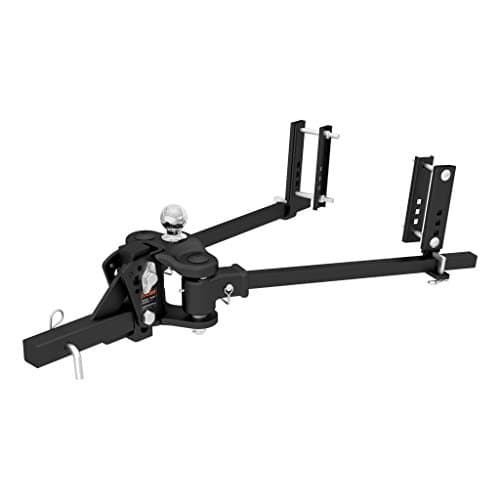
CURT TruTrack 4P Weight Distribution Hitch, 17500
CURT's answer to the four-point Equal-i-zer, with a 10,000 lb rating and an adjustable sway bias — generally a couple of hundred dollars under the hitch it is aimed at.
Price as of November 18, 2026. #ad How this is funded
Read the full write-up or compare it with the rest below.
Quick picks
Scored on the published hitch rubric - sway control method (25%), tongue-weight range (20%), backing-up behavior (20%), setup effort (15%), quietness (10%) and price for capability (10%). Every listing was confirmed live and in stock before it was featured. The Equal-i-zer itself is not ranked here; it is the benchmark these are measured against.
| # | Product | Best for | Score | Price |
|---|---|---|---|---|
| 1 | CURT TruTrack 4P Weight Distribution Hitch, 17500 CURT's answer to the four-point Equal-i-zer, with a 10,000 lb rating and an adjustable sway bias — generally a couple of hundred dollars under the hitch it is aimed at. Closest alternative | Four-point sway control at a mid-range price | 9.2/10 | |
| 2 | 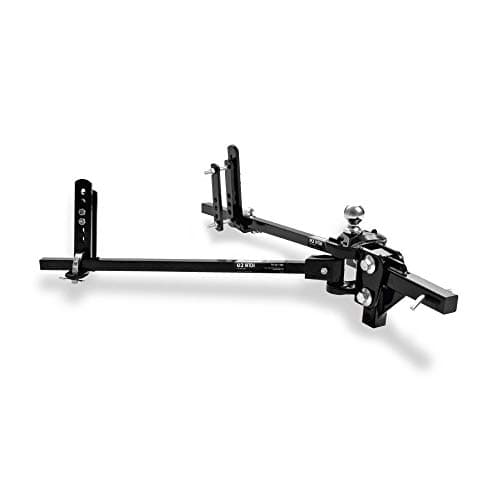 Fastway e2 2-Point Sway Control Trunnion Hitch, 92-00-1200 The trunnion version sits the bars higher than round bars do, which matters on a steep driveway, and this one includes the shank. Same family, less money | 8,000-12,000 lb trailers where ground clearance matters | 9.2/10 | |
| 3 | 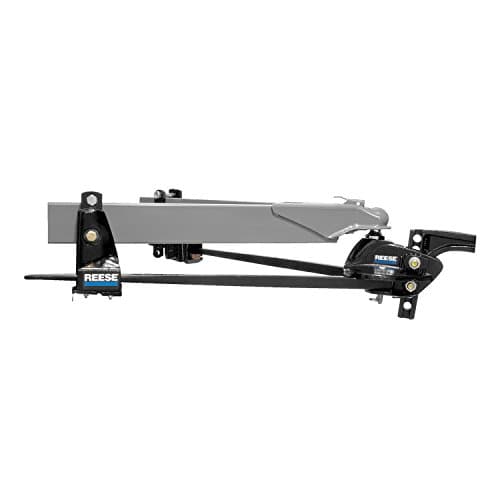 Reese Steadi-Flex Trunnion Weight-Distributing Hitch Kit, 66559 The sealed-friction answer to a four-point hitch: integrated sway control, a shank already in the box, and nothing to grease or squeal because the friction happens inside the bar ends. Buy it if you want the quiet version of continuous sway control. Lowest maintenance | Owners who want a sealed, low-maintenance friction system | 9.1/10 | |
| 4 | 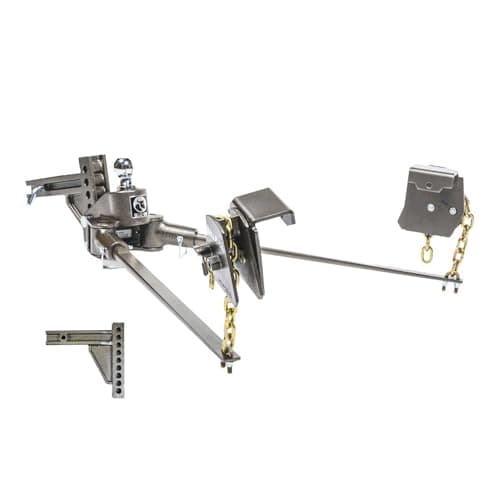 Blue Ox SwayPro BXW1000-S Weight Distributing Hitch Chain-tensioned spring bars that run under the A-frame rather than clamping onto it — quieter than a bracket hitch, and the hookup is a latch rather than a lift. Quietest bar setup | Owners who want a quiet, under-slung bar setup | 9.1/10 | |
| 5 | 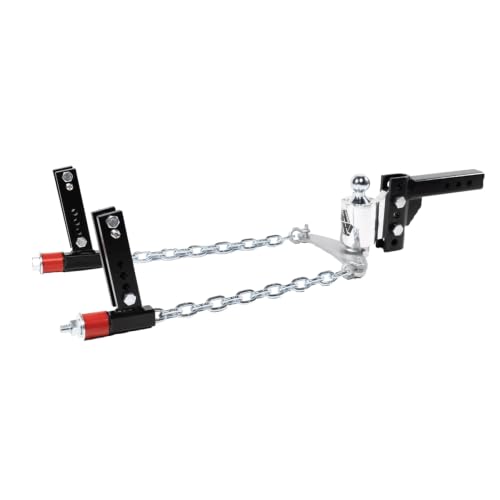 Andersen No-Sway Weight Distribution Hitch Chains and a urethane cone instead of steel spring bars, so it is the quietest and the lightest of the mainstream kits — and the only one most people can lift with one hand. Lightest, no spring bars | Owners who care most about weight, noise and a short hookup | 9.1/10 | See today’s price on the Andersen No-Sway Weight No buyable offer at the last price check. |
| 6 | 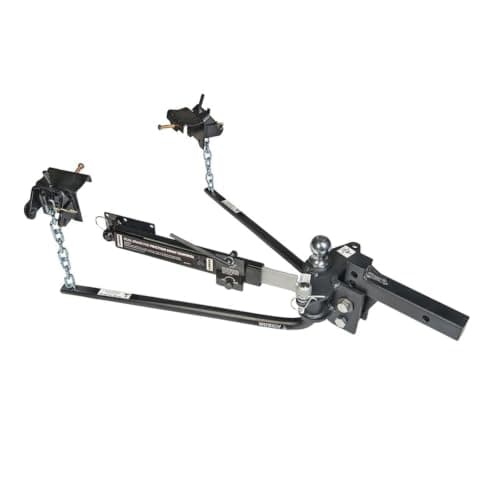 Husky Round Bar Weight Distribution Hitch, 30849 The only kit here that arrives with a 10 in shank and a 2-5/16 in ball in the box, which is why its real-world cost undercuts hitches with a lower sticker price. Cheapest alternative | The cheapest complete kit that still includes shank and ball | 8.6/10 |
Tap any row to jump to the full write-up. Prices come from Amazon and are read automatically — see each product below for the date.
The short answer
First, the fair version of what you are leaving. The Equal-i-zer is the default recommendation in this category and it has earned that: its 4-Point Integrated Sway Control works at four surfaces inside the head and at the brackets, which means sway resistance is always on and there is no friction bar to unclip before you turn or back up. The company publishes that the hitch is American made and that the brand sits in the Dexter family. It is the top pick on our own main hitch roundup, and if nothing on this page gives you a reason to switch, the honest advice is to buy the Equal-i-zer and stop reading.
What sends people looking is narrower than “it is not good”. There are four real reasons, and they are worth separating because each one points at a different hitch:
What to remember
- Price. It sits in the upper-middle of the field, and the step down is a real saving.
- Noise. The four-point design works by metal sliding on metal, so it talks to you at low speed.
- Head and bar weight. It is a substantial lump to lift on and off, and the brackets are not light.
- Bar window. The lightest Equal-i-zer kit is a 6,000 lb-class unit, which is still too stiff for some light trailers.
Integral vs add-on sway control: integral sway control is built into the hitch head, works whenever the hitch is connected, and needs nothing unclipped before a tight turn. Add-on sway control is a separate friction bar between the A-frame and the head, and it must be removed before you turn hard or back up. Every hitch on this page except the Husky is integral. That is the dividing line that matters most when you are replacing an Equal-i-zer, because going back to a friction bar is the one change people regret. All four sway control types, compared.
What makes a real alternative, not just a cheaper box
Does the sway control stay on? This is first because it is the one thing an Equal-i-zer owner is used to and would most notice losing. A four-point system resists sway at four surfaces; a two-point system such as the e2 resists at two; an under-slung cam-and-chain system such as the SwayPro resists through the bar tension itself; the Andersen uses a ball-and-chain geometry with no spring bars. All of those are always-on. A friction bar is not, and the Husky needs one.
Does the bar window match your loaded tongue weight? Spring bars are sold in ranges and the range matters more than the brand. If your rig sits near 600 lb of loaded tongue weight, a 1,000–1,200 lb bar is too stiff and will ride harshly no matter whose name is on it. If you are near 1,200 lb you need a kit rated for it. Weigh the loaded tongue, then choose, because this is the step that gets skipped and it is the one that decides whether the new hitch feels better than the old one.
How quiet is it, really? Nothing here is silent, and any page claiming otherwise is selling. The honest ranking on noise in this field runs: Andersen quietest, then the under-slung Blue Ox, then the sealed-friction Reese, then the round-bar kits, then the four-point systems that work by friction between steel faces. If noise is specifically your reason for leaving, the first two are the only ones that will satisfy you.
What is in the box, and what do you have to re-buy? If you already own an Equal-i-zer you own a shank and probably a 2-5/16 in ball, so a kit that includes those is less of a saving than it looks — and a kit that includes nothing may be cheaper overall than its price implies. Check this before you compare numbers.
| Hitch | Sway control | Bar / link type | Ball included |
|---|---|---|---|
| Equal-i-zer (the benchmark) | 4-point, integral | Trunnion spring bars | No |
| CURT TruTrack 4P | 4-point, integral | Trunnion spring bars | Yes, 2-5/16 in |
| Fastway e2 | 2-point, integral | Trunnion or round bars | No |
| Reese Steadi-Flex | Sealed friction, integral | Trunnion spring bars | No, shank included |
| Blue Ox SwayPro | Cam and chain, under-slung | Under-slung spring bars | No |
| Andersen No-Sway | Chain and ball geometry | No spring bars | Yes, 2-5/16 in |
| Husky 30849 | None included | Round spring bars | Yes, 2-5/16 in |
The six alternatives, and the reason each one exists
CURT TruTrack 4P — the closest alternative. If you want to swap an Equal-i-zer for something that behaves the same way and costs less, this is the one. Four points of integral sway control, trunnion bars, 800–1,000 lb tongue weight, 10,000 lb gross, an adjustable 2 in shank and a 2-5/16 in ball in the box — so it is a complete swap rather than a head you then have to kit out. It scores identically to the Equal-i-zer 10K on sway and backing in our rubric and better on price for capability. The honest cons: setup is the fiddliest of the four-point systems here and the fixed-support brackets are less tolerant of a frame that is not square; it is noisy in the same way the Equal-i-zer is noisy, because it works the same way, so this is not the pick if noise is your reason; and CURT’s bracket design takes longer to get right the first time.
Fastway e2 — same family, less money. Worth knowing before you shop: Fastway Trailer Products and Equal-i-zer both publish that they are part of the Dexter family, and the Fastway site’s own footer carries a Progress Mfg copyright notice. The e2 is not a rival from outside the tent — it is the simpler, cheaper design from the same corner of the industry, with 2-point integrated sway control rather than four, in round-bar and trunnion versions. The trunnion 92-00-1200 is rated 12,000 lb gross and 1,200 lb tongue, and the round bar 94-00-1033 covers 10,000 lb and 1,000 lb. For a 5,000–8,000 lb trailer in ordinary conditions, two points is enough sway control, and the money saved is real. The honest cons: two points is measurably less sway resistance than four, which you feel when a semi passes at highway speed; neither e2 includes a hitch ball, and the round-bar version does not include a shank either, so price it all in; and it is no quieter than the Equal-i-zer. The full e2 head-to-head goes through the capacity steps.
Reese Steadi-Flex — lowest maintenance. Reese’s answer to the friction-versus-integral argument is a sealed friction system inside the head, which means there is no bar to unclip and nothing to grease on a schedule. It is the pick for the owner whose complaint about the Equal-i-zer is the upkeep rather than the price: the Equal-i-zer’s sliding faces want lubricant, and if you do not keep up with it the noise gets worse and the action gets stickier. The Steadi-Flex kit includes a shank. The honest cons: it is priced above the Equal-i-zer 10K rather than below it, so this is not a money-saving move; the sealed system cannot be adjusted the way a friction pad can, so you get the resistance the design gives you; and at the time of writing the listing shows thin stock, which is worth checking before you plan around it. The Steadi-Flex against the Equal-i-zer, in detail.
Blue Ox SwayPro — quietest bar setup. The SwayPro hangs its spring bars under the head and tensions them with cam-and-chain links rather than loading them through a friction face, which is why it is the quiet option among bar hitches and why it scores 9 of 10 on noise in our rubric against the Equal-i-zer’s 5. The BXW1000-S is rated 1,000 lb tongue and 10,000 lb gross on a 9-hole shank. If your reason for leaving is that you cannot stand the groan at parking-lot speed, start here. The honest cons: it is the most expensive hitch in this comparison and the weakest on price for capability; setup is genuinely harder than a trunnion kit because the under-slung bars and link tension have to be set right; and the bar windows are narrow, so a trailer upgrade is more likely to mean a new bar set. SwayPro against the Equal-i-zer and which SwayPro rating to buy.
Andersen No-Sway — lightest, no spring bars. The most different thing on this page. There are no spring bars: the Andersen uses chains under tension and a greased ball-and-cone geometry, which makes it dramatically lighter to lift on and off, quick to hook up, and the quietest hitch in this field by a clear margin. It includes a 2-5/16 in ball and is published at 14,000 lb gross trailer weight rating with a range of bracket drops. It is the pick when your complaint about the Equal-i-zer is that the head and brackets are a heavy, awkward lump. The honest cons: the chains need to be tensioned correctly and owners report a real learning curve, the greased cone wants maintenance, and there is a documented pattern of complaints worth reading before you buy — we keep an honest page on exactly that at Andersen hitch problems. Its sway resistance is also rated lower than a four-point system in our scoring. See Andersen against the Equal-i-zer.
Husky 30849 — cheapest alternative. Included for completeness, because some people shopping for an alternative simply want to spend less and will accept the compromise. Twelve thousand pounds gross, an 800–1,200 lb bar window, a 10 in shank and a 2-5/16 in ball in the box, for roughly half the Equal-i-zer’s price. The honest cons are the reason it ranks last: it has no sway control in the box at all, so you add a friction bar and go back to unclipping before every tight turn — the exact thing an integral hitch exists to avoid. It is also the heaviest kit here to handle and the 800 lb bar floor is stiff. If price is your reason for leaving, read our under-$500 roundup first — it lays out what the budget tier costs you in behavior, and how little extra buys integral sway control back.
The common mistake
Pick by your reason, not by the ranking
| Your reason for looking | Buy this | What you accept |
|---|---|---|
| It costs too much, but I want the same behavior | CURT TruTrack 4P | Fiddlier setup, same noise |
| It costs too much and 2-point sway is enough | Fastway e2 | Less sway resistance at highway speed |
| The noise drives me mad | Blue Ox SwayPro, or Andersen | Higher price, or a learning curve |
| The head and brackets are too heavy | Andersen No-Sway | Chain tensioning and maintenance |
| I am tired of greasing it | Reese Steadi-Flex | Costs more, not less |
| My trailer is too light for the 6K bars | A 600 lb-class kit | Lower overall rating ceiling |
| I just want to spend the least | Husky 30849 plus a friction bar | Unclipping before every tight turn |
That last row deserves a note. The lightest Equal-i-zer kit is a 6,000 lb-class unit rated to 600 lb tongue weight, which is genuinely light for the brand but still too stiff for some small trailers. If your loaded tongue weight is under about 500 lb, you are not really shopping for an Equal-i-zer alternative at all — you are shopping in a different class, and the pop-up and light-trailer page is the right place to start.
One more alternative that is not a hitch: if your actual complaint is squat and a soft rear end rather than sway, air springs address that directly and cost less than any hitch here. They do not control sway and they are not a substitute for weight distribution, which is why we wrote hitch versus airbags rather than treating them as interchangeable. Read that before you spend on either.
How we picked
Every hitch here is a product already in our registry, with an ASIN resolved from a live retailer lookup, and each listing was confirmed currently available before it was featured. The ranking applies the published hitch rubric with sway control method and backing-up behavior carrying 45% between them, which is why the Husky finishes last despite being the cheapest and the Blue Ox finishes mid-table despite being the quietest. We have not towed any of these; the figures are each maker’s published specifications and live listing data, and where a maker does not publish a figure — Camco’s gross trailer weight, Andersen’s bar ratings, which do not exist because there are no bars — the tables say so. The Equal-i-zer is described here from its own published material and from its position on our own roundup, which still names it the top pick. Prices come from retailer listing data read automatically and date-stamped. The rubric and weights are on how we pick.
The picks in full
CURT TruTrack 4P Weight Distribution Hitch, 17500
CURT · Best for four-point sway control at a mid-range price
CURT's answer to the four-point Equal-i-zer, with a 10,000 lb rating and an adjustable sway bias — generally a couple of hundred dollars under the hitch it is aimed at.
Key specifications
- Gross trailer weight
- 10,000 lb
- Sway control
- 4-point, integral
- Adjustment
- Sway-control bias adjustable
- Included
- Weight distribution kit with sway control
Capacity figures read from CURT TruTrack specifications, October 2026.
How it scored
- Sway control (25%)9
- Tongue-weight range (20%)8
- Backing up (20%)9
- Setup effort (15%)6
- Quietness (10%)5
- Price for capability (10%)8
The figures above, at the weights above, converted to our published 8.4–9.8 scale by one site-wide formula. Both the weights and the formula are on how we pick, so this number is reproducible from this card.
Why we picked it
- Four points of sway control for less than the obvious four-point alternative
- Bias adjustment lets you dial sway resistance to the trailer
- No bar to unclip before backing
Good to know
More parts to understand on first setup than a two-point kit
Price as of November 18, 2026. #ad How this is funded
Fastway e2 2-Point Sway Control Trunnion Hitch, 92-00-1200
Fastway · Best for 8,000-12,000 lb trailers where ground clearance matters
The trunnion version sits the bars higher than round bars do, which matters on a steep driveway, and this one includes the shank.
Key specifications
- Trailer weight rating
- 12,000 lb
- Tongue weight rating
- 1,200 lb
- Sway control
- 2-point, integral
- Included
- Standard hitch shank included; ball sold separately
Capacity figures read from Fastway e2 product specifications (Equal-i-zer / Progress Mfg), October 2026.
How it scored
- Sway control (25%)7
- Tongue-weight range (20%)9
- Backing up (20%)9
- Setup effort (15%)7
- Quietness (10%)5
- Price for capability (10%)8
The figures above, at the weights above, converted to our published 8.4–9.8 scale by one site-wide formula. Both the weights and the formula are on how we pick, so this number is reproducible from this card.
Why we picked it
- Trunnion bars give more clearance than round bars at the same rating
- Shank included
- Good match for a loaded 30-33 ft trailer behind a half-ton
Good to know
Trunnion heads are slightly fussier to index correctly on first setup
Price as of November 18, 2026. #ad How this is funded
Reese Steadi-Flex Trunnion Weight-Distributing Hitch Kit, 66559
Reese · Best for owners who want a sealed, low-maintenance friction system
The sealed-friction answer to a four-point hitch: integrated sway control, a shank already in the box, and nothing to grease or squeal because the friction happens inside the bar ends. Buy it if you want the quiet version of continuous sway control.
Key specifications
- Gross trailer weight
- 10,000 lb
- Bars
- Trunnion
- Included
- Shank included
- Sway control
- Integrated, sealed
How it scored
- Sway control (25%)8
- Tongue-weight range (20%)8
- Backing up (20%)8
- Setup effort (15%)7
- Quietness (10%)7
- Price for capability (10%)6
The figures above, at the weights above, converted to our published 8.4–9.8 scale by one site-wide formula. Both the weights and the formula are on how we pick, so this number is reproducible from this card.
Why we picked it
- Integrated sway control with no separate bar to unclip
- Enclosed friction surfaces shrug off road grit, and need no grease
- Shank in the box, so it is closer to a complete setup than most kits
Good to know
Priced at the premium end, and the friction level is not user-adjustable
Price as of November 18, 2026. #ad How this is funded
Blue Ox SwayPro BXW1000-S Weight Distributing Hitch
Blue Ox · Best for owners who want a quiet, under-slung bar setup
Chain-tensioned spring bars that run under the A-frame rather than clamping onto it — quieter than a bracket hitch, and the hookup is a latch rather than a lift.
Key specifications
- Tongue weight
- 1,000 lb
- Towing capacity
- 10,000 lb
- Shank
- 9-hole, 2 in receiver
- Sway control
- Spring-bar tension, always engaged
Capacity figures read from Blue Ox SwayPro specifications, October 2026.
How it scored
- Sway control (25%)8
- Tongue-weight range (20%)8
- Backing up (20%)8
- Setup effort (15%)6
- Quietness (10%)9
- Price for capability (10%)5
The figures above, at the weights above, converted to our published 8.4–9.8 scale by one site-wide formula. Both the weights and the formula are on how we pick, so this number is reproducible from this card.
Why we picked it
- Notably quieter than bracket-style friction hitches
- Clamp-on latches make hooking up quick once set
- Bars stay under tension through a turn, so backing is normal
Good to know
Most expensive option in this range
Price as of November 18, 2026. #ad How this is funded
Andersen No-Sway Weight Distribution Hitch
Andersen Hitches · Best for owners who care most about weight, noise and a short hookup
Chains and a urethane cone instead of steel spring bars, so it is the quietest and the lightest of the mainstream kits — and the only one most people can lift with one hand.
Key specifications
- Gross trailer weight rating
- 14,000 lb
- Shank
- 2 in shank, 4 in drop
- Ball
- 2-5/16 in included
- Sway control
- Friction cone, always engaged
Capacity figures read from Andersen Hitches weight distribution specifications, October 2026.
How it scored
- Sway control (25%)7
- Tongue-weight range (20%)8
- Backing up (20%)8
- Setup effort (15%)6
- Quietness (10%)10
- Price for capability (10%)6
The figures above, at the weights above, converted to our published 8.4–9.8 scale by one site-wide formula. Both the weights and the formula are on how we pick, so this number is reproducible from this card.
Why we picked it
- Quiet — the complaint that defines steel-bar hitches mostly goes away
- Much lighter than a bar-and-bracket kit, so hookup is a one-person job
- Ball and shank are included, which is rarer than it should be
Good to know
Chain tension is set by feel and a wrench, which is fiddlier to get right the first time
No buyable offer at the last price check.
Husky Round Bar Weight Distribution Hitch, 30849
Husky · Best for the cheapest complete kit that still includes shank and ball
The only kit here that arrives with a 10 in shank and a 2-5/16 in ball in the box, which is why its real-world cost undercuts hitches with a lower sticker price.
Key specifications
- Gross trailer weight
- 12,000 lb
- Tongue weight range
- 800-1,200 lb
- Included
- 10 in shank and 2-5/16 in ball
- Sway control
- None integral — add a friction bar
How it scored
- Sway control (25%)4
- Tongue-weight range (20%)8
- Backing up (20%)4
- Setup effort (15%)7
- Quietness (10%)7
- Price for capability (10%)9
The figures above, at the weights above, converted to our published 8.4–9.8 scale by one site-wide formula. Both the weights and the formula are on how we pick, so this number is reproducible from this card.
Why we picked it
- Complete out of the box: shank and ball included
- Tongue-weight window is broad enough to survive a trailer upgrade
- Steel construction, simple to service
Good to know
No built-in sway control, so you add a friction bar and remember to unclip it before backing
Price as of November 18, 2026. #ad How this is funded
Our recommendation
Of the 6 picks above, these are the two to choose between.
Our pick
CURT TruTrack 4P Weight Distribution Hitch, 17500
Best for four-point sway control at a mid-range price. CURT's answer to the four-point Equal-i-zer, with a 10,000 lb rating and an adjustable sway bias — generally a couple of hundred dollars under the hitch it is aimed at.
Price as of November 18, 2026. #ad How this is funded
Runner-up
Fastway e2 2-Point Sway Control Trunnion Hitch, 92-00-1200
Best for 8,000-12,000 lb trailers where ground clearance matters. The trunnion version sits the bars higher than round bars do, which matters on a steep driveway, and this one includes the shank.
Price as of November 18, 2026. #ad How this is funded
Common questions
The CURT TruTrack 4P — the other four-point integral system in this field, with an adjustable shank and ball included, usually for less money. It is not quieter, because it works the same way.
Closely related: both brands publish Dexter family membership and the Fastway site’s footer carries a Progress Mfg copyright. Neither spells out the relationship, so neither will we. Practically, the e2 is the cheaper 2-point design.
The Andersen, clearly — no spring bars at all. Among bar hitches, the Blue Ox SwayPro, because its bars hang under the head instead of loading a sliding friction face.
Yes — the Fastway e2 (2-point) and the CURT TruTrack 4P (4-point). But below about $500 integral sway control disappears from this field and everything uses an add-on friction bar.
Usually not. Switch when your tongue weight has moved outside the bar window, when noise or head weight is genuinely spoiling it, or when you need a lighter bar class — not because something else is cheaper.
Sources
- Equal-i-zer published hitch specifications and bar ratings — read November 2026
- Blue Ox SwayPro published specifications — read November 2026
- Andersen Hitches published weight distribution hitch specifications — read November 2026
- CURT published weight distribution specifications — read November 2026
- Reese published Steadi-Flex product information — read November 2026
Read next
Brands: want your product tested? For Brands.