Weight Distribution & Sway Control
Blue Ox SwayPro 750 vs 1000 vs 1500: Which One Do You Need?
These are the same hitch three times over. The only real difference is how stiff the bars are, and the number that chooses for you is your loaded tongue weight — not your trailer's brochure weight and not your truck's badge.
By Mike M. ·
How this page is funded: we earn a commission if you buy through our links, at no extra cost to you. It never changes which product we rank first. Prices come from Amazon and are read automatically — each one shows the date it was read. Full disclosure.
Quick picks
The same product in three bar ratings, scored on the published hitch rubric. The scores barely move between them because the design is identical — the choice is a capacity match, not a quality ranking.
| # | Product | Best for | Score | Price |
|---|---|---|---|---|
| 1 | 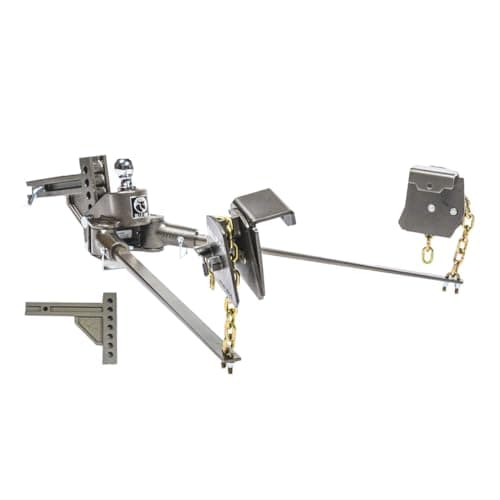 Blue Ox SwayPro BXW0750 Weight Distributing Hitch The smallest SwayPro most travel trailer owners should consider: the same quiet under-slung chain-and-bar design as the bigger kits, sprung for a tongue weight that an actual half-ton-towable trailer puts on the ball. Most travel trailers | Trailers in the 4,000-7,500 lb range with tongue weight near 750 lb | 7.2/ 10 | |
| 2 | 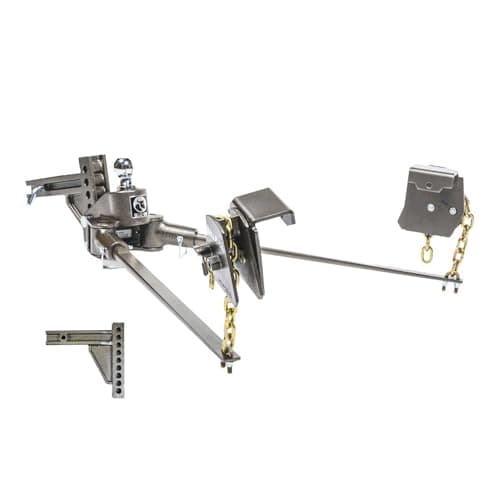 Blue Ox SwayPro BXW1000-S Weight Distributing Hitch Chain-tensioned spring bars that run under the A-frame rather than clamping onto it — quieter than a bracket hitch, and the hookup is a latch rather than a lift. Half-ton at the top of its range | Owners who want a quiet, under-slung bar setup | 7.5/ 10 | |
| 3 | Blue Ox SwayPro BXW1500 Weight Distributing Hitch Same quiet under-slung design as the BXW1000 with a 15,000 lb ceiling, for the trailer that is at the top of a three-quarter-ton's rating. Heavy bumper-pull only | Heavy bumper-pull trailers up to 15,000 lb | 7.7/ 10 |
Tap any row to jump to the full write-up. Prices come from Amazon and are read automatically — see each product below for the date.
The short answer
The numbers in the model names are not quality tiers. A BXW1500 is not a better hitch than a BXW0750 any more than a 10 mm wrench is better than an 8 mm one. All three use the same under-slung spring bars, the same chain-and-latch tensioning, and the same always-engaged sway control. What changes is the stiffness of the bars — and a spring bar is only doing its job when it is loaded somewhere near what it was sprung for.
Spring bar rating: the tongue weight a hitch’s bars are designed to transfer. The first number in a SwayPro model name is that rating in pounds (0750 = 750 lb); the towing figure is ten times it. Rated for 750 lb does not mean “good up to 750 lb and better below” — it means the bars flex correctly when carrying something near that.
The three models, side by side
| BXW0750 | BXW1000 | BXW1500 | |
|---|---|---|---|
| Tongue weight rating | 750 lb | 1,000 lb | 1,500 lb |
| Maximum trailer weight | 7,500 lb | 10,000 lb | 15,000 lb |
| Receiver | 2 in | 2 in | 2 in |
| Shank | 7-hole | 9-hole on the -S | 7-hole |
| Sway control | Spring-bar tension, always engaged | Same | Same |
| Typical tow vehicle | Mid-size or half-ton | Half-ton to three-quarter-ton | Three-quarter-ton and up |
| Hitch ball included | No | No | No |
Read the first row, not the second. The maximum trailer weight is the number that sells hitches and the tongue weight rating is the number that fits them. A 7,000 lb trailer loaded nose-heavy can put more weight on the ball than an 8,500 lb trailer loaded sensibly, and it is the ball weight the bars have to carry.
Finding the number that decides this
Tongue weight on a travel trailer typically runs 10–15% of the loaded trailer weight. “Loaded” is the operative word: dry weight from the brochure is the trailer before water, propane, bikes, a full pantry, and the two folding chairs nobody ever takes out. Real-world loaded weight commonly lands 800–1,500 lb above dry.
So the arithmetic that matters is a range, not a point. Take your expected loaded trailer weight, multiply by 0.10 and by 0.15, and you have the window your tongue weight lives in. A 6,000 lb loaded trailer gives you 600–900 lb. That window sits comfortably inside the 750 lb rating and would be laughably under-loaded on a 1,500 lb bar set.
If you want the actual figure rather than a percentage, measuring tongue weight takes about ten minutes with a tongue weight scale and settles the question for good. It is also the measurement that tells you whether your truck’s payload is the real constraint, which it often is on a half-ton.
The common mistake
Why buying extra capacity makes it worse
This is the part the model numbers actively mislead people about. A spring bar transfers load by deflecting. Bars rated for 1,500 lb that are carrying 600 lb barely deflect at all, and three things follow from that.
The ride gets harsh. Stiff bars with little deflection pass road inputs straight through to the trailer frame and the truck’s rear suspension instead of absorbing them. Owners describe it as the trailer feeling “jacked up” and every expansion joint arriving as a bang.
Sway control weakens. On a SwayPro the sway resistance comes from bar tension. Under-loaded bars are under-tensioned bars, which means the mechanism you paid for is working at a fraction of its intended authority exactly when a passing semi tests it.
Tuning gets twitchy. Setup on a chain-tensioned hitch is done in whole chain links. With correctly matched bars, one link is a sensible increment. With bars far too stiff, one link is a large change in transferred load, so you end up choosing between too little and too much with nothing in between.
The failure in the other direction is more obvious and more dangerous: under-rated bars carrying more than they are sprung for will sag, will not restore the ride height you are aiming for, and are operating outside their rating. That is a real safety issue, not a comfort complaint. The point is not that bigger is always wrong — it is that there is a correct answer in the middle and both sides of it are worse.
Where each one belongs
BXW0750 — 750 lb / 7,500 lb
- Loaded tongue weight roughly 500-750 lb
- Trailers around 4,000-7,500 lb loaded — the bulk of travel trailers
- Mid-size trucks and half-tons not near their payload ceiling
- The cheapest of the three, and the right answer more often than the other two combined
BXW1000 — 1,000 lb / 10,000 lb
- Loaded tongue weight roughly 750-1,000 lb
- Trailers around 7,500-10,000 lb loaded
- Half-tons at the top of their payload, and three-quarter-tons
- The step most people over-buy into when 750 was correct
The BXW1500 sits outside that pair for a reason: at 1,500 lb of tongue weight you are towing something that a half-ton has no business behind at all. If your loaded tongue weight is genuinely approaching 1,500 lb, the hitch is no longer the interesting question — your truck’s payload and rear axle rating are, and payload versus towing capacity is the page to read before the hitch page.
One practical note on shanks. Blue Ox sells these in 7-hole and 9-hole shank variants (the “-S” suffix on some part numbers), and the hole count is about height adjustment, not strength. A lifted truck or an unusually tall receiver may need the taller shank to get the trailer level, which is a separate problem from bar rating — the lifted-truck roundup covers it.
All three set up the same way
Whichever rating you buy, the procedure is identical and it is the part that determines whether the hitch works. SwayPro bars hook to chain-mounted latches on the trailer A-frame, and the number of links you leave slack sets how much weight transfers. Too many links and you have a dead-weight hitch with extra parts; too few and you have unloaded the rear axle past the point of useful steering.
Blue Ox’s own instruction is to measure the front wheel-well height of the tow vehicle unhitched, then set tension so the front end returns to within about half an inch of that figure once the trailer is coupled. That measurement is the whole job. The full setup guide walks through it with the measurements written down, and it applies the same to all three ratings here.
Budget for a hitch ball as well. None of the three includes one, and the ball has to match your coupler — the ball size chart sorts out which, and torquing it correctly matters more than people expect.
What to remember
- The model number is a spring-bar rating in pounds of tongue weight, not a quality tier.
- Multiply loaded trailer weight by 0.10 and 0.15 to get the tongue weight window that chooses for you.
- Most travel trailers belong on the 750, not the 1000 — dry weight is what makes people over-buy.
- Over-sprung bars ride harshly, tension poorly and weaken the sway control you bought.
- Under-rated bars sag and operate outside their rating, which is the genuinely unsafe direction.
- Shank hole count is about height adjustment, not capacity. Lifted trucks are a separate problem.
- Setup is the same for all three: tension until the front wheel-well height returns to near unhitched.
How we compared them
We have not towed with these hitches. This comparison is a documented reading of Blue Ox’s published capacity figures, the current retailer listing data our price pipeline reads automatically, and what owners consistently report about matching bar ratings — stated as reporting, not as our own experience. Part numbers within each rating differ by shank, so confirm the exact listing before ordering. Our method is on how we pick.
If you have not settled on Blue Ox yet, two other pages are more useful than this one: SwayPro versus the Equal-i-zer is the cross-brand decision most people actually face, and hitches by trailer weight lays out the whole field by the same tongue-weight logic used here.
The picks in full
Blue Ox SwayPro BXW0750 Weight Distributing Hitch
Blue Ox · Best for trailers in the 4,000-7,500 lb range with tongue weight near 750 lb
The smallest SwayPro most travel trailer owners should consider: the same quiet under-slung chain-and-bar design as the bigger kits, sprung for a tongue weight that an actual half-ton-towable trailer puts on the ball.
Key specifications
- Tongue weight
- 750 lb
- Towing capacity
- 7,500 lb
- Shank
- 7-hole, 2 in receiver
- Sway control
- Spring-bar tension, always engaged
Capacity figures read from Blue Ox SwayPro specifications, October 2026.
How it scored
- Sway control (25%)8
- Tongue-weight range (20%)6
- Backing up (20%)8
- Setup effort (15%)6
- Quietness (10%)9
- Price for capability (10%)6
Weighted average of the figures above. We did not test this product — see how we pick.
What it does well
- Bars matched to a mid-size trailer instead of over-sprung for one
- Same quiet latch-style hookup as the rest of the SwayPro range
- 7-hole shank gives enough height adjustment for most half-ton hitch heights
What it is bad at
- Too little capacity if your loaded tongue weight is over 750 lb
- Chain link count has to be set correctly or the bars do nothing
- Shank is included, the hitch ball is not
Price as of October 21, 2026. #ad How this is funded
Blue Ox SwayPro BXW1000-S Weight Distributing Hitch
Blue Ox · Best for owners who want a quiet, under-slung bar setup
Chain-tensioned spring bars that run under the A-frame rather than clamping onto it — quieter than a bracket hitch, and the hookup is a latch rather than a lift.
Key specifications
- Tongue weight
- 1,000 lb
- Towing capacity
- 10,000 lb
- Shank
- 9-hole, 2 in receiver
- Sway control
- Spring-bar tension, always engaged
Capacity figures read from Blue Ox SwayPro specifications, October 2026.
How it scored
- Sway control (25%)8
- Tongue-weight range (20%)8
- Backing up (20%)8
- Setup effort (15%)6
- Quietness (10%)9
- Price for capability (10%)5
Weighted average of the figures above. We did not test this product — see how we pick.
What it does well
- Notably quieter than bracket-style friction hitches
- Clamp-on latches make hooking up quick once set
- Bars stay under tension through a turn, so backing is normal
What it is bad at
- Most expensive option in this range
- Initial setup is the fussiest here — chain link count has to be right
- Shank included, ball is not
Price as of October 21, 2026. #ad How this is funded
Blue Ox SwayPro BXW1500 Weight Distributing Hitch
Blue Ox · Best for heavy bumper-pull trailers up to 15,000 lb
Same quiet under-slung design as the BXW1000 with a 15,000 lb ceiling, for the trailer that is at the top of a three-quarter-ton's rating.
Key specifications
- Maximum towing
- 15,000 lb
- Shank
- 7-hole, 2 in receiver
- Sway control
- Spring-bar tension, always engaged
- Noise
- No friction surfaces to squeal
Capacity figures read from Blue Ox SwayPro specifications, October 2026.
How it scored
- Sway control (25%)8
- Tongue-weight range (20%)9
- Backing up (20%)8
- Setup effort (15%)6
- Quietness (10%)9
- Price for capability (10%)5
Weighted average of the figures above. We did not test this product — see how we pick.
What it does well
- Heavy capacity without going to a friction-bracket design
- Quiet in turns
- Latch-style hookup
What it is bad at
- Over-sprung for a light trailer — do not buy for headroom you do not need
- Expensive
- Chain setup takes patience the first time
Price as of October 21, 2026. #ad How this is funded
Common questions
The first number is the tongue weight rating in pounds; trailer capacity is ten times it. So 0750 is 750 lb of tongue weight and 7,500 lb of trailer. Suffixes are shank variants, not capacity.
Yes. Under-loaded bars barely deflect, so you get a harsh ride, weaker sway control and tuning steps too coarse to dial in. Match the rating to your tongue weight.
Measure the tongue weight. At 7,000 lb loaded you are looking at roughly 700–1,050 lb on the ball — under about 750 lb goes on the BXW0750, above it goes on the BXW1000.
No — the ball is separate on all three, and it has to match your coupler. The ball size chart covers which, and torque it properly.
Often yes — bars are sold as parts — but confirm the specific bar set is listed as compatible with your head before buying. Head and latch geometry vary across the range.
Sources
- Blue Ox published SwayPro weight distributing hitch specifications — read October 2026
- NHTSA — towing, trailer safety and load limits — read October 2026
- SAE J684 — trailer couplings, hitches and safety chains — read October 2026