Roundup
The Best RV Drinking Water Hose
Potable-safe hoses compared on certification, kink resistance and length — and why a garden hose is not a substitute.
Our pick: Camco TastePURE 25 ft RV Drinking Water Hose
The least glamorous section on the site, and the one where cheap gear costs you the most. Here is what to buy once rather than three times.
How this page is funded: we earn a commission if you buy through our links, at no extra cost to you. It never changes which product we rank first. Prices come from Amazon and are read automatically — each one shows the date it was read. Full disclosure.
A full hookup is three connections: power, fresh water, and waste. This section covers the last two, and the thing to understand before you buy anything is that fresh water and waste need completely separate equipment that never touches. A hose that has been near the sewer connection is a sewer hose forever. Buy a white drinking-water hose for fresh water, keep it coiled separately, and never improvise.
A drinking-water-safe hose, a pressure regulator, and a sewer hose kit. In that order, because you will use water on the first trip whether or not you dump the tanks.
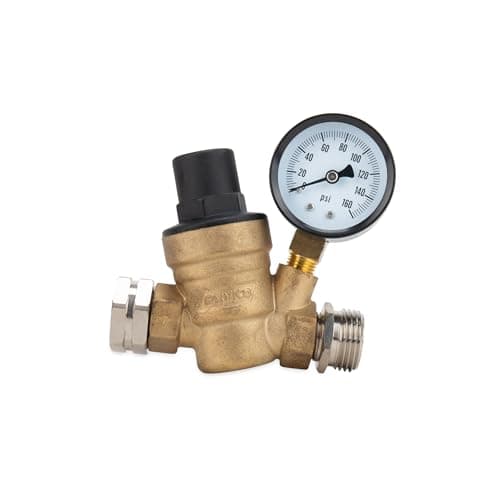
The pressure regulator is the item people skip and should not. Campground water pressure is not regulated to anything in particular; a pedestal can deliver well over 100 psi, and RV plumbing is generally designed around something closer to 40–60 psi. A burst fitting inside a wall is an expensive, slow-to-find repair, and the regulator that prevents it costs less than a tank of gas. Adjustable or preset is the only real decision, and a gauge is worth the extra because it tells you what the pedestal is actually doing.
The common mistake
Wall thickness and fittings. The cheapest hoses are thin vinyl accordion that kinks, crushes under a foot and splits along a fold after a season. Mid-range hoses use a reinforced wall that holds its shape when you pull it across gravel. The premium options go further: metal-reinforced polyolefin, or a smooth-bore hose that does not trap residue in accordion ridges at all. If you camp a handful of weekends a year, the mid-range kit is genuinely enough. If you are out most weekends, the owner report is consistent — the thick-walled hose outlasts two cheap ones.
Then there is the support. A sewer hose needs a continuous downhill run, and without support it sags between the trailer and the connection. The sag holds waste, the waste stays there, and the smell you blame on the hose is actually the sag. A rigid folding trough gives the most consistent slope and takes the most storage space; a coiled spring support compresses to almost nothing and gives a less precise slope. Most people are better served by the one they will actually carry.
| Buy this | Because |
|---|---|
| A 20 ft sewer hose kit | 10 ft will not reach on a lot of sites |
| A hose support | A sagging hose holds waste and smells |
| A white drinking-water hose | A garden hose is not potable-rated |
| A pressure regulator | Pedestals can exceed 100 psi |
| An inline filter | Chlorine taste, mostly |
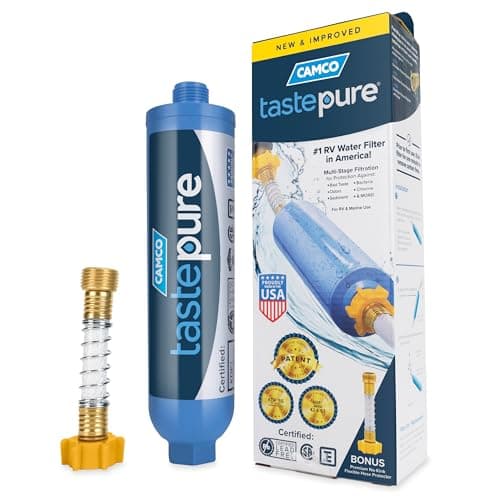
A standard inline RV water filter is a carbon cartridge. It improves taste and smell and catches sediment. It does not make unsafe water safe, and the honest versions do not claim to. If you are filling from a tested municipal supply — which most campgrounds are — taste is the actual problem and a cheap carbon filter solves it. If you genuinely need bacteriological protection, that is a multi-stage system with a cartridge rated for it, at ten times the price, and you should know which problem you are buying for.
One sequencing question comes up constantly and has a clear answer: the regulator goes at the spigot, upstream of the filter, so the filter housing never sees full pedestal pressure. The reasoning, in full.
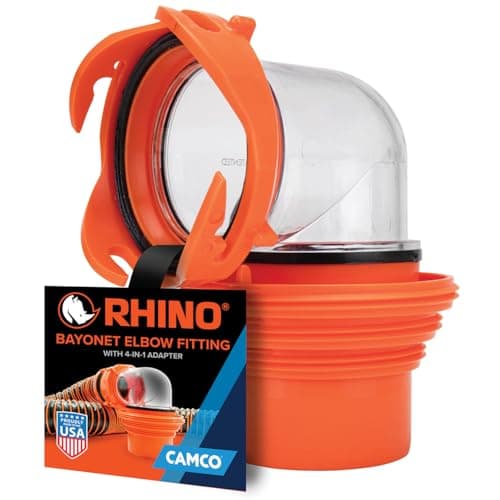
Finally, the fittings. A brass 90-degree elbow at the trailer’s city-water inlet removes the sharp bend that eventually splits every potable hose, and a stepped 4-in-1 sewer adapter is what makes your hose fit whatever strange connection a dump station has. The fittings, explained is worth ten minutes before your first trip.
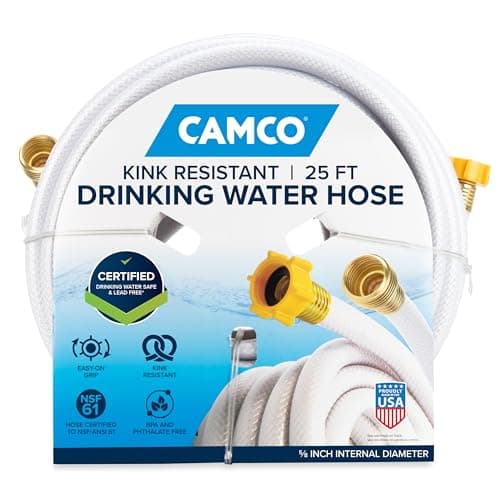
Roundup
Potable-safe hoses compared on certification, kink resistance and length — and why a garden hose is not a substitute.
Our pick: Camco TastePURE 25 ft RV Drinking Water Hose
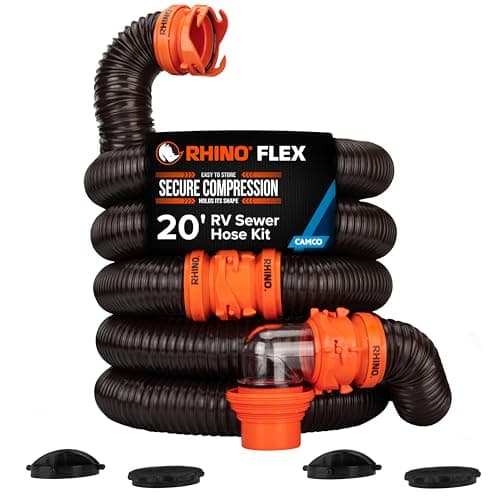
Roundup
Five sewer hose kits ranked on crush resistance, fittings and storage — plus why 20 ft is the length to buy.
Our pick: Camco RhinoFLEX 20 ft Complete RV Sewer Hose Kit
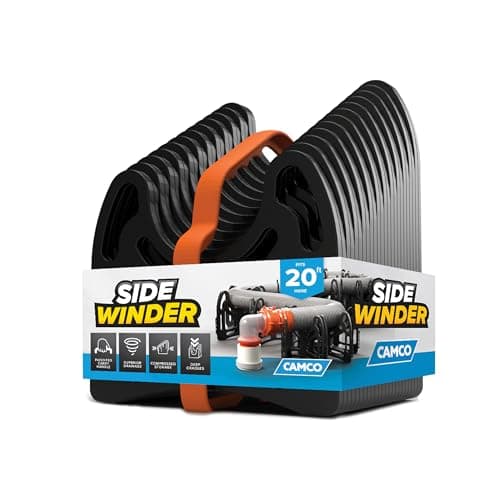
Roundup
Rigid troughs give the most consistent slope; coiled supports store small. Three compared, plus why the sag is what smells.
Our pick: Camco Sidewinder Telescoping RV Sewer Hose Support, 20 ft
Price as of October 5, 2026. #ad How this is funded
Roundup
Four filters from disposable inline to multi-stage canister — and which problem each one actually solves.
Our pick: Camco TastePURE RV Water Filter, GAC and KDF
Price as of October 5, 2026. #ad How this is funded
Roundup
Four regulators compared, adjustable and preset — and why a pedestal that can exceed 100 psi is a real risk to RV plumbing.
Our pick: Camco Adjustable RV Water Pressure Regulator, Lead-Free Brass
Price as of October 5, 2026. #ad How this is funded
Head to head
A preset limits and forgets; an adjustable lets you trade pressure for flow and shows the pedestal reading.
Our pick: Camco Adjustable RV Water Pressure Regulator, Lead-Free Brass
Price as of October 5, 2026. #ad How this is funded
Head to head
The cheap accordion standard against a smooth-bore system with an integrated valve — what the price difference actually buys.
Our pick: Camco RhinoFLEX 20 ft Complete RV Sewer Hose Kit
How to
Connect, support, dump black then gray, rinse, disconnect. The sequence that keeps the smell out.
Our pick: Camco RhinoFLEX 20 ft Complete RV Sewer Hose Kit
Guide
The bumper tube, a dedicated tote, a PVC tube under the frame and the fence-post trick — with the hygiene rules.
Our pick: Camco RhinoFLEX 20 ft Complete RV Sewer Hose Kit
Guide
Regulator at the spigot, then the filter. Why that order protects the weakest component, with the full assembly in sequence.
Our pick: Camco Adjustable RV Water Pressure Regulator, Lead-Free Brass
Price as of October 5, 2026. #ad How this is funded
Explainer
Every fitting on a sewer hose kit, what it connects to, and which spare to carry.
Our pick: Camco RhinoFLEX Clear Sewer Hose Elbow with 4-in-1 Adapter
No. Garden hoses are not certified for potable water and they taste like it. A drinking-water-safe hose costs about the same. Our picks.
Around 50 psi suits most RV plumbing, and many makers advise staying at or below 60. Set it with a gauge rather than by ear. Regulator picks.
Give it a continuous downhill slope so nothing sits in a sag, rinse it after every dump, and cap both ends for storage. Persistent smell is almost always residue trapped in a low spot. The setup sequence.