Weight Distribution & Sway Control
The Best Weight Distribution Hitch For A Pop-Up Camper
A pop-up puts 150-350 lb on the ball. That is the whole problem with this category: almost everything sold for travel trailers is sprung far too stiff for it.
By Mike M. ·
How this page is funded: we earn a commission if you buy through our links, at no extra cost to you. It never changes which product we rank first. Prices come from Amazon and are read automatically — each one shows the date it was read. Full disclosure.
Quick picks
Scored against the published hitch rubric, then filtered to one thing a pop-up owner cannot ignore: the lowest bar rating each kit is available in. A kit that only starts at 1,000 lb is the wrong kit here no matter how it scores.
| # | Product | Best for | Score | Price |
|---|---|---|---|---|
| 1 | 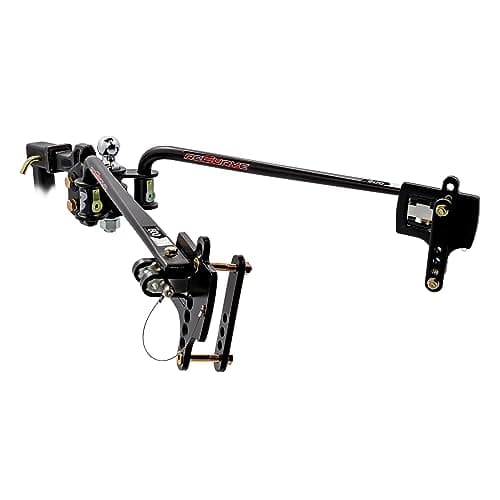 Camco Eaz-Lift ReCurve R3 Weight Distribution Hitch, 48771 An 800 lb-max kit with adjustable sway control and the ball included. Sized for the small trailer most first-time buyers actually own, rather than the one they imagine. Top pick | Light trailers under about 800 lb of tongue weight | 6.4/ 10 | |
| 2 | 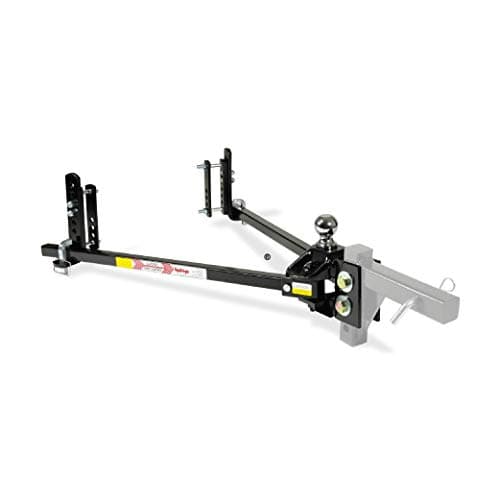 Equal-i-zer 4-Point Sway Control Hitch, 90-00-0601 The small-bar Equal-i-zer. Buying this instead of the 1,000 lb version is the fix for the harsh, over-sprung ride people complain about on light trailers. Best sway control | Light trailers with a loaded tongue weight near 600 lb | 7.6/ 10 | |
| 3 | 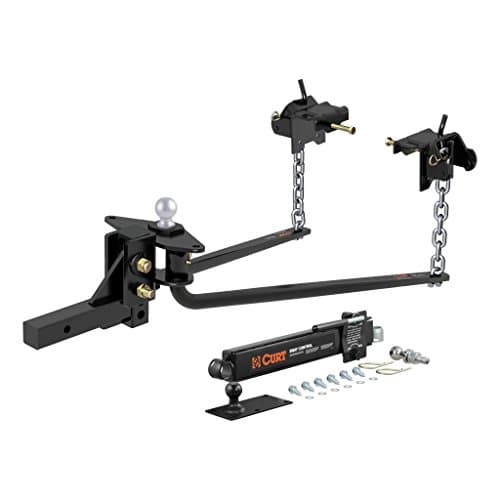 CURT Round Bar Weight Distribution Hitch with Sway Control, 17062 A conventional round-bar kit with a friction sway bar in the box. It is the cheapest way to get both jobs covered, and the cheapness shows up as a bar you have to remember to unclip. Best value | The lowest price with sway control included | 6.2/ 10 | $331.07View on Amazon
|
| 4 | 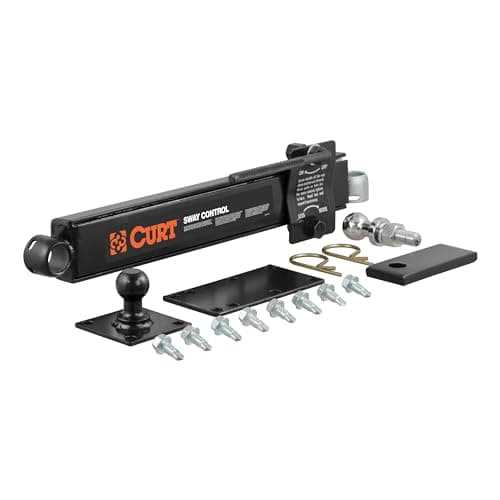 CURT Trailer Sway Control Kit, 17200 A friction bar and the brackets to mount it. The honest use for this is retrofitting a plain weight distribution hitch, not replacing a hitch that has sway control built in. If you only need sway | Adding sway control to a hitch that has none | 5.4/ 10 | |
| 5 | 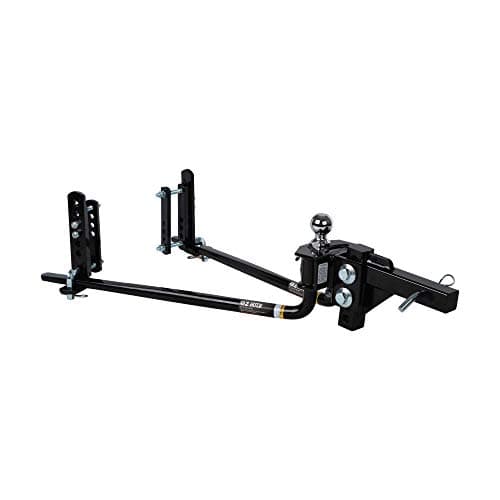 Fastway e2 2-Point Sway Control Round Bar Hitch, 94-00-1033 Equal-i-zer's own value line: two points of built-in sway control instead of four, at a price that leaves money for the shank and ball you still have to buy. If the camper is a heavy one | A first hitch on a 5,000-8,000 lb trailer, on a budget | 7.5/ 10 |
Tap any row to jump to the full write-up. Prices come from Amazon and are read automatically — see each product below for the date.
The short answer
This page exists because the standard advice for this question is wrong. Search for a hitch and you are shown 1,000 lb and 1,200 lb bar sets, because that is what sells to travel-trailer owners. Bolt one of those under a folding camper and you have built a very expensive solid axle: the bars never flex, the trailer transmits every expansion joint straight into the truck, and the thing you bought to make towing calmer makes it harsher.
Loaded tongue weight: the downward force the coupler puts on the ball with the camper packed the way you travel. On a pop-up that usually means the dry hitch weight from the brochure plus the battery, the propane bottles, and whatever is in the front storage box — commonly 60–120 lb of additions on a trailer whose dry tongue was only 150–200 lb to begin with.
First: run the squat test, because you may not need one
A pop-up is the one trailer category where the honest answer is frequently “save your money”. Folding campers run roughly 1,200–3,500 lb loaded with tongue weights of 150–350 lb. Behind a full-size truck that is inside the range the rear springs were designed for, and no amount of spring bar will improve it.
- 1
Measure the truck unhitched
On level ground, measure from the ground to the top of the front and rear wheel arches. Write both down. - 2
Hitch up the loaded camper
Same ground, camper packed the way you actually travel — battery, bottles, everything in the storage box. - 3
Measure again and compare
If the rear has dropped more than about two inches, or the front has risen more than about an inch, weight distribution will help. If both numbers barely moved, it will not.
The other trigger is your owner’s manual. Several mid-size SUVs and minivans require weight distribution above a tongue weight in the 200–350 lb range, which a loaded pop-up clears easily even though the same camper behind a pickup would need nothing. The three tests runs through all of this properly.
The common mistake
What to look for in a light-duty kit
Three specifications decide this, and only one of them is the number on the box.
The lowest available bar rating. This is the whole game. Spring bars are sized in bands, and the band has to bracket your real figure. A pop-up at 280 lb wants bars rated in the 400–600 lb region, not 1,000 lb. The Eaz-Lift ReCurve R3 and the Equal-i-zer 600 lb kit are the two mainstream options that go low enough; most of the catalog starts at 800 lb.
Whether sway control is built in. Pop-ups have a tall, light, flat-sided box and a short wheelbase, which makes them twitchy in crosswinds and in the bow wave of a passing semi. Integral friction is working the moment you pull away and needs nothing unclipped before you reverse onto a site. Sway control types compared separates the designs.
Coupler clearance. Folding campers have shallow A-frames and the propane bottles, battery tray and spare tire are often mounted right where a spring-bar bracket wants to clamp. Measure the clear straight run of A-frame rail on each side before you order. You need roughly 24–30 in of unobstructed rail for a bracket to land in the right place, and plenty of pop-ups do not have it on both sides.
| Loaded tongue weight | Bar rating to look for | Typical camper |
|---|---|---|
| Under 200 lb | Usually no hitch needed | Small A-frame or tent trailer, full-size tow vehicle |
| 200-300 lb | 400-600 lb | Mid-size pop-up behind an SUV or minivan |
| 300-400 lb | 600 lb | Loaded high-wall pop-up, or an off-road folding camper |
| 400-600 lb | 600-800 lb | Hard-side folding camper with a slide |
| Over 600 lb | 800 lb and up | No longer really a pop-up — use the main chart |
The option nobody mentions: a friction bar on its own
Weight distribution and sway control are two different jobs, and a pop-up owner very often needs only the second one. The camper is light enough that the truck sits level, but it still gets shoved around by trucks and crosswinds because of its shape.
In that situation a standalone friction sway bar bolted to your existing ball mount does the job for a small fraction of a full kit. It is a bar with a ball socket on one end and an A-frame bracket on the other, and it resists the trailer pivoting. The catch is real: you must unclip it before any tight turn, every single time, or risk bending the bar. For a camper that comes out six weekends a year that trade is usually worth it. Weight distribution vs sway control explains which job you are actually trying to do.
What this ranking is, and is not
We did not tow with these hitches. There is no test lab here and no fleet of campers. This ranking is a documented reading of each maker’s published bar ratings and bracket dimensions, the current retailer listing data read automatically, and what owners consistently report — stated as reporting, not as our own experience. The rubric and its weights are published on how we pick.
The verdict
Buy the Eaz-Lift ReCurve R3 if the squat test says you need weight distribution: it is the kit most likely to be available in a bar rating that suits a folding camper, and it includes the shank. Buy the Equal-i-zer 600 lb kit instead if sway is your main complaint and you want four points of integral friction you never have to think about — it costs more and it creaks in tight turns, which is normal rather than a fault.
Buy the CURT 17062 if you want a conventional round-bar kit with sway control at the lowest price and your tongue weight is at the top of the pop-up range. Buy the CURT 17200 friction bar on its own if the truck already sits level and you only want the camper to stop wandering. And buy the Fastway e2 only if your “pop-up” is actually a hard-side folding camper with a loaded tongue near 600 lb, at which point you are in normal travel-trailer territory and should read the main hitch roundup instead.
What to remember
- Most pop-ups behind a full-size truck need nothing. Run the squat test before you spend.
- The spec that matters is the lowest bar rating the kit is sold in, not its maximum.
- 1,000 lb bars under a 300 lb tongue ride worse than no hitch at all.
- Measure the clear A-frame rail on both sides — bottles, battery and spare often sit where a bracket needs to clamp.
- If the truck sits level and the camper only wanders, buy sway control alone.
The picks in full
Camco Eaz-Lift ReCurve R3 Weight Distribution Hitch, 48771
Camco Eaz-Lift · Best for light trailers under about 800 lb of tongue weight
An 800 lb-max kit with adjustable sway control and the ball included. Sized for the small trailer most first-time buyers actually own, rather than the one they imagine.
Key specifications
- Max tongue weight
- 800 lb
- Ball
- 2 in ball included, 8,000 lb max rating
- Sway control
- Adjustable
- Rating
- 600 lb nominal / 800 lb maximum tongue weight
Capacity figures read from Camco Eaz-Lift specifications, October 2026.
How it scored
- Sway control (25%)7
- Tongue-weight range (20%)5
- Backing up (20%)7
- Setup effort (15%)7
- Quietness (10%)7
- Price for capability (10%)5
Weighted average of the figures above. We did not test this product — see how we pick.
What it does well
- Correctly sprung for a genuinely light trailer
- Ball included and rated to match
- Sway resistance is adjustable rather than fixed
What it is bad at
- No headroom whatsoever above 800 lb of tongue weight
- Priced like a heavier kit
- Sway adjustment is by feel, with no scale to repeat a setting
Price as of October 10, 2026. #ad How this is funded
Equal-i-zer 4-Point Sway Control Hitch, 90-00-0601
Equal-i-zer · Best for light trailers with a loaded tongue weight near 600 lb
The small-bar Equal-i-zer. Buying this instead of the 1,000 lb version is the fix for the harsh, over-sprung ride people complain about on light trailers.
Key specifications
- Trailer weight rating
- 6,000 lb
- Tongue weight rating
- 600 lb
- Sway control
- 4-point, integral to the head
- Included
- Weight distribution kit; shank and ball sold separately
Capacity figures read from Equal-i-zer product specifications, October 2026.
How it scored
- Sway control (25%)9
- Tongue-weight range (20%)6
- Backing up (20%)9
- Setup effort (15%)8
- Quietness (10%)5
- Price for capability (10%)6
Weighted average of the figures above. We did not test this product — see how we pick.
What it does well
- Correctly sprung for a 400-600 lb tongue, where the 1,000 lb bars ride stiff
- Same four-point sway geometry as the bigger versions
- Light enough that one person can hook up without a fight
What it is bad at
- No headroom if you upgrade trailers later — the bars are the limit, not a suggestion
- Costs close to the 1,000 lb kit, so the saving is in ride quality, not money
- Shank and ball still sold separately
Price as of October 10, 2026. #ad How this is funded
CURT Round Bar Weight Distribution Hitch with Sway Control, 17062
CURT · Best for the lowest price with sway control included
A conventional round-bar kit with a friction sway bar in the box. It is the cheapest way to get both jobs covered, and the cheapness shows up as a bar you have to remember to unclip.
Key specifications
- Gross trailer weight
- 10,000 lb
- Sway control
- Separate friction bar, included
- Bars
- Round bar
- Ball
- Not included
Capacity figures read from CURT 17062 specifications, October 2026.
How it scored
- Sway control (25%)5
- Tongue-weight range (20%)8
- Backing up (20%)4
- Setup effort (15%)7
- Quietness (10%)6
- Price for capability (10%)9
Weighted average of the figures above. We did not test this product — see how we pick.
What it does well
- Sway control included at this price, which is unusual
- Round bars tolerate a slightly wrong bracket angle
- Simple design, cheap to replace parts on
What it is bad at
- The friction bar must be unclipped before a tight turn or you can damage it
- Sway resistance is a single point, so it is the weakest here in a crosswind
- No ball included
CURT Trailer Sway Control Kit, 17200
CURT · Best for adding sway control to a hitch that has none
A friction bar and the brackets to mount it. The honest use for this is retrofitting a plain weight distribution hitch, not replacing a hitch that has sway control built in.
Key specifications
- Type
- Friction sway control bar
- Use
- Add-on for weight distribution hitches
- Mounting
- A-frame bracket plus ball on the shank
- Operation
- Manual — must be disconnected to back sharply
Capacity figures read from CURT 17200 specifications, October 2026.
How it scored
- Sway control (25%)4
- Tongue-weight range (20%)6
- Backing up (20%)3
- Setup effort (15%)7
- Quietness (10%)6
- Price for capability (10%)9
Weighted average of the figures above. We did not test this product — see how we pick.
What it does well
- Cheapest route to some sway resistance on a hitch that has none
- Simple, serviceable, nothing to go wrong electronically
- Works with most conventional round-bar kits
What it is bad at
- Must be unclipped before tight turns and backing, every single time
- One friction point is much weaker than an integrated four-point head
- Needs a second ball and a spare hole in the shank
Price as of October 10, 2026. #ad How this is funded
Fastway e2 2-Point Sway Control Round Bar Hitch, 94-00-1033
Fastway · Best for a first hitch on a 5,000-8,000 lb trailer, on a budget
Equal-i-zer's own value line: two points of built-in sway control instead of four, at a price that leaves money for the shank and ball you still have to buy.
Key specifications
- Trailer weight rating
- 10,000 lb
- Tongue weight rating
- 1,000 lb
- Sway control
- 2-point, integral
- Included
- Weight distribution kit; shank and ball sold separately
Capacity figures read from Fastway e2 product specifications (Equal-i-zer / Progress Mfg), October 2026.
How it scored
- Sway control (25%)7
- Tongue-weight range (20%)8
- Backing up (20%)9
- Setup effort (15%)7
- Quietness (10%)5
- Price for capability (10%)8
Weighted average of the figures above. We did not test this product — see how we pick.
What it does well
- Integral sway control, so nothing to unclip before backing
- Cheaper than the four-point Equal-i-zer with most of the behavior
- Round bars are more forgiving of an imperfect bracket height
What it is bad at
- Two friction points rather than four, so it works less hard in a crosswind
- Still creaks, same as its four-point sibling
- Shank and ball sold separately
Price as of October 10, 2026. #ad How this is funded
Common questions
Usually not behind a full-size truck — a loaded pop-up puts roughly 150–350 lb on the ball. You do need one if your manual requires it at that tongue weight, or if the rear squats more than about two inches when you hitch up, which is common with mid-size SUVs and minivans.
Match the band to your measured loaded tongue weight: 200–300 lb wants 400–600 lb bars, 300–400 lb wants 600 lb bars. The usual 1,000 lb travel-trailer bars never flex at those loads and ride harshly.
Only the sway-control part of it. Spring bars move load onto the front axle; resisting the pivot is a separate job done by integral friction or a bolt-on friction bar. What actually causes sway is worth ten minutes.
Sometimes — measure first. Brackets need roughly 24–30 in of clear straight rail per side, and bottles, battery tray and spare often occupy exactly that space. Plenty of pop-ups have the room on one side only.
Sources
- Equal-i-zer published hitch specifications and bar ratings — read October 2026
- Andersen Hitches weight distribution hitch specifications — read October 2026
- Reese published weight-distributing hitch specifications — read October 2026
- CURT published weight distribution specifications — read October 2026
- Blue Ox SwayPro published specifications — read October 2026
- SAE J684 — trailer couplings, hitches and safety chains — read October 2026