Leveling, chocking and stabilizing are three separate jobs, and buying the wrong product for the job is why a trailer that looks level still feels like a boat.
12 pages4 guides
How this page is funded: we earn a commission if you buy through our links, at no extra cost to you. It never changes which product we rank first. Prices come from Amazon and are read automatically — each one shows the date it was read. Full disclosure.
Three jobs, three categories of product, and a lot of confusion between them.
Leveling means getting the trailer horizontal, which matters more than comfort: an absorption fridge needs to be close to level to work at all, and running one badly out of level can damage it. Side to side you level by raising one set of wheels — blocks under the tires, or a ramp you drive up. Front to back you level with the tongue jack, which is already fitted.
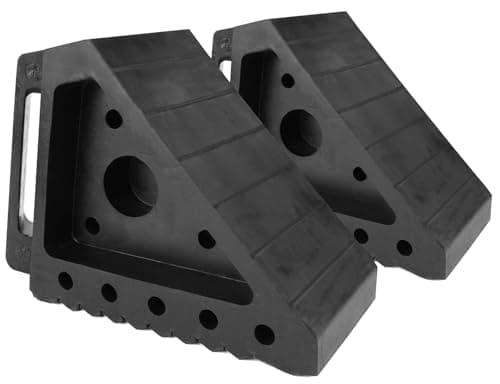
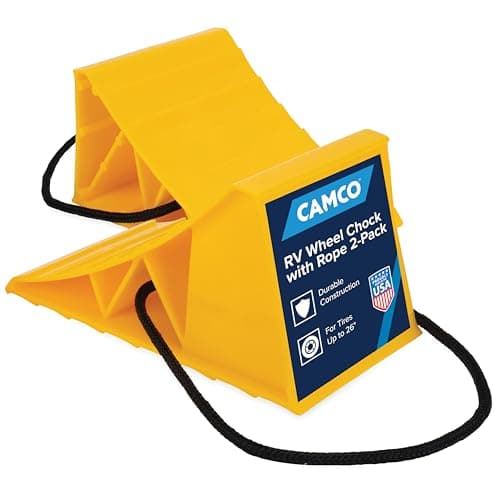
Chocking means stopping the trailer rolling. It is a safety item, not a comfort item, and it is the one that people skimp on. Two chocks is the bare minimum; four is correct on a tandem axle, and on any slope you want them on the downhill side of every wheel before you unhitch.
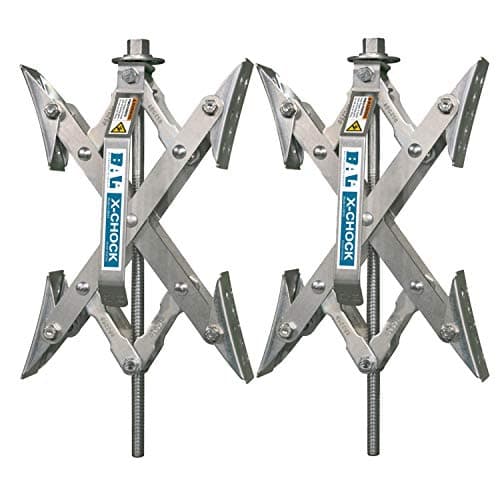
Stabilizing means stopping the trailer moving when you walk around inside it. The scissor jacks at the corners do some of this. A wheel stabilizer that wedges between the two tires of a tandem axle does the rest, and it is doing nothing at all for a single-axle trailer, because there is no gap to wedge into.
What to buy first, in order
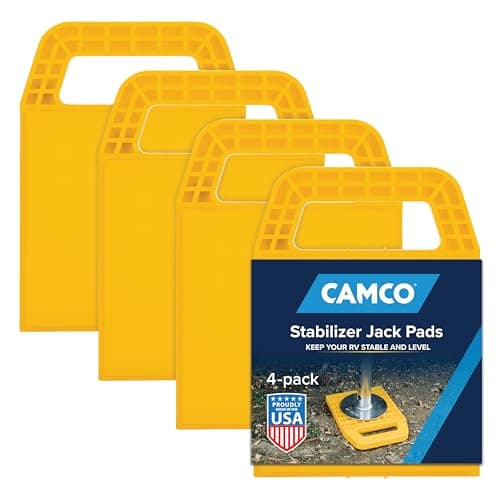
Chocks, then something to level with, then jack pads, then a stabilizer. Chocks because they are the safety item and they cost almost nothing. Leveling because the fridge needs it. Jack pads because on any soft or gravel site the scissor jacks sink and the trailer you leveled at seven is not level at midnight. A wheel stabilizer last, because it is a comfort upgrade and only works on a tandem axle.
The common mistake
Using the scissor jacks to lift the trailer. They are stabilizer jacks, not leveling jacks — most are rated only to steady the trailer, not to carry its weight. Winding one down hard enough to lift a corner bends the jack and can twist the frame. Level with blocks under the wheels and the tongue jack; the difference matters.
Blocks or ramps: what decides the price
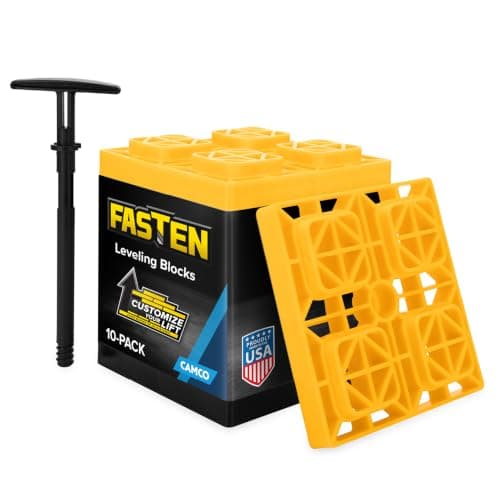
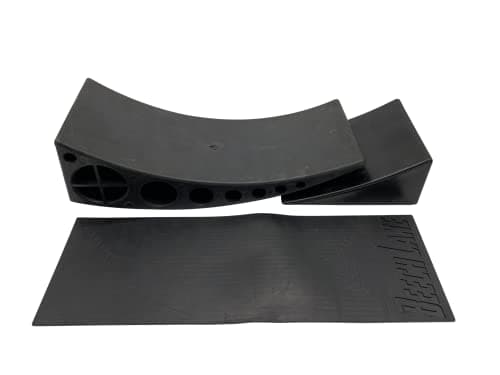
Interlocking plastic blocks are the cheap, versatile answer. A ten-pack costs less than a tank of gas, they interlock so a stack cannot shear sideways, and they go under jacks as well as tires. The cost is in your time: you guess a height, drive up, check, and restack, usually twice.
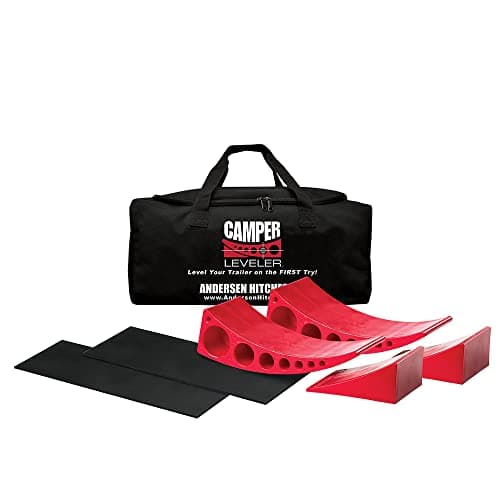
Curved drive-up levelers cost two to four times as much and remove the guessing entirely. You drive up the ramp until the bubble centers and chock it there, at any height within its range rather than in one-inch steps. For a lot of owners this is the single best money spent at a campsite, and the honest counterpoint is that they are bulky, they will not go under a jack, and on a single-axle trailer you still need something under the other wheel sometimes.
People use scrap lumber, and it works right up until it does not. A 2x10 offcut has no interlock, so a two-layer stack can shear sideways as a tire climbs it; construction lumber splits along the grain under a point load; and a cracked block under a loaded tire is a trailer coming off its support. If you are going to use wood, use thick hardwood plywood rather than dimensional lumber, keep stacks to two layers, and accept that the engineering case for plastic blocks is real.
One more thing worth knowing before your first trip: level the trailer before you unhitch, not after. Once the tow vehicle is gone you have lost the only easy way to move the trailer a foot forward, and the fix for guessing wrong is re-hitching in the dark. The full sequence is here.
Four for a tandem axle — one on each side of the tires, both sides. Two is the practical minimum on level ground with the trailer still hitched. The full answer.
Most makers set a limit, commonly four layers. Past that, move the trailer to a flatter part of the site rather than building a taller tower — a tall stack fails sideways, not downward.
No. A tandem-tire stabilizer resists rocking; it is not designed to stop the trailer rolling. Use conventional chocks for safety and the stabilizer as well. Side by side.