Weight Distribution & Sway Control
The Best Weight Distribution Hitch For Your Trailer Weight
Nine hitches, ranked against a published rubric and sorted by the only number that decides which one fits: your loaded tongue weight.
By Mike M. ·
How this page is funded: we earn a commission if you buy through our links, at no extra cost to you. It never changes which product we rank first. Prices come from Amazon and are read automatically — each one shows the date it was read. Full disclosure.
Quick picks
Scored against the published rubric for this category: sway control method (25%), tongue-weight range (20%), backing-up behavior (20%), setup effort (15%), quietness (10%) and price for capability (10%). Weighted for a first-time owner, which is why backing up outranks capacity headroom.
| # | Product | Best for | Score | Price |
|---|---|---|---|---|
| 1 | 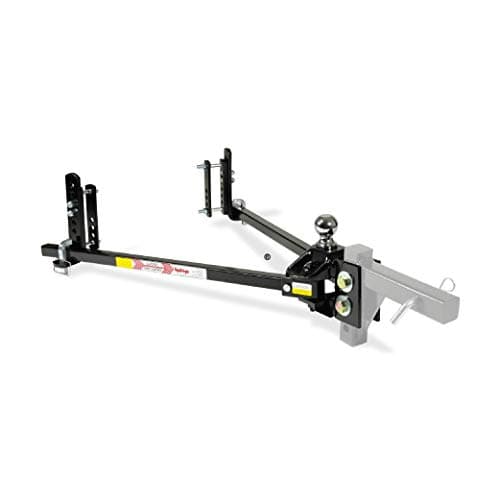 Equal-i-zer 4-Point Sway Control Hitch, 90-00-1001 Four-point sway control built into the head, so there is no friction bar to unclip before you back into a site — the single biggest quality-of-life difference for a first-timer. Top pick | Most half-ton trucks pulling a 5,000-10,000 lb trailer | 7.9/ 10 | |
| 2 | 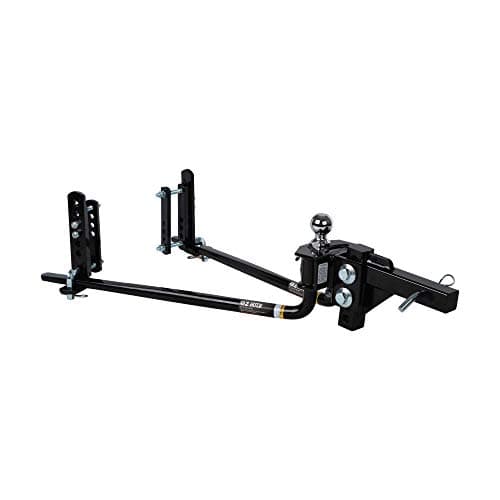 Fastway e2 2-Point Sway Control Round Bar Hitch, 94-00-1033 Equal-i-zer's own value line: two points of built-in sway control instead of four, at a price that leaves money for the shank and ball you still have to buy. Best value | A first hitch on a 5,000-8,000 lb trailer, on a budget | 7.5/ 10 | |
| 3 | 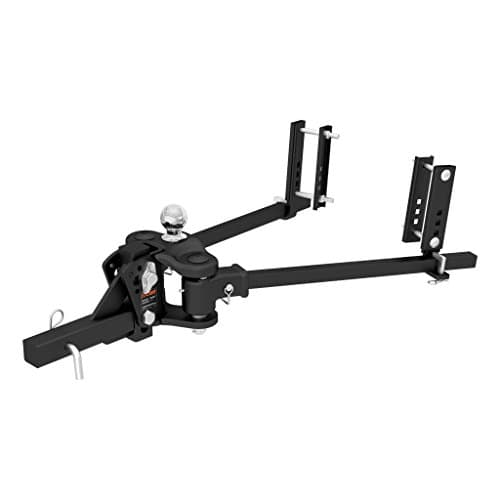 CURT TruTrack 4P Weight Distribution Hitch, 17500 CURT's answer to the four-point Equal-i-zer, with a 10,000 lb rating and an adjustable sway bias — generally a couple of hundred dollars under the hitch it is aimed at. Best for first-timers | Four-point sway control at a mid-range price | 7.9/ 10 | |
| 4 | 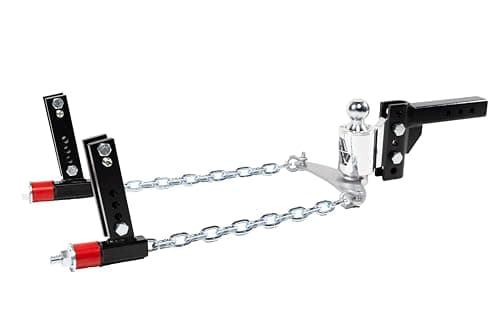 Andersen No-Sway Weight Distribution Hitch Chains and a urethane cone instead of steel spring bars, so it is the quietest and the lightest of the mainstream kits — and the only one most people can lift with one hand. Quietest | Owners who care most about weight, noise and a short hookup | 7.5/ 10 | Check price on Amazon No buyable offer at the last price check. |
| 5 | 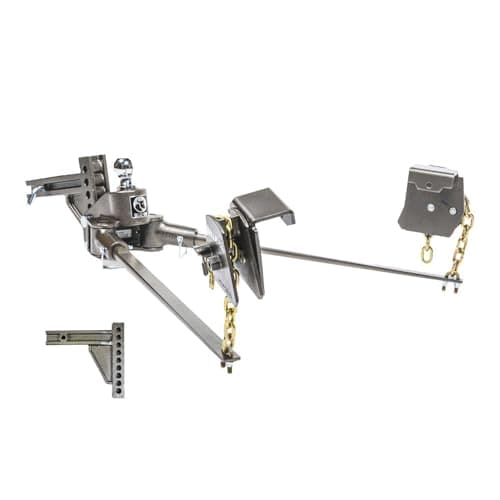 Blue Ox SwayPro BXW1000-S Weight Distributing Hitch Chain-tensioned spring bars that run under the A-frame rather than clamping onto it — quieter than a bracket hitch, and the hookup is a latch rather than a lift. | Owners who want a quiet, under-slung bar setup | 7.5/ 10 | |
| 6 | 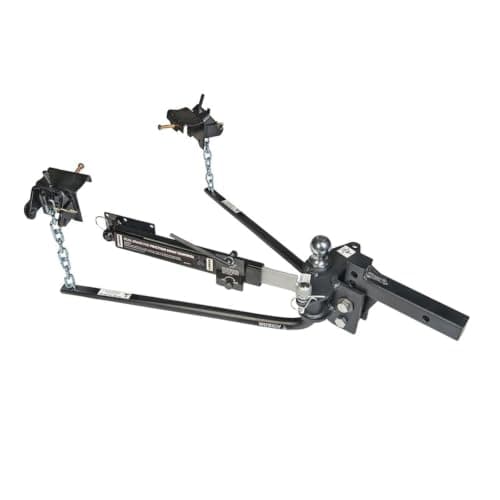 Husky Round Bar Weight Distribution Hitch, 30849 The only kit here that arrives with a 10 in shank and a 2-5/16 in ball in the box, which is why its real-world cost undercuts hitches with a lower sticker price. | The cheapest complete kit that still includes shank and ball | 6.1/ 10 | |
| 7 | 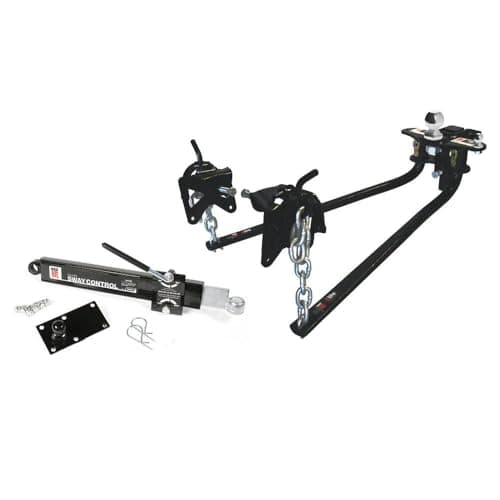 Camco Eaz-Lift Elite 1,000 lb Weight Distribution Hitch Kit, 48058 Ships ready to tow — hitch ball, sway control ball, U-bolts and chains all pre-installed — which is why this is usually the cheapest route from zero to legally hooked up. Cheapest complete kit | Getting a complete, ready-to-tow kit for the least money | 6.3/ 10 | |
| 8 | 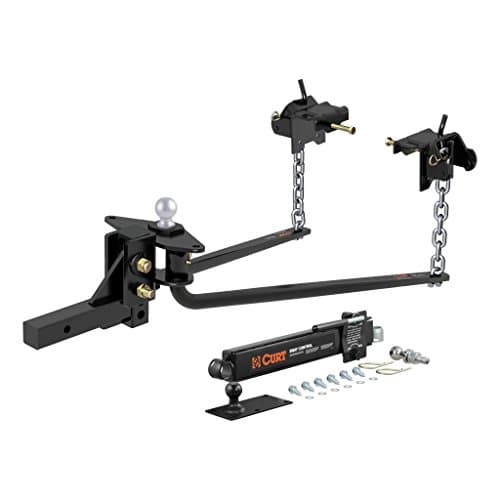 CURT Round Bar Weight Distribution Hitch with Sway Control, 17062 A conventional round-bar kit with a friction sway bar in the box. It is the cheapest way to get both jobs covered, and the cheapness shows up as a bar you have to remember to unclip. | The lowest price with sway control included | 6.2/ 10 | |
| 9 | 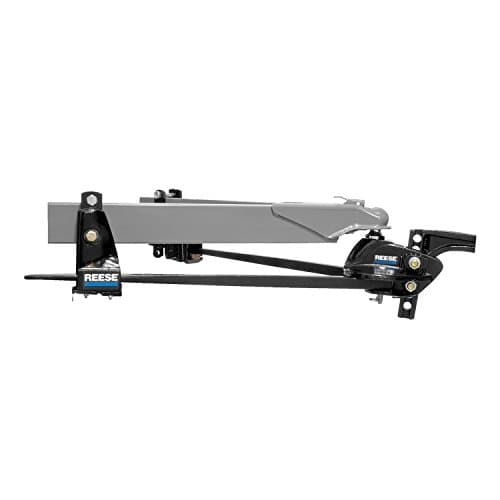 Reese Steadi-Flex Trunnion Weight-Distributing Hitch Kit, 66560 Reese's integrated-sway trunnion kit, shipped with its shank. The selling point is that the friction surfaces are enclosed, so grit does less to them over a season. | Owners who want a sealed, low-maintenance friction system | 7.6/ 10 |
Tap any row to jump to the full write-up. Prices come from Amazon and are read automatically — see each product below for the date.
The short answer
The single most useful thing to understand about this category is that almost every hitch here will physically work on your trailer. The ratings overlap, the brackets fit the same A-frames, and all of them will level your truck. What separates them is how much of a nuisance they are to live with, and that comes down to three things: whether sway control is built in or bolted on, whether the bars are sprung for your actual tongue weight, and how much noise you are willing to tolerate.
So this guide is not organized by brand loyalty. It is organized by the number you need before you spend anything.
Loaded tongue weight: the downward force the trailer’s coupler puts on the hitch ball with the trailer packed the way you actually travel — water in the tanks you fill, gear in the front storage, bikes on the rack. It is not the dry hitch weight on the brochure, which is usually 100–250 lb lower.
Before anything: get your tongue weight
Bar ratings are sold in bands — 600 lb, 800 lb, 1,000 lb, 1,200 lb, 1,400–1,600 lb — and the band has to bracket your real loaded figure. This is not a detail. A 1,000 lb bar set under a 550 lb tongue rides harsh over every expansion joint and never tensions properly, because the bars are too stiff to deflect at that load. A 600 lb set under a 900 lb tongue is simply overloaded, and the bars take a permanent set.
There are three honest ways to get the number: a tongue weight scale, a trip to a public truck scale, or a ball mount with a scale built into the shank. The last one is the only method that gives you the number every time you hook up rather than once a season, which is why it is worth the premium if you tow often.
The common mistake
Which bar rating you need
| Your loaded tongue weight | Bar rating to buy | Typical trailer |
|---|---|---|
| 350-600 lb | 600 lb | Small single-axle, teardrop, 19-22 ft |
| 550-800 lb | 800 lb | 22-26 ft tandem axle |
| 750-1,000 lb | 1,000 lb | 26-32 ft tandem axle |
| 1,000-1,200 lb | 1,200 lb | 32-36 ft, loaded heavy |
| 1,200-1,600 lb | 1,400-1,600 lb | Large bumper-pull, 3/4-ton tow vehicle |
Where your number falls near a boundary, go to the band that contains it rather than the one above. Headroom you do not use is a harsher ride, not a safety margin. The full selection chart runs the same arithmetic by trailer weight and tow vehicle.
The sway control question that decides everything
Weight distribution and sway control are separate jobs. Spring bars move load onto the truck’s front axle and the trailer’s axles; friction resists the trailer pivoting around the ball. Hitches handle the second job in one of two ways, and the difference runs through this entire ranking.
Integral sway control builds friction into the head or the bracket geometry. It is always working. You can back into a site, turn hard, and jackknife into a driveway without touching anything. The Equal-i-zer, the Fastway e2, the CURT TruTrack and the Reese Steadi-Flex all work this way.
A bolt-on friction bar is a separate arm with a ball on the shank and a bracket on the A-frame. It works, it is cheap, and you must unclip it before any tight turn, every single time. Forget once and you can bend the bar or the bracket. On a long highway trip this is irrelevant. On a wet Friday night trying to reverse into a tight site with someone waiting behind you, it is the difference between an annoyance and a genuinely bad evening.
For a first-time owner this is the specification that matters most, which is exactly why it carries 20% of the score for backing behavior on top of the 25% for the sway method itself. The sway control types compared goes deeper, and weight distribution vs sway control separates the two jobs properly.
Yes, it will make noise
Every friction-based hitch creaks. The Equal-i-zer family is notorious for it: a groaning, grinding complaint in tight turns at low speed, loud enough that new owners post asking what they have broken. Nothing is broken. It is steel sliding on steel under several hundred pounds of load, and the manufacturer’s own guidance treats it as normal.
If silence matters to you more than anything else, two designs genuinely deliver it. The Andersen uses chains and a urethane friction cone instead of steel spring bars and brackets, and it is the quietest mainstream hitch by a wide margin. The Blue Ox SwayPro runs its bars under the A-frame on chains with no bracket friction surfaces, which is nearly as quiet. Both cost more, and the Andersen’s cone is a wear item you will eventually replace.
The two hidden costs
The shank. Most kits do not include one. The shank is the bar that slides into your receiver and carries the head, and it needs to be the right drop or rise to get your trailer level. Budget for one unless the listing explicitly says it is included — the Equal-i-zer 16,000 lb kit, the Fastway e2 trunnion, the Reese Steadi-Flex and the Husky kit all include theirs, and that genuinely changes the price ranking.
The ball. Separate again on most kits, and it must match your coupler exactly — a 2-5/16 in coupler on a 2 in ball is how trailers come off. The ball size chart is one page and worth reading before you order.
Put together, a hitch with a $330 sticker and no shank or ball can land closer to $480 by the time it is usable, and a $375 kit that includes both is the cheaper purchase. That is why the Husky and the Eaz-Lift Elite score as well as they do on price-for-capability despite being the least sophisticated designs here.
What this ranking is, and is not
We did not tow with these hitches. There is no test lab here and no fleet of trailers, and a site that claims otherwise is asking you to take its word for something you cannot check. What this ranking is: a documented reading of published capacity specifications from each maker, the current Amazon listing data read automatically at build time, and what owners consistently report — stated as reporting, not as our own experience.
The scoring rubric, the weights, and what disqualifies a product are all published on how we pick. If you disagree with a score, the arithmetic is reproducible from the numbers printed on each product card.
The verdict
Buy the Equal-i-zer 90-00-1001 if your loaded tongue weight lands in the 750–1,000 lb band and you want the hitch that most owners end up with and stop thinking about. Buy the Fastway e2 if the extra two friction points are not worth the price difference to you — it is the same company and the same backing behavior. Buy the CURT TruTrack if you want four points of sway control with adjustable bias at a mid-range price, and you are comfortable with a slightly more involved first setup.
Buy the Andersen if you will lift the hitch on and off frequently, or if noise genuinely bothers you. Buy the Eaz-Lift Elite if the budget is the constraint and you accept unclipping a friction bar before every tight turn. And buy the Equal-i-zer 600 lb or an equivalent small-bar kit if your tongue weight is genuinely light — that is the choice that fixes a harsh ride, and it is the one people get wrong most often.
What to remember
- Measure loaded tongue weight first. Every other decision depends on it.
- Integral sway control means nothing to unclip before backing. For a first-timer that is worth more than capacity headroom.
- Friction hitches creak in tight turns. It is normal, not a fault.
- Check whether the shank and ball are included before comparing prices — it can be a $150 swing.
- A bar set rated far above your tongue weight rides worse, not safer.
The picks in full
Equal-i-zer 4-Point Sway Control Hitch, 90-00-1001
Equal-i-zer · Best for most half-ton trucks pulling a 5,000-10,000 lb trailer
Four-point sway control built into the head, so there is no friction bar to unclip before you back into a site — the single biggest quality-of-life difference for a first-timer.
Key specifications
- Trailer weight rating
- 10,000 lb
- Tongue weight rating
- 1,000 lb
- Sway control
- 4-point, integral to the head
- Included
- Weight distribution kit; shank and ball sold separately
Capacity figures read from Equal-i-zer product specifications, October 2026.
How it scored
- Sway control (25%)9
- Tongue-weight range (20%)8
- Backing up (20%)9
- Setup effort (15%)7
- Quietness (10%)5
- Price for capability (10%)7
Weighted average of the figures above. We did not test this product — see how we pick.
What it does well
- Sway control is always on — nothing to remember, nothing to remove
- Back up and turn sharply without unhooking anything
- Bracket height is adjustable in the field with a wrench, not a shop visit
What it is bad at
- It creaks and groans in tight turns; owners report this consistently and it is normal, not a fault
- Needs a shank and ball bought separately, which catches people out on price
- Heavier to lift onto the coupler than a friction-bar setup
Price as of October 5, 2026. #ad How this is funded
Fastway e2 2-Point Sway Control Round Bar Hitch, 94-00-1033
Fastway · Best for a first hitch on a 5,000-8,000 lb trailer, on a budget
Equal-i-zer's own value line: two points of built-in sway control instead of four, at a price that leaves money for the shank and ball you still have to buy.
Key specifications
- Trailer weight rating
- 10,000 lb
- Tongue weight rating
- 1,000 lb
- Sway control
- 2-point, integral
- Included
- Weight distribution kit; shank and ball sold separately
Capacity figures read from Fastway e2 product specifications (Equal-i-zer / Progress Mfg), October 2026.
How it scored
- Sway control (25%)7
- Tongue-weight range (20%)8
- Backing up (20%)9
- Setup effort (15%)7
- Quietness (10%)5
- Price for capability (10%)8
Weighted average of the figures above. We did not test this product — see how we pick.
What it does well
- Integral sway control, so nothing to unclip before backing
- Cheaper than the four-point Equal-i-zer with most of the behavior
- Round bars are more forgiving of an imperfect bracket height
What it is bad at
- Two friction points rather than four, so it works less hard in a crosswind
- Still creaks, same as its four-point sibling
- Shank and ball sold separately
Price as of October 5, 2026. #ad How this is funded
CURT TruTrack 4P Weight Distribution Hitch, 17500
CURT · Best for four-point sway control at a mid-range price
CURT's answer to the four-point Equal-i-zer, with a 10,000 lb rating and an adjustable sway bias — generally a couple of hundred dollars under the hitch it is aimed at.
Key specifications
- Gross trailer weight
- 10,000 lb
- Sway control
- 4-point, integral
- Adjustment
- Sway-control bias adjustable
- Included
- Weight distribution kit with sway control
Capacity figures read from CURT TruTrack specifications, October 2026.
How it scored
- Sway control (25%)9
- Tongue-weight range (20%)8
- Backing up (20%)9
- Setup effort (15%)6
- Quietness (10%)5
- Price for capability (10%)8
Weighted average of the figures above. We did not test this product — see how we pick.
What it does well
- Four points of sway control for less than the obvious four-point alternative
- Bias adjustment lets you dial sway resistance to the trailer
- No bar to unclip before backing
What it is bad at
- More parts to understand on first setup than a two-point kit
- Less owner experience published than the market leaders, so fewer reports to read
- Friction surfaces mean friction noise
Price as of October 5, 2026. #ad How this is funded
Andersen No-Sway Weight Distribution Hitch
Andersen Hitches · Best for owners who care most about weight, noise and a short hookup
Chains and a urethane cone instead of steel spring bars, so it is the quietest and the lightest of the mainstream kits — and the only one most people can lift with one hand.
Key specifications
- Gross trailer weight rating
- 14,000 lb
- Shank
- 2 in shank, 4 in drop
- Ball
- 2-5/16 in included
- Sway control
- Friction cone, always engaged
Capacity figures read from Andersen Hitches weight distribution specifications, October 2026.
How it scored
- Sway control (25%)7
- Tongue-weight range (20%)8
- Backing up (20%)8
- Setup effort (15%)6
- Quietness (10%)10
- Price for capability (10%)6
Weighted average of the figures above. We did not test this product — see how we pick.
What it does well
- Quiet — the complaint that defines steel-bar hitches mostly goes away
- Much lighter than a bar-and-bracket kit, so hookup is a one-person job
- Ball and shank are included, which is rarer than it should be
What it is bad at
- Chain tension is set by feel and a wrench, which is fiddlier to get right the first time
- The urethane cone is a wear part you will eventually replace
- Price sits at the top of the range
Blue Ox SwayPro BXW1000-S Weight Distributing Hitch
Blue Ox · Best for owners who want a quiet, under-slung bar setup
Chain-tensioned spring bars that run under the A-frame rather than clamping onto it — quieter than a bracket hitch, and the hookup is a latch rather than a lift.
Key specifications
- Tongue weight
- 1,000 lb
- Towing capacity
- 10,000 lb
- Shank
- 9-hole, 2 in receiver
- Sway control
- Spring-bar tension, always engaged
Capacity figures read from Blue Ox SwayPro specifications, October 2026.
How it scored
- Sway control (25%)8
- Tongue-weight range (20%)8
- Backing up (20%)8
- Setup effort (15%)6
- Quietness (10%)9
- Price for capability (10%)5
Weighted average of the figures above. We did not test this product — see how we pick.
What it does well
- Notably quieter than bracket-style friction hitches
- Clamp-on latches make hooking up quick once set
- Bars stay under tension through a turn, so backing is normal
What it is bad at
- Most expensive option in this range
- Initial setup is the fussiest here — chain link count has to be right
- Shank included, ball is not
Price as of October 5, 2026. #ad How this is funded
Husky Round Bar Weight Distribution Hitch, 30849
Husky · Best for the cheapest complete kit that still includes shank and ball
The only kit here that arrives with a 10 in shank and a 2-5/16 in ball in the box, which is why its real-world cost undercuts hitches with a lower sticker price.
Key specifications
- Gross trailer weight
- 12,000 lb
- Tongue weight range
- 800-1,200 lb
- Included
- 10 in shank and 2-5/16 in ball
- Sway control
- None integral — add a friction bar
How it scored
- Sway control (25%)4
- Tongue-weight range (20%)8
- Backing up (20%)4
- Setup effort (15%)7
- Quietness (10%)7
- Price for capability (10%)9
Weighted average of the figures above. We did not test this product — see how we pick.
What it does well
- Complete out of the box: shank and ball included
- Tongue-weight window is broad enough to survive a trailer upgrade
- Steel construction, simple to service
What it is bad at
- No built-in sway control, so you add a friction bar and remember to unclip it before backing
- 800 lb bottom of the range is too stiff for a light trailer
- Heavier than the aluminum alternatives
Price as of October 5, 2026. #ad How this is funded
Camco Eaz-Lift Elite 1,000 lb Weight Distribution Hitch Kit, 48058
Camco Eaz-Lift · Best for getting a complete, ready-to-tow kit for the least money
Ships ready to tow — hitch ball, sway control ball, U-bolts and chains all pre-installed — which is why this is usually the cheapest route from zero to legally hooked up.
Key specifications
- Tongue weight
- 1,000 lb
- Sway control
- Manually adjusted friction bar, included
- Included
- Hitch ball, sway ball, U-bolts, chain package
- Assembly
- Pre-installed hardware
Capacity figures read from Camco Eaz-Lift specifications, October 2026.
How it scored
- Sway control (25%)5
- Tongue-weight range (20%)7
- Backing up (20%)4
- Setup effort (15%)8
- Quietness (10%)6
- Price for capability (10%)10
Weighted average of the figures above. We did not test this product — see how we pick.
What it does well
- Genuinely complete in the box — no second order for a ball
- Lowest all-in cost of any kit here
- Chain-and-bracket setup is easy to understand
What it is bad at
- Manual friction sway control: unclip before tight turns, every time
- Finish is the least durable here; surface rust is a common report
- No sway resistance at all if you forget to reconnect the bar
Price as of October 5, 2026. #ad How this is funded
CURT Round Bar Weight Distribution Hitch with Sway Control, 17062
CURT · Best for the lowest price with sway control included
A conventional round-bar kit with a friction sway bar in the box. It is the cheapest way to get both jobs covered, and the cheapness shows up as a bar you have to remember to unclip.
Key specifications
- Gross trailer weight
- 10,000 lb
- Sway control
- Separate friction bar, included
- Bars
- Round bar
- Ball
- Not included
Capacity figures read from CURT 17062 specifications, October 2026.
How it scored
- Sway control (25%)5
- Tongue-weight range (20%)8
- Backing up (20%)4
- Setup effort (15%)7
- Quietness (10%)6
- Price for capability (10%)9
Weighted average of the figures above. We did not test this product — see how we pick.
What it does well
- Sway control included at this price, which is unusual
- Round bars tolerate a slightly wrong bracket angle
- Simple design, cheap to replace parts on
What it is bad at
- The friction bar must be unclipped before a tight turn or you can damage it
- Sway resistance is a single point, so it is the weakest here in a crosswind
- No ball included
Price as of October 5, 2026. #ad How this is funded
Reese Steadi-Flex Trunnion Weight-Distributing Hitch Kit, 66560
Reese · Best for owners who want a sealed, low-maintenance friction system
Reese's integrated-sway trunnion kit, shipped with its shank. The selling point is that the friction surfaces are enclosed, so grit does less to them over a season.
Key specifications
- Gross trailer weight
- 12,000 lb
- Bars
- Trunnion
- Included
- Shank included
- Sway control
- Integrated
How it scored
- Sway control (25%)8
- Tongue-weight range (20%)8
- Backing up (20%)8
- Setup effort (15%)7
- Quietness (10%)7
- Price for capability (10%)6
Weighted average of the figures above. We did not test this product — see how we pick.
What it does well
- Integrated sway control with no separate bar
- Enclosed friction surfaces shrug off road grit
- Shank in the box
What it is bad at
- Priced near the premium kits without the premium name recognition
- Heavy
- 12,000 lb bars are too stiff for a light trailer
Price as of October 5, 2026. #ad How this is funded
Common questions
Match the bar rating to your loaded tongue weight, not trailer length. 750–1,000 lb measured means 1,000 lb bars; 550–800 lb means 800 lb bars. Going well above your real figure gives a harsher ride without adding safety.
Not with integral sway control — the Equal-i-zer, Fastway e2, CURT TruTrack and Reese Steadi-Flex all back and turn normally. A separate bolt-on friction bar does have to be disconnected before tight turns, every time.
It depends on the tow vehicle, not the trailer weight alone. Behind a half-ton truck, often no. Behind a mid-size SUV, frequently yes — the trailer is a bigger fraction of the vehicle weight and the tongue limit is lower. Check your manual’s wording.
Sometimes — some manuals list a higher maximum trailer weight with weight distribution fitted. It never increases payload: tongue weight still counts against the door-jamb sticker in full. Payload is usually the real limit.
The kits here span a wide range, and the live price is in the table above. The number that catches people is the extras: a shank and a ball can add a meaningful amount to a kit that looked cheaper on the shelf, so check what is in the box before comparing.
Sources
- Equal-i-zer published hitch specifications and bar ratings — read October 2026
- Blue Ox SwayPro published specifications — read October 2026
- CURT published weight distribution specifications — read October 2026
- Andersen Hitches weight distribution hitch specifications — read October 2026
- SAE J684 — trailer couplings, hitches and safety chains — read October 2026
- 49 CFR 393.70 — coupling devices and towing methods — read October 2026