Weight Distribution & Sway Control
Weight Distribution Hitch vs Airbags
Both make a squatting truck sit level. Only one of them restores load to the front axle, and neither of them adds a pound of payload.
By Mike M. ·
How this page is funded: we earn a commission if you buy through our links, at no extra cost to you. It never changes which product we rank first. Prices come from Amazon and are read automatically — each one shows the date it was read. Full disclosure.
Quick picks
Weight distribution hitches that address the geometry problem airbags do not. Air springs are a suspension upgrade, not an Amazon pick we rank here.
| # | Product | Best for | Score | Price |
|---|---|---|---|---|
| 1 | 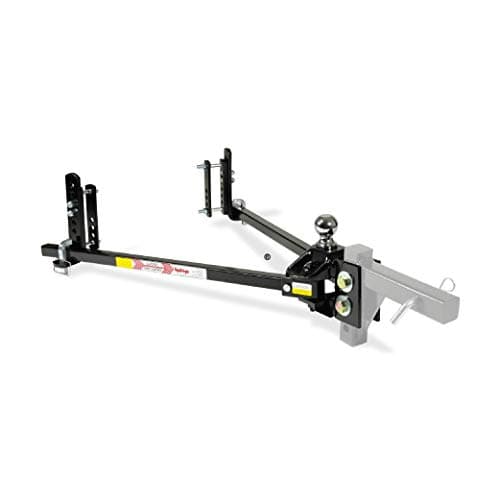 Equal-i-zer 4-Point Sway Control Hitch, 90-00-1001 Four-point sway control built into the head, so there is no friction bar to unclip before you back into a site — the single biggest quality-of-life difference for a first-timer. Top pick | Most half-ton trucks pulling a 5,000-10,000 lb trailer | 7.9/ 10 | |
| 2 | 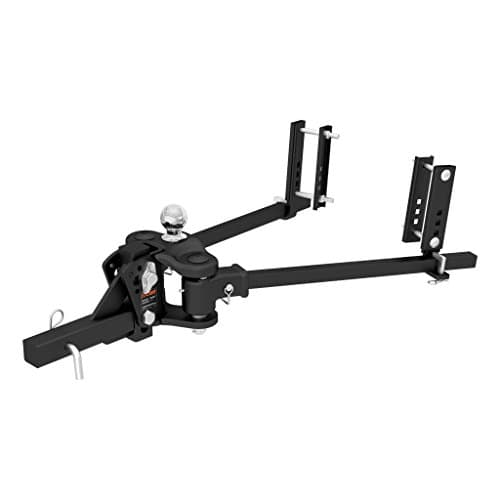 CURT TruTrack 4P Weight Distribution Hitch, 17500 CURT's answer to the four-point Equal-i-zer, with a 10,000 lb rating and an adjustable sway bias — generally a couple of hundred dollars under the hitch it is aimed at. | Four-point sway control at a mid-range price | 7.9/ 10 | |
| 3 | 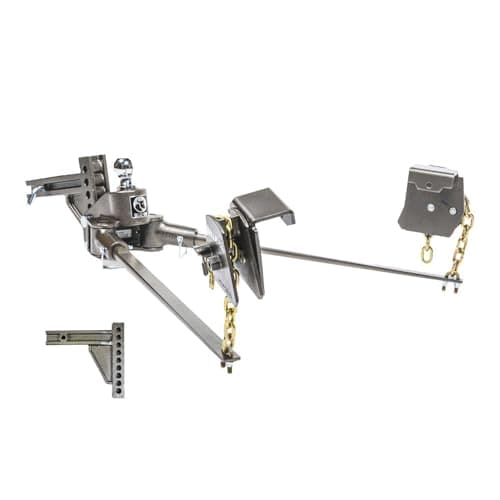 Blue Ox SwayPro BXW1000-S Weight Distributing Hitch Chain-tensioned spring bars that run under the A-frame rather than clamping onto it — quieter than a bracket hitch, and the hookup is a latch rather than a lift. | Owners who want a quiet, under-slung bar setup | 7.5/ 10 |
Tap any row to jump to the full write-up. Prices come from Amazon and are read automatically — see each product below for the date.
The short answer
This confusion is understandable because the visible outcome is the same. A squatting truck looks wrong, and either solution makes it look right. What is happening underneath is completely different.
What airbags actually do
Air springs sit between the frame and the rear axle, in parallel with the leaf springs. Inflate them and the rear suspension gets stiffer and the ride height comes back up. The truck is level again.
But consider where the load went. Nowhere. The 800 lb on the hitch is still 800 lb behind the rear axle, still levering the front of the truck up. Airbags resist thesuspension compressing; they do not change the force balance between the axles. If anything, a stiff air spring transmits more of the tongue load straight into the rear axle.
What airbags genuinely give you: a level stance, a less wallowy ride, headlights that point at the road, and the ability to level a truck carrying an off-center load. Those are real benefits. They are not weight distribution.
The common mistake
What weight distribution does differently
Spring bars make the hitch head and the trailer A-frame into one rigid-ish beam. That beam pivots about the rear axle, which rotates load forward onto the front axle and backward onto the trailer axles. A typical setup transfers a meaningful share of tongue weight off the rear axle in both directions.
The front tires get their load back, which is what restores steering feel and braking balance. And in the integral-sway designs, the same bars and brackets provide the friction that damps sway.
| Airbags | Weight distribution hitch | |
|---|---|---|
| Stops the truck squatting | Yes | Yes |
| Restores front axle load | No | Yes |
| Loads the trailer axles | No | Yes |
| Resists sway | No | With integral sway control |
| Increases payload rating | No | No |
| Satisfies a manual's WD requirement | No | Yes |
| Helps with an off-center bed load | Yes | No |
Why plenty of owners run both
They are not alternatives. A weight distribution hitch handles the trailer; airbags handle the truck. If you also carry weight in the bed — a generator, firewood, a bike rack, a topper full of gear — airbags level that load in a way a hitch cannot touch, because the hitch only acts on the tongue.
Owners with heavy-tongued trailers and loaded beds commonly fit both and report the combination as the best of the two. The order of purchase is clear though: the hitch first, because it is what the manual requires and what addresses the geometry.
The payload point, because it keeps coming up
Neither solution adds payload. Payload is a certification limit derived from axle, spring, tire and brake ratings on your specific truck. Airbags do not change the axle rating. A weight distribution hitch does not delete weight; it relocates some of it.
A truck that is over its door-jamb sticker is over it with airbags fitted and over it with a weight distribution hitch fitted. The arithmetic is here, and it is the number most half-ton owners run out of first.
The verdict
Buy the weight distribution hitch. It is what the manual asks for, it fixes the geometry rather than the appearance, and the integral-sway versions solve a second problem at the same time. Add airbags afterward if you also carry weight in the bed or want a firmer, more level ride — not instead.
What to remember
- Airbags stop the suspension compressing; they do not move load between axles.
- Only weight distribution restores front axle load and keeps steering effective.
- Only weight distribution, with integral sway control, does anything about sway.
- Neither one adds a pound of payload capacity.
- They are complementary, and the hitch comes first.
The picks in full
Equal-i-zer 4-Point Sway Control Hitch, 90-00-1001
Equal-i-zer · Best for most half-ton trucks pulling a 5,000-10,000 lb trailer
Four-point sway control built into the head, so there is no friction bar to unclip before you back into a site — the single biggest quality-of-life difference for a first-timer.
Key specifications
- Trailer weight rating
- 10,000 lb
- Tongue weight rating
- 1,000 lb
- Sway control
- 4-point, integral to the head
- Included
- Weight distribution kit; shank and ball sold separately
Capacity figures read from Equal-i-zer product specifications, October 2026.
How it scored
- Sway control (25%)9
- Tongue-weight range (20%)8
- Backing up (20%)9
- Setup effort (15%)7
- Quietness (10%)5
- Price for capability (10%)7
Weighted average of the figures above. We did not test this product — see how we pick.
What it does well
- Sway control is always on — nothing to remember, nothing to remove
- Back up and turn sharply without unhooking anything
- Bracket height is adjustable in the field with a wrench, not a shop visit
What it is bad at
- It creaks and groans in tight turns; owners report this consistently and it is normal, not a fault
- Needs a shank and ball bought separately, which catches people out on price
- Heavier to lift onto the coupler than a friction-bar setup
Price as of October 5, 2026. #ad How this is funded
CURT TruTrack 4P Weight Distribution Hitch, 17500
CURT · Best for four-point sway control at a mid-range price
CURT's answer to the four-point Equal-i-zer, with a 10,000 lb rating and an adjustable sway bias — generally a couple of hundred dollars under the hitch it is aimed at.
Key specifications
- Gross trailer weight
- 10,000 lb
- Sway control
- 4-point, integral
- Adjustment
- Sway-control bias adjustable
- Included
- Weight distribution kit with sway control
Capacity figures read from CURT TruTrack specifications, October 2026.
How it scored
- Sway control (25%)9
- Tongue-weight range (20%)8
- Backing up (20%)9
- Setup effort (15%)6
- Quietness (10%)5
- Price for capability (10%)8
Weighted average of the figures above. We did not test this product — see how we pick.
What it does well
- Four points of sway control for less than the obvious four-point alternative
- Bias adjustment lets you dial sway resistance to the trailer
- No bar to unclip before backing
What it is bad at
- More parts to understand on first setup than a two-point kit
- Less owner experience published than the market leaders, so fewer reports to read
- Friction surfaces mean friction noise
Price as of October 5, 2026. #ad How this is funded
Blue Ox SwayPro BXW1000-S Weight Distributing Hitch
Blue Ox · Best for owners who want a quiet, under-slung bar setup
Chain-tensioned spring bars that run under the A-frame rather than clamping onto it — quieter than a bracket hitch, and the hookup is a latch rather than a lift.
Key specifications
- Tongue weight
- 1,000 lb
- Towing capacity
- 10,000 lb
- Shank
- 9-hole, 2 in receiver
- Sway control
- Spring-bar tension, always engaged
Capacity figures read from Blue Ox SwayPro specifications, October 2026.
How it scored
- Sway control (25%)8
- Tongue-weight range (20%)8
- Backing up (20%)8
- Setup effort (15%)6
- Quietness (10%)9
- Price for capability (10%)5
Weighted average of the figures above. We did not test this product — see how we pick.
What it does well
- Notably quieter than bracket-style friction hitches
- Clamp-on latches make hooking up quick once set
- Bars stay under tension through a turn, so backing is normal
What it is bad at
- Most expensive option in this range
- Initial setup is the fussiest here — chain link count has to be right
- Shank included, ball is not
Price as of October 5, 2026. #ad How this is funded
Common questions
No. Air springs stop the suspension compressing but do not transfer load forward, and they do nothing for sway. They do not satisfy a manual’s weight distribution requirement.
No. Towing capacity and payload are certification limits based on axle, spring, tire and brake ratings. Air springs change none of them.
Many owners do and it works well. The hitch handles the tongue load and axle balance; airbags handle weight in the bed. Fit the hitch first.
Sources
- Equal-i-zer published hitch specifications and bar ratings — read October 2026
- Andersen Hitches weight distribution hitch specifications — read October 2026
- CURT published weight distribution specifications — read October 2026
- Blue Ox SwayPro published specifications — read October 2026
- SAE J2807 — tow-vehicle gross combination weight rating procedure — read October 2026