A campground pedestal is an unknown piece of wiring maintained by somebody you will never meet. Here is how to find out what it is doing before you plug in.
10 pages4 guides
How this page is funded: we earn a commission if you buy through our links, at no extra cost to you. It never changes which product we rank first. Prices come from Amazon and are read automatically — each one shows the date it was read. Full disclosure.
Your trailer is 30 amp or 50 amp. Look at the plug on the end of the shore power cord: three prongs, one of them angled, is 30 amp — a single 120 V circuit, 3,600 watts at the wall. Four prongs is 50 amp, which is not a bigger version of the same thing. A 50 amp RV service is two separate 120 V legs of 50 amps each, roughly 12,000 watts total. The difference matters for every product on this page.
Surge protector or EMS: this is the whole decision
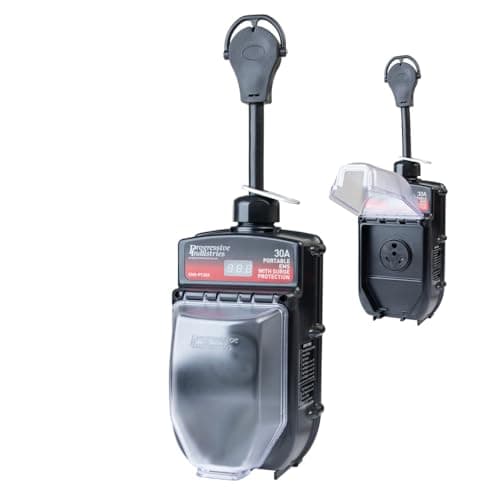
A surge protector absorbs a voltage spike — a lightning strike nearby, a utility switching event. It is a sacrificial component with a joule rating, and good ones also have diagnostic lights that tell you whether the pedestal is wired correctly before you plug the trailer in.
An electrical management system does that and watches the supply continuously, and disconnects power when the voltage goes outside a safe window. That second job is the one that actually saves equipment. The classic campground failure is not a spike: it is a hot afternoon in a full park where every air conditioner is running and the voltage sags to 102 V. Low voltage makes motors draw more current to do the same work, they overheat, and the air conditioner compressor that fails in August fails because of that, not because of lightning. A plain surge protector watches this happen and does nothing.
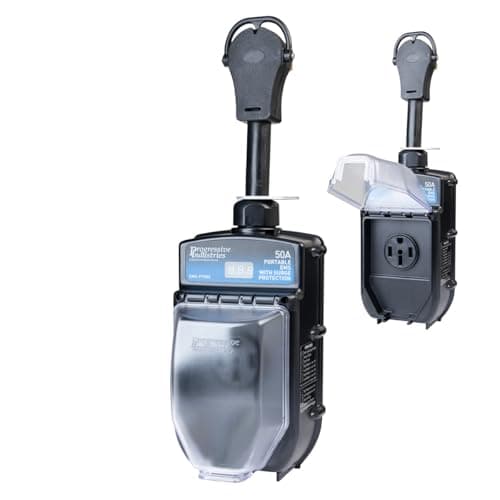
Using a 30 amp protector on a 50 amp trailer through an adapter. A 30 amp unit can only see one 120 V leg; the other leg feeds half your trailer unmonitored. If your trailer is 50 amp, the protector has to be 50 amp.
Portable or hardwired: what decides price
A portable unit hangs off the pedestal, which means it is exposed to weather and to theft — these get stolen often enough that every portable unit should be locked to the pedestal with a cable. A hardwired unit lives inside the trailer, cannot be stolen, is better sealed, and costs you an install. Hardwired units with Bluetooth also give you a readout inside the trailer, which is where you are when the voltage sags.
The second price driver is whether the surge module is replaceable. A surge protector that takes a serious hit has done its job and is spent; on cheaper units that means buying another one, and on better units it means a module.
Adapters, cords and what they cannot do
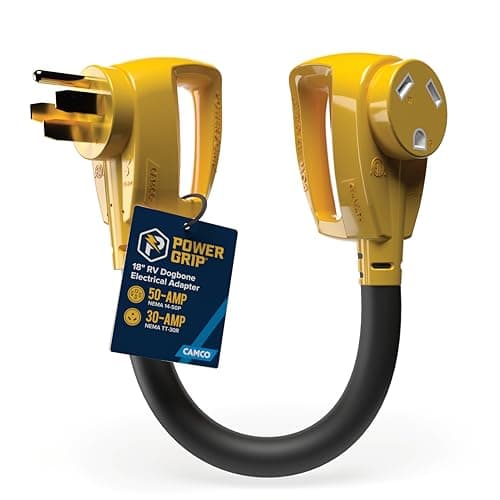
A dogbone adapter lets a 30 amp cord plug into a 50 amp pedestal or a household outlet. It changes the plug shape. It does not change how much power is available: a 30 amp trailer on a 50 amp post is still a 30 amp trailer, and a 30 amp trailer on a household 15 amp outlet gets 15 amps, which will run the fridge and the lights and will trip the breaker the moment you ask for air conditioning. Which adapter is which.
Extension cords are where people improvise dangerously. A household extension cord is typically 14 or 16 gauge, nowhere near enough for a 30 amp load, and under-gauge cord gets hot and drops voltage — the same low-voltage problem as a sagging pedestal, except self-inflicted. If you need length, buy a 10-gauge RV extension cord.
Before you plug anything in, check the pedestal. A good protector will tell you, and the sequence takes thirty seconds. Open ground and reverse polarity are both common and both worth walking away from. If you are new to all of this, start with the basics page.
Yes — and an EMS is the better buy. The common campground fault is sustained low voltage in a busy park, not a lightning spike, and only an EMS disconnects for it. Surge protector vs EMS.
Yes, with a 30-to-15 amp adapter, but you only get 15 amps — fridge, lights and small loads. Air conditioning will trip the breaker, and a household extension cord is too thin to add safely.
No. A 50 amp RV plug resembles some 240 V outlets but is two 120 V legs, not one 240 V circuit. Connecting the two puts 240 V across 120 V equipment. Why, in detail.