Weight Distribution & Sway Control
Which Weight Distribution Hitch Fits Your Trailer Weight
One table, five weight bands, and the hitch that covers each. This is the page the rest of this section is built around.
By Mike M. ·
How this page is funded: we earn a commission if you buy through our links, at no extra cost to you. It never changes which product we rank first. Prices come from Amazon and are read automatically — each one shows the date it was read. Full disclosure.
Quick picks
One hitch per band, so you can go straight from the chart to a product. Full reasoning on each pick is below the table.
| # | Product | Best for | Score | Price |
|---|---|---|---|---|
| 1 | 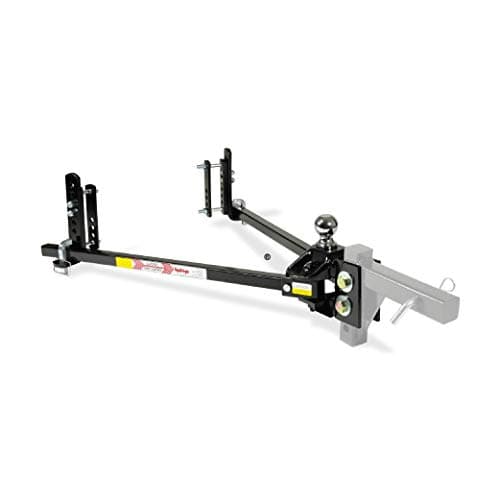 Equal-i-zer 4-Point Sway Control Hitch, 90-00-0601 The small-bar Equal-i-zer. Buying this instead of the 1,000 lb version is the fix for the harsh, over-sprung ride people complain about on light trailers. 600 lb band | Light trailers with a loaded tongue weight near 600 lb | 7.6/ 10 | |
| 2 | 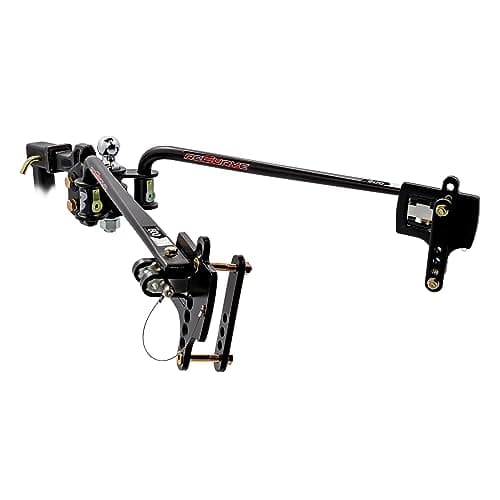 Camco Eaz-Lift ReCurve R3 Weight Distribution Hitch, 48771 An 800 lb-max kit with adjustable sway control and the ball included. Sized for the small trailer most first-time buyers actually own, rather than the one they imagine. 800 lb band | Light trailers under about 800 lb of tongue weight | 6.4/ 10 | |
| 3 | 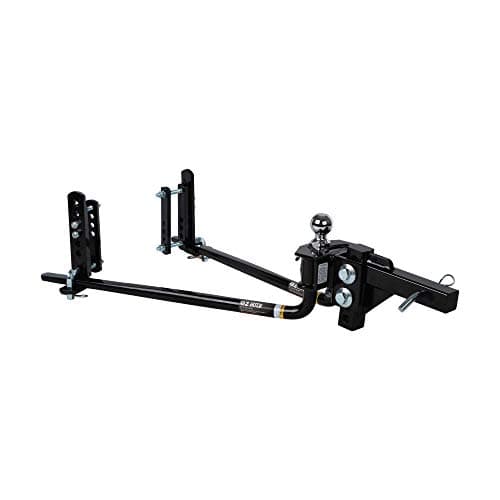 Fastway e2 2-Point Sway Control Round Bar Hitch, 94-00-1033 Equal-i-zer's own value line: two points of built-in sway control instead of four, at a price that leaves money for the shank and ball you still have to buy. | A first hitch on a 5,000-8,000 lb trailer, on a budget | 7.5/ 10 | |
| 4 | Equal-i-zer 4-Point Sway Control Hitch, 90-00-1001 Four-point sway control built into the head, so there is no friction bar to unclip before you back into a site — the single biggest quality-of-life difference for a first-timer. 1,000 lb band | Most half-ton trucks pulling a 5,000-10,000 lb trailer | 7.9/ 10 | |
| 5 | 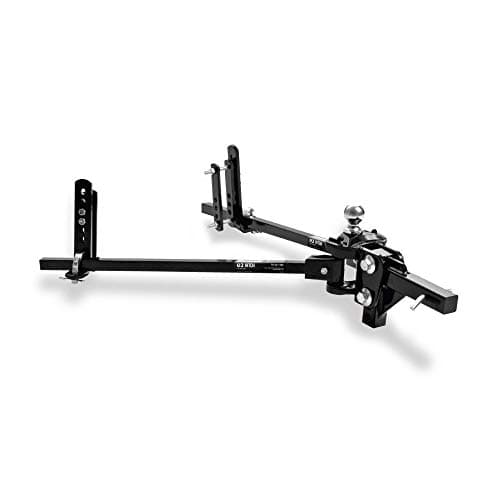 Fastway e2 2-Point Sway Control Trunnion Hitch, 92-00-1200 The trunnion version sits the bars higher than round bars do, which matters on a steep driveway, and this one includes the shank. 1,200 lb band | 8,000-12,000 lb trailers where ground clearance matters | 7.7/ 10 | |
| 6 | 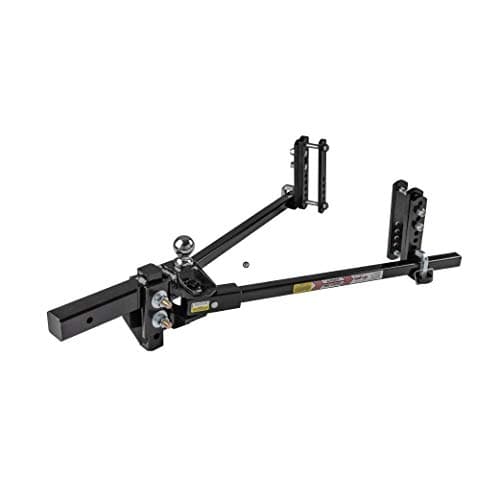 Equal-i-zer 4-Point Sway Control Hitch, 90-00-1600 The heavy end of the Equal-i-zer line, and the one version that ships with a standard shank included rather than as an extra line on the invoice. 1,600 lb band | Heavy trailers over 10,000 lb behind a three-quarter-ton or bigger | 8.0/ 10 |
Tap any row to jump to the full write-up. Prices come from Amazon and are read automatically — see each product below for the date.
The short answer
Almost every guide to buying a weight distribution hitch starts with brands. That is backwards. The hitch you need is determined by a number, and once you have the number the brand choice is a question of preference and price rather than fit.
This page is the chart, the arithmetic behind it, and the four ways people get it wrong.
Bar rating: the tongue weight a hitch’s spring bars are sprung for. It is a spring rate, not a safety ceiling — bars far stiffer than your tongue weight distribute load worse, not more safely.
The chart
| Loaded trailer weight | Tongue weight at 12% | Bar band | Typical trailer |
|---|---|---|---|
| 3,000 - 4,500 lb | 360 - 540 lb | 600 lb | Single axle, 18-22 ft |
| 4,500 - 6,000 lb | 540 - 720 lb | 600 or 800 lb | Small tandem, 22-26 ft |
| 6,000 - 8,000 lb | 720 - 960 lb | 1,000 lb | Tandem axle, 26-32 ft |
| 8,000 - 10,000 lb | 960 - 1,200 lb | 1,000 or 1,200 lb | Large tandem, 30-35 ft |
| 10,000 - 13,000 lb | 1,200 - 1,560 lb | 1,400 - 1,600 lb | Heavy bumper-pull, 3/4-ton tow |
Where your figure lands near a band boundary, choose the band that contains it rather than the one above. Two bands overlap deliberately in the table because real trailers land in the overlap and the right answer depends on how you load.
The second axis: your tow vehicle
The chart above tells you what the trailer needs. Your tow vehicle decides whether you can legally pull it at all, and the limit is almost never the towing capacity.
| Tow vehicle class | Typical payload | Realistic tongue weight budget |
|---|---|---|
| Mid-size SUV | 900 - 1,300 lb | 350 - 550 lb |
| Half-ton, standard payload | 1,300 - 1,700 lb | 550 - 800 lb |
| Half-ton, max tow / heavy payload | 1,900 - 2,400 lb | 900 - 1,400 lb |
| Three-quarter ton | 2,800 - 3,800 lb | 1,500 - 2,400 lb |
The tongue weight budget column is the payload minus a realistic allowance for passengers, the hitch itself and cargo. Work it out properly in payload vs towing capacity and how much can my truck tow.
If the trailer the chart points you at needs more tongue weight budget than your truck has, the hitch is not the problem and no hitch solves it. That is the moment to look at a lighter trailer, and it is far cheaper to discover now.
Band by band, with the hitch for each
600 lb band — under about 4,500 lb trailer
Small single-axle trailers, teardrops and light hybrids. The common error here is buying a 1,000 lb kit because it was on sale. The 5,000 lb trailer page covers this band in detail, and the short version is that a correctly sprung small kit rides better and distributes better than a big one.
800 lb band — roughly 4,500 to 6,500 lb
A 22–26 ft tandem axle loaded for a family. This is where the overlap matters most: load the front pass-through heavy and you are at 800 lb, load it over the axles and you are at 600.
1,000 lb band — roughly 6,000 to 8,500 lb
The volume band, and the band most hitches are sold in. A 26–32 ft trailer behind a half-ton. Integral four-point sway control is the right default here — the trailer has enough side area for crosswind to matter. The 7,000 lb page is the detailed version.
1,200 lb band — roughly 8,500 to 10,500 lb
Long trailers, often at the top of a half-ton’s payload or the bottom of a three-quarter-ton’s. Trunnion bars are worth having at this weight for the extra ground clearance at the same rating.
1,400–1,600 lb band — above 10,500 lb
Heavy bumper-pull trailers behind a three-quarter-ton or larger. At this point the hitch shipping with a shank included is a real saving, and the sway control is not optional.
The four ways people get this wrong
1. Using the dry weight. The brochure’s dry weight and dry hitch weight describe a trailer with empty tanks and nothing in it. Nobody tows that trailer. Water alone is 8.34 lb per gallon, so a 40-gallon fresh tank is 334 lb, and where that tank sits relative to the axles decides how much of it lands on your tongue.
2. Buying by trailer length. Two 28 ft trailers can differ by 300 lb of tongue weight depending on axle placement and where the storage is. Length is a proxy, and a poor one.
3. Treating bar rating as a margin. Covered above and worth repeating because it is the most common error: more bar is a harsher ride and less effective distribution, not a bigger safety factor.
4. Forgetting the hitch weighs something. Head, bars, brackets and shank commonly total 70–100 lb, all of it in the receiver and all of it against your payload.
The common mistake
What the standards actually say
Two documents sit behind all of this. SAE J684 is the standard trailer couplings, hitches and safety chains are tested to, and it is why a rating stamped on a hitch means something. SAE J2807 is the procedure modern tow ratings are established under, which is what makes a 2026 tow rating comparable between manufacturers.
And 49 CFR 393.70 sets out the federal requirements for coupling devices in commercial towing. None of it is written for consumers, and all of it is a useful reality check when somebody online tells you a published rating is conservative.
Where to go from here
Read your figure off the chart, pick the hitch in that band from the table at the top of this page, and then read the two pages that stop people getting it wrong: how to measure tongue weight and how to set the hitch up once it arrives.
What to remember
- Bar rating is matched to loaded tongue weight, never to trailer length.
- Estimate at 12% of loaded trailer weight to shop; measure before you tow.
- Your tow vehicle's payload sticker, not its towing capacity, is usually the binding limit.
- A bar set far stiffer than your tongue weight rides harsh and distributes worse.
- The hitch itself weighs 70-100 lb and counts against payload.
The picks in full
Equal-i-zer 4-Point Sway Control Hitch, 90-00-0601
Equal-i-zer · Best for light trailers with a loaded tongue weight near 600 lb
The small-bar Equal-i-zer. Buying this instead of the 1,000 lb version is the fix for the harsh, over-sprung ride people complain about on light trailers.
Key specifications
- Trailer weight rating
- 6,000 lb
- Tongue weight rating
- 600 lb
- Sway control
- 4-point, integral to the head
- Included
- Weight distribution kit; shank and ball sold separately
Capacity figures read from Equal-i-zer product specifications, October 2026.
How it scored
- Sway control (25%)9
- Tongue-weight range (20%)6
- Backing up (20%)9
- Setup effort (15%)8
- Quietness (10%)5
- Price for capability (10%)6
Weighted average of the figures above. We did not test this product — see how we pick.
What it does well
- Correctly sprung for a 400-600 lb tongue, where the 1,000 lb bars ride stiff
- Same four-point sway geometry as the bigger versions
- Light enough that one person can hook up without a fight
What it is bad at
- No headroom if you upgrade trailers later — the bars are the limit, not a suggestion
- Costs close to the 1,000 lb kit, so the saving is in ride quality, not money
- Shank and ball still sold separately
Price as of October 5, 2026. #ad How this is funded
Camco Eaz-Lift ReCurve R3 Weight Distribution Hitch, 48771
Camco Eaz-Lift · Best for light trailers under about 800 lb of tongue weight
An 800 lb-max kit with adjustable sway control and the ball included. Sized for the small trailer most first-time buyers actually own, rather than the one they imagine.
Key specifications
- Max tongue weight
- 800 lb
- Ball
- 2 in ball included, 8,000 lb max rating
- Sway control
- Adjustable
- Rating
- 600 lb nominal / 800 lb maximum tongue weight
Capacity figures read from Camco Eaz-Lift specifications, October 2026.
How it scored
- Sway control (25%)7
- Tongue-weight range (20%)5
- Backing up (20%)7
- Setup effort (15%)7
- Quietness (10%)7
- Price for capability (10%)5
Weighted average of the figures above. We did not test this product — see how we pick.
What it does well
- Correctly sprung for a genuinely light trailer
- Ball included and rated to match
- Sway resistance is adjustable rather than fixed
What it is bad at
- No headroom whatsoever above 800 lb of tongue weight
- Priced like a heavier kit
- Sway adjustment is by feel, with no scale to repeat a setting
Price as of October 5, 2026. #ad How this is funded
Fastway e2 2-Point Sway Control Round Bar Hitch, 94-00-1033
Fastway · Best for a first hitch on a 5,000-8,000 lb trailer, on a budget
Equal-i-zer's own value line: two points of built-in sway control instead of four, at a price that leaves money for the shank and ball you still have to buy.
Key specifications
- Trailer weight rating
- 10,000 lb
- Tongue weight rating
- 1,000 lb
- Sway control
- 2-point, integral
- Included
- Weight distribution kit; shank and ball sold separately
Capacity figures read from Fastway e2 product specifications (Equal-i-zer / Progress Mfg), October 2026.
How it scored
- Sway control (25%)7
- Tongue-weight range (20%)8
- Backing up (20%)9
- Setup effort (15%)7
- Quietness (10%)5
- Price for capability (10%)8
Weighted average of the figures above. We did not test this product — see how we pick.
What it does well
- Integral sway control, so nothing to unclip before backing
- Cheaper than the four-point Equal-i-zer with most of the behavior
- Round bars are more forgiving of an imperfect bracket height
What it is bad at
- Two friction points rather than four, so it works less hard in a crosswind
- Still creaks, same as its four-point sibling
- Shank and ball sold separately
Price as of October 5, 2026. #ad How this is funded
Equal-i-zer 4-Point Sway Control Hitch, 90-00-1001
Equal-i-zer · Best for most half-ton trucks pulling a 5,000-10,000 lb trailer
Four-point sway control built into the head, so there is no friction bar to unclip before you back into a site — the single biggest quality-of-life difference for a first-timer.
Key specifications
- Trailer weight rating
- 10,000 lb
- Tongue weight rating
- 1,000 lb
- Sway control
- 4-point, integral to the head
- Included
- Weight distribution kit; shank and ball sold separately
Capacity figures read from Equal-i-zer product specifications, October 2026.
How it scored
- Sway control (25%)9
- Tongue-weight range (20%)8
- Backing up (20%)9
- Setup effort (15%)7
- Quietness (10%)5
- Price for capability (10%)7
Weighted average of the figures above. We did not test this product — see how we pick.
What it does well
- Sway control is always on — nothing to remember, nothing to remove
- Back up and turn sharply without unhooking anything
- Bracket height is adjustable in the field with a wrench, not a shop visit
What it is bad at
- It creaks and groans in tight turns; owners report this consistently and it is normal, not a fault
- Needs a shank and ball bought separately, which catches people out on price
- Heavier to lift onto the coupler than a friction-bar setup
Price as of October 5, 2026. #ad How this is funded
Fastway e2 2-Point Sway Control Trunnion Hitch, 92-00-1200
Fastway · Best for 8,000-12,000 lb trailers where ground clearance matters
The trunnion version sits the bars higher than round bars do, which matters on a steep driveway, and this one includes the shank.
Key specifications
- Trailer weight rating
- 12,000 lb
- Tongue weight rating
- 1,200 lb
- Sway control
- 2-point, integral
- Included
- Standard hitch shank included; ball sold separately
Capacity figures read from Fastway e2 product specifications (Equal-i-zer / Progress Mfg), October 2026.
How it scored
- Sway control (25%)7
- Tongue-weight range (20%)9
- Backing up (20%)9
- Setup effort (15%)7
- Quietness (10%)5
- Price for capability (10%)8
Weighted average of the figures above. We did not test this product — see how we pick.
What it does well
- Trunnion bars give more clearance than round bars at the same rating
- Shank included
- Good match for a loaded 30-33 ft trailer behind a half-ton
What it is bad at
- Trunnion heads are slightly fussier to index correctly on first setup
- Two-point sway control only
- Noisy in tight turns
Price as of October 5, 2026. #ad How this is funded
Equal-i-zer 4-Point Sway Control Hitch, 90-00-1600
Equal-i-zer · Best for heavy trailers over 10,000 lb behind a three-quarter-ton or bigger
The heavy end of the Equal-i-zer line, and the one version that ships with a standard shank included rather than as an extra line on the invoice.
Key specifications
- Trailer weight rating
- 16,000 lb
- Tongue weight rating
- 1,600 lb
- Sway control
- 4-point, integral to the head
- Included
- Standard hitch shank included; ball sold separately
Capacity figures read from Equal-i-zer product specifications, October 2026.
How it scored
- Sway control (25%)9
- Tongue-weight range (20%)9
- Backing up (20%)9
- Setup effort (15%)7
- Quietness (10%)5
- Price for capability (10%)6
Weighted average of the figures above. We did not test this product — see how we pick.
What it does well
- Shank included, which closes most of the price gap with the 10,000 lb kit
- Enough bar for a loaded fifth-wheel-weight bumper-pull trailer
- Same no-unclip backing behavior as the rest of the line
What it is bad at
- Badly over-sprung for anything under about 1,000 lb of tongue weight
- Heavy — awkward to store and to lift onto the coupler alone
- Price is the highest in the Equal-i-zer range
Price as of October 5, 2026. #ad How this is funded
Common questions
At 12% a 6,000 lb loaded trailer puts about 720 lb on the ball — the 800 lb band. Load the front storage heavily and it can reach 900 lb, which moves you into the 1,000 lb band. Measure before deciding.
Use a public truck scale: weigh with the tongue on the scale, then off it, and take the difference. For shopping only, estimate at 12% of loaded trailer weight. Both methods, step by step.
Only if both tongue weights fall inside the same bar band and the A-frames are similar. Heads and shanks are reusable; bars are matched to a band. Two trailers 300 lb apart usually need different bars.
It needs to bracket your measured figure, not match it. Bands overlap. What matters is not sitting far above or below the band — far above rides harsh, far below overloads the bars.
Sources
- Equal-i-zer published hitch specifications and bar ratings — read October 2026
- SAE J684 — trailer couplings, hitches and safety chains — read October 2026
- SAE J2807 — tow-vehicle gross combination weight rating procedure — read October 2026
- 49 CFR 393.70 — coupling devices and towing methods — read October 2026