Weight Distribution & Sway Control
Weight Distribution vs Sway Control
Two jobs, often in one box, frequently confused. If your truck squats you need one of them. If your trailer wanders you need the other.
By Mike M. ·
How this page is funded: we earn a commission if you buy through our links, at no extra cost to you. It never changes which product we rank first. Prices come from Amazon and are read automatically — each one shows the date it was read. Full disclosure.
Quick picks
A hitch that does both, a hitch that does weight distribution only, and the friction kit that adds sway control to it.
| # | Product | Best for | Score | Price |
|---|---|---|---|---|
| 1 | 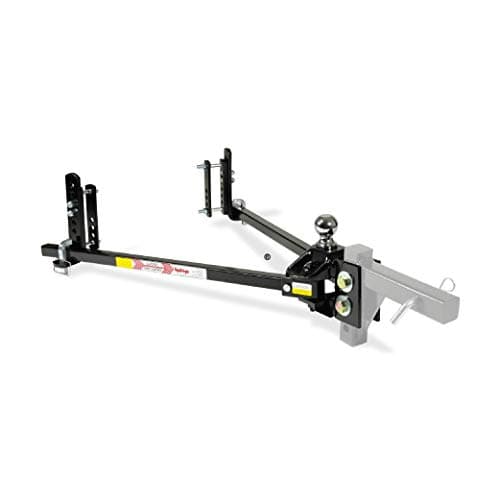 Equal-i-zer 4-Point Sway Control Hitch, 90-00-1001 Four-point sway control built into the head, so there is no friction bar to unclip before you back into a site — the single biggest quality-of-life difference for a first-timer. Does both | Most half-ton trucks pulling a 5,000-10,000 lb trailer | 7.9/ 10 | |
| 2 | 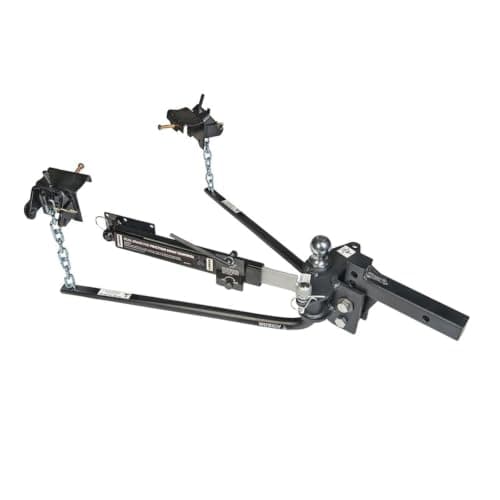 Husky Round Bar Weight Distribution Hitch, 30849 The only kit here that arrives with a 10 in shank and a 2-5/16 in ball in the box, which is why its real-world cost undercuts hitches with a lower sticker price. Weight distribution only | The cheapest complete kit that still includes shank and ball | 6.1/ 10 | |
| 3 | 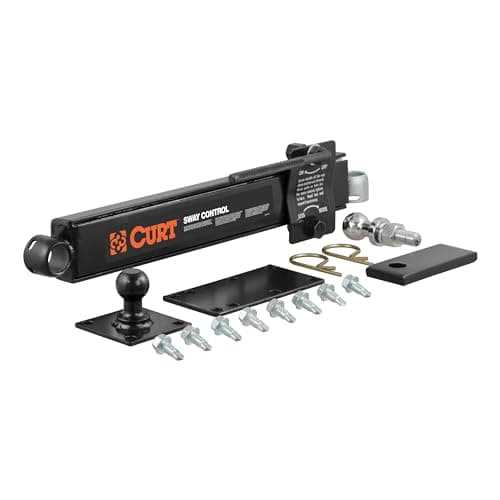 CURT Trailer Sway Control Kit, 17200 A friction bar and the brackets to mount it. The honest use for this is retrofitting a plain weight distribution hitch, not replacing a hitch that has sway control built in. Sway control only | Adding sway control to a hitch that has none | 5.4/ 10 | |
| 4 | 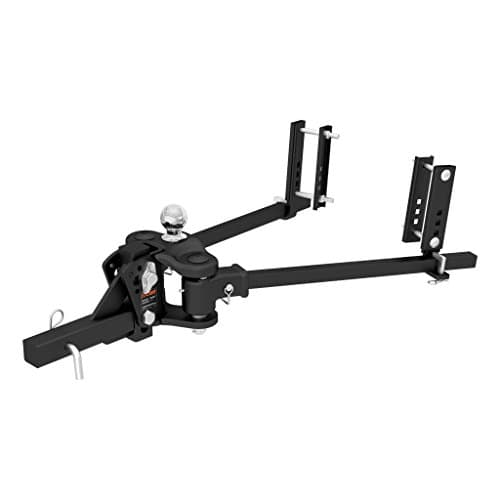 CURT TruTrack 4P Weight Distribution Hitch, 17500 CURT's answer to the four-point Equal-i-zer, with a 10,000 lb rating and an adjustable sway bias — generally a couple of hundred dollars under the hitch it is aimed at. | Four-point sway control at a mid-range price | 7.9/ 10 |
Tap any row to jump to the full write-up. Prices come from Amazon and are read automatically — see each product below for the date.
The short answer
These two phrases appear together on so many product listings that most people assume they are two names for the same thing. They are not, and knowing which is which tells you what to buy when something feels wrong.
What weight distribution does
Put 800 lb on the back of a pickup, three or four feet behind the rear axle, and two things happen. The rear suspension compresses. And because the rear axle is now a fulcrum, the front of the truck rises — which takes load off the front tires.
Lighter front tires means less grip for steering and less braking contribution from the front brakes, which do most of the work. Headlights point at the trees. The truck feels vague, and it is not imagination: the geometry genuinely changed.
A weight distribution hitch uses spring bars as levers between the hitch head and the trailer frame. Tensioning them pushes down on the trailer’s A-frame and up on the back of the hitch, which rotates load forward onto the truck’s front axle and backward onto the trailer axles. The truck returns to something near its unloaded stance and the front tires get their job back.
The symptom it fixes: the truck squatting, the nose rising, headlights aiming high, vague steering. The mechanism in detail.
What sway control does
A trailer is attached to a ball, and a ball is a pivot. That pivot is necessary — the trailer has to articulate to go round a corner — and it is also the thing that lets the trailer oscillate left and right while the truck goes straight.
Sway control adds friction to that pivot so the oscillation is damped. A disturbance that would have built into a sway cycle decays instead. More friction interfaces mean faster damping, which is the whole argument between two-point and four-point designs.
The symptom it fixes: the trailer wandering, feeling pushed by passing trucks, correcting repeatedly in a crosswind. Diagnosing sway properly comes first, because about half of it is loading rather than hardware.
The four combinations you can buy
| Setup | Truck sits level | Resists sway | Back up freely |
|---|---|---|---|
| Plain ball mount | No | No | Yes |
| Weight distribution, no sway control | Yes | No | Yes |
| Weight distribution + bolt-on friction bar | Yes | One point | No — must unclip |
| Integral sway control hitch | Yes | Two or four points | Yes |
The common mistake
Which do you need?
Weight distribution: when your manual says so, or when the truck squats noticeably. The usual triggers are tongue weight above a limit stated in the towing section, or a trailer heavier than roughly half the tow vehicle’s weight.
Sway control: on any travel trailer long enough to have meaningful side area, which in practice means essentially all of them. Buying a hitch with it integral costs little more than buying one without and adding a friction bar.
And the thing neither of them does: neither one adds payload. The tongue weight still counts in full against the sticker in your door frame. That is a separate limit, and on a half-ton it is usually the binding one.
The verdict
If you are buying once, buy a hitch with integral sway control and the right bar band. You get both jobs covered, nothing to unclip, and no second purchase. If you already own a plain weight distribution kit, a friction bar is the cheap retrofit with a real discipline cost attached.
The picks in full
Equal-i-zer 4-Point Sway Control Hitch, 90-00-1001
Equal-i-zer · Best for most half-ton trucks pulling a 5,000-10,000 lb trailer
Four-point sway control built into the head, so there is no friction bar to unclip before you back into a site — the single biggest quality-of-life difference for a first-timer.
Key specifications
- Trailer weight rating
- 10,000 lb
- Tongue weight rating
- 1,000 lb
- Sway control
- 4-point, integral to the head
- Included
- Weight distribution kit; shank and ball sold separately
Capacity figures read from Equal-i-zer product specifications, October 2026.
How it scored
- Sway control (25%)9
- Tongue-weight range (20%)8
- Backing up (20%)9
- Setup effort (15%)7
- Quietness (10%)5
- Price for capability (10%)7
Weighted average of the figures above. We did not test this product — see how we pick.
What it does well
- Sway control is always on — nothing to remember, nothing to remove
- Back up and turn sharply without unhooking anything
- Bracket height is adjustable in the field with a wrench, not a shop visit
What it is bad at
- It creaks and groans in tight turns; owners report this consistently and it is normal, not a fault
- Needs a shank and ball bought separately, which catches people out on price
- Heavier to lift onto the coupler than a friction-bar setup
Price as of October 5, 2026. #ad How this is funded
Husky Round Bar Weight Distribution Hitch, 30849
Husky · Best for the cheapest complete kit that still includes shank and ball
The only kit here that arrives with a 10 in shank and a 2-5/16 in ball in the box, which is why its real-world cost undercuts hitches with a lower sticker price.
Key specifications
- Gross trailer weight
- 12,000 lb
- Tongue weight range
- 800-1,200 lb
- Included
- 10 in shank and 2-5/16 in ball
- Sway control
- None integral — add a friction bar
How it scored
- Sway control (25%)4
- Tongue-weight range (20%)8
- Backing up (20%)4
- Setup effort (15%)7
- Quietness (10%)7
- Price for capability (10%)9
Weighted average of the figures above. We did not test this product — see how we pick.
What it does well
- Complete out of the box: shank and ball included
- Tongue-weight window is broad enough to survive a trailer upgrade
- Steel construction, simple to service
What it is bad at
- No built-in sway control, so you add a friction bar and remember to unclip it before backing
- 800 lb bottom of the range is too stiff for a light trailer
- Heavier than the aluminum alternatives
Price as of October 5, 2026. #ad How this is funded
CURT Trailer Sway Control Kit, 17200
CURT · Best for adding sway control to a hitch that has none
A friction bar and the brackets to mount it. The honest use for this is retrofitting a plain weight distribution hitch, not replacing a hitch that has sway control built in.
Key specifications
- Type
- Friction sway control bar
- Use
- Add-on for weight distribution hitches
- Mounting
- A-frame bracket plus ball on the shank
- Operation
- Manual — must be disconnected to back sharply
Capacity figures read from CURT 17200 specifications, October 2026.
How it scored
- Sway control (25%)4
- Tongue-weight range (20%)6
- Backing up (20%)3
- Setup effort (15%)7
- Quietness (10%)6
- Price for capability (10%)9
Weighted average of the figures above. We did not test this product — see how we pick.
What it does well
- Cheapest route to some sway resistance on a hitch that has none
- Simple, serviceable, nothing to go wrong electronically
- Works with most conventional round-bar kits
What it is bad at
- Must be unclipped before tight turns and backing, every single time
- One friction point is much weaker than an integrated four-point head
- Needs a second ball and a spare hole in the shank
Price as of October 5, 2026. #ad How this is funded
CURT TruTrack 4P Weight Distribution Hitch, 17500
CURT · Best for four-point sway control at a mid-range price
CURT's answer to the four-point Equal-i-zer, with a 10,000 lb rating and an adjustable sway bias — generally a couple of hundred dollars under the hitch it is aimed at.
Key specifications
- Gross trailer weight
- 10,000 lb
- Sway control
- 4-point, integral
- Adjustment
- Sway-control bias adjustable
- Included
- Weight distribution kit with sway control
Capacity figures read from CURT TruTrack specifications, October 2026.
How it scored
- Sway control (25%)9
- Tongue-weight range (20%)8
- Backing up (20%)9
- Setup effort (15%)6
- Quietness (10%)5
- Price for capability (10%)8
Weighted average of the figures above. We did not test this product — see how we pick.
What it does well
- Four points of sway control for less than the obvious four-point alternative
- Bias adjustment lets you dial sway resistance to the trailer
- No bar to unclip before backing
What it is bad at
- More parts to understand on first setup than a two-point kit
- Less owner experience published than the market leaders, so fewer reports to read
- Friction surfaces mean friction noise
Price as of October 5, 2026. #ad How this is funded
Common questions
Yes — a friction bar can be fitted on some conventional setups. It resists pivoting but does nothing about squat or lost front-axle load.
Most owners should have both. Weight distribution does not resist pivoting, and on any trailer with real side area, sway control is what stops a disturbance building.
Indirectly. Restoring front-axle load keeps the steering effective, which is what lets you correct a developing sway. It does not damp the oscillation itself.
Sources
- Equal-i-zer published hitch specifications and bar ratings — read October 2026
- Andersen Hitches weight distribution hitch specifications — read October 2026
- CURT published weight distribution specifications — read October 2026
- Blue Ox SwayPro published specifications — read October 2026