Water & Waste
The Best RV Water Pressure Regulator
The cheapest insurance policy on your trailer. A burst fitting inside a wall costs a thousand times what this does.
By Mike M. ·
How this page is funded: we earn a commission if you buy through our links, at no extra cost to you. It never changes which product we rank first. Prices come from Amazon and are read automatically — each one shows the date it was read. Full disclosure.
Quick picks
Scored on material safety (35%), flow (20%), kink/durability (20%), build (15%) and price (10%).
| # | Product | Best for | Score | Price |
|---|---|---|---|---|
| 1 | 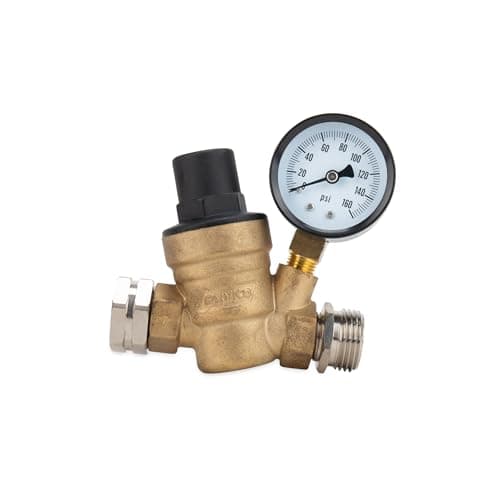 Camco Adjustable RV Water Pressure Regulator, Lead-Free Brass Adjustable lead-free brass with a gauge. Being able to dial pressure down to about 50 psi matters because a campground pedestal can deliver far more than your plumbing is rated for. Top pick | Setting your own pressure instead of accepting a preset | 8.2/ 10 | |
| 2 | 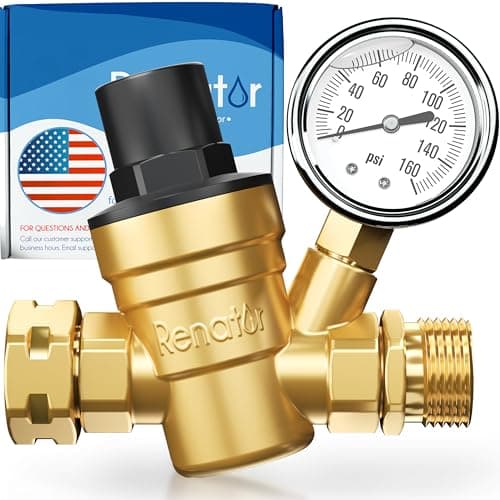 Renator RV Water Pressure Regulator with Gauge, M11-0660R Adjustable, lead-free brass, gauge and inlet screen, at well under half the price of the obvious alternative. It is the value pick in a category where the expensive option is not much better. Best value | An adjustable regulator with a gauge, for the least money | 8.2/ 10 | |
| 3 | 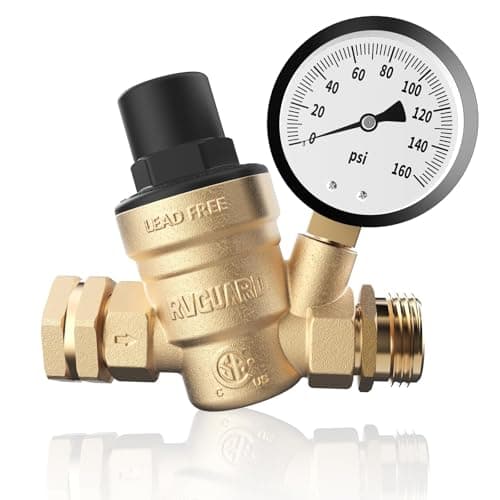 RVGUARD RV Water Pressure Regulator Valve, CSA Approved A CSA-approved lead-free brass regulator with no gauge and nothing to set. If you only want the pressure limited and never want to think about it, this is the whole product. Simplest | A simple preset regulator for occasional trips | 7.9/ 10 | |
| 4 | 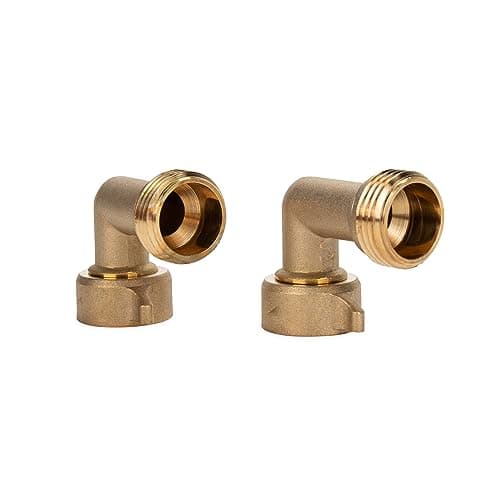 Camco 90-Degree Hose Elbow, Brass, 2-Pack, 22507 A brass 90-degree elbow at the city-water inlet. The hose stops bending sharply against the trailer wall, which is where almost every potable hose eventually splits. | Stopping the hose kinking at the trailer inlet | 8.8/ 10 |
Tap any row to jump to the full write-up. Prices come from Amazon and are read automatically — see each product below for the date.
The short answer
Campground water pressure is not regulated to anything in particular. A pedestal can deliver well over 100 psi, and RV plumbing — plastic fittings, push-fit connections, flexible lines run inside walls — is generally designed around something closer to 40–60 psi.
A burst fitting inside a wall is a slow leak you find late, and water damage is the thing that writes trailers off. The regulator that prevents it costs less than a tank of gas.
Adjustable or preset
Preset regulators limit to a fixed pressure, typically somewhere in the 40–50 psi range, with nothing to set. They are compact, cheap and you can leave one on the hose permanently. The downside is that they often throttle flow more than necessary, so your shower is weaker than it needs to be, and you never learn what the pedestal was doing.
Adjustable regulators have a screw and usually a gauge. You can dial pressure up for better flow when the supply is good, and down when it is high. The gauge is the real feature: it tells you the pedestal pressure, which is how you know whether your weak shower is the regulator or the campground.
| If you… | Buy |
|---|---|
| Camp a few weekends a year and want it simple | Preset brass |
| Want the best shower the site allows | Adjustable with gauge |
| Stay at seasonal sites for long periods | Adjustable with gauge |
| Want to diagnose a weak-flow problem | Adjustable with gauge |
Brass, and lead-free
Two things to insist on. Brass rather than plastic: the regulator sits on the ground at a pedestal, gets stepped on, driven over and kicked, and a plastic body cracks. Lead-free brass: ordinary brass alloys contain lead, which is not what you want in a potable water path. Every regulator worth buying states lead-free explicitly.
An inlet screen is a useful extra. It catches grit before it reaches your plumbing, and on an older campground supply that is not theoretical. The screens clog, so clean it occasionally — a clogged screen is the single most common cause of “my new regulator killed my water pressure.”
Setting it
- 1
Fit the regulator at the spigot
At the campground end of the hose, not at the trailer. The whole hose is then protected, and so is the filter if you use one. - 2
Open the spigot fully and read the gauge
With no water running inside the trailer, the gauge reads static pressure. Note it. Anything over 60 psi is worth regulating down. - 3
Adjust to about 50 psi
Turn the adjustment screw — usually with a wrench rather than fingers — until the static reading is around 50. Check your trailer manual, as some makers specify lower. - 4
Run a tap and re-check
Dynamic pressure with water flowing will be lower than static. If flow is poor, check the inlet screen before adjusting further.
The common mistake
If your pressure drops after fitting one
This is the most common complaint and it has three usual causes, in order of likelihood:
- A clogged inlet screen. Unscrew, rinse, refit. Fixes it most of the time.
- A preset regulator set lower than you need. Nothing to do but swap to an adjustable one.
- Too much hose. Fifty feet of 5/8 in hose drops noticeable pressure compared with twenty-five. Use the shorter hose when you can.
The verdict
Buy adjustable with a gauge. The value option does the same job as the premium one for noticeably less, and the gauge is worth having whichever you choose. Keep a preset in the drawer as a backup if you like — they are cheap enough that having a spare is not extravagant, and it is the one item in this hub you genuinely should not camp without.
What to remember
- Campground pedestals can exceed 100 psi; RV plumbing is designed for much less.
- Fit the regulator at the spigot, not at the trailer.
- Set around 50 psi, or lower if your trailer manual says so.
- Insist on lead-free brass, not plastic.
- A clogged inlet screen is the usual cause of 'the regulator killed my pressure'.
The picks in full
Camco Adjustable RV Water Pressure Regulator, Lead-Free Brass
Camco · Best for setting your own pressure instead of accepting a preset
Adjustable lead-free brass with a gauge. Being able to dial pressure down to about 50 psi matters because a campground pedestal can deliver far more than your plumbing is rated for.
Key specifications
- Type
- Adjustable
- Material
- Lead-free brass
- Gauge
- Yes
- Connection
- Standard garden hose thread
Capacity figures read from Camco regulator specifications, October 2026.
How it scored
- Material safety (35%)9
- Flow rate (20%)8
- Kink resistance (20%)7
- Build quality (15%)9
- Price for capability (10%)7
Weighted average of the figures above. We did not test this product — see how we pick.
What it does well
- Adjustable, so you can trade flow against pressure
- Gauge tells you what the pedestal is actually doing
- Brass body survives being stepped on
What it is bad at
- Costs several times a preset regulator
- The gauge is the first thing to fog or fail
- Adjustment screw needs a wrench, not fingers
Price as of October 5, 2026. #ad How this is funded
Renator RV Water Pressure Regulator with Gauge, M11-0660R
Renator · Best for an adjustable regulator with a gauge, for the least money
Adjustable, lead-free brass, gauge and inlet screen, at well under half the price of the obvious alternative. It is the value pick in a category where the expensive option is not much better.
Key specifications
- Type
- Adjustable with gauge
- Material
- Lead-free brass
- Extras
- Inlet filter screen
- Model
- M11-0660R
How it scored
- Material safety (35%)9
- Flow rate (20%)8
- Kink resistance (20%)7
- Build quality (15%)7
- Price for capability (10%)10
Weighted average of the figures above. We did not test this product — see how we pick.
What it does well
- Cheapest adjustable-with-gauge regulator here
- Inlet screen catches grit before it reaches your plumbing
- Gauge is easy to read at eye level on a pedestal
What it is bad at
- Gauge accuracy is approximate — treat it as a guide
- The screen clogs and needs cleaning, which people forget
- Shorter track record than the established brands
Price as of October 5, 2026. #ad How this is funded
RVGUARD RV Water Pressure Regulator Valve, CSA Approved
RVGUARD · Best for a simple preset regulator for occasional trips
A CSA-approved lead-free brass regulator with no gauge and nothing to set. If you only want the pressure limited and never want to think about it, this is the whole product.
Key specifications
- Type
- Preset
- Certification
- CSA approved
- Material
- Lead-free brass
- Gauge
- None
How it scored
- Material safety (35%)9
- Flow rate (20%)6
- Kink resistance (20%)7
- Build quality (15%)8
- Price for capability (10%)9
Weighted average of the figures above. We did not test this product — see how we pick.
What it does well
- Nothing to adjust, nothing to get wrong
- Third-party certification is stated on the listing
- Compact — it lives on the hose permanently
What it is bad at
- No gauge, so you never learn what the pedestal was doing
- Preset pressure may throttle flow more than you want
- Not adjustable if your trailer tolerates higher pressure
Price as of October 5, 2026. #ad How this is funded
Camco 90-Degree Hose Elbow, Brass, 2-Pack, 22507
Camco · Best for stopping the hose kinking at the trailer inlet
A brass 90-degree elbow at the city-water inlet. The hose stops bending sharply against the trailer wall, which is where almost every potable hose eventually splits.
Key specifications
- Pack
- 2 elbows
- Material
- Solid brass, certified lead-free
- Fitting
- Easy-grip connector
- Use
- RV inlets and outdoor faucets
Capacity figures read from Camco brass fitting specifications, October 2026.
How it scored
- How often you use it (40%)8
- Build quality (25%)9
- Takes up little room (20%)10
- Price for capability (15%)9
Weighted average of the figures above. We did not test this product — see how we pick.
What it does well
- Removes the sharp bend that destroys hoses
- Brass, lead-free and certified
- Easy-grip ring means no wrench
What it is bad at
- One more thing to lose
- Brass is heavy enough to stress a plastic inlet if the hose pulls
- Adds another washer that can weep
Price as of October 5, 2026. #ad How this is funded
Common questions
Yes. Pedestals can exceed 100 psi and RV plumbing is designed around 40–60. A burst fitting inside a wall is slow to find, and water damage writes trailers off.
Around 50 psi, and many makers advise staying at or below 60. Check your trailer manual — some specify lower — and set it with the gauge.
At the spigot, upstream of the hose and any filter. Fitting it at the trailer leaves the hose exposed to full pedestal pressure.
Most often a clogged inlet screen — rinse it. Otherwise a preset limiting lower than you want, or too much hose.
Sources
- Camco published water and waste product specifications — read October 2026
- RV Industry Association — standards and compliance program — read October 2026