Water & Waste
The Best RV Drinking Water Hose
The cheapest item on this site that you should absolutely not substitute. Here is what the white jacket actually means.
By Mike M. ·
How this page is funded: we earn a commission if you buy through our links, at no extra cost to you. It never changes which product we rank first. Prices come from Amazon and are read automatically — each one shows the date it was read. Full disclosure.
Quick picks
Scored on material safety (35%), flow (20%), kink resistance (20%), build (15%) and price (10%). Certification is weighted highest for the obvious reason.
| # | Product | Best for | Score | Price |
|---|---|---|---|---|
| 1 | 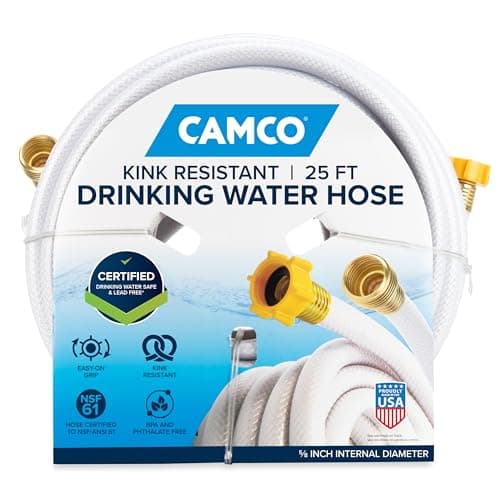 Camco TastePURE 25 ft RV Drinking Water Hose A drinking-water-safe hose in the length that reaches most pedestals. A garden hose is not a substitute, and this is cheap enough that there is no reason to use one. Top pick | The drinking-water hose you should own before anything else | 7.8/ 10 | $13.97View on Amazon
|
| 2 | 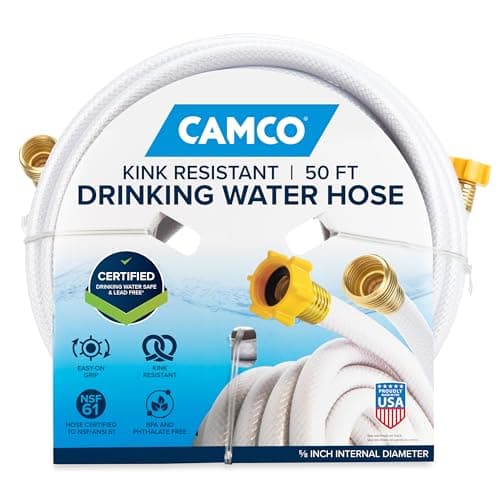 Camco TastePURE 50 ft RV Drinking Water Hose The 50 ft version. Buy this as a second hose rather than a first: fifty feet of hose is heavier to coil and slower to drain than you expect. Buy as a second hose | Long sites where the spigot is at the wrong end | 7.5/ 10 | |
| 3 | 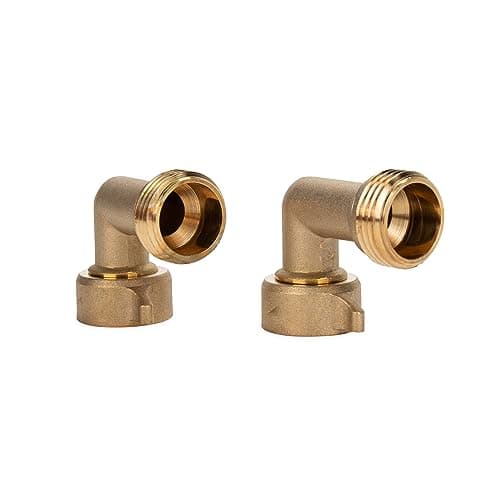 Camco 90-Degree Hose Elbow, Brass, 2-Pack, 22507 A brass 90-degree elbow at the city-water inlet. The hose stops bending sharply against the trailer wall, which is where almost every potable hose eventually splits. Buy this too | Stopping the hose kinking at the trailer inlet | 8.8/ 10 | |
| 4 | 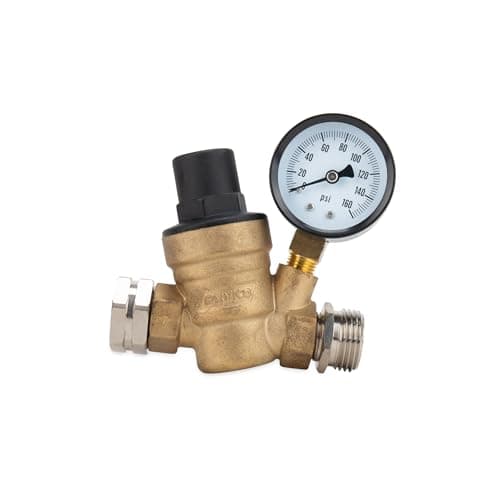 Camco Adjustable RV Water Pressure Regulator, Lead-Free Brass Adjustable lead-free brass with a gauge. Being able to dial pressure down to about 50 psi matters because a campground pedestal can deliver far more than your plumbing is rated for. | Setting your own pressure instead of accepting a preset | 8.2/ 10 |
Tap any row to jump to the full write-up. Prices come from Amazon and are read automatically — see each product below for the date.
The short answer
This is the cheapest purchase in this hub and the one where substituting the wrong product is genuinely a health question rather than a convenience one.
Why not a garden hose
A garden hose is not manufactured or certified for potable water. The materials are chosen for durability and cost, not for what they leach into standing water, and hose sitting warm in the sun for a day is exactly the condition in which leaching happens.
Even setting aside the health question, there is the taste. Water that has stood in a green garden hose tastes of it, strongly and unmistakably, and no filter fully removes that.
A hose marked as drinking-water safe is made from materials chosen for potable contact. It costs about the same as a garden hose. There is no argument for the substitution.
Drinking-water safe: a hose certified for potable water contact. Look for explicit wording on the hose jacket or packaging — the white or blue jacket is a convention, not a certification in itself.
Length: 25 ft first, 50 ft second
Twenty-five feet reaches the spigot on most campground sites and is manageable to coil wet. Fifty feet reaches on awkward sites where the spigot is at the wrong end or shared between two pads.
Buy the 25 first. A 50 ft hose full of water is heavy, slow to drain, slow to coil, and every extra foot drops a little more pressure at the faucet. Carrying both and using the short one most of the time is the right setup.
The common mistake
Kinking, and the fix that is not a hose
The main practical complaint about potable RV hoses is kinking. The jackets are relatively thin, and the two places they kink are at the spigot and at the trailer’s city-water inlet, where the hose has to turn sharply against a fixed fitting.
Premium no-kink hoses exist and are genuinely better. But the cheaper and more effective fix is a brass 90-degree elbow at the trailer inlet. It removes the sharp bend entirely, which is where almost every potable hose eventually splits. It costs very little and it extends the life of whichever hose you buy.
The rest of the fresh-water kit
| Item | Why | Where |
|---|---|---|
| Drinking-water hose | Potable-safe, no garden-hose taste | This page |
| Pressure regulator | Pedestals can exceed 100 psi; RV plumbing is designed for far less | Regulator picks |
| 90-degree brass elbow | Stops the hose kinking and splitting at the inlet | This page |
| Inline filter | Chlorine taste and sediment | Filter picks |
| A short 4 ft hose | Between the regulator and the filter, keeps the assembly tidy | Optional |
Order on the hose matters: regulator at the spigot, then the filter, then the hose to the trailer. Why that order.
Keeping it clean
Three habits, none of them onerous:
- Cap both ends for storage. A pair of plastic caps or a quick-connect with built-in caps keeps grit and insects out of the ends you will put your drinking water through.
- Store it separately from the sewer hose. Different compartment if you have one, different bag if you do not.
- Sanitize the system occasionally. The usual method is a dilute bleach solution through the fresh tank and lines, left to stand and then flushed. Follow your trailer manual’s dilution, and do it at the start of the season rather than mid-trip.
What to remember
- A garden hose is not potable-certified and makes the water taste of hose.
- Buy 25 ft first; a 50 ft is a second hose, not a first one.
- A brass 90-degree elbow at the trailer inlet is the cheapest fix for kinking and splitting.
- Regulator at the spigot, then filter, then hose to the trailer.
- Cap both ends, and never store it with the sewer hose.
The picks in full
Camco TastePURE 25 ft RV Drinking Water Hose
Camco · Best for the drinking-water hose you should own before anything else
A drinking-water-safe hose in the length that reaches most pedestals. A garden hose is not a substitute, and this is cheap enough that there is no reason to use one.
Key specifications
- Length
- 25 ft
- Safety
- Drinking-water safe, lead-free
- Diameter
- 5/8 in
- Origin
- Made in USA
Capacity figures read from Camco TastePURE specifications, October 2026.
How it scored
- Material safety (35%)10
- Flow rate (20%)7
- Kink resistance (20%)5
- Build quality (15%)6
- Price for capability (10%)10
Weighted average of the figures above. We did not test this product — see how we pick.
What it does well
- Certified for potable water, which a garden hose is not
- Twenty-five feet reaches most campground spigots
- Costs about the same as a garden hose
What it is bad at
- Kinks more than a premium hose
- Twenty-five feet is short on a long pull-through site
- The white jacket shows dirt immediately
Camco TastePURE 50 ft RV Drinking Water Hose
Camco · Best for long sites where the spigot is at the wrong end
The 50 ft version. Buy this as a second hose rather than a first: fifty feet of hose is heavier to coil and slower to drain than you expect.
Key specifications
- Length
- 50 ft
- Safety
- Drinking-water safe, lead-free
- Diameter
- 5/8 in
- Origin
- Made in USA
Capacity figures read from Camco TastePURE specifications, October 2026.
How it scored
- Material safety (35%)10
- Flow rate (20%)6
- Kink resistance (20%)5
- Build quality (15%)6
- Price for capability (10%)9
Weighted average of the figures above. We did not test this product — see how we pick.
What it does well
- Reaches the spigot on awkward sites where 25 ft does not
- Same potable-water certification
- Barely more expensive than the short one
What it is bad at
- Heavy and slow to coil when wet
- More hose means more pressure drop at the faucet
- Takes real storage space
Price as of October 5, 2026. #ad How this is funded
Camco 90-Degree Hose Elbow, Brass, 2-Pack, 22507
Camco · Best for stopping the hose kinking at the trailer inlet
A brass 90-degree elbow at the city-water inlet. The hose stops bending sharply against the trailer wall, which is where almost every potable hose eventually splits.
Key specifications
- Pack
- 2 elbows
- Material
- Solid brass, certified lead-free
- Fitting
- Easy-grip connector
- Use
- RV inlets and outdoor faucets
Capacity figures read from Camco brass fitting specifications, October 2026.
How it scored
- How often you use it (40%)8
- Build quality (25%)9
- Takes up little room (20%)10
- Price for capability (15%)9
Weighted average of the figures above. We did not test this product — see how we pick.
What it does well
- Removes the sharp bend that destroys hoses
- Brass, lead-free and certified
- Easy-grip ring means no wrench
What it is bad at
- One more thing to lose
- Brass is heavy enough to stress a plastic inlet if the hose pulls
- Adds another washer that can weep
Price as of October 5, 2026. #ad How this is funded
Camco Adjustable RV Water Pressure Regulator, Lead-Free Brass
Camco · Best for setting your own pressure instead of accepting a preset
Adjustable lead-free brass with a gauge. Being able to dial pressure down to about 50 psi matters because a campground pedestal can deliver far more than your plumbing is rated for.
Key specifications
- Type
- Adjustable
- Material
- Lead-free brass
- Gauge
- Yes
- Connection
- Standard garden hose thread
Capacity figures read from Camco regulator specifications, October 2026.
How it scored
- Material safety (35%)9
- Flow rate (20%)8
- Kink resistance (20%)7
- Build quality (15%)9
- Price for capability (10%)7
Weighted average of the figures above. We did not test this product — see how we pick.
What it does well
- Adjustable, so you can trade flow against pressure
- Gauge tells you what the pedestal is actually doing
- Brass body survives being stepped on
What it is bad at
- Costs several times a preset regulator
- The gauge is the first thing to fog or fail
- Adjustment screw needs a wrench, not fingers
Price as of October 5, 2026. #ad How this is funded
Common questions
No. Garden hoses are not certified for potable contact, and water that has stood in one tastes of it. A drinking-water-safe hose costs about the same.
Twenty-five feet as your main hose; add a 50 ft as a second hose for awkward sites rather than as your only one.
Because it has to turn sharply against the fixed inlet fitting. A brass 90-degree elbow at the inlet removes the bend, and that is where most hoses eventually split.
Sources
- Camco published water and waste product specifications — read October 2026
- RV Industry Association — standards and compliance program — read October 2026