Water & Waste
How To Set Up And Use An RV Sewer Hose
Nine steps. Black before gray is the one most people know; the rest of the order matters almost as much.
By Mike M. ·
How this page is funded: we earn a commission if you buy through our links, at no extra cost to you. It never changes which product we rank first. Prices come from Amazon and are read automatically — each one shows the date it was read. Full disclosure.
Quick picks
The four things this procedure needs.
| # | Product | Best for | Score | Price |
|---|---|---|---|---|
| 1 | 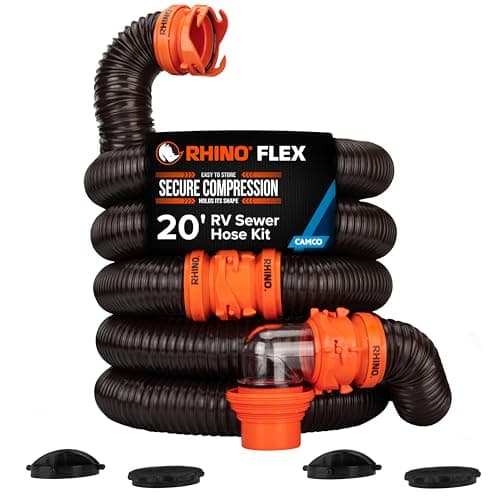 Camco RhinoFLEX 20 ft Complete RV Sewer Hose Kit The default sewer hose for a reason: a reinforced 23-mil wall that holds its shape, swivel fittings on both ends, and a complete kit so you are not ordering an adapter from the dump station. The hose | A first sewer hose that will not need replacing in a season | 8.0/ 10 | $63.00View on Amazon
|
| 2 | 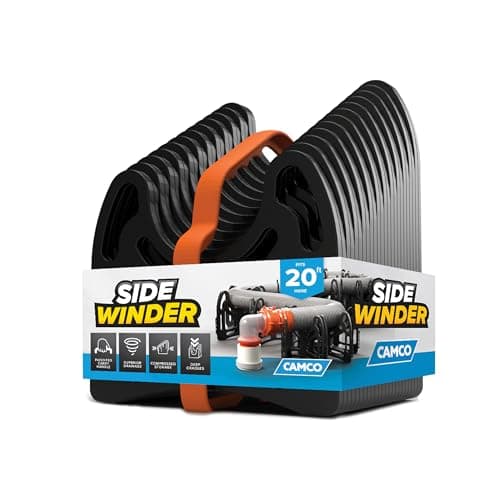 Camco Sidewinder Telescoping RV Sewer Hose Support, 20 ft A rigid folding trough that holds the hose in a steady slope. Without one, the hose sags, the sag holds waste, and the smell you blame on the hose is actually the sag. | Giving the hose a continuous downhill run | 6.9/ 10 | |
| 3 | 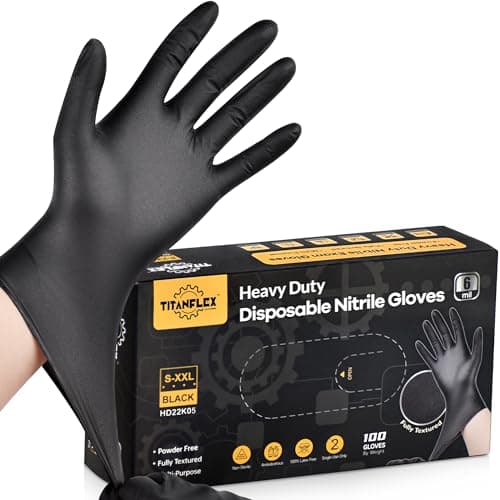 TitanFlex Heavy Duty Nitrile Gloves, 6-mil, 100-Count Six-mil nitrile, fully textured. Thin exam gloves tear on a bayonet fitting; these are the thickness that survives connecting and disconnecting a sewer hose. Not optional | The dump station, and not thinking about it afterward | 8.3/ 10 | $14.99View on Amazon
|
| 4 | 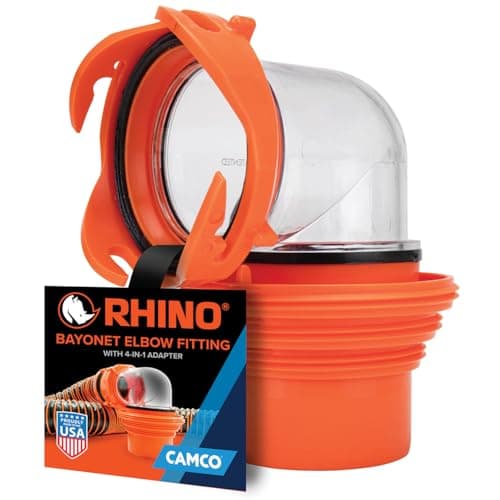 Camco RhinoFLEX Clear Sewer Hose Elbow with 4-in-1 Adapter A clear 90-degree elbow with a stepped 4-in-1 adapter, which is the part that makes a sewer hose fit a strange dump connection. Keep a spare. | The adapter that fits whatever the dump station has | 8.6/ 10 | $15.99View on Amazon
|
Tap any row to jump to the full write-up. Prices come from Amazon and are read automatically — see each product below for the date.
The short answer
This is a ten-minute job that goes badly when done out of order, and the consequences of doing it badly are memorable.
The procedure
- 1
Gloves on, before you touch anything
Six-mil nitrile. Thin exam gloves tear on a bayonet fitting, which defeats the purpose at the worst moment. - 2
Check both valves are closed
Black and gray. Look at the handles; do not assume. The trailer outlet cap is holding back whatever is in the lines downstream of a valve that was left open, and that is what you are about to remove. - 3
Remove the outlet cap, pointing it away from you
There is often a small amount of liquid behind it even with the valves closed. Hold a bucket or a rag under it, and keep it out of the dirt once removed. - 4
Connect the hose to the trailer and twist-lock it
The bayonet fitting rotates onto the lugs. It should feel positively locked, not merely pushed on. Give it a gentle pull to confirm. - 5
Connect the other end to the sewer, with the adapter
The stepped 4-in-1 adapter on the 90-degree elbow goes into the ground connection, and it should be seated, not resting. If the connection has a threaded ring, use it. The fittings explained. - 6
Support the hose for a continuous downhill run
Before opening a valve, not after. Set the support so there is no level or rising section anywhere along the run. Support options. - 7
Open the black tank valve fully, and wait
Fully open, not partially — a partly open valve passes liquid and leaves solids. Let it run until the flow stops completely. If you have a clear elbow this is the moment it earns its money. - 8
Close black, then open gray
Gray water is relatively clean and it rinses the hose. This is why the order is black first. Let the gray run until it stops, then close it. - 9
Rinse, disconnect, cap both ends
If you have a tank rinser or a dedicated rinse hose, flush the hose through. Then lift the trailer end to drain the hose toward the sewer, disconnect, cap both ends, and stow it away from the fresh water hose.
Why black before gray, in one paragraph
Black tank contents are what you do not want left in the hose. Gray water — sinks and shower — is comparatively clean and comes with soap in it. Dumping black first and gray second means the last thing through the hose is soapy water, which rinses it. Dumping gray first wastes that rinse entirely.
Leave the black valve closed between dumps
If you are hooked up to a sewer for a long stay, the temptation is to leave the black valve open so it drains continuously. Do not.
Liquid drains away and solids do not. What you get is a tank with a pile of solids in the bottom and no water to carry them out — the “pyramid” problem — which blocks the outlet and jams the level sensors reading full.
Keep the black valve closed, let the tank fill to about two thirds, and then dump. The volume of water is what moves the solids. Gray can be left open if you want, though leaving it closed and dumping it after black gives you the rinse.
The common mistake
If the sensors read full after dumping
Almost always residue stuck to the sensor probes rather than a full tank. The fix is water and agitation, not chemicals.
A back-flush tank rinser with a gate valve lets you fill the tank with clean water, close the valve, drive a short distance to slosh it, and dump again. Two or three cycles usually clears it. A dedicated tank wand through the toilet does a similar job for the area under the toilet.
Use a dedicated rinse hose for this — never the drinking water hose — and keep it a different color so there is no confusion in the dark.
What to remember
- Gloves first, 6-mil nitrile, and check both valves are closed before removing the cap.
- Connect both ends and support the hose before opening any valve.
- Black first, then gray — the gray water rinses the hose.
- Never leave the black valve open on a long stay; solids stay behind.
- Stuck sensors are residue, not a full tank. Water and agitation, not chemicals.
The picks in full
Camco RhinoFLEX 20 ft Complete RV Sewer Hose Kit
Camco · Best for a first sewer hose that will not need replacing in a season
The default sewer hose for a reason: a reinforced 23-mil wall that holds its shape, swivel fittings on both ends, and a complete kit so you are not ordering an adapter from the dump station.
Key specifications
- Length
- 20 ft (two 10 ft hoses)
- Fittings
- Bayonet and 4-in-1 adapter included
- Caps
- Translucent elbow in the kit
- Origin
- Made in USA
Capacity figures read from Camco RhinoFLEX specifications, October 2026.
How it scored
- Crush resistance (30%)8
- Fittings (25%)9
- Storage (20%)6
- Build quality (15%)8
- Price for capability (10%)9
Weighted average of the figures above. We did not test this product — see how we pick.
What it does well
- Holds its shape instead of collapsing in a sag
- Complete kit — nothing else to buy on day one
- Fittings are the industry standard, so parts are everywhere
What it is bad at
- Twenty feet is bulkier to store than most bumper tubes allow
- The accordion wall traps residue and needs rinsing properly
- Not the thickest-walled hose Camco makes
Camco Sidewinder Telescoping RV Sewer Hose Support, 20 ft
Camco · Best for giving the hose a continuous downhill run
A rigid folding trough that holds the hose in a steady slope. Without one, the hose sags, the sag holds waste, and the smell you blame on the hose is actually the sag.
Key specifications
- Length
- 20 ft
- Type
- Telescoping, folding
- Material
- Rigid plastic
- Part
- 43052
Capacity figures read from Camco Sidewinder specifications, October 2026.
How it scored
- Crush resistance (30%)8
- Fittings (25%)6
- Storage (20%)5
- Build quality (15%)8
- Price for capability (10%)8
Weighted average of the figures above. We did not test this product — see how we pick.
What it does well
- Rigid, so the slope stays where you set it
- Folds and telescopes for storage
- Keeps the hose off gravel, which is what kills hoses
What it is bad at
- Bulky even folded
- The folding hinges are the failure point over time
- Takes up the whole length of a pass-through
Price as of October 5, 2026. #ad How this is funded
TitanFlex Heavy Duty Nitrile Gloves, 6-mil, 100-Count
TitanFlex · Best for the dump station, and not thinking about it afterward
Six-mil nitrile, fully textured. Thin exam gloves tear on a bayonet fitting; these are the thickness that survives connecting and disconnecting a sewer hose.
Key specifications
- Thickness
- 6 mil
- Count
- 100 per box
- Texture
- Fully textured
- Material
- Nitrile, latex-free, powder-free
How it scored
- How often you use it (40%)9
- Build quality (25%)8
- Takes up little room (20%)6
- Price for capability (15%)10
Weighted average of the figures above. We did not test this product — see how we pick.
What it does well
- Thick enough not to tear on a sewer fitting
- Textured grip works when wet
- A hundred gloves lasts years of weekends
What it is bad at
- Disposable, so there is waste every dump
- Size runs small for some hands — check before ordering a case
- Box is bulky in a small cabinet
Camco RhinoFLEX Clear Sewer Hose Elbow with 4-in-1 Adapter
Camco · Best for the adapter that fits whatever the dump station has
A clear 90-degree elbow with a stepped 4-in-1 adapter, which is the part that makes a sewer hose fit a strange dump connection. Keep a spare.
Key specifications
- Type
- 90-degree clear elbow
- Adapter
- 4-in-1 stepped, fits 3 in and 3-1/2 in to 4 in
- Connection
- Bayonet
- Origin
- Made in USA
Capacity figures read from Camco sewer fitting specifications, October 2026.
How it scored
- How often you use it (40%)9
- Build quality (25%)7
- Takes up little room (20%)9
- Price for capability (15%)10
Weighted average of the figures above. We did not test this product — see how we pick.
What it does well
- Fits essentially every sewer connection you will meet
- Clear body shows when a rinse is done
- Cheap enough to carry two
What it is bad at
- Clear plastic stains quickly
- The stepped adapter cracks if you force it into a tight connection
- Threads are coarse and strip if cross-threaded
Common questions
Black first, then gray. The gray water is comparatively clean and rinses the hose; dumping it first wastes that.
No. Liquid drains and solids do not, which leaves a pile with no water to carry it out — blocking the outlet and jamming the sensors. Fill to about two thirds, then dump.
Almost always residue on the sensor probes, not a full tank. Fill with clean water through a rinser, agitate, dump again — two or three cycles. Chemicals rarely fix it.
Sources
- Camco published water and waste product specifications — read October 2026
- RV Industry Association — standards and compliance program — read October 2026