Water & Waste
Water Pressure Regulator: Before Or After The Filter?
Regulator first, always. The filter housing is the weakest plastic part in the chain and it should never see pedestal pressure.
By Mike M. ·
How this page is funded: we earn a commission if you buy through our links, at no extra cost to you. It never changes which product we rank first. Prices come from Amazon and are read automatically — each one shows the date it was read. Full disclosure.
Quick picks
The components, in the order they go on the hose.
| # | Product | Best for | Score | Price |
|---|---|---|---|---|
| 1 | 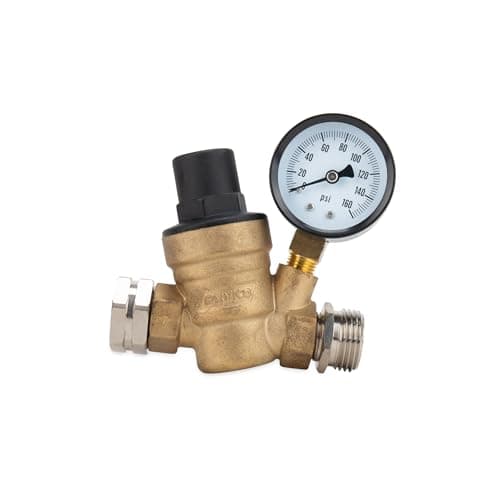 Camco Adjustable RV Water Pressure Regulator, Lead-Free Brass Adjustable lead-free brass with a gauge. Being able to dial pressure down to about 50 psi matters because a campground pedestal can deliver far more than your plumbing is rated for. Goes first | Setting your own pressure instead of accepting a preset | 8.2/ 10 | |
| 2 | 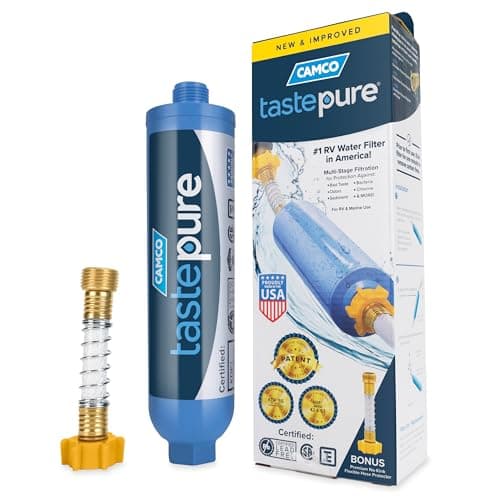 Camco TastePURE RV Water Filter, GAC and KDF An inline carbon filter for chlorine taste and sediment. It is not a purifier and does not claim to be, and for most campground water that is exactly the right scope. | Taste and smell, for the price of a tank of gas | 7.2/ 10 | |
| 3 | 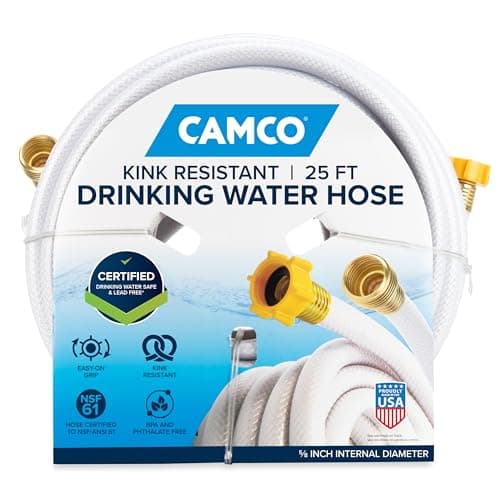 Camco TastePURE 25 ft RV Drinking Water Hose A drinking-water-safe hose in the length that reaches most pedestals. A garden hose is not a substitute, and this is cheap enough that there is no reason to use one. | The drinking-water hose you should own before anything else | 7.8/ 10 | $13.97View on Amazon
|
| 4 | 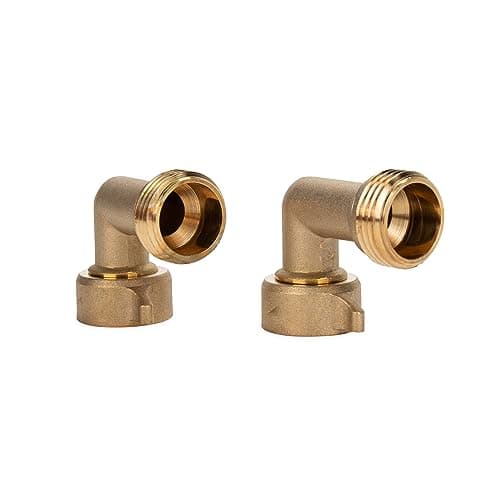 Camco 90-Degree Hose Elbow, Brass, 2-Pack, 22507 A brass 90-degree elbow at the city-water inlet. The hose stops bending sharply against the trailer wall, which is where almost every potable hose eventually splits. | Stopping the hose kinking at the trailer inlet | 8.8/ 10 |
Tap any row to jump to the full write-up. Prices come from Amazon and are read automatically — see each product below for the date.
The short answer
This question comes up constantly and has a clear answer, so this is a short page.
The full assembly, in order
- 1
Campground spigot
Unknown pressure. Could be 40 psi, could be well over 100. You do not know until you measure. - 2
Pressure regulator
Screwed directly onto the spigot, or onto a short lead from it. Everything downstream is now protected. - 3
A short connecting hose (optional)
A 4 ft lead between the regulator and the filter keeps the assembly off the ground and takes strain off the spigot threads. Worth having. - 4
Inline filter or canister
Downstream of the regulator, so the housing sees regulated pressure only. Mind the flow-direction arrows. - 5
Main drinking water hose
Your 25 ft potable hose runs from the filter to the trailer. - 6
90-degree brass elbow
At the trailer's city-water inlet, so the hose does not kink against the fitting. This is where hoses split. - 7
Trailer city-water inlet
Connected last, and the whole chain upstream is regulated and filtered.
Why this order, concretely
The filter housing is the weak link. A disposable inline filter is a thin-walled plastic cylinder; a canister housing is thicker but still plastic with a threaded joint and an O-ring. Neither is designed for 110 psi. Putting the regulator upstream means the housing lives its whole life at 50.
The hose is the second weak link. A potable RV hose is not a high-pressure hose. If the regulator is at the trailer end, the entire hose run sits at full pedestal pressure continuously, and a hose failure at that pressure delivers an impressive amount of water into your site.
And the gauge reads something useful. At the spigot, an adjustable regulator’s gauge reads the pedestal’s own pressure, which is the diagnostic number you want. Downstream of a filter it reads whatever the filter let through, which tells you much less.
The common mistake
The one apparent exception
Some owners fit a coarse sediment screen or strainer before the regulator, on the grounds that grit from an old campground supply can damage the regulator’s internals.
That is reasonable, and it is not really an exception: a strainer is a mesh, not a pressure-bearing filter housing, and most good regulators have one built into the inlet already. If yours does, clean it occasionally — a clogged inlet screen is the usual reason a new regulator gets blamed for poor flow.
Two related order questions
Does the filter go before or after a water softener? Generally the sediment filter goes first to protect the softener resin, then the softener, then a carbon stage. Follow the softener maker’s guidance, which varies.
Does any of this matter when filling the fresh tank rather than running on city water? Yes, for the filter — you want filtered water going into the tank. Less so for the regulator, since the tank fill is not pressurized plumbing, but there is no reason to take the regulator off and plenty of reason to leave it on.
What to remember
- Spigot, regulator, filter, hose, 90-degree elbow, trailer.
- The filter housing is plastic and the weakest pressure-bearing part — keep it downstream.
- An unregulated hose run sits at full pedestal pressure continuously.
- At the spigot, the regulator's gauge reads the useful number.
- A coarse inlet strainer before the regulator is fine, and most regulators have one.
The picks in full
Camco Adjustable RV Water Pressure Regulator, Lead-Free Brass
Camco · Best for setting your own pressure instead of accepting a preset
Adjustable lead-free brass with a gauge. Being able to dial pressure down to about 50 psi matters because a campground pedestal can deliver far more than your plumbing is rated for.
Key specifications
- Type
- Adjustable
- Material
- Lead-free brass
- Gauge
- Yes
- Connection
- Standard garden hose thread
Capacity figures read from Camco regulator specifications, October 2026.
How it scored
- Material safety (35%)9
- Flow rate (20%)8
- Kink resistance (20%)7
- Build quality (15%)9
- Price for capability (10%)7
Weighted average of the figures above. We did not test this product — see how we pick.
What it does well
- Adjustable, so you can trade flow against pressure
- Gauge tells you what the pedestal is actually doing
- Brass body survives being stepped on
What it is bad at
- Costs several times a preset regulator
- The gauge is the first thing to fog or fail
- Adjustment screw needs a wrench, not fingers
Price as of October 5, 2026. #ad How this is funded
Camco TastePURE RV Water Filter, GAC and KDF
Camco · Best for taste and smell, for the price of a tank of gas
An inline carbon filter for chlorine taste and sediment. It is not a purifier and does not claim to be, and for most campground water that is exactly the right scope.
Key specifications
- Media
- GAC and KDF
- Type
- Inline, disposable
- Life
- Seasonal / per listing
- Origin
- Made in USA
Capacity figures read from Camco TastePURE filter specifications, October 2026.
How it scored
- Material safety (35%)7
- Flow rate (20%)6
- Kink resistance (20%)8
- Build quality (15%)6
- Price for capability (10%)10
Weighted average of the figures above. We did not test this product — see how we pick.
What it does well
- Removes the chlorine taste that puts people off campground water
- Fits inline on the hose in seconds
- Cheap enough to replace every season without thinking
What it is bad at
- Does not remove bacteria — this is taste and sediment only
- Restricts flow noticeably
- Disposable, so it is a recurring cost
Price as of October 5, 2026. #ad How this is funded
Camco TastePURE 25 ft RV Drinking Water Hose
Camco · Best for the drinking-water hose you should own before anything else
A drinking-water-safe hose in the length that reaches most pedestals. A garden hose is not a substitute, and this is cheap enough that there is no reason to use one.
Key specifications
- Length
- 25 ft
- Safety
- Drinking-water safe, lead-free
- Diameter
- 5/8 in
- Origin
- Made in USA
Capacity figures read from Camco TastePURE specifications, October 2026.
How it scored
- Material safety (35%)10
- Flow rate (20%)7
- Kink resistance (20%)5
- Build quality (15%)6
- Price for capability (10%)10
Weighted average of the figures above. We did not test this product — see how we pick.
What it does well
- Certified for potable water, which a garden hose is not
- Twenty-five feet reaches most campground spigots
- Costs about the same as a garden hose
What it is bad at
- Kinks more than a premium hose
- Twenty-five feet is short on a long pull-through site
- The white jacket shows dirt immediately
Camco 90-Degree Hose Elbow, Brass, 2-Pack, 22507
Camco · Best for stopping the hose kinking at the trailer inlet
A brass 90-degree elbow at the city-water inlet. The hose stops bending sharply against the trailer wall, which is where almost every potable hose eventually splits.
Key specifications
- Pack
- 2 elbows
- Material
- Solid brass, certified lead-free
- Fitting
- Easy-grip connector
- Use
- RV inlets and outdoor faucets
Capacity figures read from Camco brass fitting specifications, October 2026.
How it scored
- How often you use it (40%)8
- Build quality (25%)9
- Takes up little room (20%)10
- Price for capability (15%)9
Weighted average of the figures above. We did not test this product — see how we pick.
What it does well
- Removes the sharp bend that destroys hoses
- Brass, lead-free and certified
- Easy-grip ring means no wrench
What it is bad at
- One more thing to lose
- Brass is heavy enough to stress a plastic inlet if the hose pulls
- Adds another washer that can weep
Price as of October 5, 2026. #ad How this is funded
Common questions
Before. Regulator at the spigot, filter downstream. The filter housing is the weakest pressure-bearing part and should never see pedestal pressure — nor should the hose.
The regulator yes. A used filter should not be left installed over winter — a damp carbon cartridge is a growth medium.
Not required, but useful: a 4 ft lead keeps the assembly off the ground and takes strain off the spigot threads.
Sources
- Camco published water and waste product specifications — read October 2026
- RV Industry Association — standards and compliance program — read October 2026