Leveling, Chocks & Stabilizing
The Best Camper Stabilizer Jacks
The single most misunderstood part on a travel trailer. A stabilizer jack is there to stop the trailer moving, not to hold it up, and almost every failure comes from asking it to do the second job.
By Mike M. ·
How this page is funded: we earn a commission if you buy through our links, at no extra cost to you. It never changes which product we rank first. Prices come from Amazon and are read automatically — each one shows the date it was read. Full disclosure.
Quick picks
Scored on the published leveling rubric - lift (25%), grip (25%), packed size (20%), build (20%), price (10%). Capacities below are each maker's stated figure; none of them is independently verified and none of them is a lifting rating.
| # | Product | Best for | Score | Price |
|---|---|---|---|---|
| 1 | 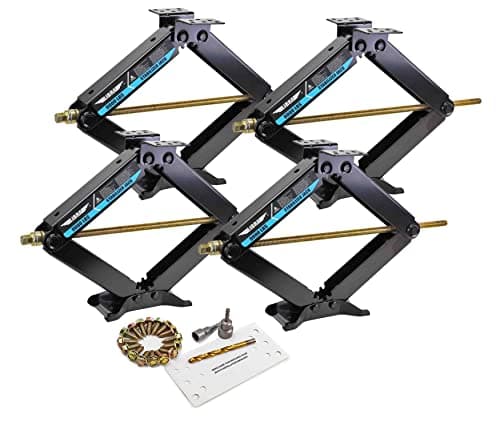 LIBRA 9,000 lb HD 24 in RV Stabilizer Scissor Jacks, Set of 4 The highest stated capacity in a set of four at this price, with drill sockets on both sides of each jack and the mounting hardware in the box — which is what turns a jack swap into an afternoon rather than a parts hunt. Top pick | Replacing all four factory jacks in one purchase | 7.0/ 10 | |
| 2 | 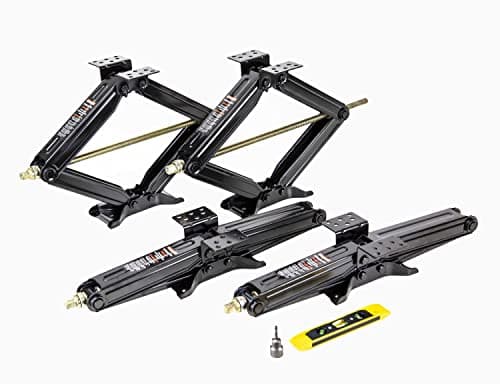 ROCKMAN 24 in 7,500 lb RV Stabilizer Scissor Jacks, Set of 4 The value set: four 24 in jacks with a power drill socket and a magnetic level included, at a noticeably lower price than the heavy-duty option for a capacity most travel trailers never approach. Best value set | A full set of four for the least money | 6.4/ 10 | |
| 3 | 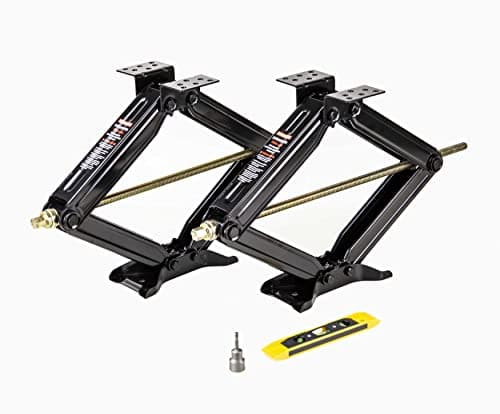 ROCKMAN 24 in 7,500 lb RV Stabilizer Scissor Jacks, Pair The same jack as the four-pack sold in twos, which is what you want when only the rear pair has seized or when your trailer came with jacks at one end only. Buy a pair | Adding jacks to one end, or replacing a seized pair | 6.4/ 10 | |
| 4 | 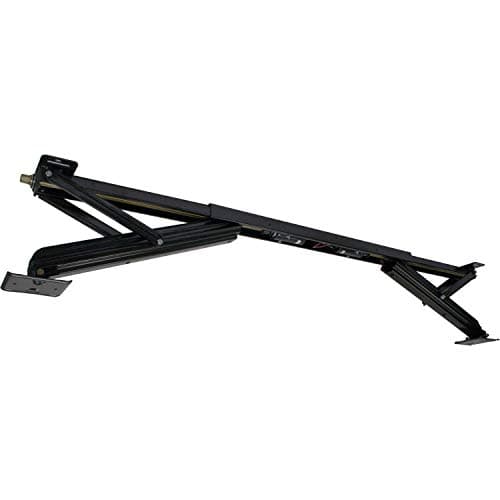 BAL Powered C-Jack 25 in Electric Stabilizer Jack, 21100005 A 12 V bolt-on electric stabilizer from the brand that makes the X-Chock, for owners who have decided that cranking is the part of setup they want to delete. It is sold per jack, so a full set is four purchases. The electric option | Anyone who will not crank four jacks by hand again | 6.5/ 10 | |
| 5 | 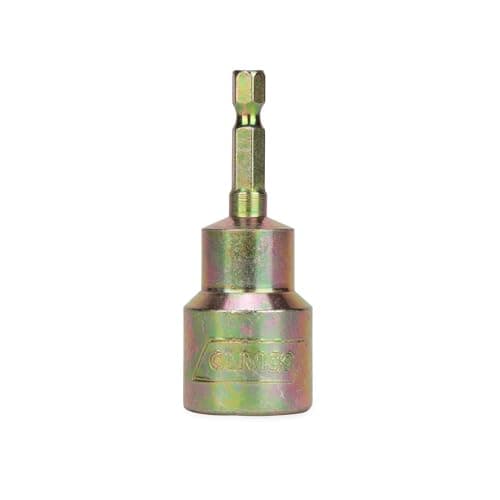 Camco RV Scissor Jack Drill Adapter Socket, 48865 A zinc-plated socket that drops a cordless drill onto a scissor jack drive. It is the cheapest item on this page and it changes setup time more than any jack upgrade does. Buy this regardless | Making the jacks you already own fast | 6.6/ 10 |
Tap any row to jump to the full write-up. Prices come from Amazon and are read automatically — see each product below for the date.
The short answer
Start with what the part is for, because the single most common failure in this category is a misunderstanding rather than a defect. A stabilizer jack exists to stop a parked trailer rocking and bouncing when people move around inside it. It is not a lifting jack, it is not a leveling jack, and it is not a jack stand. The capacity number on the box is a static rating for holding a load, not a rating for raising one.
Stabilizer jack: the scissor or C-shaped jack bolted to the trailer frame near each corner. It takes up slack between the frame and the ground so the trailer stops moving on its suspension. Leveling is a separate job done by blocks or ramps under the wheels and by the tongue jack.
What stabilizer jacks do, and what they do not
A travel trailer sits on leaf springs. Those springs are doing their job when the trailer moves at 65 mph, and they are the reason the trailer rocks when you walk to the fridge at a campsite. Stabilizer jacks take that movement out by transferring a small part of the trailer’s weight to four fixed points on the ground.
The things they are not for are the things that break them:
| Job | Stabilizer jacks? | What actually does it |
|---|---|---|
| Stop the trailer rocking | Yes - this is the job | Four stabilizer jacks, snug |
| Level side to side | No | Blocks or ramps under the wheels |
| Level front to back | No | The tongue jack |
| Lift a wheel off the ground | No | A bottle jack at a rated lift point |
| Support the trailer for a wheel change | No | A jack stand on the frame |
| Take weight off the suspension in storage | No | Jack stands rated for the load |
That table is the whole safety argument for this page. Stabilizer jacks vs leveling jacks covers the distinction in full, and it is worth reading before you spend anything, because an owner who wants their trailer lifted is shopping for the wrong part entirely.
The common mistake
What to look for
Extended height, matched to your frame. The number that decides whether a jack fits is the distance from your frame rail to the ground at a typical site, and 24 in is the near-universal size on travel trailers. Measure before ordering: a jack that only just reaches is a jack at the end of its travel, which is where scissor jacks are weakest.
A drill socket, not just a crank handle. Four jacks, hand-cranked, is a genuine chore every single setup and every single departure. A drill socket on the jack drive turns about four minutes of cranking into roughly twenty seconds. Every jack on this page has one or accepts one.
Stated capacity, read honestly. Capacities in this category run from about 5,000 to 9,500 lb per jack, and they are static holding ratings published by the seller with no independent verification. More is not a reason to pay much more, because no stabilizer jack is carrying anything close to its number in normal use.
Bolt pattern and mounting hardware. Some sets include the bolts and some do not. If yours do not, you are measuring the existing holes in your frame and sourcing hardware before you can finish the job.
Finish, because these live under a trailer. Scissor jacks spend their life in road spray and get set down in mud. Zinc plating on a budget jack tends to surface-rust at the pivots within a couple of seasons. That is cosmetic for a while and then it is stiff.
How many you actually need. Four is the normal answer: one near each corner, set back from the extreme ends of the frame so they are working under structure rather than under overhang. Plenty of smaller trailers leave the factory with two at the rear only, on the logic that the tongue jack already holds the front — which works, but leaves the front corners free to flex. If yours came with two and the trailer still moves when someone walks to the front, adding a pair at the front is a cheaper fix than replacing anything. Longer trailers sometimes benefit from a fifth and sixth jack at the midpoint, though that is a bigger install and most owners never need it.
The picks
LIBRA 9,000 lb HD, set of four. The highest stated capacity in a four-pack at this price, with a drill socket on each side of every jack — which matters more than it sounds, because at some corners of a trailer only one side is reachable. Installation hardware is in the box, which several competing sets omit. It is the heaviest set here to hold in position while you bolt it up, and the capacity figure is the seller’s, not an independent test.
ROCKMAN 7,500 lb, set of four. The value answer. Four 24 in jacks with a power drill socket and a magnetic level included, well under the LIBRA on price, at a capacity no travel trailer will ever approach in this application. The magnetic level in the box is genuinely useful during the install. Expect budget plating to show rust at the pivots in time.
ROCKMAN 7,500 lb, pair. The same jack sold in twos. This is what you want when the rear pair has seized, or when your trailer came with jacks at one end only — which is common on smaller trailers. It costs more per jack than the four-pack, so only buy it when you genuinely need two.
BAL Powered C-Jack, 12 V electric. The real electric option, from the brand that also makes the X-Chock. A switch does the work: no crank, no drill, no kneeling in gravel. The honest accounting is that it is sold one jack at a time at several times the price of a complete manual set, and the install is the real cost — you are running 12 V wiring to each corner. A motor is also one more thing that can fail away from home. Buy it because you want to stop cranking, not because it stabilizes better.
Camco RV scissor jack drill adapter socket. Listed last and arguably the best-value item on the page. It is a zinc-plated socket that puts a cordless drill onto a scissor jack drive, and it works on the jacks already bolted to your trailer. Check your jack’s drive size before ordering, and go easy on the trigger at the end of travel — a high-torque drill will happily over-tighten a jack.
Manual scissor jacks
- A complete set of four costs a fraction of one electric jack
- Nothing to wire and nothing electrical to fail
- A drill socket makes them nearly as fast in practice
- Still means getting down at four corners
- Budget plating rusts at the pivots over time
Electric stabilizer jacks
- A switch instead of a crank or a drill
- No kneeling in gravel or mud at each corner
- BAL has a long record in RV stabilizing hardware
- Sold per jack, so a full set is four purchases
- Running 12 V to each corner is the real install cost
Replacing a set: measure before you unbolt anything
Three measurements decide whether the jacks you order will bolt straight on, and all three are easier to take with the old jacks still in place.
Frame rail to ground, at a realistic site. Not on a flat driveway with the trailer level — take it with a couple of inches of blocks under one side, which is the condition the jacks actually work in. That number tells you whether a 24 in jack gives you working travel or only just reaches.
The bolt pattern, and how the jack mounts. Most travel trailer scissor jacks bolt to a flange on the frame through a fixed hole pattern. Some are welded. If yours are welded on, a direct swap is a fabrication job rather than a wrench job, and that changes the economics of the whole decision before you order anything.
Which side the drive sits on. At some corners of a trailer — typically behind a propane rack or a battery box — only one side of the jack is reachable with a drill. A jack with sockets on both sides removes that problem; a jack with one socket on the wrong side creates it.
While you are under there, work out why you are replacing them. Scissor jacks almost always fail the same way: the lead screw runs dry, grit packs into the threads, and the jack goes stiff and then seizes. If the jack is otherwise straight, cleaning the screw and greasing it may buy you several more seasons for the price of nothing. Jacks worth actually replacing are the bent ones, the ones with stripped gears, and the ones that have rusted through at a pivot.
| Symptom | Usual cause | Fix |
|---|---|---|
| Stiff, but works | Dry or gritty lead screw | Clean and grease the screw |
| Turns but will not extend | Stripped gear or nut | Replace that jack |
| Visibly bent leg | Used to lift, or hit a curb extended | Replace, and read the warning above |
| Rust flaking at the pivots | Years of road spray on budget plating | Replace when it binds, not before |
| Only one end has jacks | Factory fitted the front only | Add a pair rather than a set of four |
One habit prevents most of this: run each jack through its full travel once a season and put grease on the lead screw while it is extended. It takes about ten minutes for all four and it is on the annual maintenance checklist for the same reason the other items are — it is cheap now and expensive later.
Using them in the right order
- 1
Level side to side first, while still hitched
Blocks or a ramp under the low side’s wheels, then pull up until the trailer is level across its width. Blocks against ramps covers which to carry. - 2
Chock the wheels, then unhitch
Chock before unhitching. Once the wheels are chocked the side-to-side attitude is fixed, which is why it has to be right first. - 3
Level front to back with the tongue jack
The tongue jack is the only thing that sets the trailer’s lengthwise attitude. The front-to-back guide covers what to stand it on. - 4
Bring the stabilizer jacks down last
Only now. Run each one down until the pad meets the ground and then snug it — you are taking up slack, not lifting. If a corner of the trailer rises, you have gone too far. - 5
Put something under each pad on soft ground
A jack pad or an interlocked stack of blocks spreads the load and stops the foot sinking overnight. The jack pad roundup ranks the options. - 6
Retract them fully before moving anything
Jacks up before the slide comes in, and certainly before the trailer moves. A jack left part-extended is the one that catches a curb on the way out.
If your trailer has a slide out, the order tightens further — level and stabilize before the slide moves — and if the site is awkward, leveling on uneven ground covers the point at which the site is simply the wrong site.
What to remember
- Stabilizer jacks stop movement. They do not lift, level, or replace a jack stand.
- 24 in extended height fits most travel trailers - measure your frame-to-ground distance.
- A drill socket turns four minutes of cranking into about twenty seconds.
- Stated capacities are seller figures and are static holding ratings, not lifting ratings.
- Jacks go down last, after leveling and chocking, and come up first.
- Put a pad under every foot on soft ground or they sink overnight.
How we picked
We have not installed these jacks and we do not own a trailer to bolt them to. This ranking reads each maker’s published specifications and the stated contents of the live retailer listing, and every listing was confirmed live and in stock before it was featured. Where we describe how a budget jack ages we are reporting what owners consistently say and what the finish implies, stated as reporting rather than as our own experience. Stated capacities are the sellers’ own figures and we have no independent verification of any of them — which is why we rank on fit, drive and included hardware rather than on whose number is biggest. Current prices come from retailer listing data read automatically and date-stamped. The rubric and its weights are on how we pick. Measure your own frame height and check your jack’s drive size before ordering anything here.
The picks in full
LIBRA 9,000 lb HD 24 in RV Stabilizer Scissor Jacks, Set of 4
LIBRA · Best for replacing all four factory jacks in one purchase
The highest stated capacity in a set of four at this price, with drill sockets on both sides of each jack and the mounting hardware in the box — which is what turns a jack swap into an afternoon rather than a parts hunt.
Key specifications
- Stated capacity
- 9,000 lb per jack
- Extended height
- 24 in
- Pack
- Set of 4
- Drive
- Dual power drill sockets
How it scored
- Lift range (25%)8
- Grip / stability (25%)7
- Packed size (20%)4
- Build quality (20%)8
- Price for capability (10%)8
Weighted average of the figures above. We did not test this product — see how we pick.
What it does well
- Highest stated capacity of the sets here, by a clear margin
- A drill socket on each side, so you can reach the jack from either angle
- Installation hardware included, which several competing sets omit
What it is bad at
- No independent verification of the stated capacity
- Heaviest set here to lift into position during the swap
- Stated capacity is a static rating and says nothing about lifting the trailer
Price as of October 21, 2026. #ad How this is funded
ROCKMAN 24 in 7,500 lb RV Stabilizer Scissor Jacks, Set of 4
ROCKMAN · Best for a full set of four for the least money
The value set: four 24 in jacks with a power drill socket and a magnetic level included, at a noticeably lower price than the heavy-duty option for a capacity most travel trailers never approach.
Key specifications
- Stated capacity
- 7,500 lb per jack
- Extended height
- 24 in
- Pack
- Set of 4
- Included
- Power drill socket and magnetic level
How it scored
- Lift range (25%)7
- Grip / stability (25%)7
- Packed size (20%)4
- Build quality (20%)6
- Price for capability (10%)9
Weighted average of the figures above. We did not test this product — see how we pick.
What it does well
- Cheapest route to replacing all four jacks
- Drill socket included, so you are not buying one separately
- Magnetic level in the box is genuinely useful during the install
What it is bad at
- No independent verification of the stated capacity
- Lower capacity than the LIBRA set for a modest saving
- Zinc finish on budget jacks tends to surface-rust at the pivots
Price as of October 21, 2026. #ad How this is funded
ROCKMAN 24 in 7,500 lb RV Stabilizer Scissor Jacks, Pair
ROCKMAN · Best for adding jacks to one end, or replacing a seized pair
The same jack as the four-pack sold in twos, which is what you want when only the rear pair has seized or when your trailer came with jacks at one end only.
Key specifications
- Stated capacity
- 7,500 lb per jack
- Extended height
- 24 in
- Pack
- Pair
- Included
- Power drill socket and magnetic level
How it scored
- Lift range (25%)7
- Grip / stability (25%)7
- Packed size (20%)5
- Build quality (20%)6
- Price for capability (10%)7
Weighted average of the figures above. We did not test this product — see how we pick.
What it does well
- Buy two rather than four when only one end needs them
- Same specification as the four-pack, so a mixed install still matches
- Drill socket and level included even in the pair
What it is bad at
- Costs more per jack than the set of four
- No independent verification of the stated capacity
- Mixing with older jacks of a different height needs a check before ordering
Price as of October 21, 2026. #ad How this is funded
BAL Powered C-Jack 25 in Electric Stabilizer Jack, 21100005
BAL · Best for anyone who will not crank four jacks by hand again
A 12 V bolt-on electric stabilizer from the brand that makes the X-Chock, for owners who have decided that cranking is the part of setup they want to delete. It is sold per jack, so a full set is four purchases.
Key specifications
- Type
- Electric, 12 V motor
- Extended height
- 25 in
- Mounting
- Bolt-on
- Construction
- Weather-resistant steel
How it scored
- Lift range (25%)8
- Grip / stability (25%)8
- Packed size (20%)3
- Build quality (20%)8
- Price for capability (10%)3
Weighted average of the figures above. We did not test this product — see how we pick.
What it does well
- No cranking and no drill — a switch does the work
- BAL has a long record in RV stabilizing hardware
- Bolt-on mount rather than a weld-in
What it is bad at
- By far the most expensive option here, and sold one jack at a time
- Needs 12 V wiring run to each jack, which is the real install cost
- A motor is one more thing that can fail away from home
Price as of October 21, 2026. #ad How this is funded
Camco RV Scissor Jack Drill Adapter Socket, 48865
Camco · Best for making the jacks you already own fast
A zinc-plated socket that drops a cordless drill onto a scissor jack drive. It is the cheapest item on this page and it changes setup time more than any jack upgrade does.
Key specifications
- Fits
- 1/4 in hex quick-connect chucks
- Material
- Forged carbon steel, zinc plated
- Finish
- Corrosion-resistant plating
- Part
- 48865
How it scored
- Lift range (25%)2
- Grip / stability (25%)6
- Packed size (20%)10
- Build quality (20%)8
- Price for capability (10%)10
Weighted average of the figures above. We did not test this product — see how we pick.
What it does well
- Turns a four-minute crank into about twenty seconds per jack
- Costs a fraction of any jack on this page
- Works with the jacks already on the trailer
What it is bad at
- Check your jack's drive size before ordering — not every jack uses the same hex
- A high-torque drill can over-tighten a jack if you are careless
- Small enough to lose in a storage bay
Price as of October 21, 2026. #ad How this is funded
Common questions
Measure frame rail to ground. Most travel trailers take a 24 in extended-height scissor jack, and you want margin rather than a jack working at the end of its travel.
No. The capacity figure is a static holding rating, not a lifting one. Level first, then bring the jacks down only until snug. Use a bottle jack and jack stands for lifting and supporting.
Worth it if what you want is to stop cranking — they do not stabilize better. Sold per jack, and the 12 V wiring is the real cost. A drill socket on manual jacks gets most of the way for a few dollars.
Yes — with an adapter socket matched to your jack’s drive, commonly 3/4 in or 19 mm hex. Check your drive size first, and ease off at the end of travel.
Sources
- BAL published Powered C-Jack specifications — read October 2026
- Camco published RV scissor jack drill adapter specifications — read October 2026
- RV Industry Association — standards and compliance program — read October 2026