Leveling, Chocks & Stabilizing
Stabilizer Jacks vs Leveling Jacks
The jacks at the corners of your trailer are almost certainly not for lifting it. Using them that way bends jacks and twists frames.
By Mike M. ·
How this page is funded: we earn a commission if you buy through our links, at no extra cost to you. It never changes which product we rank first. Prices come from Amazon and are read automatically — each one shows the date it was read. Full disclosure.
Quick picks
What to level with, and what to put under the jacks you do have.
| # | Product | Best for | Score | Price |
|---|---|---|---|---|
| 1 | 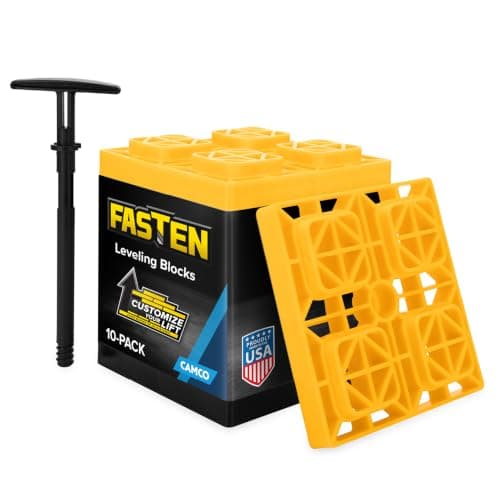 Camco FasTen RV Leveling Blocks, 10-Pack Interlocking plastic blocks that lock together instead of sliding apart, which is the whole difference between these and loose wood. They also go under a jack, which a curved leveler cannot. Level with these | The default: cheap, interlocking, use them for everything | 7.5/ 10 | |
| 2 | 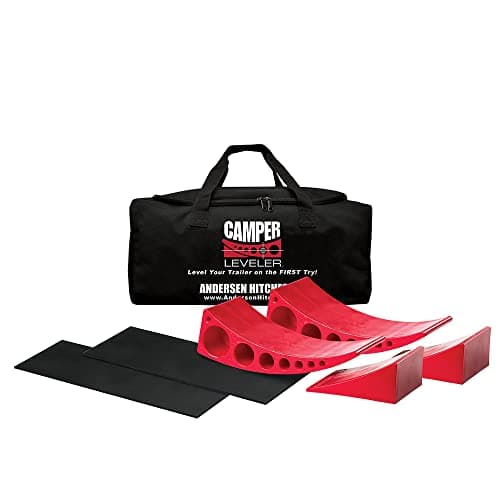 Andersen Camper Leveler, 2-Pack with Mats and Bag A curved ramp you drive up until the bubble centers, then chock. It replaces the guess-stack-check-restack cycle that makes stacking blocks the most annoying job at a campsite. | Side-to-side leveling in one pull-up, with no stacking | 7.5/ 10 | |
| 3 | 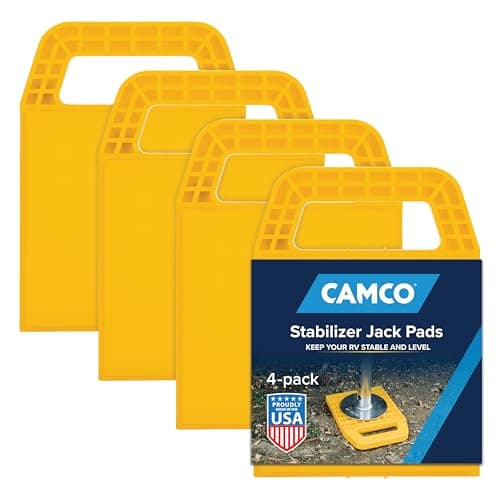 Camco RV Stabilizing Jack Pads, 4-Pack Four plastic pads for under the stabilizer jacks. They stop the jack foot sinking into soft ground, which is the usual reason a leveled trailer is no longer level in the morning. | Keeping scissor jacks out of the dirt | 7.0/ 10 | $13.97View on Amazon
|
| 4 | 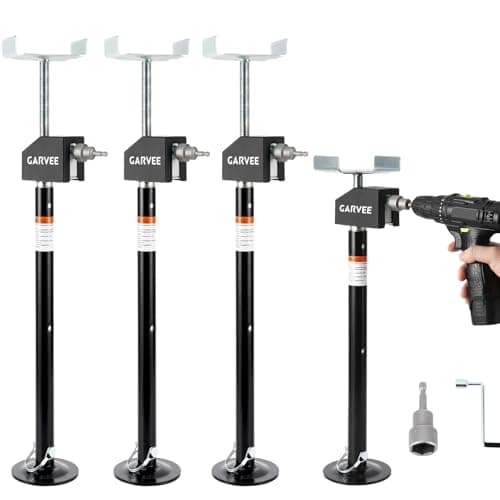 RV Slide-Out Support Jacks, Set of 4 Adjustable screw jacks for under a slide-out. They do not level anything; they stop a long slide bouncing, which is a different and much narrower job. | Supporting a long slide-out on a soft site | 5.5/ 10 |
Tap any row to jump to the full write-up. Prices come from Amazon and are read automatically — see each product below for the date.
The short answer
This is the most consequential misunderstanding in this section, because the mistake is intuitive and the damage is expensive.
What each type is
Scissor stabilizer jacks. A folding steel scissor mechanism on a screw, cranked down by hand or with a drill. Found at the four corners of most travel trailers. Their job is to stop the trailer moving when you walk around in it, with the trailer’s weight still carried by its wheels and tongue jack. Typical ratings are a few hundred to around a thousand pounds each, and the manual usually says explicitly that they are not for lifting.
Leveling jacks. Heavier hydraulic or electric jacks, usually on larger fifth wheels and motorhomes, often as an automatic system. These are designed to carry and lift the vehicle’s weight, and they are structurally mounted to do it.
The tongue jack. A third thing, and the one people forget is a lifting jack. It is rated to lift the tongue, which is what you use for front-to-back leveling.
What happens when you lift with a stabilizer jack
Three failure modes, in increasing order of expense:
The jack bends. A scissor mechanism loaded beyond its rating distorts, and a distorted scissor jack binds and eventually will not retract. Replaceable, and the cheapest outcome.
The mounting tears. Scissor jacks bolt or weld to the frame rail or an outrigger. Lifting a corner puts the trailer’s weight through that mounting rather than through the axles, and the mounting is not designed for it.
The frame twists. A travel trailer frame is designed to be supported at the axles and the tongue. Lifting one corner on a jack loads it in torsion. Frame damage shows up as doors that no longer close, slide-outs that bind and cracked interior panels, and it is not economically repairable.
The common mistake
How to use stabilizer jacks correctly
- 1
Level the trailer first, on its wheels
Side to side with blocks or a ramp under the tires, front to back with the tongue jack. The jacks come down last, after the trailer is level. The full sequence. - 2
Put a pad under each foot
On anything softer than concrete. Otherwise the jack sinks and you lose the stabilizing you just set. Jack pads. - 3
Wind down until firm, then stop
You are looking for solid contact carrying a modest share of the load — not lifting. If you see the trailer rise, or the tire's contact patch change, you have gone too far. - 4
Check again after a few hours
Ground settles and temperature changes things. A quarter turn is often all it needs.
A note on slide-out supports
Adjustable jacks sold to support a slide-out are a separate category and a contested one. Several slide-out manufacturers advise against supporting the slide at all, on the grounds that the slide mechanism is designed to carry its own load and external support can misalign it.
Check your own manual before buying one. If your maker permits it, they do reduce bounce on a long slide. If your maker advises against it, the forum is not a better source than the people who built the mechanism.
What to remember
- Scissor jacks steady the trailer. They are not rated to lift or carry it.
- Leveling jacks are a different, heavier system found on larger RVs.
- Level on the wheels and the tongue jack, then lower the stabilizers last.
- Lifting a corner with a scissor jack risks bending the jack, tearing the mounting, or twisting the frame.
- Check your manual before supporting a slide-out — many makers advise against it.
The picks in full
Camco FasTen RV Leveling Blocks, 10-Pack
Camco · Best for the default: cheap, interlocking, use them for everything
Interlocking plastic blocks that lock together instead of sliding apart, which is the whole difference between these and loose wood. They also go under a jack, which a curved leveler cannot.
Key specifications
- Block size
- 8.5 in x 8.5 in x 1 in
- Pack
- 10 blocks
- Interlocking
- Yes
- Origin
- Made in USA
Capacity figures read from Camco FasTen specifications, October 2026.
How it scored
- Lift range (25%)7
- Grip / stability (25%)7
- Packed size (20%)8
- Build quality (20%)7
- Price for capability (10%)10
Weighted average of the figures above. We did not test this product — see how we pick.
What it does well
- Interlock, so a stack does not shear sideways under load
- Do double duty under jacks and stabilizers
- Cheapest route to usable leveling
What it is bad at
- Stacking to the right height is trial and error
- One inch per layer means coarse adjustment
- They crack if you drive onto an unsupported overhang
Price as of October 5, 2026. #ad How this is funded
Andersen Camper Leveler, 2-Pack with Mats and Bag
Andersen Hitches · Best for side-to-side leveling in one pull-up, with no stacking
A curved ramp you drive up until the bubble centers, then chock. It replaces the guess-stack-check-restack cycle that makes stacking blocks the most annoying job at a campsite.
Key specifications
- Pack
- 2 levelers, 2 rubber mats, duffel bag
- Rated to
- 30,000 lb
- Lift
- Continuous, up to about 4 in
- Use
- Single-axle and tandem-axle trailers
Capacity figures read from Andersen Camper Leveler specifications, October 2026.
How it scored
- Lift range (25%)9
- Grip / stability (25%)8
- Packed size (20%)5
- Build quality (20%)8
- Price for capability (10%)6
Weighted average of the figures above. We did not test this product — see how we pick.
What it does well
- One pull-up, any lift height — no stacking to the nearest inch
- Chock is built into the design
- Rubber mats stop the ramp sliding on hardpack
What it is bad at
- Expensive next to a bag of plastic blocks
- Bulky to store, even in the bag
- You still need a spotter or a camera to know when to stop
Price as of October 5, 2026. #ad How this is funded
Camco RV Stabilizing Jack Pads, 4-Pack
Camco · Best for keeping scissor jacks out of the dirt
Four plastic pads for under the stabilizer jacks. They stop the jack foot sinking into soft ground, which is the usual reason a leveled trailer is no longer level in the morning.
Key specifications
- Pack
- 4 pads
- Use
- Under scissor and stabilizer jacks
- Material
- Molded plastic
- Origin
- Made in USA
Capacity figures read from Camco jack pad specifications, October 2026.
How it scored
- Lift range (25%)4
- Grip / stability (25%)7
- Packed size (20%)9
- Build quality (20%)7
- Price for capability (10%)10
Weighted average of the figures above. We did not test this product — see how we pick.
What it does well
- Cheapest fix for a trailer that settles overnight
- Spread load on gravel and soft ground
- Stack flat, take almost no space
What it is bad at
- Not rated to lift anything — these spread load, they do not level
- Plastic cracks under a jack that is already over-extended
- Four is not enough if you also want pads under the tongue jack
RV Slide-Out Support Jacks, Set of 4
Garvee · Best for supporting a long slide-out on a soft site
Adjustable screw jacks for under a slide-out. They do not level anything; they stop a long slide bouncing, which is a different and much narrower job.
Key specifications
- Pack
- Set of 4
- Rating
- 20,000 lb stated
- Range
- 21 in to 49 in
- Operation
- Power drill or hand crank
How it scored
- Lift range (25%)6
- Grip / stability (25%)6
- Packed size (20%)3
- Build quality (20%)6
- Price for capability (10%)7
Weighted average of the figures above. We did not test this product — see how we pick.
What it does well
- Big adjustment range covers most slide heights
- Drill-driven, so setting four of them is quick
- Noticeably firms up a long slide
What it is bad at
- Many slide-out makers advise against supporting the slide at all — check your manual first
- No independent verification of the stated load rating
- Heavy and bulky to carry
Price as of October 5, 2026. #ad How this is funded
Common questions
No. They are stabilizer jacks, rated to steady rather than lift. Level with blocks or a ramp under the tires and the tongue jack, then lower the stabilizers last.
Firm contact carrying a modest share of the load, on pads. If the trailer rises or the tire contact patch changes, you have gone too far.
Best case, the jack bends and binds. Worse, the mounting tears from the frame. Worst, the frame twists — doors that will not close, binding slides, cracked panels — and that is generally not economically repairable.
Sources
- Camco published leveling block and chock specifications — read October 2026
- Andersen Hitches Camper Leveler published specifications — read October 2026
- RV Industry Association — standards and compliance program — read October 2026