Leveling, Chocks & Stabilizing
How To Level A Travel Trailer On Uneven Ground
On a flat pad the sequence is enough. On a site that falls away in two directions, where you point the trailer matters more than what you put under it.
By Mike M. ·
How this page is funded: we earn a commission if you buy through our links, at no extra cost to you. It never changes which product we rank first. Prices come from Amazon and are read automatically — each one shows the date it was read. Full disclosure.
Quick picks
The gear this procedure needs, in the order you reach for it.
| # | Product | Best for | Score | Price |
|---|---|---|---|---|
| 1 | 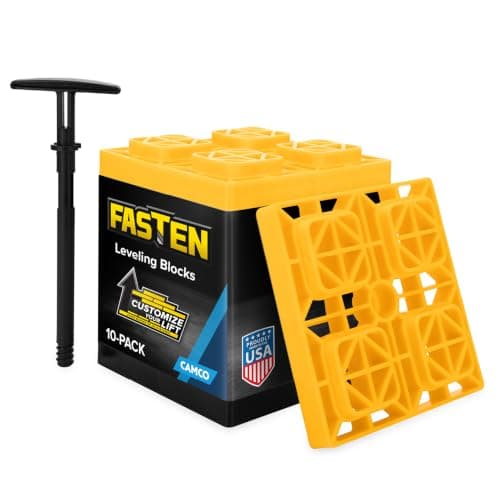 Camco FasTen RV Leveling Blocks, 10-Pack Interlocking plastic blocks that lock together instead of sliding apart, which is the whole difference between these and loose wood. They also go under a jack, which a curved leveler cannot. Build the platform | The default: cheap, interlocking, use them for everything | 7.5/ 10 | |
| 2 | 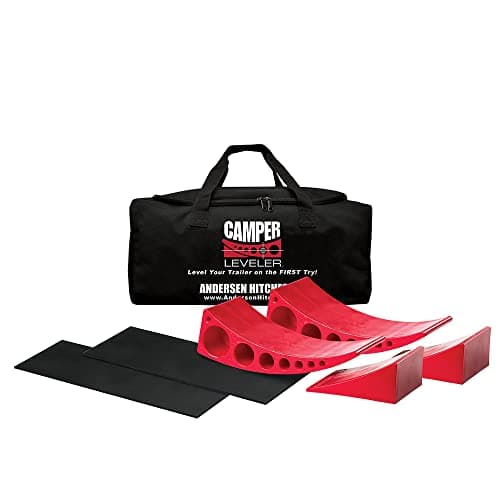 Andersen Camper Leveler, 2-Pack with Mats and Bag A curved ramp you drive up until the bubble centers, then chock. It replaces the guess-stack-check-restack cycle that makes stacking blocks the most annoying job at a campsite. One-pull alternative | Side-to-side leveling in one pull-up, with no stacking | 7.5/ 10 | |
| 3 | 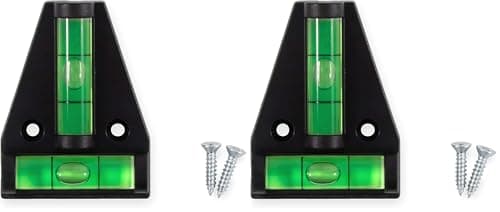 Camco RV T Level, 2-Pack, 25543 Two screw-on bubble levels, one for front-to-back and one for side-to-side. Cheap, and the reason you stop guessing from inside the trailer. Know when to stop | Knowing when to stop driving up the leveler | 8.6/ 10 | $9.16View on Amazon
|
| 4 | 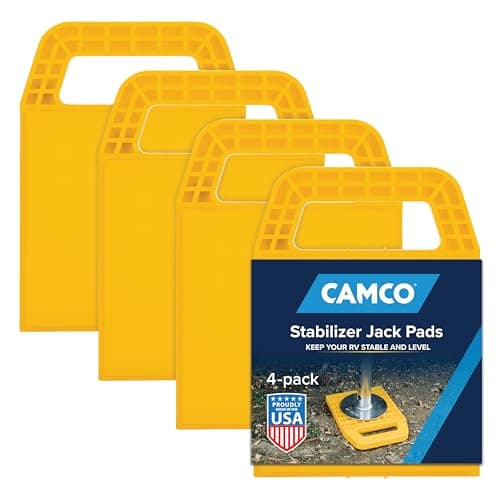 Camco RV Stabilizing Jack Pads, 4-Pack Four plastic pads for under the stabilizer jacks. They stop the jack foot sinking into soft ground, which is the usual reason a leveled trailer is no longer level in the morning. | Keeping scissor jacks out of the dirt | 7.0/ 10 | $13.27View on Amazon
|
Tap any row to jump to the full write-up. Prices come from Amazon and are read automatically — see each product below for the date.
The short answer
Every leveling guide gives you a sequence, and on a flat gravel pad the sequence is all you need. An uneven site is a different problem, because you are no longer correcting one slope with blocks — you are choosing which slope to correct with blocks and which to correct with the jack. Get that choice right and an awkward site takes ten minutes. Get it wrong and you are stacking a tower under one wheel at dusk.
Step 1: read the site before you back in
Walk it. You are looking for three things, and the whole job is decided here.
Which way does it fall, and how much? Most sites fall in two directions at once. Stand at the back of the pad and look along it, then across it. You are trying to find the orientation where the bigger slope runs along the trailer’s length rather than across it.
Where is the flattest patch big enough for the axles? The trailer does not need the whole pad to be flat. It needs the tire footprints to be at equal height. A site with a dip in the middle may be perfectly usable if the dip sits between the axles and the tongue.
What are the fixed constraints? The hookups, the picnic table, the fire ring, the tree, the low branch, and which way the door opens. There is no point finding the perfect orientation if it puts your door against a bank or your sewer outlet uphill of the connection. The sewer hose needs a downhill run and that is a real constraint on orientation, not a detail.
The common mistake
Step 2 onward: the procedure
- 1
Point the trailer so the main slope runs front to back
The tongue jack can lift or drop the front several inches with a crank. Nothing on the trailer corrects side-to-side slope. Give the jack the bigger job. - 2
Back in, still hitched, and check across the trailer
Put a spirit level on a frame rail, not on the floor or a counter. Note which side is low and roughly by how much. - 3
Build the platform for the low side, on a spread base if the ground is soft
On grass, dirt or loose gravel, lay a wider first layer to spread the load before building height. A narrow stack sinks on one corner and the trailer comes off level overnight. - 4
Support both wheels on a tandem axle, at equal height
Build the platform long enough for both tires plus a ramp. One wheel up and one on the ground loads the axles unevenly and does not level the trailer. - 5
Drive up with the tow vehicle and re-check
Pull forward or reverse onto the platform, re-read the level across the frame, and adjust. Expect to do this twice. - 6
Chock all four wheels before unhitching, downhill side first
On a slope this matters more than anywhere else. The chocks must sit on the same raised surface as the tires, not on the ground beside them. - 7
Unhitch, with a pad under the tongue jack foot
On soft or uneven ground the jack foot is the most likely thing to sink. Pad it before you take the weight, not after. - 8
Level front to back with the tongue jack, then stabilize
Spirit level lengthwise on the frame. Then set the stabilizer jacks on pads — they stop movement and are not lifting jacks. Do not use them to correct remaining slope.
When to stop building and move the trailer
There is a point at which more blocks is the wrong answer, and recognizing it is most of the skill on a bad site.
| Situation | Do this |
|---|---|
| Side-to-side correction under 4 in | Build the platform, support both wheels |
| Side-to-side correction over 4 in | Reposition or reorient the trailer |
| Front-to-back slope, any reasonable amount | Use the tongue jack; that is what it is for |
| Tongue jack at full extension and still low | Blocks under the jack foot, or reorient |
| Platform sinking into soft ground | Wider base layer, lower stack, or move |
| Door side is the low side by a lot | Reorient — the step geometry gets dangerous |
The last row is the one people override and should not. When the entry side is the low side on a steeply cross-sloped site, the bottom step ends up a long way off the ground and at an angle, and the grab handle is no longer where your hand expects it. That is a real fall risk, not an inconvenience.
Soft ground, which is its own problem
Uneven and soft frequently arrive together, and soft ground defeats a correct platform. The principle is simple: spread before you build. A wide first layer under the whole platform distributes the tire load over more ground, and the same goes for the tongue jack and every stabilizer foot.
Check it again the next morning. A platform that was level on a dry evening can settle after overnight rain, and the symptom is a door that no longer latches cleanly or a noticeable change in how the floor feels. Re-level rather than ignoring it, especially before running a slide out.
What to remember
- Orientation is the biggest lever. Give the front-to-back slope to the tongue jack.
- Spirit level on the frame rail, never on the floor or a counter.
- On soft ground, spread the load with a wide base layer before building height.
- Support both wheels of a tandem axle at equal height, every time.
- Chocks sit on the raised surface with the tires, downhill side first.
- Over about 4 in of side-to-side correction, move the trailer rather than stacking.
- If the entry side is the low side on a steep cross-slope, reorient — the steps become a fall risk.
The picks in full
Camco FasTen RV Leveling Blocks, 10-Pack
Camco · Best for the default: cheap, interlocking, use them for everything
Interlocking plastic blocks that lock together instead of sliding apart, which is the whole difference between these and loose wood. They also go under a jack, which a curved leveler cannot.
Key specifications
- Block size
- 8.5 in x 8.5 in x 1 in
- Pack
- 10 blocks
- Interlocking
- Yes
- Origin
- Made in USA
Capacity figures read from Camco FasTen specifications, October 2026.
How it scored
- Lift range (25%)7
- Grip / stability (25%)7
- Packed size (20%)8
- Build quality (20%)7
- Price for capability (10%)10
Weighted average of the figures above. We did not test this product — see how we pick.
What it does well
- Interlock, so a stack does not shear sideways under load
- Do double duty under jacks and stabilizers
- Cheapest route to usable leveling
What it is bad at
- Stacking to the right height is trial and error
- One inch per layer means coarse adjustment
- They crack if you drive onto an unsupported overhang
Price as of October 10, 2026. #ad How this is funded
Andersen Camper Leveler, 2-Pack with Mats and Bag
Andersen Hitches · Best for side-to-side leveling in one pull-up, with no stacking
A curved ramp you drive up until the bubble centers, then chock. It replaces the guess-stack-check-restack cycle that makes stacking blocks the most annoying job at a campsite.
Key specifications
- Pack
- 2 levelers, 2 rubber mats, duffel bag
- Rated to
- 30,000 lb
- Lift
- Continuous, up to about 4 in
- Use
- Single-axle and tandem-axle trailers
Capacity figures read from Andersen Camper Leveler specifications, October 2026.
How it scored
- Lift range (25%)9
- Grip / stability (25%)8
- Packed size (20%)5
- Build quality (20%)8
- Price for capability (10%)6
Weighted average of the figures above. We did not test this product — see how we pick.
What it does well
- One pull-up, any lift height — no stacking to the nearest inch
- Chock is built into the design
- Rubber mats stop the ramp sliding on hardpack
What it is bad at
- Expensive next to a bag of plastic blocks
- Bulky to store, even in the bag
- You still need a spotter or a camera to know when to stop
Price as of October 10, 2026. #ad How this is funded
Camco RV T Level, 2-Pack, 25543
Camco · Best for knowing when to stop driving up the leveler
Two screw-on bubble levels, one for front-to-back and one for side-to-side. Cheap, and the reason you stop guessing from inside the trailer.
Key specifications
- Pack
- 2 levels
- Mounting
- Screw-mounted
- Axes
- Front-to-back and side-to-side
- Part
- 25543
Capacity figures read from Camco RV T Level specifications, October 2026.
How it scored
- How often you use it (40%)9
- Build quality (25%)6
- Takes up little room (20%)10
- Price for capability (15%)10
Weighted average of the figures above. We did not test this product — see how we pick.
What it does well
- Lets you read level from outside the trailer, where you are standing
- Costs less than a sandwich
- No batteries, nothing to pair
What it is bad at
- You have to mount them with the trailer already level, or they lie forever
- Screw holes in the trailer skin
- Harder to read at dusk than a phone app
Camco RV Stabilizing Jack Pads, 4-Pack
Camco · Best for keeping scissor jacks out of the dirt
Four plastic pads for under the stabilizer jacks. They stop the jack foot sinking into soft ground, which is the usual reason a leveled trailer is no longer level in the morning.
Key specifications
- Pack
- 4 pads
- Use
- Under scissor and stabilizer jacks
- Material
- Molded plastic
- Origin
- Made in USA
Capacity figures read from Camco jack pad specifications, October 2026.
How it scored
- Lift range (25%)4
- Grip / stability (25%)7
- Packed size (20%)9
- Build quality (20%)7
- Price for capability (10%)10
Weighted average of the figures above. We did not test this product — see how we pick.
What it does well
- Cheapest fix for a trailer that settles overnight
- Spread load on gravel and soft ground
- Stack flat, take almost no space
What it is bad at
- Not rated to lift anything — these spread load, they do not level
- Plastic cracks under a jack that is already over-extended
- Four is not enough if you also want pads under the tongue jack
Common questions
So the larger slope runs along the length. The tongue jack corrects front to back with a crank; side to side can only be fixed with blocks under the tires. Give the jack the bigger job.
Side to side, about four inches of correction is the practical limit — past that you are building a tower. Front to back there is far more latitude because the tongue jack has real travel.
No — they stop movement, they do not lift. Using them to carry real load can bend the jacks or twist the frame. The difference between the two is worth five minutes.
Spread before you build: a wider first layer under the whole platform, and pads under the tongue jack and stabilizer feet. Re-check the next morning — platforms settle after rain.
Sources
- Camco published leveling block and chock specifications — read October 2026
- Andersen Hitches Camper Leveler published specifications — read October 2026
- Tri-Lynx Lynx Levelers published load ratings and stacking guidance — read October 2026
- Lippert published RV leveling and stabilizing documentation — read October 2026