Leveling, Chocks & Stabilizing
How To Level A Travel Trailer With A Slide Out
A slide out changes one thing about leveling, and it is not a small thing: the trailer must be level and stable before the slide moves, and it must stay that way.
By Mike M. ·
How this page is funded: we earn a commission if you buy through our links, at no extra cost to you. It never changes which product we rank first. Prices come from Amazon and are read automatically — each one shows the date it was read. Full disclosure.
Quick picks
The gear this procedure calls for, including support under a long slide on a soft site.
| # | Product | Best for | Score | Price |
|---|---|---|---|---|
| 1 | 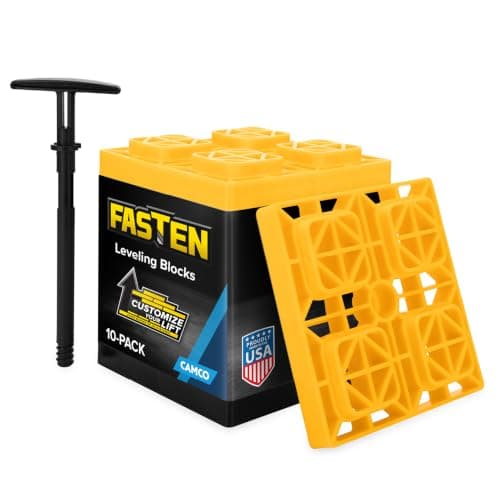 Camco FasTen RV Leveling Blocks, 10-Pack Interlocking plastic blocks that lock together instead of sliding apart, which is the whole difference between these and loose wood. They also go under a jack, which a curved leveler cannot. Level with these | The default: cheap, interlocking, use them for everything | 7.5/ 10 | |
| 2 | 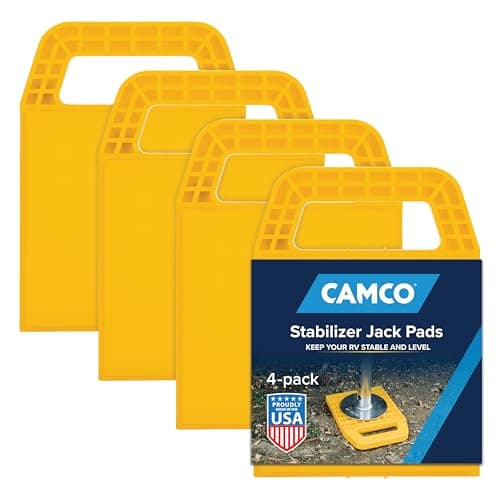 Camco RV Stabilizing Jack Pads, 4-Pack Four plastic pads for under the stabilizer jacks. They stop the jack foot sinking into soft ground, which is the usual reason a leveled trailer is no longer level in the morning. Under every jack | Keeping scissor jacks out of the dirt | 7.0/ 10 | $13.27View on Amazon
|
| 3 | 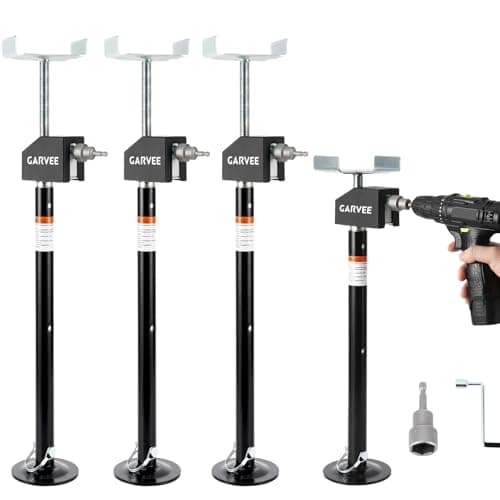 RV Slide-Out Support Jacks, Set of 4 Adjustable screw jacks for under a slide-out. They do not level anything; they stop a long slide bouncing, which is a different and much narrower job. Under a long slide | Supporting a long slide-out on a soft site | 5.5/ 10 | Check price on Amazon No buyable offer at the last price check. |
| 4 | 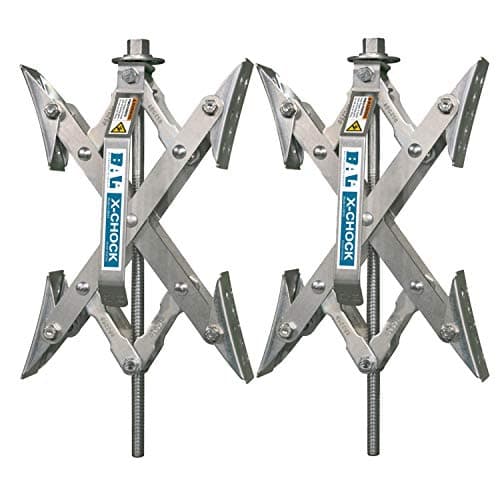 X-Chock Wheel Stabilizer, Pair, 28012 Wedges between the two tires of a tandem axle and screws out against both. It is doing a different job from a chock — it stops the trailer rocking rather than stopping it rolling. | Stopping the rocking motion on a tandem-axle trailer | 6.8/ 10 |
Tap any row to jump to the full write-up. Prices come from Amazon and are read automatically — see each product below for the date.
The short answer
Everything on the standard leveling page still applies. What a slide out adds is a constraint on sequence and a reason to care about stability far more than a trailer without one.
Slide out: a section of the trailer’s side wall that extends outward on rails or rack-and-pinion gears to widen a room. It is a heavy assembly cantilevered off one side of the frame, which is why it is sensitive to the frame not sitting square.
Why the order matters
A slide runs on rails and is driven by a motor through gears, a rack, or a hydraulic ram. All of those designs assume the opening it travels through is square. When a trailer sits unlevel, the frame flexes slightly and the opening is no longer quite square to the slide box.
Three things follow. The motor works harder, because it is pushing the box through an opening that is now a few millimeters out of true — which you hear as a laboring or uneven noise. The seals compress unevenly, so the top seal may not contact across its full length and water finds the gap. And the box can bind partway, at which point you have a trailer you cannot pack up until you level it and try again.
The second effect is the one that costs money quietly. Slide seal failure shows up as a damp patch on a wall or ceiling months later, and by then the cause is invisible.
The common mistake
The procedure
- 1
Position and level side to side while still hitched
Spirit level on the frame rail. Build the platform under the low side, supporting both wheels of a tandem axle at equal height, and drive up with the tow vehicle. - 2
Chock all four wheels, downhill side first
Chocks on the same raised surface as the tires. The tow vehicle is holding the trailer right now; the chocks are about to be. - 3
Unhitch with a pad under the tongue jack foot
Pad first, then take the weight. Release the weight distribution bars, unlatch the coupler and drive the truck clear. - 4
Level front to back with the tongue jack
Spirit level lengthwise on the frame. Get this right now; correcting it after the slide is out means retracting the slide first. - 5
Set every stabilizer jack onto a pad, snug but not lifting
Extend each jack until it is firmly loaded and the trailer stops moving when you rock it. Stabilizers prevent movement; they are not lifting jacks and must not be used to take out remaining slope. - 6
Re-check the level before you touch the slide switch
This is the check the whole page exists for. Both axes, on the frame. If anything has settled onto the blocks or into soft ground, fix it now. - 7
Run the slide out, listening to it
Operate it in one continuous motion and listen. A laboring, grinding or uneven sound means stop, retract, and re-check level. Do not push a binding slide through. - 8
Support a long slide if the ground is soft
On a long slide over soft ground, slide support jacks under the outboard edge reduce how much the frame carries cantilevered. Set them to support, not to lift the box — forcing a slide upward from below strains the mechanism as surely as an unlevel frame does. - 9
Re-check after the first night
Blocks settle, soft ground compacts and jack feet sink. Re-read the level in the morning and adjust, and always re-check before retracting the slide.
Packing up: the reverse order, and why
Retract the slide before you raise the stabilizer jacks or touch the tongue jack. The trailer must still be level and supported when the box travels back in, for exactly the reasons it had to be level going out. Owners who raise the jacks first and then discover the slide will not retract have created the one failure mode that strands a trailer at a campsite.
Then: jacks up, hitch up, bars on, chocks out, blocks collected. The departure checklist runs the whole sequence, and the slide line sits deliberately near the top of it.
The separate problem: rocking with the slide out
A slide out puts several hundred pounds a couple of feet beyond the side of the frame, which makes a trailer noticeably more willing to rock when someone walks across it. Two things reduce it, and they address different causes.
Stabilizer jacks on firm pads stop vertical movement at the four corners. X-chocks between the tandem wheels stop the trailer rocking on its own suspension, which is the motion most people actually notice and the one stabilizer jacks do least about. X-chocks and how they differ from wheel chocks cover that, and jack pads are what keep the jack feet out of the dirt.
What to remember
- Level and stabilize completely before the slide moves. Every time.
- Re-check both axes immediately before touching the slide switch.
- A laboring or grinding slide means stop and re-check level, not push harder.
- Stabilizer jacks stop movement; they are not lifting jacks and must not correct slope.
- Retract the slide before raising any jack when packing up.
- Re-check the level each morning — blocks settle and jack feet sink overnight.
- X-chocks address the rocking a slide out makes worse better than stabilizer jacks do.
The picks in full
Camco FasTen RV Leveling Blocks, 10-Pack
Camco · Best for the default: cheap, interlocking, use them for everything
Interlocking plastic blocks that lock together instead of sliding apart, which is the whole difference between these and loose wood. They also go under a jack, which a curved leveler cannot.
Key specifications
- Block size
- 8.5 in x 8.5 in x 1 in
- Pack
- 10 blocks
- Interlocking
- Yes
- Origin
- Made in USA
Capacity figures read from Camco FasTen specifications, October 2026.
How it scored
- Lift range (25%)7
- Grip / stability (25%)7
- Packed size (20%)8
- Build quality (20%)7
- Price for capability (10%)10
Weighted average of the figures above. We did not test this product — see how we pick.
What it does well
- Interlock, so a stack does not shear sideways under load
- Do double duty under jacks and stabilizers
- Cheapest route to usable leveling
What it is bad at
- Stacking to the right height is trial and error
- One inch per layer means coarse adjustment
- They crack if you drive onto an unsupported overhang
Price as of October 10, 2026. #ad How this is funded
Camco RV Stabilizing Jack Pads, 4-Pack
Camco · Best for keeping scissor jacks out of the dirt
Four plastic pads for under the stabilizer jacks. They stop the jack foot sinking into soft ground, which is the usual reason a leveled trailer is no longer level in the morning.
Key specifications
- Pack
- 4 pads
- Use
- Under scissor and stabilizer jacks
- Material
- Molded plastic
- Origin
- Made in USA
Capacity figures read from Camco jack pad specifications, October 2026.
How it scored
- Lift range (25%)4
- Grip / stability (25%)7
- Packed size (20%)9
- Build quality (20%)7
- Price for capability (10%)10
Weighted average of the figures above. We did not test this product — see how we pick.
What it does well
- Cheapest fix for a trailer that settles overnight
- Spread load on gravel and soft ground
- Stack flat, take almost no space
What it is bad at
- Not rated to lift anything — these spread load, they do not level
- Plastic cracks under a jack that is already over-extended
- Four is not enough if you also want pads under the tongue jack
RV Slide-Out Support Jacks, Set of 4
Garvee · Best for supporting a long slide-out on a soft site
Adjustable screw jacks for under a slide-out. They do not level anything; they stop a long slide bouncing, which is a different and much narrower job.
Key specifications
- Pack
- Set of 4
- Rating
- 20,000 lb stated
- Range
- 21 in to 49 in
- Operation
- Power drill or hand crank
How it scored
- Lift range (25%)6
- Grip / stability (25%)6
- Packed size (20%)3
- Build quality (20%)6
- Price for capability (10%)7
Weighted average of the figures above. We did not test this product — see how we pick.
What it does well
- Big adjustment range covers most slide heights
- Drill-driven, so setting four of them is quick
- Noticeably firms up a long slide
What it is bad at
- Many slide-out makers advise against supporting the slide at all — check your manual first
- No independent verification of the stated load rating
- Heavy and bulky to carry
X-Chock Wheel Stabilizer, Pair, 28012
BAL · Best for stopping the rocking motion on a tandem-axle trailer
Wedges between the two tires of a tandem axle and screws out against both. It is doing a different job from a chock — it stops the trailer rocking rather than stopping it rolling.
Key specifications
- Pack
- Pair, one handle
- Use
- Tandem-axle trailers only
- Action
- Scissor wedge, ratchet-tightened
- Function
- Stabilizing, not primary chocking
How it scored
- Holding force (35%)6
- Fit range (25%)6
- Everyday usability (20%)8
- Build quality (10%)9
- Price for capability (10%)7
Weighted average of the figures above. We did not test this product — see how we pick.
What it does well
- Visibly reduces the side-to-side rock that makes a trailer feel flimsy
- Ratchets tight so it does not work loose
- One handle does both chocks
What it is bad at
- Useless on a single-axle trailer — there is no gap to fill
- Not a substitute for a real chock on a slope
- Fiddly to fit if your tires sit close together
Price as of October 10, 2026. #ad How this is funded
Common questions
Before, always. An unlevel trailer flexes the frame enough to put the slide opening out of true, which makes the motor labor, compresses the seals unevenly and can leave the box bound partway.
Better not to. While hitched, the trailer is partly resting on the tow vehicle’s suspension, which is not a fixed reference. Unhitch, level, stabilize, then run the slide.
Usually not, and never instead of leveling — slides are built to be cantilevered. They are worth it on a long slide over soft ground, set to support rather than to lift.
Check the level first — a frame that settled since the slide went out is the usual cause. Re-level, re-stabilize, try again. Do not raise the jacks or hitch up first; the slide needs the trailer level and supported.
Sources
- Camco published leveling block and chock specifications — read October 2026
- Andersen Hitches Camper Leveler published specifications — read October 2026
- Tri-Lynx Lynx Levelers published load ratings and stacking guidance — read October 2026
- Lippert published RV leveling and stabilizing documentation — read October 2026