Leveling, Chocks & Stabilizing
The Best RV Leveling Blocks
Blocks are cheap, versatile and slow. Ramps are quick and bulky. Here is which to buy and why most owners end up with both.
By Mike M. ·
How this page is funded: we earn a commission if you buy through our links, at no extra cost to you. It never changes which product we rank first. Prices come from Amazon and are read automatically — each one shows the date it was read. Full disclosure.
Quick picks
Scored on lift range (25%), grip and stability (25%), packed size (20%), build (20%) and price (10%). Weighted so a product that will not slide on wet concrete beats one that packs smaller.
| # | Product | Best for | Score | Price |
|---|---|---|---|---|
| 1 | 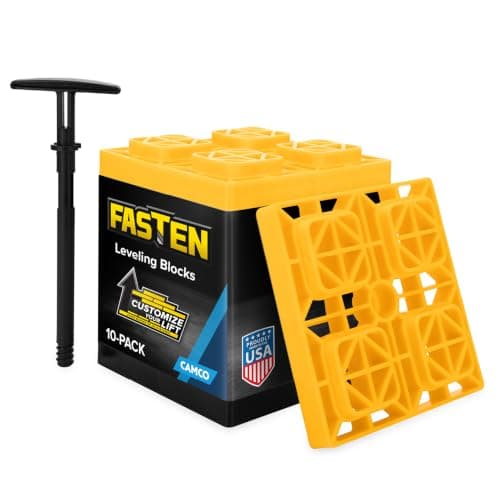 Camco FasTen RV Leveling Blocks, 10-Pack Interlocking plastic blocks that lock together instead of sliding apart, which is the whole difference between these and loose wood. They also go under a jack, which a curved leveler cannot. Top pick | The default: cheap, interlocking, use them for everything | 7.5/ 10 | |
| 2 | 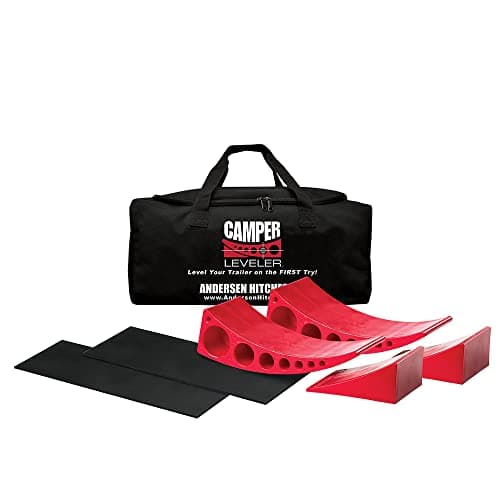 Andersen Camper Leveler, 2-Pack with Mats and Bag A curved ramp you drive up until the bubble centers, then chock. It replaces the guess-stack-check-restack cycle that makes stacking blocks the most annoying job at a campsite. Fastest leveling | Side-to-side leveling in one pull-up, with no stacking | 7.5/ 10 | |
| 3 | 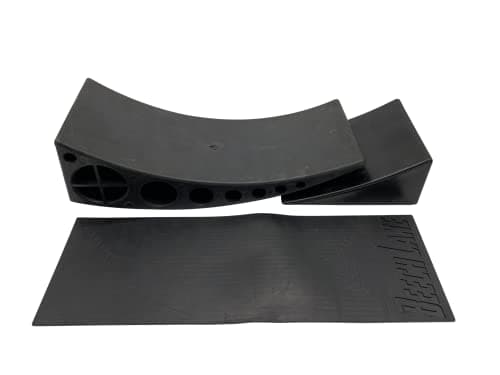 Beech Lane Camper Leveler, 1 Pack The same drive-up curved-ramp idea as the Andersen at under half the price, rated to 35,000 lb, and it includes the chock and grip mat. Best value ramp | Curved-ramp leveling for a single-axle trailer, cheaply | 7.5/ 10 | |
| 4 | 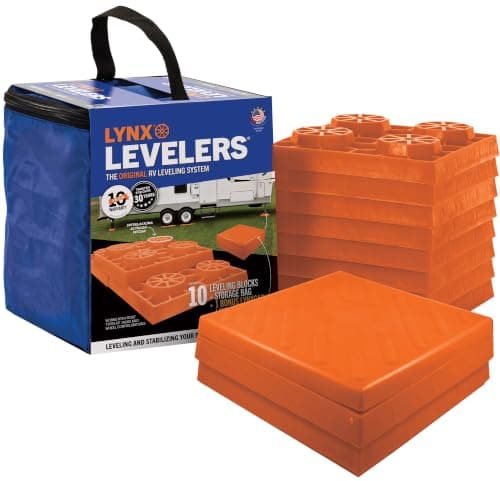 Lynx Levelers, 11-Pack with Cap and Storage Bag The long-standing honeycomb block. Eleven pieces including a cap, which is the detail that matters: the cap gives a flat top so a jack foot does not sit in the honeycomb. | Leveling, jack pads and stabilizer feet from one bag | 7.3/ 10 | |
| 5 | 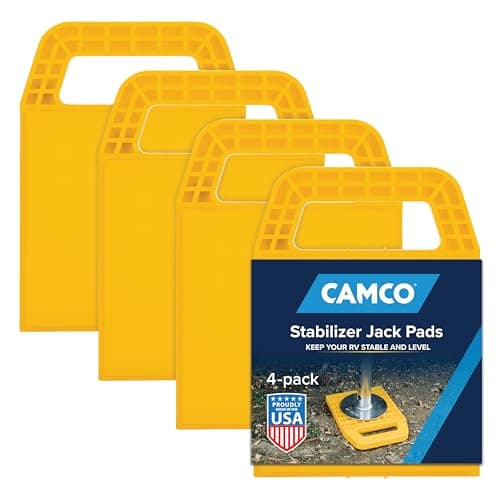 Camco RV Stabilizing Jack Pads, 4-Pack Four plastic pads for under the stabilizer jacks. They stop the jack foot sinking into soft ground, which is the usual reason a leveled trailer is no longer level in the morning. Buy these too | Keeping scissor jacks out of the dirt | 7.0/ 10 | $13.97View on Amazon
|
| 6 | 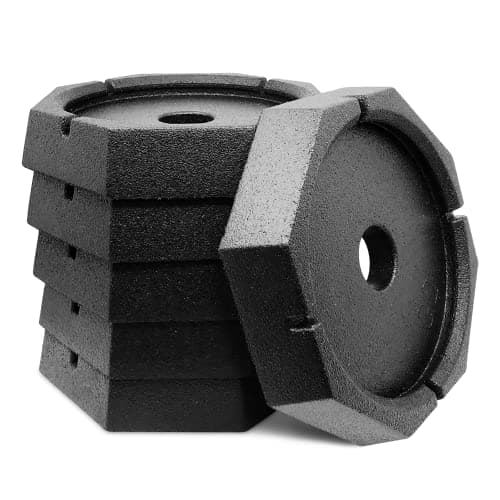 SnapPad Xtra Permanent RV Jack Pads, 6-Pack Rubber pads that snap permanently onto the jack feet, so there is nothing to place, nothing to forget and nothing to leave behind at a site. | Never carrying jack pads again | 7.8/ 10 |
Tap any row to jump to the full write-up. Prices come from Amazon and are read automatically — see each product below for the date.
The short answer
Leveling a travel trailer side to side means raising one set of wheels. There are exactly two ways to do that, and they have genuinely different trade-offs rather than one being better.
Why level matters, beyond comfort
A trailer that is not level is not just annoying. An absorption refrigerator — which is what most travel trailers have — relies on gravity to circulate ammonia through its cooling coils, and running it significantly out of level reduces cooling and can, over time, damage it. Most makers specify something like 3 degrees side to side and 6 degrees front to back as the limit.
There are practical reasons too: doors that swing shut on their own, water that will not drain out of a shower pan, and a bed with a noticeable downhill end. But the fridge is the one that costs money.
Interlocking blocks: the default
Molded plastic blocks, usually about 8.5 in square and an inch thick, that interlock so a stack cannot shear sideways as a tire climbs onto it. A ten- or eleven-pack is enough for most situations.
What they are good at: cost, and versatility. One bag does leveling under wheels, pads under scissor jacks, a base under the tongue jack, and a platform under a sinking stabilizer. Nothing else here does all four.
What they are bad at: precision and time. Each layer is an inch, so you cannot land between steps, and getting it right means a guess, a drive-up, a check and usually a restack. Twice, in the rain, with somebody watching.
The detail that matters: a cap piece. A honeycomb block has an open top, and a jack foot sitting in the honeycomb concentrates load on thin webs. A flat cap piece spreads it. Buy a set that includes one.
Curved levelers: the time saver
A molded ramp you drive up until the bubble centers, then chock in place. Continuous lift rather than one-inch steps, and one pull-up instead of a cycle.
What they are good at: speed and precision. Any lift height within their range, first time, no stacking.
What they are bad at: bulk, price, and they cannot go under a jack. They also slide on hardpack or wet concrete without the rubber grip mat, which is why the better kits include one — and why the kits that do not are a false economy.
The common mistake
Jack pads: the cheap thing nobody buys and everybody needs
Your scissor jacks have small steel feet. On gravel, dirt or soft grass, those feet sink — slowly, over hours — and the trailer you leveled at seven is not level at midnight.
Plastic pads under each jack spread the load and stop it. They cost almost nothing, they stack flat, and they are the single highest-return purchase in this section.
The permanent version snaps onto the jack feet so there is nothing to place and nothing to leave behind at a site. It is jack-specific, so check the fit, and it costs substantially more — for a trailer you set up every weekend it earns it.
How much lift do you actually need?
| Site cross-slope | Lift needed | Blocks (1 in each) |
|---|---|---|
| 1 degree | About 1.5 in | 2 layers |
| 2 degrees | About 3 in | 3 layers |
| 3 degrees | About 4.5 in | 5 layers |
| 4 degrees | About 6 in | 6 layers — find a flatter spot |
Most block makers cap stacking at around four layers. Past that, the honest answer is to move the trailer rather than build a taller tower — a tall stack fails sideways, and a tire coming off a five-high stack is a bad afternoon.
The verdict
Start with interlocking blocks and jack pads. That covers you for everything and costs very little. Add a curved leveler kit when you decide the restacking is not worth your time, which for most people is somewhere around trip four. Buy the permanent jack pads if you camp most weekends.
What to remember
- An out-of-level absorption fridge cools badly and can be damaged. That is the real reason to level.
- Interlocking blocks are cheap and versatile but slow — one inch per layer and a lot of restacking.
- Curved levelers give continuous lift in one pull-up, and cannot go under a jack.
- Jack pads are the cheapest high-return purchase here. Jacks sink overnight on soft ground.
- Cap stacks at about four layers. Past that, move the trailer.
The picks in full
Camco FasTen RV Leveling Blocks, 10-Pack
Camco · Best for the default: cheap, interlocking, use them for everything
Interlocking plastic blocks that lock together instead of sliding apart, which is the whole difference between these and loose wood. They also go under a jack, which a curved leveler cannot.
Key specifications
- Block size
- 8.5 in x 8.5 in x 1 in
- Pack
- 10 blocks
- Interlocking
- Yes
- Origin
- Made in USA
Capacity figures read from Camco FasTen specifications, October 2026.
How it scored
- Lift range (25%)7
- Grip / stability (25%)7
- Packed size (20%)8
- Build quality (20%)7
- Price for capability (10%)10
Weighted average of the figures above. We did not test this product — see how we pick.
What it does well
- Interlock, so a stack does not shear sideways under load
- Do double duty under jacks and stabilizers
- Cheapest route to usable leveling
What it is bad at
- Stacking to the right height is trial and error
- One inch per layer means coarse adjustment
- They crack if you drive onto an unsupported overhang
Price as of October 5, 2026. #ad How this is funded
Andersen Camper Leveler, 2-Pack with Mats and Bag
Andersen Hitches · Best for side-to-side leveling in one pull-up, with no stacking
A curved ramp you drive up until the bubble centers, then chock. It replaces the guess-stack-check-restack cycle that makes stacking blocks the most annoying job at a campsite.
Key specifications
- Pack
- 2 levelers, 2 rubber mats, duffel bag
- Rated to
- 30,000 lb
- Lift
- Continuous, up to about 4 in
- Use
- Single-axle and tandem-axle trailers
Capacity figures read from Andersen Camper Leveler specifications, October 2026.
How it scored
- Lift range (25%)9
- Grip / stability (25%)8
- Packed size (20%)5
- Build quality (20%)8
- Price for capability (10%)6
Weighted average of the figures above. We did not test this product — see how we pick.
What it does well
- One pull-up, any lift height — no stacking to the nearest inch
- Chock is built into the design
- Rubber mats stop the ramp sliding on hardpack
What it is bad at
- Expensive next to a bag of plastic blocks
- Bulky to store, even in the bag
- You still need a spotter or a camera to know when to stop
Price as of October 5, 2026. #ad How this is funded
Beech Lane Camper Leveler, 1 Pack
Beech Lane · Best for curved-ramp leveling for a single-axle trailer, cheaply
The same drive-up curved-ramp idea as the Andersen at under half the price, rated to 35,000 lb, and it includes the chock and grip mat.
Key specifications
- Pack
- 1 leveler, 1 chock, 1 rubber grip mat
- Rated to
- 35,000 lb
- Type
- Curved ramp, continuous lift
- Patent
- Patented design
How it scored
- Lift range (25%)9
- Grip / stability (25%)7
- Packed size (20%)6
- Build quality (20%)7
- Price for capability (10%)9
Weighted average of the figures above. We did not test this product — see how we pick.
What it does well
- Dramatically cheaper than the alternative curved leveler
- Chock and grip mat in the box
- Highest stated load rating in this group
What it is bad at
- One leveler per pack — a tandem axle usually wants a second
- Plastic flexes on soft ground without the mat
- Less established brand with fewer long-term owner reports
Price as of October 5, 2026. #ad How this is funded
Lynx Levelers, 11-Pack with Cap and Storage Bag
Tri-Lynx · Best for leveling, jack pads and stabilizer feet from one bag
The long-standing honeycomb block. Eleven pieces including a cap, which is the detail that matters: the cap gives a flat top so a jack foot does not sit in the honeycomb.
Key specifications
- Pack
- 11 pieces including 1 cap level top
- Design
- Interlocking honeycomb
- Storage
- Bag included
- Origin
- Made in USA
How it scored
- Lift range (25%)7
- Grip / stability (25%)6
- Packed size (20%)8
- Build quality (20%)7
- Price for capability (10%)10
Weighted average of the figures above. We did not test this product — see how we pick.
What it does well
- Cap piece gives a flat bearing surface for jacks
- Honeycomb is strong for its weight
- Decades of owner reports to read
What it is bad at
- Honeycomb edges split if you drive onto a stack at an angle
- No grip mat, so they slide on wet concrete
- Same coarse one-inch-per-layer stacking
Price as of October 5, 2026. #ad How this is funded
Camco RV Stabilizing Jack Pads, 4-Pack
Camco · Best for keeping scissor jacks out of the dirt
Four plastic pads for under the stabilizer jacks. They stop the jack foot sinking into soft ground, which is the usual reason a leveled trailer is no longer level in the morning.
Key specifications
- Pack
- 4 pads
- Use
- Under scissor and stabilizer jacks
- Material
- Molded plastic
- Origin
- Made in USA
Capacity figures read from Camco jack pad specifications, October 2026.
How it scored
- Lift range (25%)4
- Grip / stability (25%)7
- Packed size (20%)9
- Build quality (20%)7
- Price for capability (10%)10
Weighted average of the figures above. We did not test this product — see how we pick.
What it does well
- Cheapest fix for a trailer that settles overnight
- Spread load on gravel and soft ground
- Stack flat, take almost no space
What it is bad at
- Not rated to lift anything — these spread load, they do not level
- Plastic cracks under a jack that is already over-extended
- Four is not enough if you also want pads under the tongue jack
SnapPad Xtra Permanent RV Jack Pads, 6-Pack
SnapPad · Best for never carrying jack pads again
Rubber pads that snap permanently onto the jack feet, so there is nothing to place, nothing to forget and nothing to leave behind at a site.
Key specifications
- Pack
- 6 pads
- Size
- 9 in round
- Fit
- LCI leveling system jack feet
- Origin
- Made in USA
How it scored
- Lift range (25%)5
- Grip / stability (25%)9
- Packed size (20%)10
- Build quality (20%)9
- Price for capability (10%)5
Weighted average of the figures above. We did not test this product — see how we pick.
What it does well
- Permanently attached — no pads to set out or lose
- Rubber is quieter and grips better than plastic
- Spreads load over a much larger area than a bare foot
What it is bad at
- Fit is jack-specific — check your jack feet before buying
- Costs more than fifteen packs of plastic pads
- Adds a fixed amount to your minimum jack height
Price as of October 5, 2026. #ad How this is funded
Common questions
Most makers cap it at around four layers. Beyond that a stack shifts sideways as the tire climbs it. If you need more lift, move the trailer.
Yes, on the side you are raising. Supporting only one wheel of a tandem pair twists the suspension and loads one axle much more heavily than the other.
Yes, within their limits. They are designed for trailer tire point loads and interlock so a stack resists shearing. They fail when driven onto at an angle, stacked too high, or with a tire overhanging an unsupported edge.
Sources
- Camco published leveling block and chock specifications — read October 2026
- Andersen Hitches Camper Leveler published specifications — read October 2026
- RV Industry Association — standards and compliance program — read October 2026