Leveling, Chocks & Stabilizing
RV Leveling Blocks vs Ramps
These are not two versions of the same product. Blocks are a stackable kit you can use under jacks, pads and tongue jacks; ramps do one job, once, faster than blocks ever will.
By Mike M. ·
How this page is funded: we earn a commission if you buy through our links, at no extra cost to you. It never changes which product we rank first. Prices come from Amazon and are read automatically — each one shows the date it was read. Full disclosure.
Quick picks
Scored on the published leveling rubric - lift (25%), grip (25%), packed size (20%), build (20%), price (10%). The two blocks and the two ramps that represent each approach properly.
| # | Product | Best for | Score | Price |
|---|---|---|---|---|
| 1 | 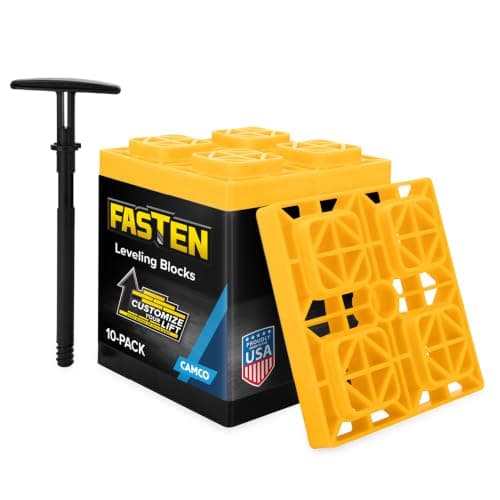 Camco FasTen RV Leveling Blocks, 10-Pack Interlocking plastic blocks that lock together instead of sliding apart, which is the whole difference between these and loose wood. They also go under a jack, which a curved leveler cannot. Best blocks | The default: cheap, interlocking, use them for everything | 7.5/ 10 | |
| 2 | 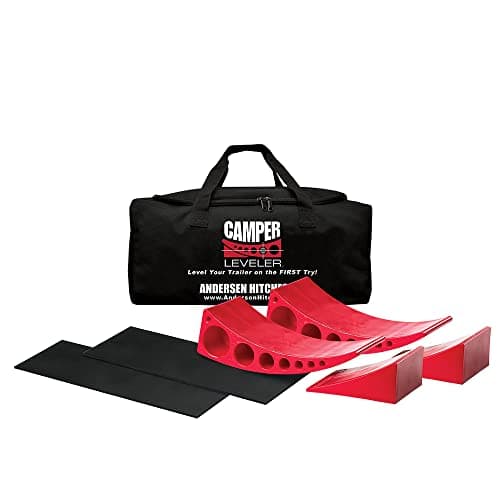 Andersen Camper Leveler, 2-Pack with Mats and Bag A curved ramp you drive up until the bubble centers, then chock. It replaces the guess-stack-check-restack cycle that makes stacking blocks the most annoying job at a campsite. Best ramps | Side-to-side leveling in one pull-up, with no stacking | 7.5/ 10 | |
| 3 | 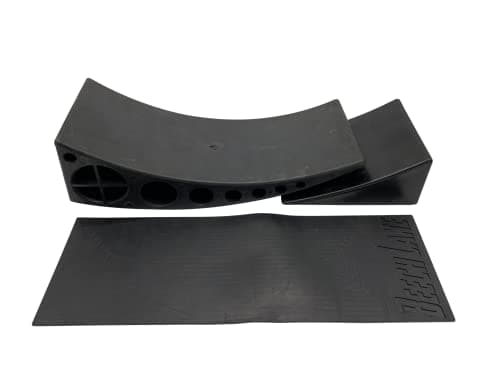 Beech Lane Camper Leveler, 1 Pack The same drive-up curved-ramp idea as the Andersen at under half the price, rated to 35,000 lb, and it includes the chock and grip mat. Cheapest ramp | Curved-ramp leveling for a single-axle trailer, cheaply | 7.5/ 10 | |
| 4 | 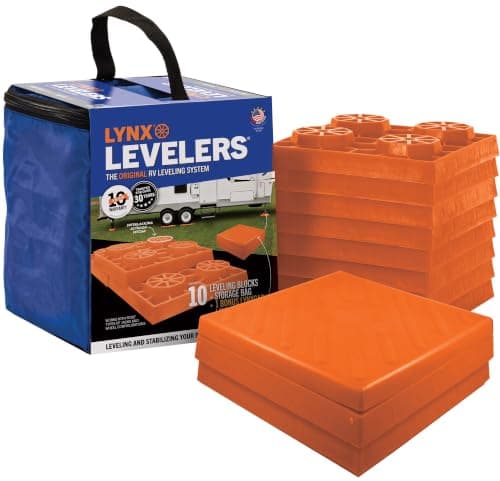 Lynx Levelers, 11-Pack with Cap and Storage Bag The long-standing honeycomb block. Eleven pieces including a cap, which is the detail that matters: the cap gives a flat top so a jack foot does not sit in the honeycomb. Most versatile blocks | Leveling, jack pads and stabilizer feet from one bag | 7.3/ 10 |
Tap any row to jump to the full write-up. Prices come from Amazon and are read automatically — see each product below for the date.
The short answer
The confusion is in the word “leveling,” which covers two different tasks. Side-to-side leveling means raising one side’s wheels until the trailer is level across its width. Everything else — keeping the tongue jack out of the mud, giving stabilizer feet something solid to land on, spreading load on a soft site — is a separate job that only one of these two products can do.
Curved leveler: a wedge-shaped ramp with a continuously rising surface and a chock that drops in behind it. You drive up until the trailer is level and stop; the chock holds you there. There are no increments, so you are never stuck between two block heights.
Head to head
| Stacking blocks | Curved ramps | |
|---|---|---|
| Lift increments | Fixed, usually 1 in per block | Continuous, no increments |
| Typical max lift | Limited by how high you dare stack | About 4 in on the Andersen |
| Setup | Guess height, stack, pull up, re-check, re-stack | One pull-up, stop when level |
| Also works under | Tongue jack, stabilizers, jack pads | Wheels only |
| Dual wheels | Yes, with enough blocks | Check the model's rating |
| Packed size | Compact, stacks flat | Bulkier per unit |
| Price | Lowest | Higher |
The row that decides it for most first-time owners is the second-to-last one. A 10-pack of blocks is the cheapest piece of RV gear that solves four problems. A pair of ramps solves one problem beautifully. Those are different purchases, not competing ones.
Where blocks win
They do more than one job. This is the real argument. The same bag of blocks goes under the tongue jack so it is not sinking into gravel, under the stabilizer feet so they reach the ground on a crowned site, and under a wheel when you need two inches of lift. A ramp cannot do any of those. The jack pad roundup covers the dedicated versions, but blocks cover it adequately in a pinch.
They go higher. A badly sloped site may need five or six inches on one side. Ramps top out; blocks keep stacking, within reason — and the limit on how high you should stack them is a judgment call rather than a published number. Leveling on uneven ground covers the point at which a site is simply the wrong site.
They cost less. Meaningfully less, for a kit that covers more ground.
The Lynx version adds a level top cap. The 11-piece Lynx kit includes a cap that gives you a flat top surface for a jack foot, which is the detail that makes blocks genuinely useful under stabilizers rather than just adequate.
Where ramps win
One pull-up, no guessing. The stacking workflow is: estimate the height, build the stack, pull up, discover you are an inch out, get out, adjust, pull up again. The ramp workflow is: put the ramp down, drive up until the bubble is centered, stop, drop the chock in. On a wet evening after six hours of driving, that difference is the whole product.
Continuous adjustment. Blocks come in one-inch steps. Trailers do not need whole numbers of inches. A ramp gives you whatever height you stopped at.
Fewer pieces to lose. Two ramps and two chocks, in a bag. Ten blocks spread across a gravel pad in the dark is a genuine category of camping irritation.
They come with a grip mat. Both ramps on this page ship with rubber mats, which matters more than it sounds: the common failure mode for a plastic ramp is sliding forward on hard-packed gravel as the tire climbs it.
Camco FasTen blocks
- One kit covers wheels, tongue jack, stabilizers and soft ground
- Interlocking, so a stack behaves as one piece
- Stacks as high as the site needs
- Cheapest route to leveling, by a clear margin
- Requires guessing, re-parking and picking ten pieces back up
Andersen Camper Leveler
- Levels in one pull-up with no stacking
- Continuous lift to about 4 in - no increments to land between
- Rated to 30,000 lb, with mats and a bag included
- Four pieces to put away instead of ten
- Does nothing for the tongue jack or stabilizer feet
Which should you buy
Buy blocks first if you are outfitting a first trailer and want the most capability per dollar. Ten FasTen blocks cover leveling, jack support and soft ground, and they are the thing you will reach for most often. The Lynx 11-pack is the alternative if you want the level cap for jack feet.
Buy ramps first if you already own a bag of blocks and the stacking is what you want to stop doing, or if you move sites frequently and setup speed is the thing you are buying. The Andersen is the one to get; the Beech Lane single pack is the cheaper way in and includes its own chock and grip mat.
Buy both, eventually, which is what most regular campers do. Ramps for the wheels, blocks for everything else. Then add a level you can actually read — the side-to-side guide covers the measuring half of this job, which neither product does for you.
The common mistake
What to remember
- Blocks and ramps are not substitutes - blocks do four jobs, ramps do one well.
- Blocks are cheaper, stack higher, and work under jacks and stabilizer feet.
- Ramps level in one pull-up with continuous height and no guessing.
- The Lynx kit's level cap makes blocks genuinely usable under jack feet.
- Always use the grip mat under a ramp on hard ground.
- Most regular campers end up owning both.
How we compared them
We have not leveled a trailer with each of these on the same site. This comparison reads each maker’s published dimensions, ratings and kit contents alongside current retailer listing data read automatically, and reports the workflow differences the designs dictate plus what owners consistently say about them. Ratings vary by part number — check the listing for the exact kit you order, particularly for dual-wheel use. Our method is on how we pick.
The picks in full
Camco FasTen RV Leveling Blocks, 10-Pack
Camco · Best for the default: cheap, interlocking, use them for everything
Interlocking plastic blocks that lock together instead of sliding apart, which is the whole difference between these and loose wood. They also go under a jack, which a curved leveler cannot.
Key specifications
- Block size
- 8.5 in x 8.5 in x 1 in
- Pack
- 10 blocks
- Interlocking
- Yes
- Origin
- Made in USA
Capacity figures read from Camco FasTen specifications, October 2026.
How it scored
- Lift range (25%)7
- Grip / stability (25%)7
- Packed size (20%)8
- Build quality (20%)7
- Price for capability (10%)10
Weighted average of the figures above. We did not test this product — see how we pick.
What it does well
- Interlock, so a stack does not shear sideways under load
- Do double duty under jacks and stabilizers
- Cheapest route to usable leveling
What it is bad at
- Stacking to the right height is trial and error
- One inch per layer means coarse adjustment
- They crack if you drive onto an unsupported overhang
Price as of October 21, 2026. #ad How this is funded
Andersen Camper Leveler, 2-Pack with Mats and Bag
Andersen Hitches · Best for side-to-side leveling in one pull-up, with no stacking
A curved ramp you drive up until the bubble centers, then chock. It replaces the guess-stack-check-restack cycle that makes stacking blocks the most annoying job at a campsite.
Key specifications
- Pack
- 2 levelers, 2 rubber mats, duffel bag
- Rated to
- 30,000 lb
- Lift
- Continuous, up to about 4 in
- Use
- Single-axle and tandem-axle trailers
Capacity figures read from Andersen Camper Leveler specifications, October 2026.
How it scored
- Lift range (25%)9
- Grip / stability (25%)8
- Packed size (20%)5
- Build quality (20%)8
- Price for capability (10%)6
Weighted average of the figures above. We did not test this product — see how we pick.
What it does well
- One pull-up, any lift height — no stacking to the nearest inch
- Chock is built into the design
- Rubber mats stop the ramp sliding on hardpack
What it is bad at
- Expensive next to a bag of plastic blocks
- Bulky to store, even in the bag
- You still need a spotter or a camera to know when to stop
Price as of October 21, 2026. #ad How this is funded
Beech Lane Camper Leveler, 1 Pack
Beech Lane · Best for curved-ramp leveling for a single-axle trailer, cheaply
The same drive-up curved-ramp idea as the Andersen at under half the price, rated to 35,000 lb, and it includes the chock and grip mat.
Key specifications
- Pack
- 1 leveler, 1 chock, 1 rubber grip mat
- Rated to
- 35,000 lb
- Type
- Curved ramp, continuous lift
- Patent
- Patented design
How it scored
- Lift range (25%)9
- Grip / stability (25%)7
- Packed size (20%)6
- Build quality (20%)7
- Price for capability (10%)9
Weighted average of the figures above. We did not test this product — see how we pick.
What it does well
- Dramatically cheaper than the alternative curved leveler
- Chock and grip mat in the box
- Highest stated load rating in this group
What it is bad at
- One leveler per pack — a tandem axle usually wants a second
- Plastic flexes on soft ground without the mat
- Less established brand with fewer long-term owner reports
Price as of October 21, 2026. #ad How this is funded
Lynx Levelers, 11-Pack with Cap and Storage Bag
Tri-Lynx · Best for leveling, jack pads and stabilizer feet from one bag
The long-standing honeycomb block. Eleven pieces including a cap, which is the detail that matters: the cap gives a flat top so a jack foot does not sit in the honeycomb.
Key specifications
- Pack
- 11 pieces including 1 cap level top
- Design
- Interlocking honeycomb
- Storage
- Bag included
- Origin
- Made in USA
How it scored
- Lift range (25%)7
- Grip / stability (25%)6
- Packed size (20%)8
- Build quality (20%)7
- Price for capability (10%)10
Weighted average of the figures above. We did not test this product — see how we pick.
What it does well
- Cap piece gives a flat bearing surface for jacks
- Honeycomb is strong for its weight
- Decades of owner reports to read
What it is bad at
- Honeycomb edges split if you drive onto a stack at an angle
- No grip mat, so they slide on wet concrete
- Same coarse one-inch-per-layer stacking
Price as of October 21, 2026. #ad How this is funded
Common questions
Better at leveling wheels, worse value overall. Ramps cannot support a tongue jack or a stabilizer foot, and blocks can.
Makers publish no maximum, which tells you something. Keep stacks interlocked, fully supported and modest — past about four inches, move the trailer instead.
Yes — the ramp’s chock holds the trailer on the ramp, not the trailer in place. How many chocks you need covers it.
Yes, and it is one of the best reasons to own them. Interlock the stack, center it, flat side up.
Sources
- Camco published FasTen leveling block and T-level specifications — read October 2026
- Andersen Hitches published Camper Leveler specifications and rating — read October 2026
- Tri-Lynx published Lynx Levelers specifications — read October 2026