Leveling, Chocks & Stabilizing
Leveling Blocks vs Curved Levelers
One is cheap and does four jobs. The other is quick and does one. Most owners genuinely should buy both, and here is why.
By Mike M. ·
How this page is funded: we earn a commission if you buy through our links, at no extra cost to you. It never changes which product we rank first. Prices come from Amazon and are read automatically — each one shows the date it was read. Full disclosure.
Quick picks
The best of each kind, side by side.
| # | Product | Best for | Score | Price |
|---|---|---|---|---|
| 1 | 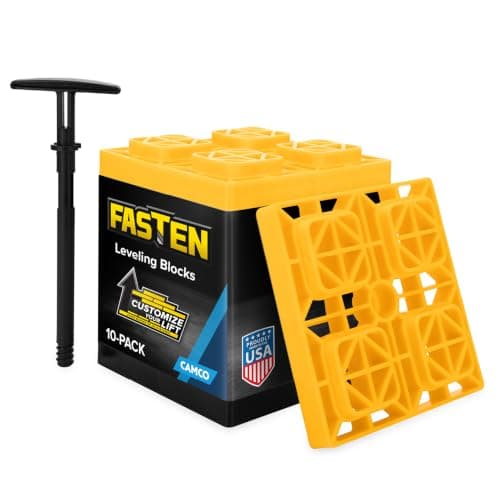 Camco FasTen RV Leveling Blocks, 10-Pack Interlocking plastic blocks that lock together instead of sliding apart, which is the whole difference between these and loose wood. They also go under a jack, which a curved leveler cannot. Best blocks | The default: cheap, interlocking, use them for everything | 7.5/ 10 | |
| 2 | 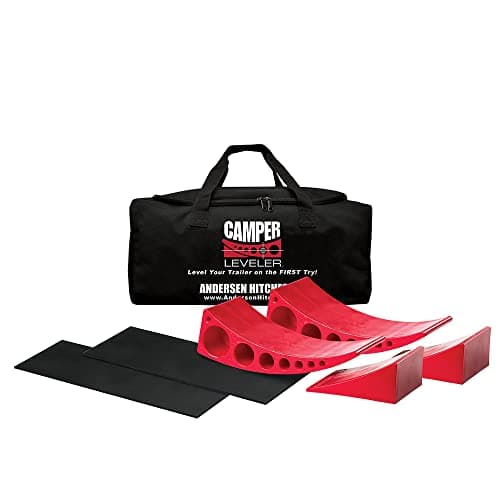 Andersen Camper Leveler, 2-Pack with Mats and Bag A curved ramp you drive up until the bubble centers, then chock. It replaces the guess-stack-check-restack cycle that makes stacking blocks the most annoying job at a campsite. Best ramp | Side-to-side leveling in one pull-up, with no stacking | 7.5/ 10 | |
| 3 | 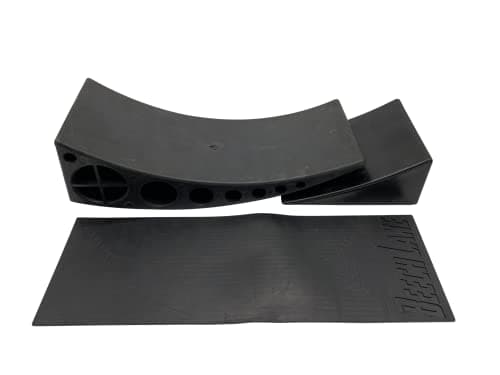 Beech Lane Camper Leveler, 1 Pack The same drive-up curved-ramp idea as the Andersen at under half the price, rated to 35,000 lb, and it includes the chock and grip mat. | Curved-ramp leveling for a single-axle trailer, cheaply | 7.5/ 10 | |
| 4 | 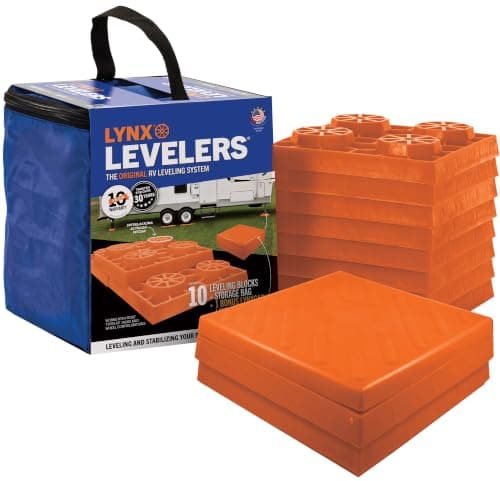 Lynx Levelers, 11-Pack with Cap and Storage Bag The long-standing honeycomb block. Eleven pieces including a cap, which is the detail that matters: the cap gives a flat top so a jack foot does not sit in the honeycomb. | Leveling, jack pads and stabilizer feet from one bag | 7.3/ 10 |
Tap any row to jump to the full write-up. Prices come from Amazon and are read automatically — see each product below for the date.
The short answer
Side by side
| Interlocking blocks | Curved levelers | |
|---|---|---|
| Lift adjustment | 1 in steps | Continuous |
| Attempts to get level | Usually 2-3 | Usually 1 |
| Goes under a jack | Yes | No |
| Goes under a stabilizer | Yes | No |
| Packed size | Flat stack, compact | Bulky |
| Relative cost | Low | 2-4x higher |
| Slides on wet concrete | Yes | Yes, without the grip mat |
| Works on a single axle | Yes | Yes, one ramp |
The real difference is your time
Both get the trailer level. The question is how long it takes and how many times you get in and out of the truck.
With blocks: estimate the cross-slope, build a stack, drive up, get out, check the bubble, decide it needs one more, drive off, add a layer, drive up again, check. Two attempts is good going. Three is normal when you are new.
With a ramp: place it, drive up slowly while somebody watches the level, stop when it reads level, chock. One attempt.
On a sunny afternoon the difference is five minutes. On a wet evening with a queue behind you and a child who needs the bathroom, it is the best money in this section.
What blocks do that ramps cannot
This is the reason not to replace blocks with ramps:
- Under the tongue jack. On a steep site the tongue jack can run out of travel, and blocks under its foot give you back several inches.
- Under stabilizer jacks. Same problem, plus they stop the jack sinking.
- As a platform for anything. A generator, a step, a bucket on soft ground.
- Front-to-back leveling on a very uneven site. Occasionally you need to raise the rear wheels, and a ramp is not practical there.
The common mistake
Both slide, and both need the same fix
Neither plastic blocks nor plastic ramps grip wet concrete or packed hardpack. The difference is that the better ramp kits ship with a textured rubber mat and blocks never do.
If you camp on paved pads, buy a rubber mat for whichever you use. A leveling device sliding out from under a climbing tire is the failure mode in this category and the mat is the fix.
The verdict
Blocks first, because they are cheap and cover everything. A ramp second, because it buys back the restacking cycle. Both together is the setup most experienced owners arrive at, and it is not redundancy — they do different jobs.
The picks in full
Camco FasTen RV Leveling Blocks, 10-Pack
Camco · Best for the default: cheap, interlocking, use them for everything
Interlocking plastic blocks that lock together instead of sliding apart, which is the whole difference between these and loose wood. They also go under a jack, which a curved leveler cannot.
Key specifications
- Block size
- 8.5 in x 8.5 in x 1 in
- Pack
- 10 blocks
- Interlocking
- Yes
- Origin
- Made in USA
Capacity figures read from Camco FasTen specifications, October 2026.
How it scored
- Lift range (25%)7
- Grip / stability (25%)7
- Packed size (20%)8
- Build quality (20%)7
- Price for capability (10%)10
Weighted average of the figures above. We did not test this product — see how we pick.
What it does well
- Interlock, so a stack does not shear sideways under load
- Do double duty under jacks and stabilizers
- Cheapest route to usable leveling
What it is bad at
- Stacking to the right height is trial and error
- One inch per layer means coarse adjustment
- They crack if you drive onto an unsupported overhang
Price as of October 5, 2026. #ad How this is funded
Andersen Camper Leveler, 2-Pack with Mats and Bag
Andersen Hitches · Best for side-to-side leveling in one pull-up, with no stacking
A curved ramp you drive up until the bubble centers, then chock. It replaces the guess-stack-check-restack cycle that makes stacking blocks the most annoying job at a campsite.
Key specifications
- Pack
- 2 levelers, 2 rubber mats, duffel bag
- Rated to
- 30,000 lb
- Lift
- Continuous, up to about 4 in
- Use
- Single-axle and tandem-axle trailers
Capacity figures read from Andersen Camper Leveler specifications, October 2026.
How it scored
- Lift range (25%)9
- Grip / stability (25%)8
- Packed size (20%)5
- Build quality (20%)8
- Price for capability (10%)6
Weighted average of the figures above. We did not test this product — see how we pick.
What it does well
- One pull-up, any lift height — no stacking to the nearest inch
- Chock is built into the design
- Rubber mats stop the ramp sliding on hardpack
What it is bad at
- Expensive next to a bag of plastic blocks
- Bulky to store, even in the bag
- You still need a spotter or a camera to know when to stop
Price as of October 5, 2026. #ad How this is funded
Beech Lane Camper Leveler, 1 Pack
Beech Lane · Best for curved-ramp leveling for a single-axle trailer, cheaply
The same drive-up curved-ramp idea as the Andersen at under half the price, rated to 35,000 lb, and it includes the chock and grip mat.
Key specifications
- Pack
- 1 leveler, 1 chock, 1 rubber grip mat
- Rated to
- 35,000 lb
- Type
- Curved ramp, continuous lift
- Patent
- Patented design
How it scored
- Lift range (25%)9
- Grip / stability (25%)7
- Packed size (20%)6
- Build quality (20%)7
- Price for capability (10%)9
Weighted average of the figures above. We did not test this product — see how we pick.
What it does well
- Dramatically cheaper than the alternative curved leveler
- Chock and grip mat in the box
- Highest stated load rating in this group
What it is bad at
- One leveler per pack — a tandem axle usually wants a second
- Plastic flexes on soft ground without the mat
- Less established brand with fewer long-term owner reports
Price as of October 5, 2026. #ad How this is funded
Lynx Levelers, 11-Pack with Cap and Storage Bag
Tri-Lynx · Best for leveling, jack pads and stabilizer feet from one bag
The long-standing honeycomb block. Eleven pieces including a cap, which is the detail that matters: the cap gives a flat top so a jack foot does not sit in the honeycomb.
Key specifications
- Pack
- 11 pieces including 1 cap level top
- Design
- Interlocking honeycomb
- Storage
- Bag included
- Origin
- Made in USA
How it scored
- Lift range (25%)7
- Grip / stability (25%)6
- Packed size (20%)8
- Build quality (20%)7
- Price for capability (10%)10
Weighted average of the figures above. We did not test this product — see how we pick.
What it does well
- Cap piece gives a flat bearing surface for jacks
- Honeycomb is strong for its weight
- Decades of owner reports to read
What it is bad at
- Honeycomb edges split if you drive onto a stack at an angle
- No grip mat, so they slide on wet concrete
- Same coarse one-inch-per-layer stacking
Price as of October 5, 2026. #ad How this is funded
Common questions
For side-to-side wheel leveling, ramps are faster and more precise. Blocks are much cheaper and do jobs a ramp cannot — under the tongue jack and stabilizers.
No — they are shaped as a ramp with no flat bearing surface for a jack foot. Use blocks or dedicated jack pads.
Sources
- Camco published leveling block and chock specifications — read October 2026
- Andersen Hitches Camper Leveler published specifications — read October 2026
- RV Industry Association — standards and compliance program — read October 2026