Leveling, Chocks & Stabilizing
How To Level A Travel Trailer
Eight steps and about ten minutes. The order is the whole trick, and getting it wrong means hitching back up to move a foot.
By Mike M. ·
How this page is funded: we earn a commission if you buy through our links, at no extra cost to you. It never changes which product we rank first. Prices come from Amazon and are read automatically — each one shows the date it was read. Full disclosure.
Quick picks
The four items this procedure needs.
| # | Product | Best for | Score | Price |
|---|---|---|---|---|
| 1 | 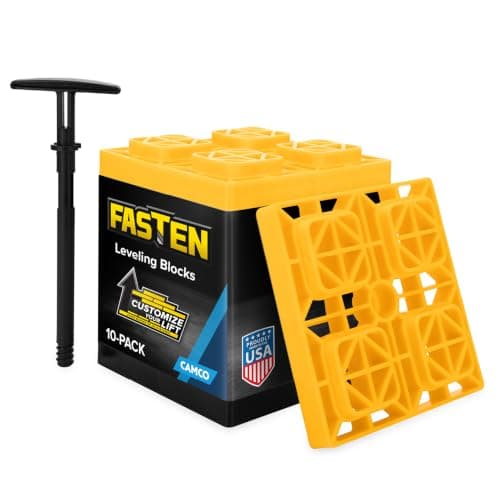 Camco FasTen RV Leveling Blocks, 10-Pack Interlocking plastic blocks that lock together instead of sliding apart, which is the whole difference between these and loose wood. They also go under a jack, which a curved leveler cannot. Level with these | The default: cheap, interlocking, use them for everything | 7.5/ 10 | |
| 2 | 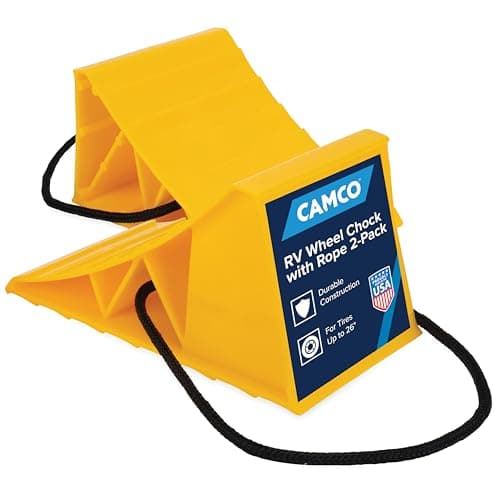 Camco RV Wheel Chocks with Rope, 2-Pack Two plastic chocks with a pull rope so you can retrieve them without lying on the ground. Unremarkable, correct, and the first thing to buy. | The basic chock every trailer needs before anything else | 7.9/ 10 | |
| 3 | 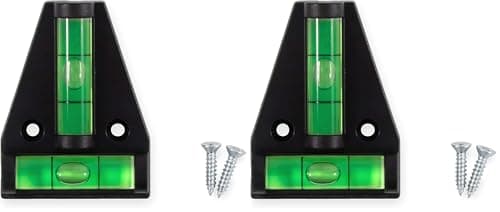 Camco RV T Level, 2-Pack, 25543 Two screw-on bubble levels, one for front-to-back and one for side-to-side. Cheap, and the reason you stop guessing from inside the trailer. | Knowing when to stop driving up the leveler | 8.6/ 10 | $9.16View on Amazon
|
| 4 | 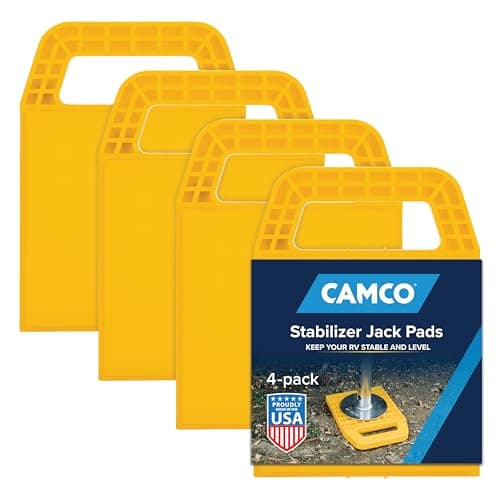 Camco RV Stabilizing Jack Pads, 4-Pack Four plastic pads for under the stabilizer jacks. They stop the jack foot sinking into soft ground, which is the usual reason a leveled trailer is no longer level in the morning. | Keeping scissor jacks out of the dirt | 7.0/ 10 | $13.97View on Amazon
|
Tap any row to jump to the full write-up. Prices come from Amazon and are read automatically — see each product below for the date.
The short answer
Leveling is not difficult. It goes wrong because people do the steps in the order they think of them rather than the order that works.
The sequence
- 1
Walk the site before you back in
Find the flattest part, note which side is low, and spot the obstacles: the tree, the water spigot, the fire ring, the low branch. Thirty seconds here saves a lot later. - 2
Back into position, still hitched
Get the trailer roughly where it needs to be. Do not unhitch. The truck is the only easy way to move the trailer and you will probably need it again. - 3
Check side to side
A bubble level on the trailer frame — not on the floor or a counter, which may not be parallel to the frame — or a level app on a phone set on the step. Note which side is low and roughly by how much. - 4
Raise the low side, with the truck
Place blocks or a curved ramp against the tires on the low side, pull forward or reverse up onto them, and re-check. On a tandem axle, support both wheels on that side. The side-to-side detail. - 5
Chock, before you unhitch
All four wheels on a tandem axle, downhill side first on any slope. The tow vehicle is holding the trailer right now; the chocks are about to be. How many you need. - 6
Unhitch
Put a block or pad under the tongue jack foot first, then wind down, release the weight distribution bars, unlatch the coupler and drive the truck clear. - 7
Level front to back with the tongue jack
Bubble level on the frame again, this time lengthwise. The tongue jack is a lifting jack and this is exactly what it is for. - 8
Lower the stabilizer jacks, on pads, last
Firm contact, not lifting. They steady the trailer; they are not rated to carry its weight. Why.
Why the order matters
Steps 4 and 6 are the ones people swap, and swapping them is the problem. Raising one side needs the trailer to move a foot or two forward or backward onto blocks. With the truck attached that is thirty seconds. With the truck parked and the trailer on its jack, it is re-hitching, moving, unhitching again — in the dark, usually.
And chocking before unhitching is not a nicety. It is the sequence that prevents runaway trailers, and the consequence of getting it wrong is not something you fix afterward.
The common mistake
How level is level enough?
Most absorption refrigerators specify something like 3 degrees side to side and 6 degrees front to back. Within those limits the fridge cools properly; outside them, cooling drops and prolonged operation can damage it.
Practically, if a bubble level reads within the bubble’s own width, you are fine. Chasing dead level beyond that is a hobby, not a requirement.
| Out of level | Consequence |
|---|---|
| Within about 1 degree | Nothing noticeable |
| 2-3 degrees | Doors swing, shower drains slowly |
| Beyond 3 degrees side to side | Absorption fridge cooling drops |
| Markedly out, for long periods | Risk of fridge damage |
Awkward sites
Steeper than your blocks can handle. Most block makers cap stacking around four layers. Past that, move the trailer rather than build a tower.
Tongue jack out of travel. Blocks under the jack foot give you back several inches, and they spread the load at the same time.
Soft ground. Pads under everything, and re-check after a couple of hours. Settling on gravel is slow and real.
Cross-slope and longitudinal slope together. Deal with the cross-slope first. You can fix front to back with the tongue jack afterward; you cannot easily fix side to side once the truck is gone.
What to remember
- Side to side while hitched, chock, unhitch, front to back, stabilizers last.
- Raising one side needs the truck. Do it before you unhitch.
- Chock before unhitching, every time.
- Level off the frame rail, not the floor or a counter.
- Within about a degree is plenty. 3 degrees side to side is the usual fridge limit.
The picks in full
Camco FasTen RV Leveling Blocks, 10-Pack
Camco · Best for the default: cheap, interlocking, use them for everything
Interlocking plastic blocks that lock together instead of sliding apart, which is the whole difference between these and loose wood. They also go under a jack, which a curved leveler cannot.
Key specifications
- Block size
- 8.5 in x 8.5 in x 1 in
- Pack
- 10 blocks
- Interlocking
- Yes
- Origin
- Made in USA
Capacity figures read from Camco FasTen specifications, October 2026.
How it scored
- Lift range (25%)7
- Grip / stability (25%)7
- Packed size (20%)8
- Build quality (20%)7
- Price for capability (10%)10
Weighted average of the figures above. We did not test this product — see how we pick.
What it does well
- Interlock, so a stack does not shear sideways under load
- Do double duty under jacks and stabilizers
- Cheapest route to usable leveling
What it is bad at
- Stacking to the right height is trial and error
- One inch per layer means coarse adjustment
- They crack if you drive onto an unsupported overhang
Price as of October 5, 2026. #ad How this is funded
Camco RV Wheel Chocks with Rope, 2-Pack
Camco · Best for the basic chock every trailer needs before anything else
Two plastic chocks with a pull rope so you can retrieve them without lying on the ground. Unremarkable, correct, and the first thing to buy.
Key specifications
- Pack
- 2 chocks
- Feature
- Pull rope
- Material
- Molded plastic
- Origin
- Made in USA
Capacity figures read from Camco wheel chock specifications, October 2026.
How it scored
- Holding force (35%)7
- Fit range (25%)8
- Everyday usability (20%)9
- Build quality (10%)6
- Price for capability (10%)10
Weighted average of the figures above. We did not test this product — see how we pick.
What it does well
- The rope saves you crawling under the trailer
- Light and stackable
- Cheap enough to buy four
What it is bad at
- Plastic slides on wet smooth concrete
- Sized for standard trailer tires, not oversized ones
- Two is the bare minimum; most trailers want four
Price as of October 5, 2026. #ad How this is funded
Camco RV T Level, 2-Pack, 25543
Camco · Best for knowing when to stop driving up the leveler
Two screw-on bubble levels, one for front-to-back and one for side-to-side. Cheap, and the reason you stop guessing from inside the trailer.
Key specifications
- Pack
- 2 levels
- Mounting
- Screw-mounted
- Axes
- Front-to-back and side-to-side
- Part
- 25543
Capacity figures read from Camco RV T Level specifications, October 2026.
How it scored
- How often you use it (40%)9
- Build quality (25%)6
- Takes up little room (20%)10
- Price for capability (15%)10
Weighted average of the figures above. We did not test this product — see how we pick.
What it does well
- Lets you read level from outside the trailer, where you are standing
- Costs less than a sandwich
- No batteries, nothing to pair
What it is bad at
- You have to mount them with the trailer already level, or they lie forever
- Screw holes in the trailer skin
- Harder to read at dusk than a phone app
Camco RV Stabilizing Jack Pads, 4-Pack
Camco · Best for keeping scissor jacks out of the dirt
Four plastic pads for under the stabilizer jacks. They stop the jack foot sinking into soft ground, which is the usual reason a leveled trailer is no longer level in the morning.
Key specifications
- Pack
- 4 pads
- Use
- Under scissor and stabilizer jacks
- Material
- Molded plastic
- Origin
- Made in USA
Capacity figures read from Camco jack pad specifications, October 2026.
How it scored
- Lift range (25%)4
- Grip / stability (25%)7
- Packed size (20%)9
- Build quality (20%)7
- Price for capability (10%)10
Weighted average of the figures above. We did not test this product — see how we pick.
What it does well
- Cheapest fix for a trailer that settles overnight
- Spread load on gravel and soft ground
- Stack flat, take almost no space
What it is bad at
- Not rated to lift anything — these spread load, they do not level
- Plastic cracks under a jack that is already over-extended
- Four is not enough if you also want pads under the tongue jack
Common questions
Side to side before — raising one side needs the trailer to move onto blocks and only the truck does that easily. Then chock, unhitch, and level front to back with the tongue jack.
Most absorption fridges specify about 3 degrees side to side and 6 front to back. Within a bubble width on a frame-mounted level is comfortably inside that.
On the frame rail, or external levels mounted while the trailer was known level. Floors and counters are not necessarily parallel to the frame.
Sources
- Camco published leveling block and chock specifications — read October 2026
- Andersen Hitches Camper Leveler published specifications — read October 2026
- RV Industry Association — standards and compliance program — read October 2026