Leveling, Chocks & Stabilizing
Are Wood Blocks Safe For RV Leveling?
People use lumber because it is free and in the garage. Here is what actually fails, and the version of wood that is genuinely fine.
By Mike M. ·
How this page is funded: we earn a commission if you buy through our links, at no extra cost to you. It never changes which product we rank first. Prices come from Amazon and are read automatically — each one shows the date it was read. Full disclosure.
Quick picks
The purpose-built alternatives, which cost very little.
| # | Product | Best for | Score | Price |
|---|---|---|---|---|
| 1 | 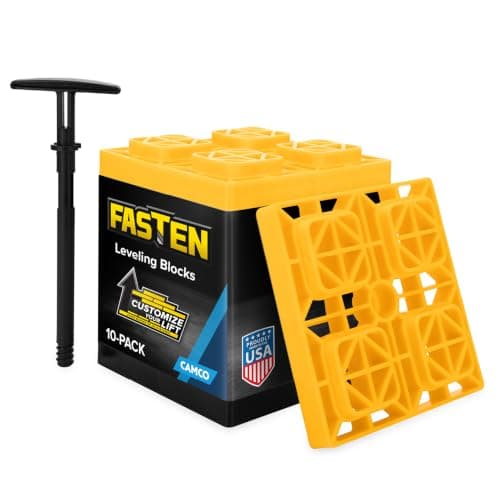 Camco FasTen RV Leveling Blocks, 10-Pack Interlocking plastic blocks that lock together instead of sliding apart, which is the whole difference between these and loose wood. They also go under a jack, which a curved leveler cannot. The alternative | The default: cheap, interlocking, use them for everything | 7.5/ 10 | |
| 2 | 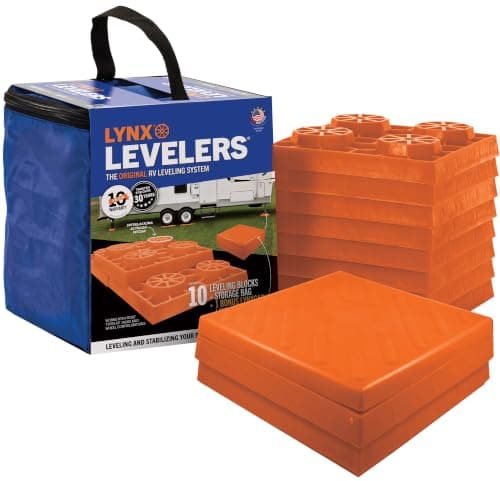 Lynx Levelers, 11-Pack with Cap and Storage Bag The long-standing honeycomb block. Eleven pieces including a cap, which is the detail that matters: the cap gives a flat top so a jack foot does not sit in the honeycomb. | Leveling, jack pads and stabilizer feet from one bag | 7.3/ 10 | |
| 3 | 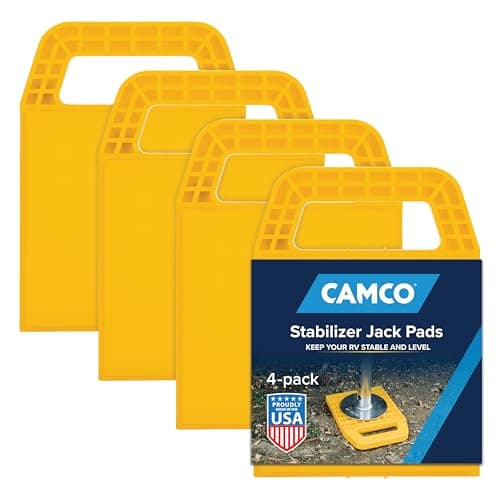 Camco RV Stabilizing Jack Pads, 4-Pack Four plastic pads for under the stabilizer jacks. They stop the jack foot sinking into soft ground, which is the usual reason a leveled trailer is no longer level in the morning. | Keeping scissor jacks out of the dirt | 7.0/ 10 | $13.97View on Amazon
|
| 4 | 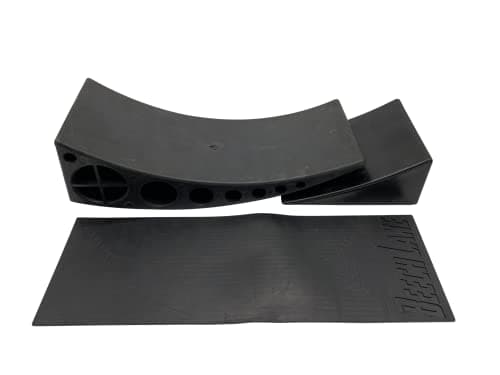 Beech Lane Camper Leveler, 1 Pack The same drive-up curved-ramp idea as the Andersen at under half the price, rated to 35,000 lb, and it includes the chock and grip mat. | Curved-ramp leveling for a single-axle trailer, cheaply | 7.5/ 10 |
Tap any row to jump to the full write-up. Prices come from Amazon and are read automatically — see each product below for the date.
The short answer
This question gets a reflexive “never use wood” online, which is both unhelpful and not quite true. Here is the actual engineering, and where the line sits.
The three ways wood fails
1. Splitting along the grain. Softwood construction lumber is strong along the grain and weak across it. A trailer tire puts a concentrated load on a small contact patch, and that is exactly the loading that drives a split along an existing grain line or a knot. A split block under a loaded tire loses most of its capacity at once.
2. No interlock, so stacks shear. Plastic leveling blocks interlock. Two stacked offcuts do not. As a tire climbs a stack it applies a horizontal force at the top, and the top piece slides off the bottom one. This is the common wood failure and it happens during the drive-up, which is the worst moment.
3. Degradation. Wood left in the weather takes up water, freezes, softens and grows fungus. A board that was fine in spring can be noticeably weaker by the following spring, and you cannot see it from outside.
The common mistake
The wood that actually works
Thick hardwood plywood, under jacks. Plywood is cross-laminated, so it has no single weak grain direction and it does not split the way solid lumber does. A 12 in square of 3/4 in or thicker hardwood plywood under a scissor jack or a tongue jack is a genuinely good jack pad. Many experienced owners use exactly this.
Short, thick hardwood offcuts, single layer. A single thick piece of oak under a tire is unlikely to split and cannot shear off anything because there is no stack. It is the stacking and the softwood that cause problems.
What does not work: stacked softwood under tires, anything thinner than about 3/4 in, and anything with a visible knot or check in the load path.
Wood against purpose-built blocks
| Stacked softwood | Hardwood plywood | Interlocking blocks | |
|---|---|---|---|
| Splits under point load | Yes | No | No |
| Stack shears sideways | Yes | N/A single layer | No, interlocks |
| Weather degradation | Yes | Slow | Minimal |
| Under a jack | Risky | Good | Good, with a cap |
| Under a tire | Risky | Single layer only | Designed for it |
| Cost | Free | Low | Low |
The cost column is the whole argument for wood, and it is a weak one: a ten-pack of interlocking blocks costs less than a bag of groceries and removes two failure modes entirely. If you already have hardwood plywood offcuts, use them under the jacks. Buy blocks for the tires.
Two other improvised items to think about
Concrete blocks and pavers. Worse than wood. Concrete is brittle and fails suddenly and completely rather than progressively, and a cracked paver under a loaded tire drops the trailer an inch instantly. Do not use them.
Plastic milk crates and similar. Not designed for the load, and they fail by collapsing. Also not a step stool, however convenient they look.
What to remember
- Dimensional softwood splits along the grain under a tire's point load.
- Stacked wood has no interlock, so it shears sideways during the drive-up.
- Thick hardwood plywood is genuinely fine, especially under jacks.
- Pressure treatment addresses rot, not splitting.
- Never use concrete blocks or pavers — they fail suddenly and completely.
The picks in full
Camco FasTen RV Leveling Blocks, 10-Pack
Camco · Best for the default: cheap, interlocking, use them for everything
Interlocking plastic blocks that lock together instead of sliding apart, which is the whole difference between these and loose wood. They also go under a jack, which a curved leveler cannot.
Key specifications
- Block size
- 8.5 in x 8.5 in x 1 in
- Pack
- 10 blocks
- Interlocking
- Yes
- Origin
- Made in USA
Capacity figures read from Camco FasTen specifications, October 2026.
How it scored
- Lift range (25%)7
- Grip / stability (25%)7
- Packed size (20%)8
- Build quality (20%)7
- Price for capability (10%)10
Weighted average of the figures above. We did not test this product — see how we pick.
What it does well
- Interlock, so a stack does not shear sideways under load
- Do double duty under jacks and stabilizers
- Cheapest route to usable leveling
What it is bad at
- Stacking to the right height is trial and error
- One inch per layer means coarse adjustment
- They crack if you drive onto an unsupported overhang
Price as of October 5, 2026. #ad How this is funded
Lynx Levelers, 11-Pack with Cap and Storage Bag
Tri-Lynx · Best for leveling, jack pads and stabilizer feet from one bag
The long-standing honeycomb block. Eleven pieces including a cap, which is the detail that matters: the cap gives a flat top so a jack foot does not sit in the honeycomb.
Key specifications
- Pack
- 11 pieces including 1 cap level top
- Design
- Interlocking honeycomb
- Storage
- Bag included
- Origin
- Made in USA
How it scored
- Lift range (25%)7
- Grip / stability (25%)6
- Packed size (20%)8
- Build quality (20%)7
- Price for capability (10%)10
Weighted average of the figures above. We did not test this product — see how we pick.
What it does well
- Cap piece gives a flat bearing surface for jacks
- Honeycomb is strong for its weight
- Decades of owner reports to read
What it is bad at
- Honeycomb edges split if you drive onto a stack at an angle
- No grip mat, so they slide on wet concrete
- Same coarse one-inch-per-layer stacking
Price as of October 5, 2026. #ad How this is funded
Camco RV Stabilizing Jack Pads, 4-Pack
Camco · Best for keeping scissor jacks out of the dirt
Four plastic pads for under the stabilizer jacks. They stop the jack foot sinking into soft ground, which is the usual reason a leveled trailer is no longer level in the morning.
Key specifications
- Pack
- 4 pads
- Use
- Under scissor and stabilizer jacks
- Material
- Molded plastic
- Origin
- Made in USA
Capacity figures read from Camco jack pad specifications, October 2026.
How it scored
- Lift range (25%)4
- Grip / stability (25%)7
- Packed size (20%)9
- Build quality (20%)7
- Price for capability (10%)10
Weighted average of the figures above. We did not test this product — see how we pick.
What it does well
- Cheapest fix for a trailer that settles overnight
- Spread load on gravel and soft ground
- Stack flat, take almost no space
What it is bad at
- Not rated to lift anything — these spread load, they do not level
- Plastic cracks under a jack that is already over-extended
- Four is not enough if you also want pads under the tongue jack
Beech Lane Camper Leveler, 1 Pack
Beech Lane · Best for curved-ramp leveling for a single-axle trailer, cheaply
The same drive-up curved-ramp idea as the Andersen at under half the price, rated to 35,000 lb, and it includes the chock and grip mat.
Key specifications
- Pack
- 1 leveler, 1 chock, 1 rubber grip mat
- Rated to
- 35,000 lb
- Type
- Curved ramp, continuous lift
- Patent
- Patented design
How it scored
- Lift range (25%)9
- Grip / stability (25%)7
- Packed size (20%)6
- Build quality (20%)7
- Price for capability (10%)9
Weighted average of the figures above. We did not test this product — see how we pick.
What it does well
- Dramatically cheaper than the alternative curved leveler
- Chock and grip mat in the box
- Highest stated load rating in this group
What it is bad at
- One leveler per pack — a tandem axle usually wants a second
- Plastic flexes on soft ground without the mat
- Less established brand with fewer long-term owner reports
Price as of October 5, 2026. #ad How this is funded
Common questions
A poor choice. Softwood splits along the grain under a tire’s point load, and stacked boards have no interlock so they shear sideways during the drive-up.
Thick hardwood plywood is a good jack pad — cross-laminated, so no single weak grain direction. A 12 in square of 3/4 in or thicker works well.
No. Concrete is brittle and fails suddenly and completely, so a crack under a loaded tire drops the trailer immediately. Hollow blocks are especially unsuitable.
Sources
- Camco published leveling block and chock specifications — read October 2026
- Andersen Hitches Camper Leveler published specifications — read October 2026
- RV Industry Association — standards and compliance program — read October 2026