Leveling, Chocks & Stabilizing
How Many Wheel Chocks Do I Need?
Four. Here is why, which side they go on, and the two situations where two is genuinely enough.
By Mike M. ·
How this page is funded: we earn a commission if you buy through our links, at no extra cost to you. It never changes which product we rank first. Prices come from Amazon and are read automatically — each one shows the date it was read. Full disclosure.
Quick picks
Chocks worth buying four of.
| # | Product | Best for | Score | Price |
|---|---|---|---|---|
| 1 | 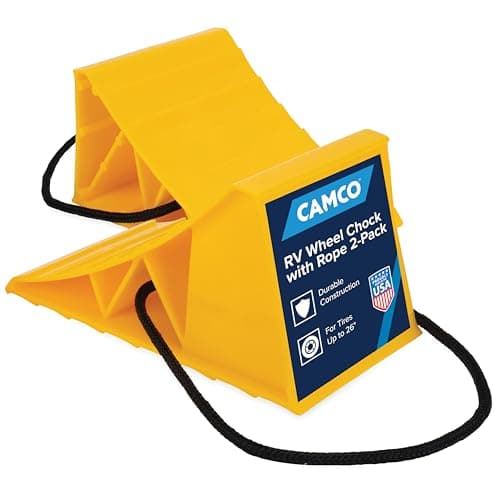 Camco RV Wheel Chocks with Rope, 2-Pack Two plastic chocks with a pull rope so you can retrieve them without lying on the ground. Unremarkable, correct, and the first thing to buy. Buy four | The basic chock every trailer needs before anything else | 7.9/ 10 | |
| 2 | 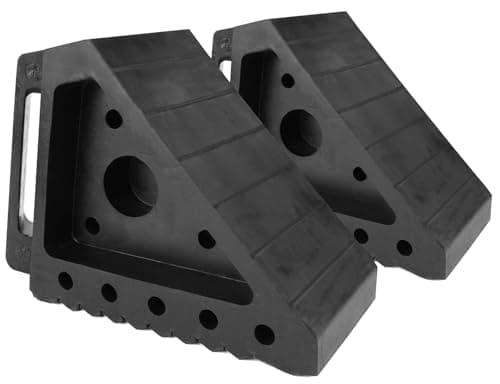 MaxxHaul Solid Rubber Wheel Chock, 2-Pack, 70472 Solid rubber rather than hollow plastic, with non-slip pads. On a slope or a polished garage floor this is the one that stays put, which is the only specification that matters. | Chocking on a slope or on smooth concrete | 8.3/ 10 | |
| 3 | 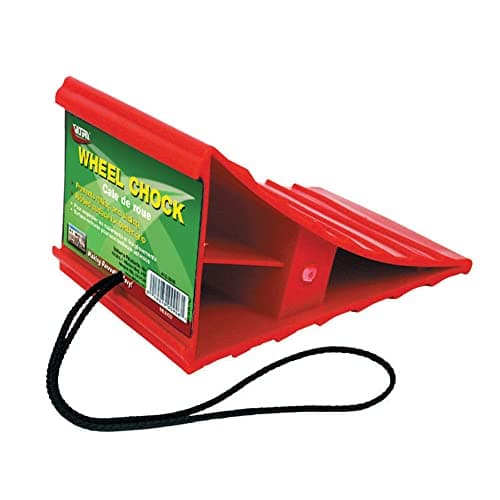 Valterra RV Wheel Chock, A10-0908 A single cheap chock in a color you can see on gravel. Buy two or four; the only argument for one is that you already lost one. | A spare chock to keep in the truck bed | 6.8/ 10 | |
| 4 | 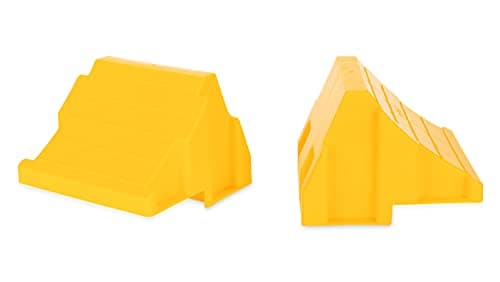 Camco Leveling Block Wheel Chocks, 2-Pack, 44401 A chock shaped to sit against a tire that is already up on blocks, which is exactly the situation where a normal chock does not reach. | Chocking a trailer that is sitting on leveling blocks | 7.8/ 10 | $34.24View on Amazon
|
Tap any row to jump to the full write-up. Prices come from Amazon and are read automatically — see each product below for the date.
The short answer
The number is simple. The reasoning is worth a page because it determines where they go, which matters more than how many you own.
Why four, not two
A chock only works in one direction. A chock in front of a tire stops it rolling forward; it does nothing about it rolling backward. So a single chock per side leaves the trailer free to roll one way.
On a tandem axle each side has two tires, and the practical arrangement is one chock behind the rear tire and one in front of the front tire — blocking both directions. Two per side, four total.
An alternative arrangement some owners use: both chocks on one side, in front and behind. That blocks both directions but leaves the other side unchocked, and a trailer can roll with the chocks sliding on one side. Four is the right answer.
Where they go
| Situation | Placement | Count |
|---|---|---|
| Level ground, unhitched, tandem axle | Front and behind, both sides | 4 |
| Level ground, still hitched | Behind the rear tires, both sides | 2 |
| On a slope, unhitched | Downhill side of every wheel, both sides | 4 minimum |
| Single axle, unhitched | Front and behind, both sides | 4 |
| On blocks or a ramp | Tall chocks, or the ramp's own wedge | 2-4 |
Note the last row. A trailer up on leveling blocks sits several inches higher than a standard chock expects, and a chock that only reaches the bottom of the tire does less than you think. Either use a taller leveling-block-style chock, or the wedge that came with your curved leveler.
The order, which matters more than the count
Chock before you unhitch. While the trailer is coupled, the tow vehicle is holding it through the coupler, the safety chains and the trailer brakes. The moment you release the coupler, nothing is holding it but the chocks and the tongue jack.
On a slope, place the downhill chocks first. If the trailer is going to move at all, it is going to move downhill, and those are the chocks that catch it.
The common mistake
Three things that are not chocks
A tandem-tire stabilizer. It resists rocking, not rolling, and it presses against the tire treads rather than the ground. The difference.
Stabilizer jacks. They steady the trailer. They are not rated to carry its weight and they certainly do not stop it rolling. Why.
The trailer’s own brakes. Electric trailer brakes need the tow vehicle’s controller to energize them. An unhitched trailer has no working brakes unless it has a mechanical parking brake, and most travel trailers do not.
So: buy four
Chocks cost very little. Four is the right number, and a pair of rubber ones plus a pair of plastic ones covers both wet pavement and gravel. Keep them where you can reach them without unpacking the truck, because the moment you need them is before you unhitch, not after.
What to remember
- Four for a tandem axle: one each side of the tires, both sides.
- A chock only works in one direction, which is why one per side is not enough.
- Chock before unhitching, downhill side first on a slope.
- A trailer on leveling blocks needs taller chocks.
- The tongue jack is not a brake, and an unhitched trailer has no working brakes.
The picks in full
Camco RV Wheel Chocks with Rope, 2-Pack
Camco · Best for the basic chock every trailer needs before anything else
Two plastic chocks with a pull rope so you can retrieve them without lying on the ground. Unremarkable, correct, and the first thing to buy.
Key specifications
- Pack
- 2 chocks
- Feature
- Pull rope
- Material
- Molded plastic
- Origin
- Made in USA
Capacity figures read from Camco wheel chock specifications, October 2026.
How it scored
- Holding force (35%)7
- Fit range (25%)8
- Everyday usability (20%)9
- Build quality (10%)6
- Price for capability (10%)10
Weighted average of the figures above. We did not test this product — see how we pick.
What it does well
- The rope saves you crawling under the trailer
- Light and stackable
- Cheap enough to buy four
What it is bad at
- Plastic slides on wet smooth concrete
- Sized for standard trailer tires, not oversized ones
- Two is the bare minimum; most trailers want four
Price as of October 5, 2026. #ad How this is funded
MaxxHaul Solid Rubber Wheel Chock, 2-Pack, 70472
MaxxHaul · Best for chocking on a slope or on smooth concrete
Solid rubber rather than hollow plastic, with non-slip pads. On a slope or a polished garage floor this is the one that stays put, which is the only specification that matters.
Key specifications
- Size
- 8 in x 4 in x 6 in
- Material
- Solid rubber
- Feature
- Non-slip traction pads, built-in handle
- Pack
- 2 chocks
How it scored
- Holding force (35%)9
- Fit range (25%)7
- Everyday usability (20%)8
- Build quality (10%)9
- Price for capability (10%)9
Weighted average of the figures above. We did not test this product — see how we pick.
What it does well
- Rubber grips where plastic skates
- Solid, so it will not crush
- Handle makes placement easy
What it is bad at
- Heavy for its size
- Rubber picks up grit and marks hands and floors
- Only 6 in tall — not enough for a very large tire on a steep grade
Price as of October 5, 2026. #ad How this is funded
Valterra RV Wheel Chock, A10-0908
Valterra · Best for a spare chock to keep in the truck bed
A single cheap chock in a color you can see on gravel. Buy two or four; the only argument for one is that you already lost one.
Key specifications
- Pack
- Single chock
- Color
- Red
- Material
- Molded plastic
- Use
- Travel trailers and small RVs
How it scored
- Holding force (35%)6
- Fit range (25%)7
- Everyday usability (20%)7
- Build quality (10%)5
- Price for capability (10%)10
Weighted average of the figures above. We did not test this product — see how we pick.
What it does well
- Costs almost nothing
- Bright color so you do not drive off over it
- Light enough to keep several
What it is bad at
- Single chock per unit
- Light plastic — it slides on wet surfaces
- No rope or handle
Price as of October 5, 2026. #ad How this is funded
Camco Leveling Block Wheel Chocks, 2-Pack, 44401
Camco · Best for chocking a trailer that is sitting on leveling blocks
A chock shaped to sit against a tire that is already up on blocks, which is exactly the situation where a normal chock does not reach.
Key specifications
- Pack
- 2 chocks
- Sizing
- Sized for larger vehicle tires
- Use
- Alongside leveling blocks
- Function
- Centers and stabilizes the wheel
Capacity figures read from Camco leveling chock specifications, October 2026.
How it scored
- Holding force (35%)7
- Fit range (25%)9
- Everyday usability (20%)8
- Build quality (10%)6
- Price for capability (10%)9
Weighted average of the figures above. We did not test this product — see how we pick.
What it does well
- Solves the real problem of chocking a raised wheel
- Taller profile suits big trailer tires
- Works as a plain chock too
What it is bad at
- Bulkier to store than a standard chock
- Still plastic, still slides on wet concrete
- Not needed if you use curved levelers with built-in chocks
Common questions
Two is the practical minimum on level ground while still hitched. Unhitched, or on any slope, four — a chock only works in one direction.
Both, if you have four. On a slope the downhill side matters most and goes first. On level ground with a tandem axle: one behind the rear tire, one in front of the front tire, each side.
No. Electric trailer brakes need the tow vehicle’s controller to energize them, so an unhitched trailer has no working brakes unless it has a mechanical parking brake — and most travel trailers do not.
Sources
- Camco published leveling block and chock specifications — read October 2026
- Andersen Hitches Camper Leveler published specifications — read October 2026
- RV Industry Association — standards and compliance program — read October 2026