Weight Distribution & Sway Control
The Best Weight Distribution Hitch For A Toyota Tacoma
The mistake on a mid-size truck is buying too much hitch. A 1,000 lb bar under a 550 lb tongue does not level the truck — it just makes the ride harsh and the hookup heavier than it needs to be.
By Mike M. ·
How this page is funded: we earn a commission if you buy through our links, at no extra cost to you. It never changes which product we rank first. Prices come from Amazon and are read automatically — each one shows the date it was read. Full disclosure.
Quick picks
Scored on the published hitch rubric — sway control (25%), weight range (20%), backing and maneuvering (20%), setup (15%), noise (10%), price (10%) — then reweighted for the constraint that actually decides this one: whether the bar rating matches a mid-size truck's real tongue weight.
| # | Product | Best for | Score | Price |
|---|---|---|---|---|
| 1 | 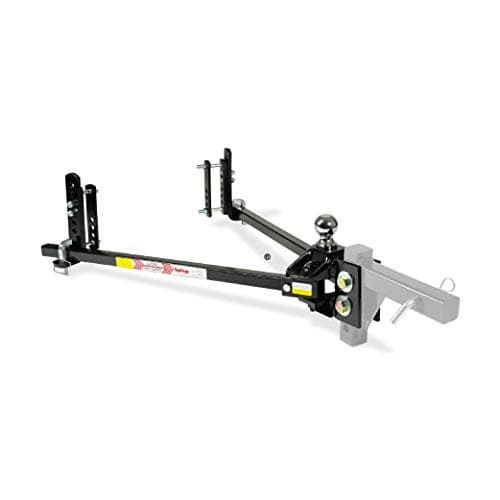 Equal-i-zer 4-Point Sway Control Hitch, 90-00-0601 The small-bar Equal-i-zer. Buying this instead of the 1,000 lb version is the fix for the harsh, over-sprung ride people complain about on light trailers. Top pick for a Tacoma | Light trailers with a loaded tongue weight near 600 lb | 7.6/ 10 | |
| 2 | 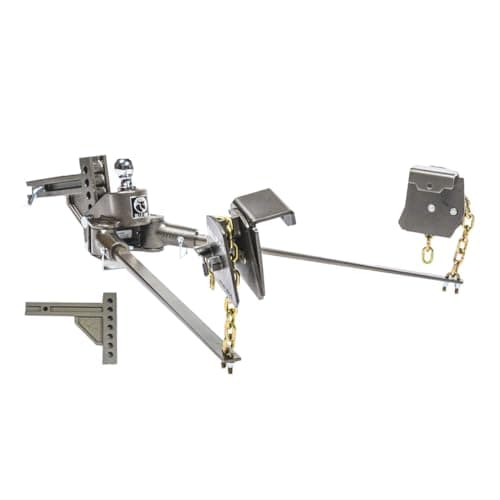 Blue Ox SwayPro BXW0750 Weight Distributing Hitch The smallest SwayPro most travel trailer owners should consider: the same quiet under-slung chain-and-bar design as the bigger kits, sprung for a tongue weight that an actual half-ton-towable trailer puts on the ball. Best if your tongue weight is near 750 lb | Trailers in the 4,000-7,500 lb range with tongue weight near 750 lb | 7.2/ 10 | |
| 3 | 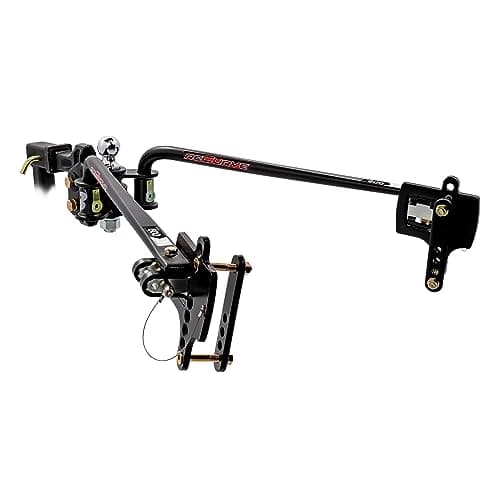 Camco Eaz-Lift ReCurve R3 Weight Distribution Hitch, 48771 An 800 lb-max kit with adjustable sway control and the ball included. Sized for the small trailer most first-time buyers actually own, rather than the one they imagine. Best value | Light trailers under about 800 lb of tongue weight | 6.4/ 10 | |
| 4 | 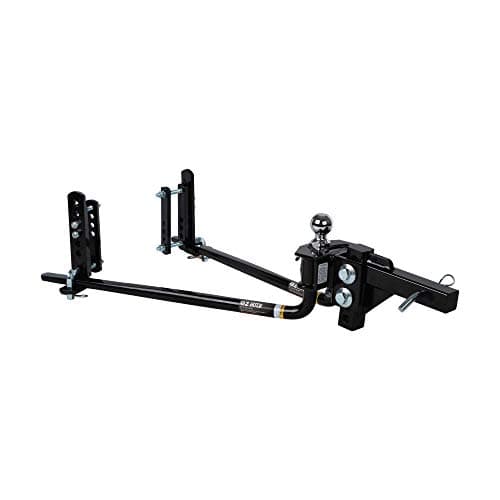 Fastway e2 2-Point Sway Control Round Bar Hitch, 94-00-1033 Equal-i-zer's own value line: two points of built-in sway control instead of four, at a price that leaves money for the shank and ball you still have to buy. Only if you are at the top of the rating | A first hitch on a 5,000-8,000 lb trailer, on a budget | 7.5/ 10 |
Tap any row to jump to the full write-up. Prices come from Amazon and are read automatically — see each product below for the date.
The short answer
A Tacoma is not a small full-size truck. It is a different towing problem, and the difference is not the tow rating — Toyota publishes a figure in the 6,400–6,800 lb region depending on cab, bed and drivetrain, which is plenty for a great many travel trailers. The difference is payload. By the time a crew cab Tacoma has four people, a cooler, a generator and a full tank in it, the remaining payload available for tongue weight is often somewhere between 400 and 700 lb, and that is the number your hitch has to be matched to.
Bar rating: the tongue weight a weight distribution hitch’s spring bars are designed to carry. It is not a maximum you are allowed to approach — it is the weight at which the bars flex the amount the engineer intended. Under about half the rating they barely flex at all, which is why an over-sized bar transfers almost nothing.
Why a smaller bar is the right answer, not a compromise
This is the part that gets sold backwards. A weight distribution hitch works by using the spring bars as levers: tension them, and some of the tongue weight is pushed forward onto the tow vehicle’s front axle and back onto the trailer’s axles. The amount transferred depends on how much the bars deflect. A 1,000 lb bar carrying 500 lb of tongue weight deflects very little, so it transfers very little — you have bought a heavy, stiff hitch that does not do the job you bought it for.
Worse, the undeflected bar behaves like a solid link between the trailer A-frame and the truck. Every bump the trailer takes arrives in the truck undamped. Owners describe this as a “harsh” or “skittish” ride and usually blame the hitch brand. The brand is fine. The bar is too stiff for the load.
So the sequence on a Tacoma is: measure the loaded tongue weight first, then buy the bar class that straddles it. How to measure tongue weight walks through doing it with a bathroom scale and a length of pipe, and the tongue weight scale roundup covers buying a tool for it.
What to look for, in Tacoma order
Bar rating that brackets your measured tongue weight. First consideration, not last. You want your loaded tongue weight to sit somewhere in the middle-to-upper part of the bar’s rated range — not at 40% of it.
Total hitch weight, because you lift it. A 1,200 lb-class head and bar set is a genuinely heavy assembly to wrestle onto an A-frame, and on a mid-size truck every pound of hitch hardware is a pound of payload gone. The lighter classes are lighter in the hand as well as on the label.
Receiver depth and shank length. A Tacoma’s 2 in receiver sits relatively high and relatively far back. Kits that include a shank remove a sizing decision; kits that do not mean you are choosing a shank by drop and length as a separate purchase. Receiver sizes covers what fits what.
Sway control that stays engaged. A shorter wheelbase is more sensitive to sway than a long-bed full-size truck, which is the single strongest argument for an integrated four-point head over a clip-on friction bar you have to remember to remove before backing.
| Hitch | Tongue weight rating | Sway control | Shank included |
|---|---|---|---|
| Equal-i-zer 90-00-0601 | 600 lb | 4-point, integral | No |
| Blue Ox SwayPro BXW0750 | 750 lb | Spring-bar tension, always on | Yes, 7-hole |
| Eaz-Lift ReCurve R3 | 600 lb nominal / 800 lb max | Adjustable, integral | Ball included |
| Fastway e2 94-00-1033 | 1,000 lb | 2-point, integral | No |
How the picks line up against a Tacoma
Equal-i-zer 600 lb. This is the four-point head on the main roundup in the size that fits. The sway control is built into the head, which means it is working whether or not you remembered anything, and it stays working when you back into a site. It is noisy — the brackets creak on tight turns, which is normal and not a fault — and the shank and ball are separate purchases.
Blue Ox SwayPro 750. Under-slung spring bars with chain-and-bracket tensioning, rated 750 lb, and quieter in use than the Equal-i-zer. It also ships with a shank, which removes a decision. If your scale reads 700–750 lb this is arguably the better buy of the two. The SwayPro rating comparison explains how the three capacities differ.
Eaz-Lift ReCurve R3. Rated 600 lb nominal and 800 lb maximum, with the 2 in ball in the box. It is the cheapest honest route to adjustable integrated sway control in this weight class. The trade is a less refined head and a 2 in ball rated to 8,000 lb, which caps what trailer you can later move it to.
Fastway e2 1,000 lb. Listed last deliberately. It is a good hitch — it ranks well on the e2 comparison — but 1,000 lb of bar under a Tacoma’s tongue weight is the exact mismatch this page exists to warn about. Buy it only if you weighed the tongue and it came in high.
The common mistake
Check payload before you check anything else
There is a scenario where no hitch on this page is the answer, and it is worth naming before you spend money. If the trailer you are matching has a loaded tongue weight that eats your entire remaining payload, a weight distribution hitch does not fix that. It moves load between axles; it does not reduce the total the truck is carrying. The hitch hardware itself adds 60–100 lb of payload consumption on top.
Find the yellow payload sticker on your driver’s door jamb, subtract people and cargo, and see what is left. Payload vs towing capacity explains why the tow rating on the brochure is usually not the number that limits you, and the three-number explainer puts them side by side.
Equal-i-zer 600 lb
- Four-point sway control integral to the head
- 600 lb bar matches a real mid-size tongue weight
- Nothing to unclip before backing
- Audibly creaky on tight low-speed turns
- Shank and ball bought separately
Blue Ox SwayPro 750
- Quieter in normal use than the Equal-i-zer
- 750 lb rating for a heavier loaded tongue
- Shank included, one fewer decision
- Chain-and-bracket setup takes longer to dial in first time
- Clamp-on brackets need A-frame clearance
What to remember
- A Tacoma's limit is payload, not the published tow rating.
- Match the bar rating to measured loaded tongue weight, not to the trailer's dry number.
- An over-sized bar transfers almost nothing and makes the ride harsh.
- Equal-i-zer 600 lb is the default; SwayPro 750 if your scale reads higher.
- Integrated sway control beats a clip-on friction bar on a short wheelbase.
- The hitch hardware itself costs you 60-100 lb of payload before the trailer does.
How we picked
We have not towed with these four hitches behind a Tacoma. This ranking is a documented reading of each maker’s published ratings and included hardware, Toyota’s published Tacoma capability figures, current retailer listing data read automatically, and the rubric on how we pick. Ratings and kit contents vary by part number — confirm both against the exact listing before you order, and read your own door-jamb sticker rather than a figure from a brochure.
The picks in full
Equal-i-zer 4-Point Sway Control Hitch, 90-00-0601
Equal-i-zer · Best for light trailers with a loaded tongue weight near 600 lb
The small-bar Equal-i-zer. Buying this instead of the 1,000 lb version is the fix for the harsh, over-sprung ride people complain about on light trailers.
Key specifications
- Trailer weight rating
- 6,000 lb
- Tongue weight rating
- 600 lb
- Sway control
- 4-point, integral to the head
- Included
- Weight distribution kit; shank and ball sold separately
Capacity figures read from Equal-i-zer product specifications, October 2026.
How it scored
- Sway control (25%)9
- Tongue-weight range (20%)6
- Backing up (20%)9
- Setup effort (15%)8
- Quietness (10%)5
- Price for capability (10%)6
Weighted average of the figures above. We did not test this product — see how we pick.
What it does well
- Correctly sprung for a 400-600 lb tongue, where the 1,000 lb bars ride stiff
- Same four-point sway geometry as the bigger versions
- Light enough that one person can hook up without a fight
What it is bad at
- No headroom if you upgrade trailers later — the bars are the limit, not a suggestion
- Costs close to the 1,000 lb kit, so the saving is in ride quality, not money
- Shank and ball still sold separately
Price as of October 21, 2026. #ad How this is funded
Blue Ox SwayPro BXW0750 Weight Distributing Hitch
Blue Ox · Best for trailers in the 4,000-7,500 lb range with tongue weight near 750 lb
The smallest SwayPro most travel trailer owners should consider: the same quiet under-slung chain-and-bar design as the bigger kits, sprung for a tongue weight that an actual half-ton-towable trailer puts on the ball.
Key specifications
- Tongue weight
- 750 lb
- Towing capacity
- 7,500 lb
- Shank
- 7-hole, 2 in receiver
- Sway control
- Spring-bar tension, always engaged
Capacity figures read from Blue Ox SwayPro specifications, October 2026.
How it scored
- Sway control (25%)8
- Tongue-weight range (20%)6
- Backing up (20%)8
- Setup effort (15%)6
- Quietness (10%)9
- Price for capability (10%)6
Weighted average of the figures above. We did not test this product — see how we pick.
What it does well
- Bars matched to a mid-size trailer instead of over-sprung for one
- Same quiet latch-style hookup as the rest of the SwayPro range
- 7-hole shank gives enough height adjustment for most half-ton hitch heights
What it is bad at
- Too little capacity if your loaded tongue weight is over 750 lb
- Chain link count has to be set correctly or the bars do nothing
- Shank is included, the hitch ball is not
Price as of October 21, 2026. #ad How this is funded
Camco Eaz-Lift ReCurve R3 Weight Distribution Hitch, 48771
Camco Eaz-Lift · Best for light trailers under about 800 lb of tongue weight
An 800 lb-max kit with adjustable sway control and the ball included. Sized for the small trailer most first-time buyers actually own, rather than the one they imagine.
Key specifications
- Max tongue weight
- 800 lb
- Ball
- 2 in ball included, 8,000 lb max rating
- Sway control
- Adjustable
- Rating
- 600 lb nominal / 800 lb maximum tongue weight
Capacity figures read from Camco Eaz-Lift specifications, October 2026.
How it scored
- Sway control (25%)7
- Tongue-weight range (20%)5
- Backing up (20%)7
- Setup effort (15%)7
- Quietness (10%)7
- Price for capability (10%)5
Weighted average of the figures above. We did not test this product — see how we pick.
What it does well
- Correctly sprung for a genuinely light trailer
- Ball included and rated to match
- Sway resistance is adjustable rather than fixed
What it is bad at
- No headroom whatsoever above 800 lb of tongue weight
- Priced like a heavier kit
- Sway adjustment is by feel, with no scale to repeat a setting
Price as of October 21, 2026. #ad How this is funded
Fastway e2 2-Point Sway Control Round Bar Hitch, 94-00-1033
Fastway · Best for a first hitch on a 5,000-8,000 lb trailer, on a budget
Equal-i-zer's own value line: two points of built-in sway control instead of four, at a price that leaves money for the shank and ball you still have to buy.
Key specifications
- Trailer weight rating
- 10,000 lb
- Tongue weight rating
- 1,000 lb
- Sway control
- 2-point, integral
- Included
- Weight distribution kit; shank and ball sold separately
Capacity figures read from Fastway e2 product specifications (Equal-i-zer / Progress Mfg), October 2026.
How it scored
- Sway control (25%)7
- Tongue-weight range (20%)8
- Backing up (20%)9
- Setup effort (15%)7
- Quietness (10%)5
- Price for capability (10%)8
Weighted average of the figures above. We did not test this product — see how we pick.
What it does well
- Integral sway control, so nothing to unclip before backing
- Cheaper than the four-point Equal-i-zer with most of the behavior
- Round bars are more forgiving of an imperfect bracket height
What it is bad at
- Two friction points rather than four, so it works less hard in a crosswind
- Still creaks, same as its four-point sibling
- Shank and ball sold separately
Price as of October 21, 2026. #ad How this is funded
Common questions
Generally yes above about 5,000 lb of loaded trailer, and often desirable below it because of the shorter wheelbase. Your owner’s manual states the threshold Toyota requires. The full decision guide walks the thresholds.
Usually a 600 lb or 750 lb class bar, chosen off a measured loaded tongue weight rather than the brochure’s dry figure. Bigger is not safer here.
No. It redistributes load; it does not raise any vehicle rating. Weight carrying vs weight distributing covers the one rating that does change.
It will fit and it will underperform. A 1,000 lb bar under 550 lb of tongue barely deflects, so it transfers little and rides hard.
Sources
- Equal-i-zer published hitch ratings and sizing guidance — read October 2026
- Blue Ox published SwayPro ratings — read October 2026
- CURT published TruTrack and weight distribution specifications — read October 2026
- SAE J684 — trailer couplings, hitches and safety chains — read October 2026
- Toyota published Tacoma towing capability figures — read October 2026