Towing Setup & Capacity
Tongue Weight vs Payload vs Towing Capacity
Three limits, and the one everybody quotes is almost never the one you hit first. Here they are side by side with the arithmetic.
By Mike M. ·
How this page is funded: we earn a commission if you buy through our links, at no extra cost to you. It never changes which product we rank first. Prices come from Amazon and are read automatically — each one shows the date it was read. Full disclosure.
Quick picks
The tools that let you measure the numbers rather than estimate them, plus the hitch that handles the tongue load.
| # | Product | Best for | Score | Price |
|---|---|---|---|---|
| 1 | 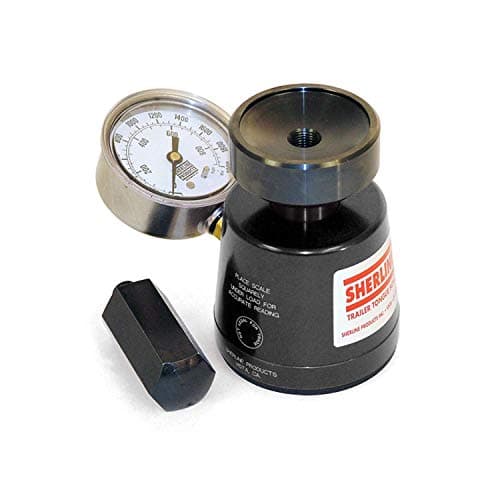 Sherline LM 2000 Trailer Tongue Weight Scale A hydraulic scale you set the coupler down on. It is the only tool here that answers the one question every hitch decision depends on, and it reads up to 2,000 lb. Measures the key number | Measuring loaded tongue weight properly, once and for all | 7.4/ 10 | |
| 2 | 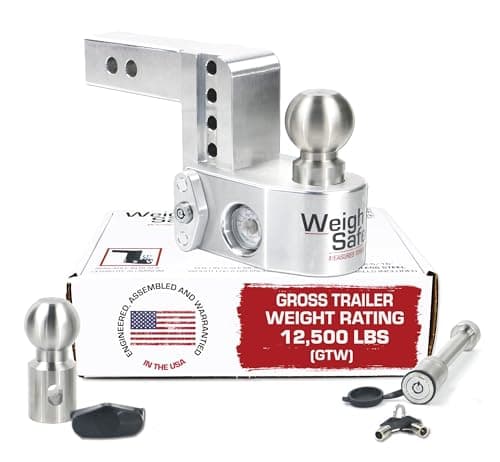 Weigh Safe Aluminum Adjustable Hitch with Tongue Weight Scale An adjustable ball mount with the scale built into the shank, so the number appears every time you couple up rather than only when you remember to get the scale out. | Seeing tongue weight every time you hook up, not once a year | 8.0/ 10 | |
| 3 | 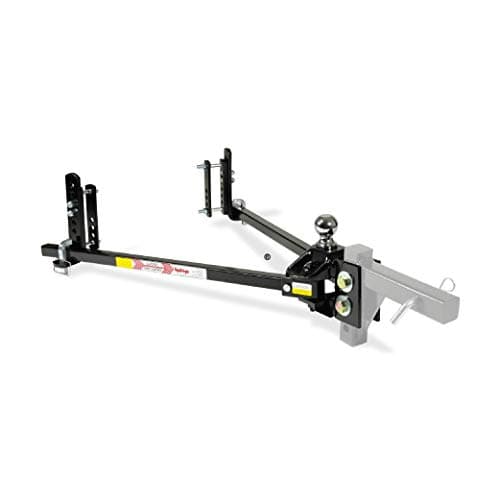 Equal-i-zer 4-Point Sway Control Hitch, 90-00-1001 Four-point sway control built into the head, so there is no friction bar to unclip before you back into a site — the single biggest quality-of-life difference for a first-timer. | Most half-ton trucks pulling a 5,000-10,000 lb trailer | 7.9/ 10 |
Tap any row to jump to the full write-up. Prices come from Amazon and are read automatically — see each product below for the date.
The short answer
These three get used interchangeably in conversation and they are three different limits with three different causes. Confusing them is how people end up with a trailer their truck cannot legally pull despite the brochure saying otherwise.
What each one actually is
Towing capacity
The maximum loaded trailer weight the vehicle is rated to tow. Established by the manufacturer, and on modern vehicles established under SAE J2807, which specifies acceleration, braking and a defined grade climb with a loaded trailer. It is primarily about powertrain, cooling and braking.
Where to find it: the towing section of your owner’s manual, matched to your exact configuration — cab, bed, axle ratio, drivetrain. Not the brochure headline, which quotes the best configuration.
Payload
The maximum combined weight of occupants and cargo the vehicle may carry. Derived from the gross vehicle weight rating minus the vehicle’s actual curb weight as built, which is why it varies between two trucks of the same model year with different options.
Where to find it: the yellow sticker in the driver’s door frame. It is specific to your vehicle, not your model.
Tongue weight
The downward force the trailer coupler puts on the hitch ball, typically 10–15% of the loaded trailer weight on a bumper-pull travel trailer. It is a property of the trailer and how you load it.
Where to find it: only by measuring. Three methods, one of which is free.
How they interact, in one worked example
Take a half-ton truck with a 9,300 lb towing capacity and a 1,487 lb payload sticker, and a 7,000 lb loaded travel trailer with 12% tongue weight.
| Weight | Running total | |
|---|---|---|
| Payload available | 1,487 lb | 1,487 lb |
| Trailer tongue weight at 12% of 7,000 lb | -840 lb | 647 lb |
| Weight distribution hitch | -95 lb | 552 lb |
| Two adults | -340 lb | 212 lb |
| Two children | -150 lb | 62 lb |
| Cooler, chairs, firewood, tools | -250 lb | -188 lb |
The trailer is 2,300 lb inside the towing capacity and the truck is 188 lb over its payload. That is not a rounding error and it is not unusual — it is the normal outcome of buying to the towing figure.
The common mistake
Which one runs out first, by vehicle
| Vehicle | Usually limited by |
|---|---|
| Mid-size SUV | Payload, and often tongue weight limit |
| Half-ton, standard payload | Payload, by a wide margin |
| Half-ton, max tow package | Payload, narrowly |
| Three-quarter ton | Towing capacity or GCWR |
| One ton | Towing capacity or GCWR |
There is a fourth limit worth knowing about: GCWR, the gross combined weight rating, which caps the truck plus trailer together. On a three-quarter-ton you can be inside payload and inside towing capacity and still over GCWR, because the truck itself is heavy. It is in the same part of the manual.
Getting your own numbers
What you need from the vehicle
- Payload, from the yellow door-jamb sticker
- Towing capacity, from the manual for your exact configuration
- Maximum tongue weight, from the towing section
- GCWR, from the same section
What you need from the trailer
- Loaded trailer weight, from a truck scale
- Loaded tongue weight, measured not estimated
- GVWR, from the trailer's own placard
- Where the heavy items sit relative to the axles
Both halves matter. A trailer’s GVWR tells you what it is allowed to weigh, not what it weighs, and the gap between them is often 1,500 lb of cargo capacity you will use.
Then work it through: how much can my truck tow runs the full procedure, and payload vs towing capacity focuses on the subtraction most people skip.
The short version
Work out your payload remainder first, divide by about 0.12, and that is the realistic loaded trailer weight for your truck. Then check that figure against towing capacity and GCWR. If the trailer you want is past the payload figure, the honest options are a lighter trailer, a lighter load, or a heavier truck — and no accessory is on that list.
What to remember
- Towing capacity is about powertrain and brakes; payload is a structural and certification limit.
- Tongue weight counts in full against payload. It is usually the biggest single line item.
- On most half-tons, payload runs out thousands of pounds before towing capacity.
- GCWR is a fourth limit that catches heavier trucks.
- No hitch and no suspension accessory increases payload.
The picks in full
Sherline LM 2000 Trailer Tongue Weight Scale
Sherline · Best for measuring loaded tongue weight properly, once and for all
A hydraulic scale you set the coupler down on. It is the only tool here that answers the one question every hitch decision depends on, and it reads up to 2,000 lb.
Key specifications
- Capacity
- 2,000 lb
- Type
- Hydraulic dial gauge
- Use
- Jack the coupler down onto the scale
- Power
- None — mechanical
How it scored
- How often you use it (40%)9
- Build quality (25%)9
- Takes up little room (20%)4
- Price for capability (15%)5
Weighted average of the figures above. We did not test this product — see how we pick.
What it does well
- Gives you the loaded number, not the brochure dry number
- No batteries, no calibration routine, no app
- Capacity covers essentially every bumper-pull trailer
What it is bad at
- Expensive for a tool most people use twice a year
- Bulky to store
- You need level ground and the coupler at the right height to read it accurately
Price as of October 5, 2026. #ad How this is funded
Weigh Safe Aluminum Adjustable Hitch with Tongue Weight Scale
Weigh Safe · Best for seeing tongue weight every time you hook up, not once a year
An adjustable ball mount with the scale built into the shank, so the number appears every time you couple up rather than only when you remember to get the scale out.
Key specifications
- Gross trailer weight
- 12,500 lb
- Drop
- 4 in adjustable
- Balls
- Stainless 2 in and 2-5/16 in
- Receiver
- 2 in
- Extras
- 2-piece lock set included
How it scored
- Rated capacity (25%)8
- Adjustability (25%)9
- Security (20%)8
- Build quality (15%)8
- Price for capability (15%)6
Weighted average of the figures above. We did not test this product — see how we pick.
What it does well
- Measures tongue weight as part of hooking up — zero extra effort
- Dual stainless balls cover both common coupler sizes
- Adjustable height, so one mount fits two trailers
What it is bad at
- The gauge reads loaded tongue weight at the ball, which is not identical to a scale under the coupler
- Aluminum body scratches easily
- Expensive for a ball mount
Price as of October 5, 2026. #ad How this is funded
Equal-i-zer 4-Point Sway Control Hitch, 90-00-1001
Equal-i-zer · Best for most half-ton trucks pulling a 5,000-10,000 lb trailer
Four-point sway control built into the head, so there is no friction bar to unclip before you back into a site — the single biggest quality-of-life difference for a first-timer.
Key specifications
- Trailer weight rating
- 10,000 lb
- Tongue weight rating
- 1,000 lb
- Sway control
- 4-point, integral to the head
- Included
- Weight distribution kit; shank and ball sold separately
Capacity figures read from Equal-i-zer product specifications, October 2026.
How it scored
- Sway control (25%)9
- Tongue-weight range (20%)8
- Backing up (20%)9
- Setup effort (15%)7
- Quietness (10%)5
- Price for capability (10%)7
Weighted average of the figures above. We did not test this product — see how we pick.
What it does well
- Sway control is always on — nothing to remember, nothing to remove
- Back up and turn sharply without unhooking anything
- Bracket height is adjustable in the field with a wrench, not a shop visit
What it is bad at
- It creaks and groans in tight turns; owners report this consistently and it is normal, not a fault
- Needs a shank and ball bought separately, which catches people out on price
- Heavier to lift onto the coupler than a friction-bar setup
Price as of October 5, 2026. #ad How this is funded
Common questions
Yes, in full. It is carried by the tow vehicle through the hitch and counts as cargo against the door-jamb sticker — usually the single largest line item in the budget.
Gross combined weight rating — the maximum total weight of truck and trailer together, everything included. You can be inside payload and towing capacity and still over GCWR.
For a private vehicle it is usually not a traffic offense in itself, but it can affect insurance and liability after an incident, and it exceeds the axle, tire, spring and brake capacity the vehicle was certified with. Commercial towing is regulated separately.
Sources
- SAE J2807 — tow-vehicle gross combination weight rating procedure — read October 2026
- SAE J684 — trailer couplings, hitches and safety chains — read October 2026
- CURT published towing product specifications — read October 2026
- 49 CFR 393.70 — coupling devices and towing methods — read October 2026