Towing Setup & Capacity
Weight-Carrying vs Weight-Distributing Capacity
Nearly every hitch label carries two pairs of numbers. Reading the wrong pair is how people tow a trailer they believe is inside spec when it is not.
By Mike M. ·
How this page is funded: we earn a commission if you buy through our links, at no extra cost to you. It never changes which product we rank first. Prices come from Amazon and are read automatically — each one shows the date it was read. Full disclosure.
Quick picks
If reading your label puts you above the weight-carrying rating, these are the parts that move you onto the higher one — plus the scale that gives you the tongue figure to check against.
| # | Product | Best for | Score | Price |
|---|---|---|---|---|
| 1 | 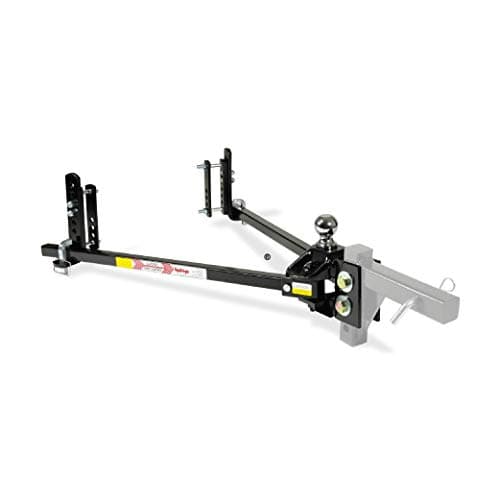 Equal-i-zer 4-Point Sway Control Hitch, 90-00-1001 Four-point sway control built into the head, so there is no friction bar to unclip before you back into a site — the single biggest quality-of-life difference for a first-timer. Most common answer | Most half-ton trucks pulling a 5,000-10,000 lb trailer | 7.9/ 10 | |
| 2 | 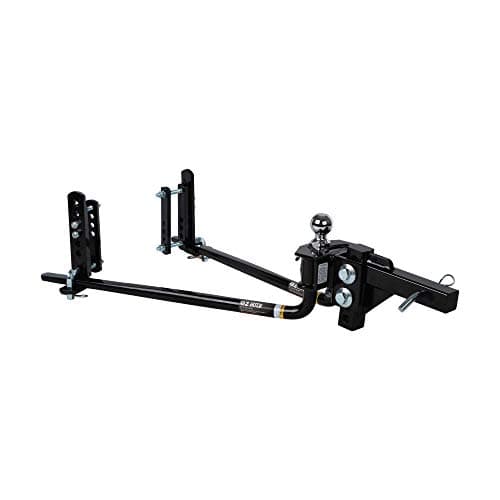 Fastway e2 2-Point Sway Control Round Bar Hitch, 94-00-1033 Equal-i-zer's own value line: two points of built-in sway control instead of four, at a price that leaves money for the shank and ball you still have to buy. Best value | A first hitch on a 5,000-8,000 lb trailer, on a budget | 7.5/ 10 | |
| 3 | 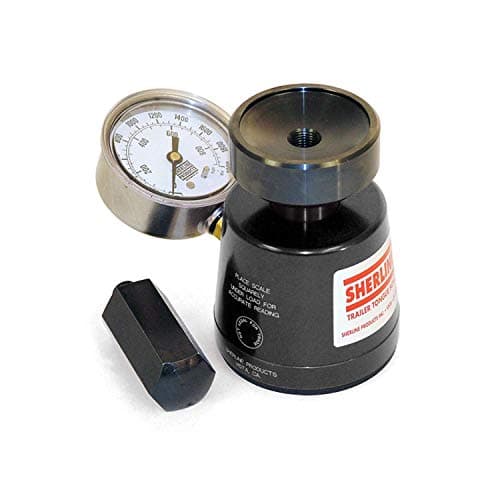 Sherline LM 2000 Trailer Tongue Weight Scale A hydraulic scale you set the coupler down on. It is the only tool here that answers the one question every hitch decision depends on, and it reads up to 2,000 lb. Get the number first | Measuring loaded tongue weight properly, once and for all | 7.4/ 10 |
Tap any row to jump to the full write-up. Prices come from Amazon and are read automatically — see each product below for the date.
The short answer
This is one of the most consequential and least-read labels in towing. A receiver sticker typically reads something like: Weight carrying: 800 lb TW / 8,000 lb GTW. Weight distributing: 1,000 lb TW / 10,000 lb GTW. Four numbers, two scenarios. Owners quote the big one because it is the big one, and then tow with a plain ball mount, which is the scenario the small one describes.
GTW and TW: GTW is gross trailer weight — the whole loaded trailer on a scale. TW is tongue weight — just the downward force at the coupler. Both have to be inside the rating pair you are actually operating under, and tongue weight is the one people exceed first.
Why there are two numbers at all
A plain ball mount makes the tongue load a cantilever. All of it is applied to the receiver, behind the rear axle, which also levers weight off the front axle of the tow vehicle. The receiver, its mounting points and the vehicle’s rear suspension take the whole thing.
Spring bars change the load path. They run from the hitch head to brackets on the trailer A-frame and are tensioned, which pushes down at both ends and in effect levers load forward onto the tow vehicle’s front axle and backward onto the trailer’s own axles. The receiver still carries plenty, but the bending moment it sees is lower for the same tongue weight, and the front axle gets its steering authority back. How weight distribution hitches work goes through the mechanics.
So the two ratings are not marketing tiers. They are two genuinely different structural situations, and the hitch maker is telling you what the part can do in each.
How to read your own label
- 1
Find the sticker or stamping
It is on the receiver tube or the cross-member of the hitch itself, not on the vehicle. On a factory-fitted hitch it may also appear in the towing section of the owner's manual. - 2
Identify both pairs
You are looking for two tongue weight figures and two gross trailer weight figures. If only one pair is listed, that hitch has one rating and weight distribution does not raise it. - 3
Measure your real loaded tongue weight
Not the brochure dry hitch weight. Loading a trailer the way a family actually loads it typically adds 100 to 250 lb to the tongue, which is frequently the difference between the two ratings. - 4
Compare, then cross-check the vehicle
If your tongue weight is above the weight-carrying figure, weight distribution is required. Then check the vehicle's own towing and payload ratings — if the vehicle is lower, the vehicle governs regardless of what the hitch allows.
Step three is the one that catches people, and it is the reason a tongue weight scale earns its price. How to measure tongue weight covers the three honest methods, two of which cost nothing.
The common mistake
A worked example
| Plain ball mount | With weight distribution | |
|---|---|---|
| Rating that applies | 800 lb TW / 8,000 lb GTW | 1,000 lb TW / 10,000 lb GTW |
| Your loaded trailer | 7,400 lb | 7,400 lb |
| Your loaded tongue weight | 930 lb | 930 lb |
| Inside the GTW rating? | Yes | Yes |
| Inside the TW rating? | No — 130 lb over | Yes |
| Verdict | Out of spec | In spec |
Note what happened. The trailer weight was never the problem; it was comfortably inside both figures. The tongue weight was the problem, and it was over by an amount that no amount of careful driving addresses. This is why tongue weight, not trailer weight, is the number this site keeps returning to.
What weight distribution does not do
It does not increase your vehicle’s payload. The tongue weight still sits on the vehicle in full and still counts against the figure on the door-jamb sticker — spring bars move where within the vehicle the load is carried, not whether it is carried. Tongue weight vs payload vs towing capacity separates the three.
It does not raise your vehicle’s maximum trailer weight unless the manufacturer says it does. Some manuals do list a higher trailer weight with weight distribution fitted; many do not. The manual is the authority, not the hitch label.
And it does not make an undersized hitch adequate. The weight-distributing rating is still a rating. If you are above it, the answer is a stronger hitch or a lighter trailer, not more bar tension.
What to remember
- Most receivers carry two ratings. Which applies depends on whether spring bars are fitted.
- Tongue weight is the figure people exceed first, not trailer weight.
- If your measured tongue weight is above the weight-carrying rating, weight distribution is required, not optional.
- Use the loaded tongue weight, never the brochure dry hitch weight — the gap is routinely 100-250 lb.
- Weight distribution never adds payload, and only raises trailer weight if your manual says so.
- The vehicle's own ratings govern whenever they are lower than the hitch's.
The picks in full
Equal-i-zer 4-Point Sway Control Hitch, 90-00-1001
Equal-i-zer · Best for most half-ton trucks pulling a 5,000-10,000 lb trailer
Four-point sway control built into the head, so there is no friction bar to unclip before you back into a site — the single biggest quality-of-life difference for a first-timer.
Key specifications
- Trailer weight rating
- 10,000 lb
- Tongue weight rating
- 1,000 lb
- Sway control
- 4-point, integral to the head
- Included
- Weight distribution kit; shank and ball sold separately
Capacity figures read from Equal-i-zer product specifications, October 2026.
How it scored
- Sway control (25%)9
- Tongue-weight range (20%)8
- Backing up (20%)9
- Setup effort (15%)7
- Quietness (10%)5
- Price for capability (10%)7
Weighted average of the figures above. We did not test this product — see how we pick.
What it does well
- Sway control is always on — nothing to remember, nothing to remove
- Back up and turn sharply without unhooking anything
- Bracket height is adjustable in the field with a wrench, not a shop visit
What it is bad at
- It creaks and groans in tight turns; owners report this consistently and it is normal, not a fault
- Needs a shank and ball bought separately, which catches people out on price
- Heavier to lift onto the coupler than a friction-bar setup
Price as of October 10, 2026. #ad How this is funded
Fastway e2 2-Point Sway Control Round Bar Hitch, 94-00-1033
Fastway · Best for a first hitch on a 5,000-8,000 lb trailer, on a budget
Equal-i-zer's own value line: two points of built-in sway control instead of four, at a price that leaves money for the shank and ball you still have to buy.
Key specifications
- Trailer weight rating
- 10,000 lb
- Tongue weight rating
- 1,000 lb
- Sway control
- 2-point, integral
- Included
- Weight distribution kit; shank and ball sold separately
Capacity figures read from Fastway e2 product specifications (Equal-i-zer / Progress Mfg), October 2026.
How it scored
- Sway control (25%)7
- Tongue-weight range (20%)8
- Backing up (20%)9
- Setup effort (15%)7
- Quietness (10%)5
- Price for capability (10%)8
Weighted average of the figures above. We did not test this product — see how we pick.
What it does well
- Integral sway control, so nothing to unclip before backing
- Cheaper than the four-point Equal-i-zer with most of the behavior
- Round bars are more forgiving of an imperfect bracket height
What it is bad at
- Two friction points rather than four, so it works less hard in a crosswind
- Still creaks, same as its four-point sibling
- Shank and ball sold separately
Price as of October 10, 2026. #ad How this is funded
Sherline LM 2000 Trailer Tongue Weight Scale
Sherline · Best for measuring loaded tongue weight properly, once and for all
A hydraulic scale you set the coupler down on. It is the only tool here that answers the one question every hitch decision depends on, and it reads up to 2,000 lb.
Key specifications
- Capacity
- 2,000 lb
- Type
- Hydraulic dial gauge
- Use
- Jack the coupler down onto the scale
- Power
- None — mechanical
How it scored
- How often you use it (40%)9
- Build quality (25%)9
- Takes up little room (20%)4
- Price for capability (15%)5
Weighted average of the figures above. We did not test this product — see how we pick.
What it does well
- Gives you the loaded number, not the brochure dry number
- No batteries, no calibration routine, no app
- Capacity covers essentially every bumper-pull trailer
What it is bad at
- Expensive for a tool most people use twice a year
- Bulky to store
- You need level ground and the coupler at the right height to read it accurately
Price as of October 10, 2026. #ad How this is funded
Common questions
Two ratings for one receiver. Carrying applies with a plain ball mount, where the receiver takes the whole tongue load. Distributing is the higher rating that applies only with spring bars fitted, because they move part of the load onto the front axle and the trailer axles.
On the sticker or stamping on the receiver tube or cross-member, and often in the manual’s towing section too. One pair of numbers means one rating, and weight distribution will not raise it.
No. The tongue weight still counts against the door-jamb payload figure in full. Spring bars change where in the vehicle it is carried, not whether it is carried.
You are outside the manufacturer’s specification, which matters for safety and for insurance. The receiver sees more bending load than it was rated for and the front axle is unloaded more than intended. Fit weight distribution or reduce the tongue weight.
Sources
- CURT published towing product specifications — read October 2026
- REDARC Tow-Pro Elite published specifications and vehicle fitment — read October 2026
- SAE J684 — trailer couplings, hitches and safety chains — read October 2026
- SAE J2807 — tow-vehicle gross combination weight rating procedure — read October 2026
- 49 CFR 393.40 — required brake systems, including trailer brakes — read October 2026