Weight Distribution & Sway Control
The Best 4-Point Sway Control Hitches
Four-point means the sway resistance is designed into the head and the bar brackets, not clipped on beside them. It is the single upgrade that most changes how a travel trailer feels at highway speed.
By Mike M. ·
How this page is funded: we earn a commission if you buy through our links, at no extra cost to you. It never changes which product we rank first. Prices come from Amazon and are read automatically — each one shows the date it was read. Full disclosure.
Quick picks
Scored on the published hitch rubric — sway control (25%), weight range (20%), backing and maneuvering (20%), setup (15%), noise (10%), price (10%). All four below have sway control integral to the head, which is the entry requirement for this page.
| # | Product | Best for | Score | Price |
|---|---|---|---|---|
| 1 | 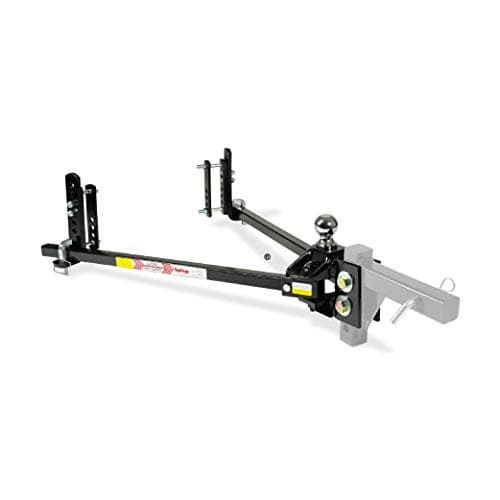 Equal-i-zer 4-Point Sway Control Hitch, 90-00-1001 Four-point sway control built into the head, so there is no friction bar to unclip before you back into a site — the single biggest quality-of-life difference for a first-timer. Top pick | Most half-ton trucks pulling a 5,000-10,000 lb trailer | 7.9/ 10 | |
| 2 | 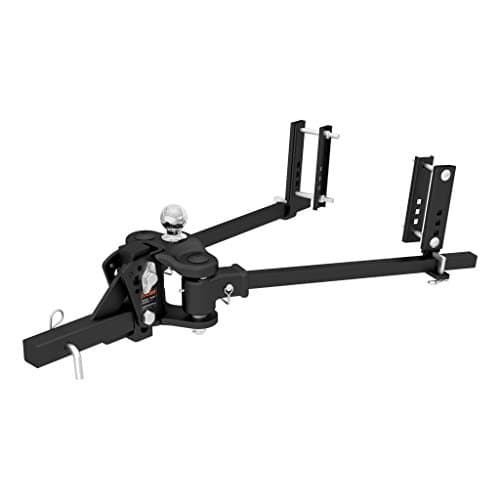 CURT TruTrack 4P Weight Distribution Hitch, 17500 CURT's answer to the four-point Equal-i-zer, with a 10,000 lb rating and an adjustable sway bias — generally a couple of hundred dollars under the hitch it is aimed at. Best value | Four-point sway control at a mid-range price | 7.9/ 10 | |
| 3 | Equal-i-zer 4-Point Sway Control Hitch, 90-00-0601 The small-bar Equal-i-zer. Buying this instead of the 1,000 lb version is the fix for the harsh, over-sprung ride people complain about on light trailers. Best for lighter trailers | Light trailers with a loaded tongue weight near 600 lb | 7.6/ 10 | |
| 4 | 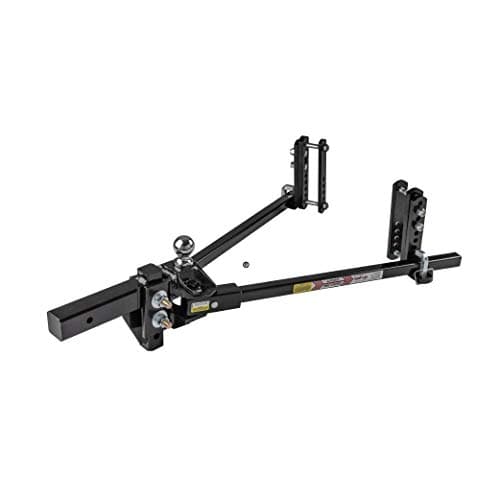 Equal-i-zer 4-Point Sway Control Hitch, 90-00-1600 The heavy end of the Equal-i-zer line, and the one version that ships with a standard shank included rather than as an extra line on the invoice. Best for heavy trailers | Heavy trailers over 10,000 lb behind a three-quarter-ton or bigger | 8.0/ 10 |
Tap any row to jump to the full write-up. Prices come from Amazon and are read automatically — see each product below for the date.
The short answer
“Four-point sway control” is a specific mechanical claim, not a marketing tier. It means there are four surfaces generating friction against trailer rotation, and on an Equal-i-zer-style head those four are: the two spring bar sockets in the head, where each bar rotates against a machined face, and the two L-brackets on the trailer A-frame, where each bar slides against a bracket plate. Rotate the trailer relative to the truck and all four resist at once.
Sway: the trailer yawing side to side around the hitch ball, usually started by a crosswind, a passing truck, or a steering correction. Weight distribution does not stop sway — it fixes axle loading. Sway control is a separate function, and this is the page about it.
Four-point against two-point against clip-on
The field has three real tiers and the names on the boxes blur them, so here is the distinction that matters at the dump station and at 65 mph.
| Approach | Engaged when | Backing up | Typical example |
|---|---|---|---|
| 4-point integral | Always | No action needed | Equal-i-zer, CURT TruTrack 4P |
| 2-point integral | Always | No action needed | Fastway e2 |
| Friction bar add-on | Only when clipped in | Must be unclipped first | CURT 17200 kit |
| Spring-bar tension only | Always, but weaker | No action needed | Blue Ox SwayPro |
The practical gap between four-point and a clip-on friction bar is not really the friction area. It is that you cannot forget a four-point head. A clip-on bar has to come off before a sharp turn or a tight reverse, and the number of owners who have snapped one by forgetting is not small. If you already own a plain weight-distribution kit, the sway control types comparison covers retrofitting honestly, including when it is not worth it.
What to look for
Tongue weight rating that brackets your measured load. The same rule as every hitch page on this site: the bars have to deflect to work. Buy the class your measured tongue weight sits inside, not the biggest one sold. Hitch by trailer weight maps the classes to trailer weights.
Whether a shank is included. The 10,000 lb Equal-i-zer does not include a shank or ball; the 16,000 lb version includes a standard shank. The TruTrack kit includes its sway control hardware. These are real cost differences the sticker does not show.
Adjustability. The TruTrack lets you bias the sway control; the Equal-i-zer head does not, it is set by geometry. Adjustable is useful if you tow a mix of trailers; fixed is one fewer thing to get wrong.
Noise tolerance. Four friction surfaces make noise. Equal-i-zer heads creak and clunk at parking-lot speeds, and this is documented normal behavior rather than a defect. If that will bother you, the quieter option is spring-bar tension (SwayPro) at the cost of weaker sway resistance — SwayPro vs Equal-i-zer is that trade in full.
The picks
Equal-i-zer 1,000 lb. The default. Four-point sway control integral to the head, 10,000 lb trailer and 1,000 lb tongue, and the widest parts and bracket availability in the category. You will buy a shank and ball separately. It creaks. It also does exactly what it says, which is why it wins the main roundup as well.
CURT TruTrack 4P. Four-point at a mid-range price with sway-control bias adjustment, rated 10,000 lb gross trailer weight, and the weight distribution and sway hardware in one kit. It is the sensible pick if the Equal-i-zer price is the thing stopping you, and the adjustable bias genuinely helps if you tow more than one trailer.
Equal-i-zer 600 lb. Same head, smaller bars, for trailers whose loaded tongue weight is near 600 lb. This is the one mid-size truck owners should be looking at — see the Tacoma page for why bar sizing matters more than brand there.
Equal-i-zer 1,600 lb. For trailers over 10,000 lb behind a three-quarter-ton or larger truck. Ships with a standard shank, which the 1,000 lb version does not. If you are in this weight class the relevant question is usually whether your receiver has a weight-distributing rating that high — class 3 vs class 4 covers it.
The common mistake
What to remember
- Four-point means four friction surfaces in the head and brackets, all engaged all the time.
- The real advantage over a clip-on friction bar is that you cannot forget it.
- Equal-i-zer 1,000 lb is the default; CURT TruTrack 4P is the value pick with adjustable bias.
- Size by measured loaded tongue weight, not by the largest rating available.
- Four-point heads creak at low speed. That is documented normal, not a fault.
- Shank and ball are separate purchases on some kits and included on others.
How we picked
We have not towed with these hitches. This ranking reads each maker’s published ratings, head design and kit contents, plus current retailer listing data read automatically, against the rubric on how we pick. Where we describe noise or backing behavior we are reporting what owners consistently say and what the design implies, stated as reporting rather than as our own testing.
The picks in full
Equal-i-zer 4-Point Sway Control Hitch, 90-00-1001
Equal-i-zer · Best for most half-ton trucks pulling a 5,000-10,000 lb trailer
Four-point sway control built into the head, so there is no friction bar to unclip before you back into a site — the single biggest quality-of-life difference for a first-timer.
Key specifications
- Trailer weight rating
- 10,000 lb
- Tongue weight rating
- 1,000 lb
- Sway control
- 4-point, integral to the head
- Included
- Weight distribution kit; shank and ball sold separately
Capacity figures read from Equal-i-zer product specifications, October 2026.
How it scored
- Sway control (25%)9
- Tongue-weight range (20%)8
- Backing up (20%)9
- Setup effort (15%)7
- Quietness (10%)5
- Price for capability (10%)7
Weighted average of the figures above. We did not test this product — see how we pick.
What it does well
- Sway control is always on — nothing to remember, nothing to remove
- Back up and turn sharply without unhooking anything
- Bracket height is adjustable in the field with a wrench, not a shop visit
What it is bad at
- It creaks and groans in tight turns; owners report this consistently and it is normal, not a fault
- Needs a shank and ball bought separately, which catches people out on price
- Heavier to lift onto the coupler than a friction-bar setup
Price as of October 21, 2026. #ad How this is funded
CURT TruTrack 4P Weight Distribution Hitch, 17500
CURT · Best for four-point sway control at a mid-range price
CURT's answer to the four-point Equal-i-zer, with a 10,000 lb rating and an adjustable sway bias — generally a couple of hundred dollars under the hitch it is aimed at.
Key specifications
- Gross trailer weight
- 10,000 lb
- Sway control
- 4-point, integral
- Adjustment
- Sway-control bias adjustable
- Included
- Weight distribution kit with sway control
Capacity figures read from CURT TruTrack specifications, October 2026.
How it scored
- Sway control (25%)9
- Tongue-weight range (20%)8
- Backing up (20%)9
- Setup effort (15%)6
- Quietness (10%)5
- Price for capability (10%)8
Weighted average of the figures above. We did not test this product — see how we pick.
What it does well
- Four points of sway control for less than the obvious four-point alternative
- Bias adjustment lets you dial sway resistance to the trailer
- No bar to unclip before backing
What it is bad at
- More parts to understand on first setup than a two-point kit
- Less owner experience published than the market leaders, so fewer reports to read
- Friction surfaces mean friction noise
Price as of October 21, 2026. #ad How this is funded
Equal-i-zer 4-Point Sway Control Hitch, 90-00-0601
Equal-i-zer · Best for light trailers with a loaded tongue weight near 600 lb
The small-bar Equal-i-zer. Buying this instead of the 1,000 lb version is the fix for the harsh, over-sprung ride people complain about on light trailers.
Key specifications
- Trailer weight rating
- 6,000 lb
- Tongue weight rating
- 600 lb
- Sway control
- 4-point, integral to the head
- Included
- Weight distribution kit; shank and ball sold separately
Capacity figures read from Equal-i-zer product specifications, October 2026.
How it scored
- Sway control (25%)9
- Tongue-weight range (20%)6
- Backing up (20%)9
- Setup effort (15%)8
- Quietness (10%)5
- Price for capability (10%)6
Weighted average of the figures above. We did not test this product — see how we pick.
What it does well
- Correctly sprung for a 400-600 lb tongue, where the 1,000 lb bars ride stiff
- Same four-point sway geometry as the bigger versions
- Light enough that one person can hook up without a fight
What it is bad at
- No headroom if you upgrade trailers later — the bars are the limit, not a suggestion
- Costs close to the 1,000 lb kit, so the saving is in ride quality, not money
- Shank and ball still sold separately
Price as of October 21, 2026. #ad How this is funded
Equal-i-zer 4-Point Sway Control Hitch, 90-00-1600
Equal-i-zer · Best for heavy trailers over 10,000 lb behind a three-quarter-ton or bigger
The heavy end of the Equal-i-zer line, and the one version that ships with a standard shank included rather than as an extra line on the invoice.
Key specifications
- Trailer weight rating
- 16,000 lb
- Tongue weight rating
- 1,600 lb
- Sway control
- 4-point, integral to the head
- Included
- Standard hitch shank included; ball sold separately
Capacity figures read from Equal-i-zer product specifications, October 2026.
How it scored
- Sway control (25%)9
- Tongue-weight range (20%)9
- Backing up (20%)9
- Setup effort (15%)7
- Quietness (10%)5
- Price for capability (10%)6
Weighted average of the figures above. We did not test this product — see how we pick.
What it does well
- Shank included, which closes most of the price gap with the 10,000 lb kit
- Enough bar for a loaded fifth-wheel-weight bumper-pull trailer
- Same no-unclip backing behavior as the rest of the line
What it is bad at
- Badly over-sprung for anything under about 1,000 lb of tongue weight
- Heavy — awkward to store and to lift onto the coupler alone
- Price is the highest in the Equal-i-zer range
Price as of October 21, 2026. #ad How this is funded
Common questions
Four friction surfaces: both spring-bar sockets in the head and both A-frame brackets. All four resist trailer yaw at the same time, and none of them has to be engaged by you.
Yes in practice: more friction surfaces, and nothing to remember before backing. A clip-on bar remains the cheapest retrofit for a kit with no sway control at all.
No — that is the point of it. Very tight jackknife angles still need care with any weight distribution hitch; follow your model’s instructions.
No. It raises the threshold and damps sway faster, but loading matters more. What causes sway covers the loading side.
Sources
- Equal-i-zer published hitch ratings and sizing guidance — read October 2026
- Blue Ox published SwayPro ratings — read October 2026
- CURT published TruTrack and weight distribution specifications — read October 2026
- SAE J684 — trailer couplings, hitches and safety chains — read October 2026