Water & Waste
The Best RV Water Line Sanitizer
A fresh water tank that has sat for a season grows a film you cannot see and can definitely taste. Sanitizing is the fix, and the filter on the hose is not a substitute for it.
By Mike M. ·
How this page is funded: we earn a commission if you buy through our links, at no extra cost to you. It never changes which product we rank first. Prices come from Amazon and are read automatically — each one shows the date it was read. Full disclosure.
Quick picks
Scored on the published essentials rubric - usefulness (40%), build (25%), packability (20%), price (15%). Four products covering two genuinely different jobs: sanitizing, and keeping a sanitized tank clean.
| # | Product | Best for | Score | Price |
|---|---|---|---|---|
| 1 | 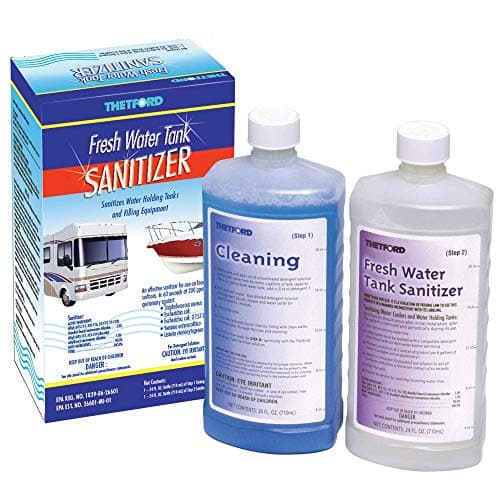 Thetford Fresh Water Tank Sanitizer, Detergent and Treatment, 36662 Two bottles, two steps: a detergent pass that lifts the biofilm off the tank walls and a sanitizing pass that kills what the detergent released. That two-stage approach is why it beats pouring bleach in and hoping. Top pick | The once-or-twice-a-year full system sanitize | 7.9/ 10 | |
| 2 | 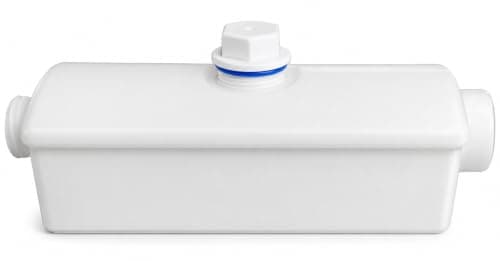 RV Inline Sanitizer, 16 oz Reusable Bleach Injector A refillable inline canister that sits between the hose and the city water inlet, so the diluted solution reaches the water heater, the lines and every fixture rather than only the fresh tank. It is a tool, not a chemical — you still supply the bleach. Best delivery method | Getting sanitizer into the lines without climbing into the tank | 7.6/ 10 | |
| 3 | 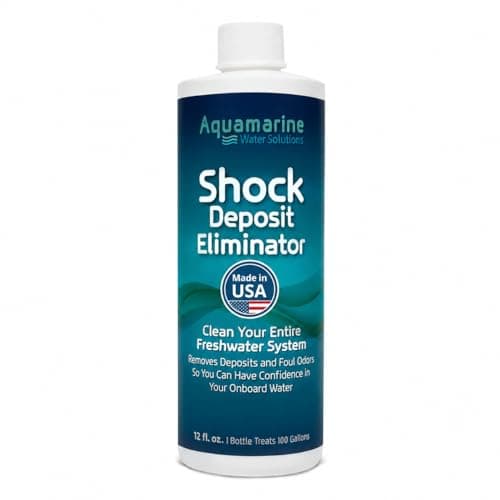 Shock RV and Boat Water Tank Deep Cleaner and Deodorizer, 12 oz Aimed at the specific problem of a system that sat: a concentrated deep clean for a tank with a stale or sulfur smell, rather than a routine seasonal sanitize. Buy it for the problem, not the calendar. For a tank that smells | A tank that already smells, after long storage | 6.8/ 10 | |
| 4 | 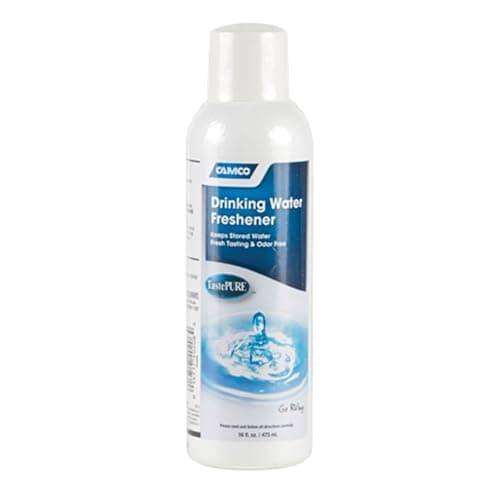 Camco TastePURE Drinking Water Freshener, 16 oz, 40206 This is maintenance, not sanitizing, and the distinction matters: it slows algae and slime in a tank you already cleaned. Treat it as the thing you use between the annual sanitize, not instead of it. Between sanitizes | Keeping a sanitized tank clean between sanitizes | 7.5/ 10 | $3.25View on Amazon
|
Tap any row to jump to the full write-up. Prices come from Amazon and are read automatically — see each product below for the date.
The short answer
Here is the thing most first-time owners get wrong, and it is understandable. You bought an inline carbon filter, you screwed it onto the hose, and it seems reasonable to assume the water is now clean. It is not the same job. The filter addresses what is coming in at a campground spigot — taste, chlorine, sediment. Sanitizing addresses what is already in your trailer: the film that grew on the inside of a plastic tank and twenty feet of PEX while the trailer sat in a yard for five months at summer temperatures.
Biofilm: the slick layer that bacteria build on a wet surface. It is what makes a tank smell stale or sulfurous, it shrugs off a plain rinse, and a chlorine solution has a much easier time killing bacteria once a detergent has lifted the film they are hiding under. That is the whole argument for a two-step product over a jug of bleach.
When this job is actually due
| Situation | Sanitize? | Why |
|---|---|---|
| First trip of the season, after storage | Yes | Months of warm, still water in a sealed tank |
| A trailer you just bought, used | Yes, before you drink anything | You do not know its history |
| A brand new trailer | Yes | Systems are tested with water at the factory and then sit |
| Water tastes or smells stale | Yes | That is the symptom this job fixes |
| You filled the tank from an unknown source | Yes | A filter does not disinfect |
| Mid-season, tank used continuously | Usually not | Water that moves has less chance to grow a film |
| Before winterizing | Optional | Sanitize in spring instead - it is the pass that matters |
For most owners that lands on once a year, in spring, plus whenever something tastes wrong. It is a half-day job dominated by filling and draining rather than by effort, which is why it gets put off and why the first glass of water each season is the one nobody enjoys. It is also on the annual maintenance checklist, alongside the jobs that cost real money when skipped.
What to look for
Whether it is a sanitizer or a freshener. This is the distinction the category blurs hardest. A sanitizer is a disinfecting pass that kills what is living in the system. A freshener is a low-dose additive that slows regrowth in a tank you already cleaned. They are both useful; they are not substitutes, and a bottle labeled “freshener” will not rescue a contaminated tank.
Whether it reaches the lines, or only the tank. Pouring something into the fresh tank treats the tank. Your system is also twenty-odd feet of line, a pump, a water heater and every fixture. Whatever you use has to be run through every tap, hot and cold, until you smell it — or it has done half a job.
Potable-safe, and intended for the purpose. Look for products made for RV and marine fresh water systems. Components in contact with drinking water are the area that standards like NSF/ANSI 61 exist to cover, and this is not the shelf to improvise on with a household cleaner.
Dilution you can actually measure. Over-concentrated chlorine is hard on seals, pump diaphragms and the water heater’s anode. A product with a stated dose per gallon beats a glug from a jug.
How long the taste takes to leave. Every method leaves some chlorine taste, and the real cost of the job is the rinse cycles that follow. A two-step product that rinses clean in two fills is better value than a cheaper one that takes four.
Whether a new trailer needs it. People are surprised by this one, so it is worth stating plainly: yes. A new trailer’s water system was filled and pressure tested with water at the factory, then sat on a dealer lot through however many weeks of weather before you collected it. Nothing about being new means the tank and lines are clean, and the first sanitize is the one most often skipped because the trailer looks spotless. The same applies to a used trailer on the day you buy it, where you simply do not know what was in the tank or how long it sat there.
The picks
Thetford Fresh Water Tank Sanitizer, 36662. The top pick because it treats the job as two problems rather than one. The detergent bottle lifts the film; the sanitizer bottle disinfects what is underneath. Thetford has a long record in RV sanitation chemistry and the product is purpose-made for potable systems rather than repurposed from a household line. It costs several times what a jug of bleach does, and two steps means two fill-and-drain cycles and most of a day — that is the honest trade.
RV Inline Sanitizer. Not a chemical, a tool: a refillable canister that sits between the hose and the city water inlet so a diluted solution reaches the water heater, the lines and every fixture instead of only the fresh tank. It is reusable season after season, so the cost amortizes quickly. You still buy and dilute the bleach yourself, which is both the appeal and the risk — it is easy to over-concentrate if you fill it without measuring. It also adds one more fitting to check for drips.
Shock RV and Boat Water Tank Deep Cleaner. Buy this for a problem, not for the calendar. It is aimed at the tank that already smells stale or sulfurous after long storage, and it is concentrated enough that a small bottle covers a full RV tank. It comes from a smaller brand with less published chemistry than Thetford, and it is priced close to the two-step kit for less volume. It is not a substitute for a proper sanitize before the first trip.
Camco TastePURE Drinking Water Freshener, 40206. The cheapest item here by a wide margin, and the one we are most careful about describing. It slows algae and slime in a tank you have already cleaned. It will not clean a tank that is already contaminated, and it does nothing for the water heater or the lines. Used for what it is, it is genuinely worth the few dollars; used instead of sanitizing, it is a way to feel like you did the job.
The common mistake
Four problems sanitizing will not fix
Worth knowing before you spend a day on it, because a sanitize that does not solve your problem usually means you were solving the wrong problem.
A rotten-egg smell from the hot tap only. That is almost always the water heater’s sacrificial anode rod reacting with sulfates in the water, not bacteria in the tank. The giveaway is that the cold side is fine. Sanitizing will knock the smell back for a few days and it will return, because the cause is still bolted into the heater. The fix is replacing or changing the anode material, which is a water heater job rather than a tank job.
A stale smell that comes back within a week. This usually means the sanitize was partial — the solution never reached the water heater because it was left bypassed and then never flushed, or a low-point drain was never opened, or the contact time got cut short. Biofilm that survives in one unreached section reseeds the rest of the system quickly. The second attempt is usually the one that works, done properly.
Water that tastes of chlorine at the campground. That is the municipal supply doing its job, and it is arriving that way through your hose. A sanitize does nothing about it because it is not your water that is the problem. An inline carbon filter is the part for that, fitted after the regulator.
Pink slime around a faucet or in the shower. That is typically a common airborne bacterium that colonizes damp surfaces, and it lands from the room rather than coming out of the tank. Clean the fixture; sanitizing the tank will not stop it recurring in a bathroom that stays damp.
The common mistake
How to sanitize the system
- 1
Read your trailer's own procedure first
Your owner’s manual states a sanitizing method and any component it tells you to bypass. That document governs, and where it differs from a product label, follow the manual. - 2
Drain everything, and bypass only what your manual says to
Fresh tank, water heater and low-point drains. Whether the water heater is included in the sanitize or bypassed for it varies by manufacturer — follow your own manual rather than a general rule. Remove any inline filter cartridge either way, so you are not circulating the solution through carbon. - 3
Mix to the stated dose, never by eye
Follow the product’s dose per gallon of tank capacity, diluted in water before it goes in. Over-concentrated chlorine is hard on pump diaphragms, seals and the water heater anode. - 4
Fill the tank, then run every tap until you smell it
Hot and cold, kitchen, bathroom, shower, and the outside shower if you have one. The solution has to reach every line, not just the tank. - 5
Let it stand for the time the product states
Contact time is what does the work. Shortening it to save an afternoon is the most common way this job gets done badly. - 6
Drain, then rinse until the chlorine taste is gone
Usually two fills, sometimes three. Run every tap on each rinse. Finish by refitting the filter cartridge you removed. - 7
Fit the filter and regulator before you refill for real
Back to normal service: regulator set at the spigot, filter after it, and a potable-safe hose between them and the trailer.
Two notes worth having before you start. First, you will need somewhere legal to dump several tanks of chlorinated water — not onto a lawn, and not into a storm drain. Second, do not try to combine this with winterizing: antifreeze and sanitizing solution are different jobs in different seasons, and the sanitize that matters is the one in spring, before the first trip.
What to remember
- Sanitizing and filtering are different jobs. A carbon filter does not disinfect.
- Once a year in spring, plus any time the water tastes or smells wrong.
- A two-step detergent-then-sanitizer product beats bleach alone, because of biofilm.
- Whatever you use has to run through every tap, hot and cold, not just the tank.
- Measure the dose - over-concentrated chlorine damages pump seals and the anode.
- A freshener is maintenance for a clean tank, never a rescue for a dirty one.
How we picked
We have not sanitized a trailer with these four products and we do not own one to test them in. This ranking reads each maker’s published product information and the stated contents and dosing on the live retailer listing, and every listing was confirmed live and in stock before it was featured. The procedure above follows the general practice that RV manufacturers publish in their own owner documentation and that public health guidance on disinfecting small drinking water systems describes — your trailer’s manual states the method for your specific system and that document governs where the two differ. We publish no dilution ratios of our own: the dose is on the bottle you buy. Current prices come from retailer listing data read automatically and date-stamped. The rubric and its weights are on how we pick.
The picks in full
Thetford Fresh Water Tank Sanitizer, Detergent and Treatment, 36662
Thetford · Best for the once-or-twice-a-year full system sanitize
Two bottles, two steps: a detergent pass that lifts the biofilm off the tank walls and a sanitizing pass that kills what the detergent released. That two-stage approach is why it beats pouring bleach in and hoping.
Key specifications
- Contents
- 2 x 24 oz bottles
- Process
- Two-step, detergent then sanitizer
- Use on
- Fresh water tank and lines
- Part
- 36662
How it scored
- How often you use it (40%)9
- Build quality (25%)8
- Takes up little room (20%)6
- Price for capability (15%)7
Weighted average of the figures above. We did not test this product — see how we pick.
What it does well
- Purpose-made for potable RV systems rather than a repurposed household product
- The detergent step addresses biofilm, which a bleach-only rinse leaves behind
- Thetford has a long record in RV sanitation chemistry
What it is bad at
- Costs several times what a jug of plain bleach does
- Two steps means two fill-and-drain cycles and most of a day
- Follow the bottle's dilution exactly — this is not a product to eyeball
Price as of October 21, 2026. #ad How this is funded
RV Inline Sanitizer, 16 oz Reusable Bleach Injector
RV Inline Sanitizer · Best for getting sanitizer into the lines without climbing into the tank
A refillable inline canister that sits between the hose and the city water inlet, so the diluted solution reaches the water heater, the lines and every fixture rather than only the fresh tank. It is a tool, not a chemical — you still supply the bleach.
Key specifications
- Capacity
- 16 fl oz
- Type
- Reusable inline canister
- Leak tested
- 65 psi
- Fill
- Household bleach, supplied by you
How it scored
- How often you use it (40%)8
- Build quality (25%)7
- Takes up little room (20%)8
- Price for capability (15%)7
Weighted average of the figures above. We did not test this product — see how we pick.
What it does well
- Reaches the lines and water heater, not just the fresh tank
- Reusable season after season, so the cost amortizes fast
- No pouring bleach through a narrow fill neck with a funnel
What it is bad at
- You still buy and dilute the bleach — this is the delivery method only
- One more fitting in the line, so one more place to check for drips
- Easy to over-concentrate if you fill it without measuring
Price as of October 21, 2026. #ad How this is funded
Shock RV and Boat Water Tank Deep Cleaner and Deodorizer, 12 oz
Shock · Best for a tank that already smells, after long storage
Aimed at the specific problem of a system that sat: a concentrated deep clean for a tank with a stale or sulfur smell, rather than a routine seasonal sanitize. Buy it for the problem, not the calendar.
Key specifications
- Size
- 12 fl oz
- Use
- Fresh water tanks and systems
- Intended for
- After seasonal storage
- Also suits
- Boat and household fresh water systems
How it scored
- How often you use it (40%)7
- Build quality (25%)6
- Takes up little room (20%)8
- Price for capability (15%)6
Weighted average of the figures above. We did not test this product — see how we pick.
What it does well
- Targets odor and residue rather than only killing bacteria
- Concentrated, so a small bottle covers a full RV tank
- Useful on a tank that has already developed a smell
What it is bad at
- Smaller brand with less published chemistry than Thetford
- Priced close to the two-step Thetford kit for less volume
- Not a substitute for a proper sanitize before the first trip
Price as of October 21, 2026. #ad How this is funded
Camco TastePURE Drinking Water Freshener, 16 oz, 40206
Camco · Best for keeping a sanitized tank clean between sanitizes
This is maintenance, not sanitizing, and the distinction matters: it slows algae and slime in a tank you already cleaned. Treat it as the thing you use between the annual sanitize, not instead of it.
Key specifications
- Size
- 16 oz
- Dose
- 1 oz treats 20 gallons
- Purpose
- Prevents algae and slime build-up
- Part
- 40206
How it scored
- How often you use it (40%)6
- Build quality (25%)7
- Takes up little room (20%)9
- Price for capability (15%)10
Weighted average of the figures above. We did not test this product — see how we pick.
What it does well
- Cheapest item in this category by a wide margin
- Slows the regrowth that makes a tank smell between sanitizes
- One bottle covers a season for most tank sizes
What it is bad at
- Not a sanitizer — it will not clean a tank that is already contaminated
- Marketing blurs the line between freshening and sanitizing; we do not
- Does nothing for the water heater or the lines
Common questions
Once a year in spring for most owners, plus whenever the water tastes wrong, after buying a used trailer, or after filling from an unknown source.
No. A carbon filter handles taste and sediment coming in; it does not disinfect what is already growing inside your tank and lines.
It works, but on its own it has to fight through biofilm — which is what the detergent step in a two-part kit is for. Measure the dose; over-concentrated chlorine damages pump seals and the anode.
A sanitizer disinfects the system once or twice a year. A freshener only slows regrowth in a tank you already cleaned, and does nothing for the lines or water heater.
Sources
- Thetford published fresh water tank sanitizer product information — read October 2026
- Camco published TastePURE drinking water freshener specifications — read October 2026
- NSF/ANSI 61 — drinking water system components, health effects — read October 2026
- CDC guidance on disinfecting private drinking water systems — read October 2026