Water & Waste
What Should You Set An RV Water Pressure Regulator To?
Most RV plumbing is rated well below mains pressure, and campground pedestals vary wildly. A regulator exists to turn an unknown number into one you chose.
By Mike M. ·
How this page is funded: we earn a commission if you buy through our links, at no extra cost to you. It never changes which product we rank first. Prices come from Amazon and are read automatically — each one shows the date it was read. Full disclosure.
Quick picks
Two adjustable regulators with gauges and one preset unit. Which you want depends entirely on whether you plan to set a number or accept one.
| # | Product | Best for | Score | Price |
|---|---|---|---|---|
| 1 | 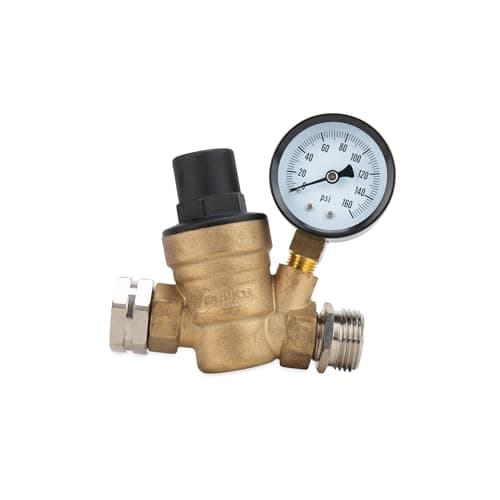 Camco Adjustable RV Water Pressure Regulator, Lead-Free Brass Adjustable lead-free brass with a gauge. Being able to dial pressure down to about 50 psi matters because a campground pedestal can deliver far more than your plumbing is rated for. Best adjustable | Setting your own pressure instead of accepting a preset | 8.2/ 10 | |
| 2 | 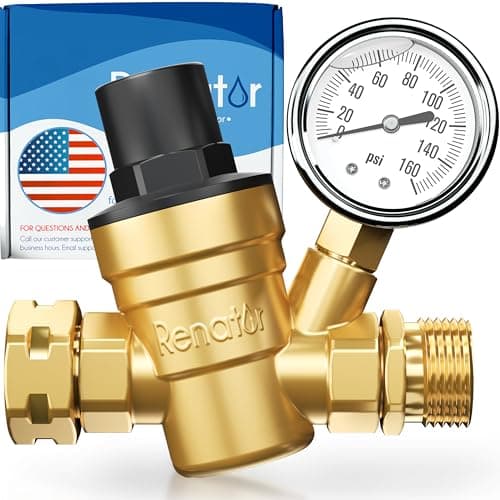 Renator RV Water Pressure Regulator with Gauge, M11-0660R Adjustable, lead-free brass, gauge and inlet screen, at well under half the price of the obvious alternative. It is the value pick in a category where the expensive option is not much better. Best value adjustable | An adjustable regulator with a gauge, for the least money | 8.2/ 10 | |
| 3 | 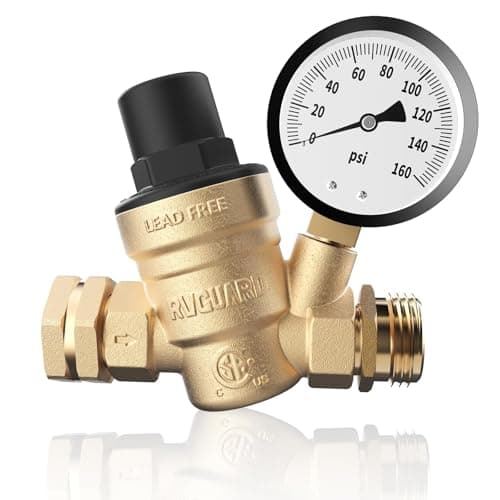 RVGUARD RV Water Pressure Regulator Valve, CSA Approved A CSA-approved lead-free brass regulator with no gauge and nothing to set. If you only want the pressure limited and never want to think about it, this is the whole product. Simplest preset | A simple preset regulator for occasional trips | 7.9/ 10 |
Tap any row to jump to the full write-up. Prices come from Amazon and are read automatically — see each product below for the date.
The short answer
The reason this matters is that a campground pedestal is an unknown. Some sites deliver gentle pressure that barely runs a shower; others sit on municipal mains and deliver something closer to 100 psi. Your trailer’s plumbing was not designed with that upper figure in mind, and the failure is not usually dramatic — it is a fitting that starts to weep behind a wall panel while you are out for the day.
Preset vs adjustable: a preset regulator limits flow to a fixed pressure chosen by the manufacturer, typically in the 40–50 psi region. An adjustable regulator has a screw and usually a gauge, so you pick the number. Adjustable costs more and gives you a reading; the full comparison is here.
Why 40 to 50 psi
Three things set this window, and they pull in opposite directions.
The bottom is set by comfort. Below roughly 40 psi, an RV shower becomes a trickle, the toilet fills slowly and the kitchen faucet feels broken. There is no safety reason to go lower; there is just a point where you stop enjoying the trailer.
The top is set by your plumbing. RV water systems use PEX, flexible connectors and plastic fittings behind walls, and manufacturers state a maximum working pressure in the owner’s manual. That figure is the real ceiling, and it is specific to your trailer — look it up rather than taking a number from a forum.
The middle is where the water heater is happiest. A water heater’s pressure-temperature relief valve weeps when system pressure sits close to its rating. Owners who find a dripping relief valve and assume the heater is failing often have a pressure problem instead.
| Setting | What you get | When to choose it |
|---|---|---|
| Under 40 psi | Weak shower, slow fills | Older trailer, or a known plumbing concern |
| 40 - 45 psi | Comfortable, conservative | Default for most travel trailers |
| 45 - 50 psi | Good shower pressure | Newer trailer with a higher stated maximum |
| Above 60 psi | No comfort gain worth the risk | Not recommended on a travel trailer |
How to set an adjustable regulator
- 1
Find your trailer's maximum working pressure
Owner’s manual, plumbing section. This is the number that governs everything below. If you cannot find it, stay at the conservative end of the window. - 2
Fit the regulator at the spigot, not at the trailer
At the pedestal end, so the hose between the spigot and the trailer is also protected. A regulator at the trailer inlet leaves your fresh water hose exposed to full pedestal pressure. - 3
Put the regulator ahead of any filter
Regulator first, then filter. A filter housing is one of the weaker parts of the chain and should never see unregulated pressure — the order explained. - 4
Back the adjustment screw out before turning the water on
Start low and come up. Turning the water on with the screw wound in means a brief spike at whatever the screw was last set to. - 5
Open the spigot fully, then open a faucet inside
You want to read pressure with water flowing, not sitting still. Static pressure on the gauge reads higher than what the system sees in use. - 6
Turn the screw in until the gauge reads your target
Small adjustments. Give the gauge a second to settle between turns, and set it with a faucet running. - 7
Close the faucet and re-check
Static pressure will read a little higher with everything closed. If that number is close to your trailer’s stated maximum, back the setting down. - 8
Re-check at every new site
The regulator holds its setting, but a pedestal with lower supply pressure than your setting simply delivers less. Glance at the gauge when you hook up.
The common mistake
Which regulator to buy
Camco adjustable, lead-free brass, with gauge. The straightforward adjustable choice: brass body, a gauge you can read, standard garden hose thread. If you want to set a number and see it, this is the one.
Renator M11-0660R. The same idea for less, with a lead-free brass body, a gauge and an inlet filter screen that catches the grit that otherwise ends up in the regulator seat. Good value for a first adjustable unit.
RVGUARD preset. No gauge, no screw, CSA approved, lead-free brass. There is a real case for this: if you camp a handful of weekends a year and will never adjust anything, a preset unit cannot be set wrong and cannot be forgotten at a high setting. The trade is that you have no reading and no choice.
Whichever you buy, look for lead-free brass and components intended for potable water — the regulator roundup ranks the field in full, and the drinking water hose roundup covers the other half of a potable-safe setup.
What to remember
- 40-50 psi suits most travel trailers; your manual's stated maximum governs.
- Below 40 psi the shower suffers; above 60 psi there is no comfort gain worth it.
- A weeping water heater relief valve is often a pressure problem, not a heater fault.
- Fit the regulator at the spigot so the hose is protected too.
- Regulator before filter, always.
- Set it with a faucet running, then re-check static pressure with everything closed.
The picks in full
Camco Adjustable RV Water Pressure Regulator, Lead-Free Brass
Camco · Best for setting your own pressure instead of accepting a preset
Adjustable lead-free brass with a gauge. Being able to dial pressure down to about 50 psi matters because a campground pedestal can deliver far more than your plumbing is rated for.
Key specifications
- Type
- Adjustable
- Material
- Lead-free brass
- Gauge
- Yes
- Connection
- Standard garden hose thread
Capacity figures read from Camco regulator specifications, October 2026.
How it scored
- Material safety (35%)9
- Flow rate (20%)8
- Kink resistance (20%)7
- Build quality (15%)9
- Price for capability (10%)7
Weighted average of the figures above. We did not test this product — see how we pick.
What it does well
- Adjustable, so you can trade flow against pressure
- Gauge tells you what the pedestal is actually doing
- Brass body survives being stepped on
What it is bad at
- Costs several times a preset regulator
- The gauge is the first thing to fog or fail
- Adjustment screw needs a wrench, not fingers
Price as of October 21, 2026. #ad How this is funded
Renator RV Water Pressure Regulator with Gauge, M11-0660R
Renator · Best for an adjustable regulator with a gauge, for the least money
Adjustable, lead-free brass, gauge and inlet screen, at well under half the price of the obvious alternative. It is the value pick in a category where the expensive option is not much better.
Key specifications
- Type
- Adjustable with gauge
- Material
- Lead-free brass
- Extras
- Inlet filter screen
- Model
- M11-0660R
How it scored
- Material safety (35%)9
- Flow rate (20%)8
- Kink resistance (20%)7
- Build quality (15%)7
- Price for capability (10%)10
Weighted average of the figures above. We did not test this product — see how we pick.
What it does well
- Cheapest adjustable-with-gauge regulator here
- Inlet screen catches grit before it reaches your plumbing
- Gauge is easy to read at eye level on a pedestal
What it is bad at
- Gauge accuracy is approximate — treat it as a guide
- The screen clogs and needs cleaning, which people forget
- Shorter track record than the established brands
Price as of October 21, 2026. #ad How this is funded
RVGUARD RV Water Pressure Regulator Valve, CSA Approved
RVGUARD · Best for a simple preset regulator for occasional trips
A CSA-approved lead-free brass regulator with no gauge and nothing to set. If you only want the pressure limited and never want to think about it, this is the whole product.
Key specifications
- Type
- Preset
- Certification
- CSA approved
- Material
- Lead-free brass
- Gauge
- None
How it scored
- Material safety (35%)9
- Flow rate (20%)6
- Kink resistance (20%)7
- Build quality (15%)8
- Price for capability (10%)9
Weighted average of the figures above. We did not test this product — see how we pick.
What it does well
- Nothing to adjust, nothing to get wrong
- Third-party certification is stated on the listing
- Compact — it lives on the hose permanently
What it is bad at
- No gauge, so you never learn what the pedestal was doing
- Preset pressure may throttle flow more than you want
- Not adjustable if your trailer tolerates higher pressure
Price as of October 21, 2026. #ad How this is funded
Common questions
40–50 psi for most travel trailers, lower if the trailer is older or the rating is unknown. Your manual’s stated maximum is the number that governs.
Usually fine on a modern trailer, but confirm your manual’s maximum. On an older trailer, 40–45 psi is the safer place to sit.
At the spigot, ahead of the hose and ahead of any filter. Spigot, regulator, filter, hose, trailer.
A preset is enough for occasional trips and cannot be set wrong. Adjustable is better if you want to choose the number and see the reading.
Sources
- Camco published adjustable water pressure regulator specifications — read October 2026
- Renator published M11-0660R regulator specifications — read October 2026
- NSF/ANSI 61 — drinking water system components, health effects — read October 2026