Towing Setup & Capacity
Towing A Travel Trailer For The First Time
Nobody is born knowing this. Here is what actually matters on your first trip, in the order you will meet it.
By Mike M. ·
How this page is funded: we earn a commission if you buy through our links, at no extra cost to you. It never changes which product we rank first. Prices come from Amazon and are read automatically — each one shows the date it was read. Full disclosure.
Quick picks
The gear that makes a first trip go better, in the order you will want it.
| # | Product | Best for | Score | Price |
|---|---|---|---|---|
| 1 | 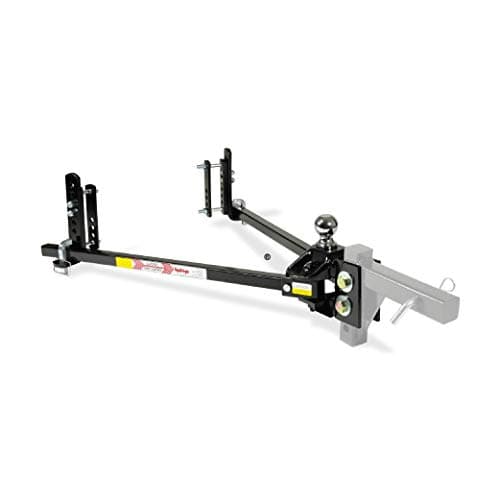 Equal-i-zer 4-Point Sway Control Hitch, 90-00-1001 Four-point sway control built into the head, so there is no friction bar to unclip before you back into a site — the single biggest quality-of-life difference for a first-timer. Buy first | Most half-ton trucks pulling a 5,000-10,000 lb trailer | 7.9/ 10 | |
| 2 | 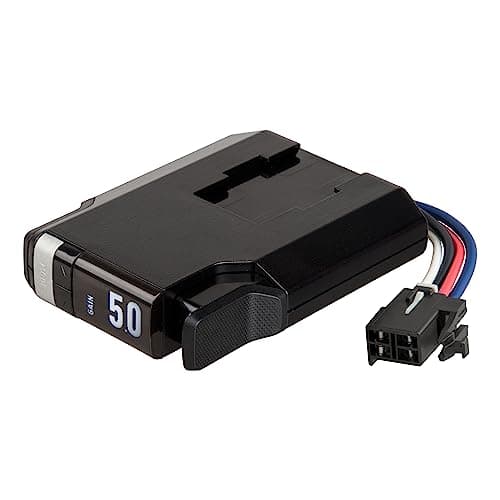 CURT TriFlex Next Proportional Trailer Brake Controller, 51146 Proportional, plug-and-play, fully adjustable and rated to four axles for well under the price of the knob-controlled version — the sensible default if your truck has a factory brake harness. | Most first-time buyers who want proportional braking cheaply | 8.2/ 10 | |
| 3 | 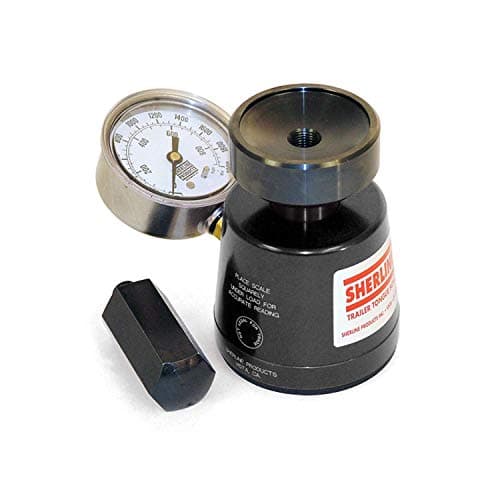 Sherline LM 2000 Trailer Tongue Weight Scale A hydraulic scale you set the coupler down on. It is the only tool here that answers the one question every hitch decision depends on, and it reads up to 2,000 lb. | Measuring loaded tongue weight properly, once and for all | 7.4/ 10 | |
| 4 | 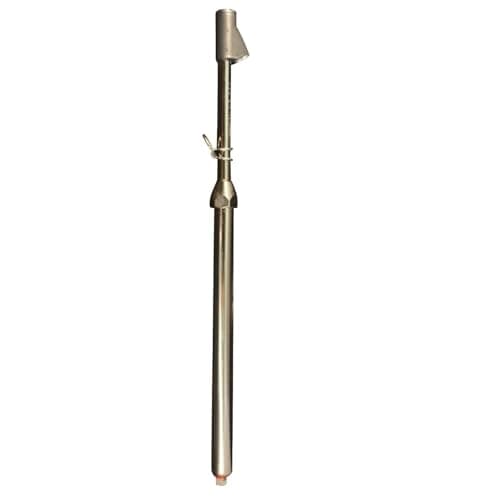 Milton S-986 Dual Head Tire Pressure Gauge, 10-160 psi Trailer tires often run 50-80 psi, which is past the top of a typical car gauge. This one reads to 160 psi and the dual head reaches an inner dually valve. | Reading trailer tire pressure that a car gauge cannot | 9.6/ 10 | |
| 5 | 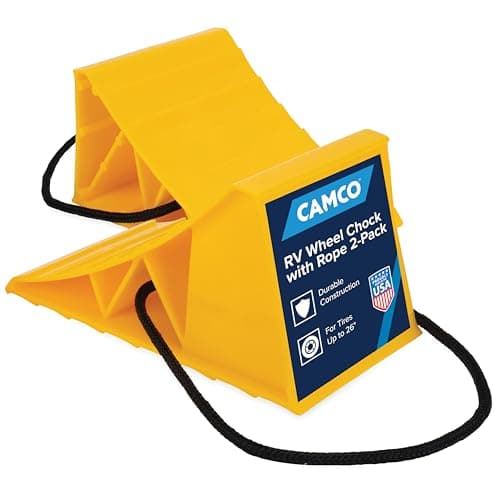 Camco RV Wheel Chocks with Rope, 2-Pack Two plastic chocks with a pull rope so you can retrieve them without lying on the ground. Unremarkable, correct, and the first thing to buy. | The basic chock every trailer needs before anything else | 7.9/ 10 |
Tap any row to jump to the full write-up. Prices come from Amazon and are read automatically — see each product below for the date.
The short answer
You bought a trailer. Somebody at the dealership showed you how to hitch it up, probably quickly, and now you are going to drive it somewhere. This page is what we would want to have read.
Before you leave the driveway, ever
These are the one-time jobs. Do them before the first trip, not during it.
01Measure your loaded tongue weight
This sizes your hitch, decides whether you need weight distribution, and tells you how much payload you have left. Three methods, one free.02Set up the weight distribution hitch properly
It is a measured procedure with a right answer, not a feel. Fender heights before and after. The procedure.03Set the brake controller gain
At 25 mph on a quiet road, apply the manual override fully and adjust until the trailer brakes firmly without locking. Controller picks.04Check trailer tire pressures and the date codes
Trailer tires run near their maximum sidewall pressure, often 50-80 psi, and age out before they wear out. The psi guide.05Torque the trailer lug nuts
To the figure in the trailer manual, and again after the first 50 miles. Wheels coming loose on new trailers is more common than it should be.06Practice in an empty parking lot
An hour on a Sunday morning in a large empty lot is worth more than any amount of reading. Practice backing, turning and parking before you do it with an audience.
The drive itself
Slow down. Sixty is a good number. Many ST trailer tires carry a speed rating in the 65–81 mph range, sway is speed-dependent with a sharp onset, and your fuel consumption at 70 with a trailer is genuinely dreadful. You will arrive about fifteen minutes later and considerably less tired.
Double your following distance, at least. You are now a 10,000 lb vehicle with a pivot in the middle. Stopping distance is much longer than you expect and the trailer will push you if you brake hard.
Swing wide on right turns. The trailer cuts the corner. Go further into the intersection than feels natural before you start the turn, and watch the trailer’s rear wheels in your mirror, not the front of the truck.
Watch for crosswind and trucks. A semi passing at speed pushes you away then pulls you in. Hold the wheel; do not chase it. Crosswind on an exposed bridge is the same.
Use the trailer brakes on descents. The manual override lets you apply trailer brakes alone to take up slack and keep the rig stretched out, which is far better than riding the truck brakes down a grade.
Fuel stops take planning. You cannot use every pump. Look for truck lanes or pull-through layouts, and get in the habit of thinking about the exit before you commit to the entrance.
Backing up, which is the bit everyone dreads
- 1
Put your hand at the bottom of the wheel
With your hand at six o'clock, the trailer goes the way you move your hand. Move your hand left, the trailer goes left. This single trick replaces all the mental gymnastics about reversing the steering. - 2
Get out and look first
Walk the space. Note the tree, the water spigot, the fire ring and the slope. Thirty seconds now saves a long conversation later. - 3
Go slow, and in small inputs
Small steering input, let the trailer respond, correct. Big inputs jackknife. If you are turning the wheel more than a quarter turn, you are over-correcting. - 4
Pull forward to reset
There is no shame in pulling forward and starting again. It is the fastest way out of a bad angle and every experienced owner does it. - 5
Use a spotter with agreed signals
Agree the signals before you start — one for stop, one for keep coming, one for how much room is left. Shouting across a campsite does not work and radios or phones on speaker do.
The five mistakes first-timers make
1. Traveling with full fresh water tanks. Water is 8.34 lb per gallon. Unless you are boondocking, fill at the campground. A 40-gallon tank is 334 lb you are hauling for no reason, and it changes your tongue weight.
2. Pulling away with something still connected. The power cord, the water hose, the sewer hose, the TV antenna up, the steps out, the jacks down. This is what the departure checklist is for, and this is not a theoretical risk.
3. Not checking lug nut torque. New trailer wheels loosen. Check after the first 50 miles and periodically after.
4. Over-packing the rear. A generator in the rear bumper and two bikes on a rear rack can take a well-balanced trailer below 10% tongue weight, which is the geometry that sways.
5. Booking a site you cannot get into. Measure your rig, including the truck, and read the site dimensions. A 34 ft trailer plus a crew cab is over 50 ft of combination and a lot of older campgrounds were not built for it.
The common mistake
Arriving, in the right order
Level side to side before you unhitch — once the truck is gone you have lost the only easy way to move the trailer a foot. Then chock, then unhitch, then level front to back with the tongue jack, then put the stabilizers down.
The full sequence, including the hookup order for water, power and waste, is in the setup checklist. And how to level covers the part that goes wrong most often.
What to remember
- Measure tongue weight, set up the hitch properly and set the brake gain before the first trip.
- Sixty mph, double the following distance, swing wide on right turns.
- Hand at the bottom of the wheel: the trailer goes the way your hand moves.
- Travel with empty fresh tanks unless you need the water.
- Use a departure checklist. Everybody who skips it eventually drives off with something attached.
The picks in full
Equal-i-zer 4-Point Sway Control Hitch, 90-00-1001
Equal-i-zer · Best for most half-ton trucks pulling a 5,000-10,000 lb trailer
Four-point sway control built into the head, so there is no friction bar to unclip before you back into a site — the single biggest quality-of-life difference for a first-timer.
Key specifications
- Trailer weight rating
- 10,000 lb
- Tongue weight rating
- 1,000 lb
- Sway control
- 4-point, integral to the head
- Included
- Weight distribution kit; shank and ball sold separately
Capacity figures read from Equal-i-zer product specifications, October 2026.
How it scored
- Sway control (25%)9
- Tongue-weight range (20%)8
- Backing up (20%)9
- Setup effort (15%)7
- Quietness (10%)5
- Price for capability (10%)7
Weighted average of the figures above. We did not test this product — see how we pick.
What it does well
- Sway control is always on — nothing to remember, nothing to remove
- Back up and turn sharply without unhooking anything
- Bracket height is adjustable in the field with a wrench, not a shop visit
What it is bad at
- It creaks and groans in tight turns; owners report this consistently and it is normal, not a fault
- Needs a shank and ball bought separately, which catches people out on price
- Heavier to lift onto the coupler than a friction-bar setup
Price as of October 5, 2026. #ad How this is funded
CURT TriFlex Next Proportional Trailer Brake Controller, 51146
CURT · Best for most first-time buyers who want proportional braking cheaply
Proportional, plug-and-play, fully adjustable and rated to four axles for well under the price of the knob-controlled version — the sensible default if your truck has a factory brake harness.
Key specifications
- Braking
- Proportional, inertia-based
- Axles
- 2-4 axles
- Install
- Plug-and-play with factory harness
- Profile
- Low profile, fully adjustable
Capacity figures read from CURT TriFlex Next specifications, October 2026.
How it scored
- Braking control (30%)9
- Install effort (25%)8
- Adjustability (20%)8
- Readout / feedback (15%)7
- Price for capability (10%)9
Weighted average of the figures above. We did not test this product — see how we pick.
What it does well
- Cheapest genuine proportional controller here
- Handles up to four axles, so it outgrows a single trailer
- Low-profile case fits where a knob controller will not
What it is bad at
- Plug-and-play only if the truck already has the brake-control connector
- Adjustment is through buttons, which is slower than a knob while moving
- No app, no remote display
Price as of October 5, 2026. #ad How this is funded
Sherline LM 2000 Trailer Tongue Weight Scale
Sherline · Best for measuring loaded tongue weight properly, once and for all
A hydraulic scale you set the coupler down on. It is the only tool here that answers the one question every hitch decision depends on, and it reads up to 2,000 lb.
Key specifications
- Capacity
- 2,000 lb
- Type
- Hydraulic dial gauge
- Use
- Jack the coupler down onto the scale
- Power
- None — mechanical
How it scored
- How often you use it (40%)9
- Build quality (25%)9
- Takes up little room (20%)4
- Price for capability (15%)5
Weighted average of the figures above. We did not test this product — see how we pick.
What it does well
- Gives you the loaded number, not the brochure dry number
- No batteries, no calibration routine, no app
- Capacity covers essentially every bumper-pull trailer
What it is bad at
- Expensive for a tool most people use twice a year
- Bulky to store
- You need level ground and the coupler at the right height to read it accurately
Price as of October 5, 2026. #ad How this is funded
Milton S-986 Dual Head Tire Pressure Gauge, 10-160 psi
Milton · Best for reading trailer tire pressure that a car gauge cannot
Trailer tires often run 50-80 psi, which is past the top of a typical car gauge. This one reads to 160 psi and the dual head reaches an inner dually valve.
Key specifications
- Range
- 10-160 psi
- Head
- Dual head chuck
- Type
- Straight foot, mechanical
- Model
- S-986
How it scored
- How often you use it (40%)10
- Build quality (25%)9
- Takes up little room (20%)9
- Price for capability (15%)10
Weighted average of the figures above. We did not test this product — see how we pick.
What it does well
- Range actually covers trailer tire pressures
- Dual head reaches awkward and inner valves
- Mechanical — no battery to die in a cold trailer
What it is bad at
- Analog scale is harder to read precisely than a digital gauge
- No calibration certificate
- Brass head is heavy in a pocket
Price as of October 5, 2026. #ad How this is funded
Camco RV Wheel Chocks with Rope, 2-Pack
Camco · Best for the basic chock every trailer needs before anything else
Two plastic chocks with a pull rope so you can retrieve them without lying on the ground. Unremarkable, correct, and the first thing to buy.
Key specifications
- Pack
- 2 chocks
- Feature
- Pull rope
- Material
- Molded plastic
- Origin
- Made in USA
Capacity figures read from Camco wheel chock specifications, October 2026.
How it scored
- Holding force (35%)7
- Fit range (25%)8
- Everyday usability (20%)9
- Build quality (10%)6
- Price for capability (10%)10
Weighted average of the figures above. We did not test this product — see how we pick.
What it does well
- The rope saves you crawling under the trailer
- Light and stackable
- Cheap enough to buy four
What it is bad at
- Plastic slides on wet smooth concrete
- Sized for standard trailer tires, not oversized ones
- Two is the bare minimum; most trailers want four
Price as of October 5, 2026. #ad How this is funded
Common questions
Around 60 mph. Many ST tires are rated 65–81 mph, sway onset is speed-dependent and sharp, and consumption rises steeply above 60. It is also much less tiring.
Not unless you need the water where you are going. Forty gallons is about 334 lb, and depending on where the tank sits it changes your tongue weight too. Fill at the campground.
Hand at the bottom of the wheel — the trailer then goes the way your hand moves. Small inputs, slow, and pull forward to reset rather than recovering a bad angle.
It varies by state and insurer. Auto liability usually extends to a towed trailer, but damage to the trailer and its contents generally needs separate coverage. Call your insurer before the first trip.
Sources
- SAE J2807 — tow-vehicle gross combination weight rating procedure — read October 2026
- SAE J684 — trailer couplings, hitches and safety chains — read October 2026
- 49 CFR 393.70 — coupling devices and towing methods — read October 2026
- CURT published towing product specifications — read October 2026