Towing Setup & Capacity
The Best Trailer Brake Controller For A Travel Trailer
Proportional braking is the only specification that genuinely changes how the rig feels. Here are five that have it, from plug-in to hardwired.
By Mike M. ·
How this page is funded: we earn a commission if you buy through our links, at no extra cost to you. It never changes which product we rank first. Prices come from Amazon and are read automatically — each one shows the date it was read. Full disclosure.
Quick picks
Scored on braking control (30%), install effort (25%), adjustability (20%), readout (15%) and price (10%). Every pick here is proportional; time-delay units are not ranked because the step up is worth the money.
| # | Product | Best for | Score | Price |
|---|---|---|---|---|
| 1 | 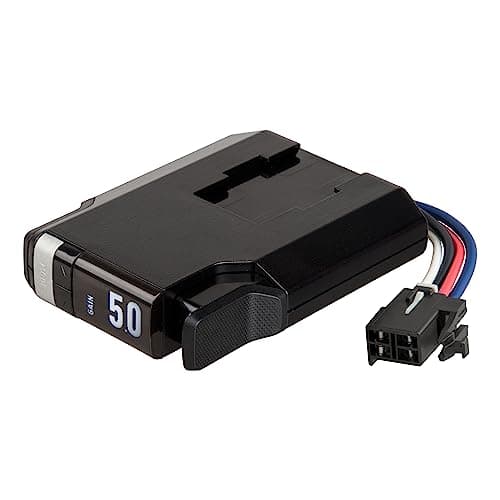 CURT TriFlex Next Proportional Trailer Brake Controller, 51146 Proportional, plug-and-play, fully adjustable and rated to four axles for well under the price of the knob-controlled version — the sensible default if your truck has a factory brake harness. Top pick | Most first-time buyers who want proportional braking cheaply | 8.2/ 10 | |
| 2 | 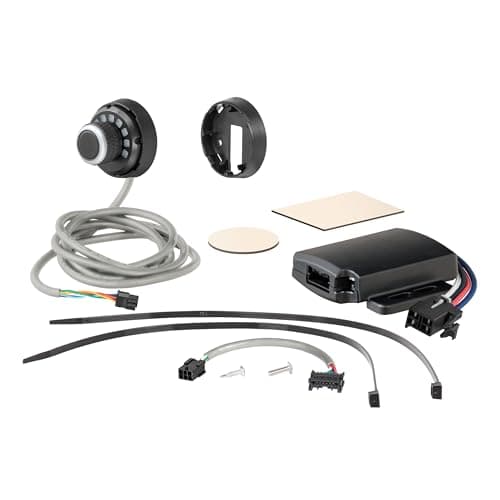 CURT Spectrum Proportional Trailer Brake Controller, 51170 Proportional braking with a dash-mounted knob, which beats an app the first time you feel the trailer push and want to change gain without looking away from the road. | A permanent install with a physical knob you can reach | 7.2/ 10 | |
| 3 | 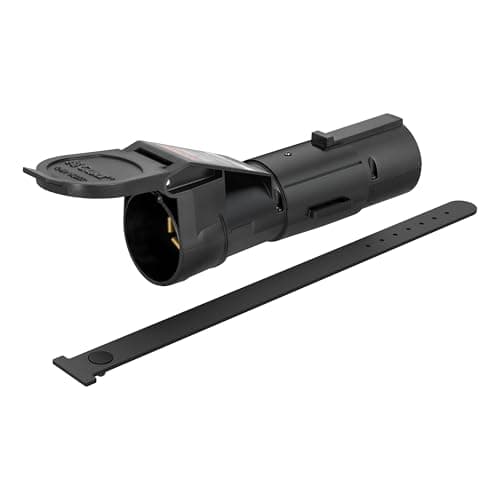 CURT Echo Mobile Bluetooth Trailer Brake Controller, 51180 Plugs in between the truck's 7-way and the trailer plug and is controlled from a phone, so there is nothing to mount and nothing to wire — the only controller here you can move between vehicles in a minute. No wiring needed | A rented or borrowed tow vehicle, or a truck you do not want to drill | 8.2/ 10 | |
| 4 | 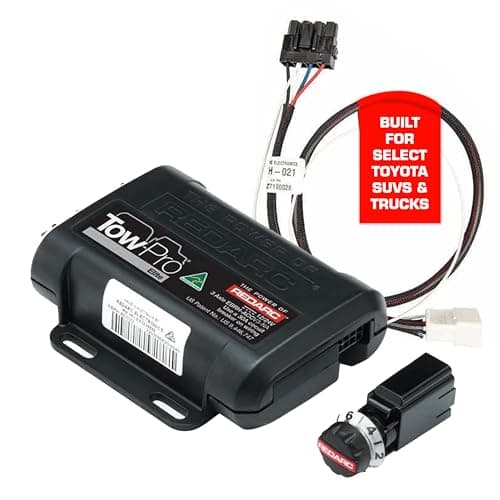 REDARC Tow-Pro Elite Electric Trailer Brake Controller Kit Sold as a vehicle-specific kit with a dash knob that looks factory and two braking modes, so you can switch from proportional to user-controlled on a loose surface. Best install | Vehicle-specific installs where a tidy factory look matters | 8.1/ 10 | |
| 5 | 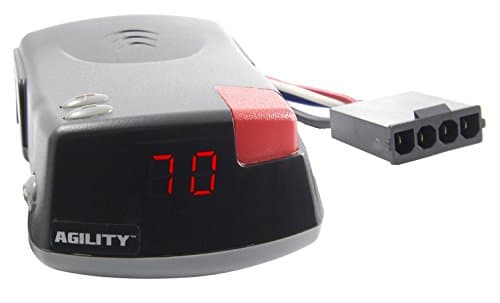 Hopkins Agility Trailer Brake Control An inexpensive proportional controller from a long-standing towing-electrics maker. It does the one job that matters — braking in proportion to the truck — without a readout to admire. Best value | The cheapest proportional controller worth fitting | 6.6/ 10 |
Tap any row to jump to the full write-up. Prices come from Amazon and are read automatically — see each product below for the date.
The short answer
A brake controller is the box in the tow vehicle that tells the trailer’s electric brakes how hard to work. Without one, a travel trailer has no brakes at all — the drums are there, the wiring is there, and nothing is sending them a signal.
This is not an optional accessory. Most states require trailer brakes above a threshold somewhere in the 1,500–3,000 lb range, and every travel trailer worth the name has them. 49 CFR 393.70 sets out the federal requirements for towing in a commercial context, and your state’s vehicle code sets the rest.
First: do you already have one?
Check before you buy. Trucks with a factory towing package frequently have a controller integrated into the dash, and you will not necessarily notice it unless you are looking.
- Look for a TRAILER GAIN readout in the instrument cluster menu, or a dedicated trailer brake screen.
- Look for a small slider or lever on the lower dash near the steering column — that is the manual trailer-brake override.
- Look in the towing section of the manual for “integrated trailer brake controller.”
If you have one, it is almost certainly proportional and it is wired into the vehicle properly. Do not add a second one.
Proportional vs time-delay: the only spec that matters
Time-delay controllers apply a fixed, pre-set amount of trailer braking that ramps up over a set period whenever you touch the brake pedal. It does not know whether you are slowing gently for a red light or stopping hard. Gentle stops get too much trailer brake, hard stops get too little.
Proportional controllers contain an accelerometer. They sense how hard the tow vehicle is decelerating and apply trailer braking in proportion. Gentle stop, gentle trailer brake. Hard stop, hard trailer brake.
In practice this is the difference between a trailer that shoves you forward at every stop sign and one you stop noticing. The price step is roughly double at the bottom of the market, and it is the best money in this category. The full comparison.
The common mistake
Install: this is the real decision for most people
| Route | What it needs | Time |
|---|---|---|
| Plug-and-play | Factory brake-control connector under the dash | 15-30 min |
| Hardwired | Power, ground, brake switch and output to the 7-way | 2-4 hours |
| Vehicle-specific kit | A harness made for your exact model | 1-2 hours |
| Plug-in between 7-ways | Nothing | 1 minute |
Most trucks from the last fifteen years with any kind of tow prep have the plug-and-play connector, usually a four-pin plug taped up behind the dash on the driver’s side. If yours does, the TriFlex is a half-hour job. If it does not, be honest with yourself about whether you are going to spend an afternoon under the dash or pay someone, and price that in.
The plug-in Echo deserves its own note. It sits between the truck’s 7-way socket and the trailer plug, senses deceleration itself, and is configured from a phone app. That means no wiring at all and it moves between vehicles in a minute — genuinely the right answer for a rented truck, a borrowed truck, or a vehicle you do not want to modify. The trade is that changing anything while driving means the phone, and it is rated for one or two axles only.
The manual override, and why it matters
Every controller worth buying has a way to apply the trailer brakes without the truck brakes — a lever, a slider, or a button. It looks like a minor feature and it is the single most useful thing on the unit.
Applying trailer brakes alone pulls the rig straight. It is the correct response when a trailer starts to sway, it is how you take up slack on a steep descent, and it is how you hold the rig steady on a hill. If a controller has no manual override, do not buy it. See what causes trailer sway for why.
Setting the gain, properly
Gain is how much braking the controller sends for a given deceleration. Set it like this, on a quiet flat road with the trailer loaded:
- Start with gain at roughly the mid point of the range.
- At about 25 mph, apply the manual override fully. Note what happens.
- If the trailer brakes lock and skid, reduce gain. If it barely slows, increase it.
- Target the point just below lock-up: firm braking, no skid. Re-check when the trailer’s load changes significantly.
Gain set too low is the common error and it is invisible until you need to stop quickly. Gain set too high flat-spots tires.
A note on what we could not pick
The Tekonsha Prodigy P3 and Primus IQ are the two most-recommended controllers in towing forums, and we have not listed either. The reason is specific: searching Amazon’s catalog for them returns almost entirely third-party units described as “replacement for” those models rather than the genuine articles, and we will not put a pick on this site that resolves to a knock-off.
If you want a Tekonsha unit, buy it from a retailer who stocks the real thing. The CURT and Hopkins units above are genuine listings from established towing-electrics makers, which is why they are the ones here.
The verdict
The TriFlex Next is the default: proportional, cheap, four axles, plug-and-play if your truck is equipped. The Hopkins Agility is the budget proportional option if you are hardwiring anyway. The Spectrum is worth the premium if you want a physical knob you can reach without looking. The REDARC is the choice for a factory-clean install on a supported vehicle. And the Echo is the answer when you cannot modify the truck at all.
What to remember
- Check for a factory controller first — a trailer gain readout in the cluster means you have one.
- Proportional beats time-delay and is the only specification that changes how the rig feels.
- Install route matters more than brand for most buyers: check for the factory connector.
- Never buy a controller without a manual trailer-brake override.
- Set gain to just below lock-up at 25 mph with the trailer loaded, and re-check when the load changes.
The picks in full
CURT TriFlex Next Proportional Trailer Brake Controller, 51146
CURT · Best for most first-time buyers who want proportional braking cheaply
Proportional, plug-and-play, fully adjustable and rated to four axles for well under the price of the knob-controlled version — the sensible default if your truck has a factory brake harness.
Key specifications
- Braking
- Proportional, inertia-based
- Axles
- 2-4 axles
- Install
- Plug-and-play with factory harness
- Profile
- Low profile, fully adjustable
Capacity figures read from CURT TriFlex Next specifications, October 2026.
How it scored
- Braking control (30%)9
- Install effort (25%)8
- Adjustability (20%)8
- Readout / feedback (15%)7
- Price for capability (10%)9
Weighted average of the figures above. We did not test this product — see how we pick.
What it does well
- Cheapest genuine proportional controller here
- Handles up to four axles, so it outgrows a single trailer
- Low-profile case fits where a knob controller will not
What it is bad at
- Plug-and-play only if the truck already has the brake-control connector
- Adjustment is through buttons, which is slower than a knob while moving
- No app, no remote display
Price as of October 5, 2026. #ad How this is funded
CURT Spectrum Proportional Trailer Brake Controller, 51170
CURT · Best for a permanent install with a physical knob you can reach
Proportional braking with a dash-mounted knob, which beats an app the first time you feel the trailer push and want to change gain without looking away from the road.
Key specifications
- Braking
- Proportional (inertia sensing)
- Control
- Dash-mount knob
- Install
- Hardwired, mount-anywhere orientation
- Display
- LED status
Capacity figures read from CURT Spectrum specifications, October 2026.
How it scored
- Braking control (30%)9
- Install effort (25%)5
- Adjustability (20%)8
- Readout / feedback (15%)7
- Price for capability (10%)6
Weighted average of the figures above. We did not test this product — see how we pick.
What it does well
- Physical knob — adjust by feel without taking your eyes off the road
- Mounts in any orientation, which matters in a cramped footwell
- Proportional response rather than a fixed time delay
What it is bad at
- Hardwiring is a real afternoon if the truck has no factory harness
- Priced above controllers with more axle capacity
- Readout is LEDs, not a numeric display
Price as of October 5, 2026. #ad How this is funded
CURT Echo Mobile Bluetooth Trailer Brake Controller, 51180
CURT · Best for a rented or borrowed tow vehicle, or a truck you do not want to drill
Plugs in between the truck's 7-way and the trailer plug and is controlled from a phone, so there is nothing to mount and nothing to wire — the only controller here you can move between vehicles in a minute.
Key specifications
- Install
- Plug-in between 7-way connectors
- Control
- Bluetooth app
- Axles
- 1-2 axles
- Mounting
- None required
Capacity figures read from CURT Echo specifications, October 2026.
How it scored
- Braking control (30%)8
- Install effort (25%)10
- Adjustability (20%)8
- Readout / feedback (15%)7
- Price for capability (10%)6
Weighted average of the figures above. We did not test this product — see how we pick.
What it does well
- No wiring, no drilling, no dash real estate
- Moves between tow vehicles in under a minute
- Sensitivity and gain adjust from the phone
What it is bad at
- You need the phone awake and paired to change anything while driving
- Rated for 1-2 axles only — not for a triple-axle trailer
- Highest price here for the fewest axles
Price as of October 5, 2026. #ad How this is funded
REDARC Tow-Pro Elite Electric Trailer Brake Controller Kit
REDARC · Best for vehicle-specific installs where a tidy factory look matters
Sold as a vehicle-specific kit with a dash knob that looks factory and two braking modes, so you can switch from proportional to user-controlled on a loose surface.
Key specifications
- Braking
- Dual mode — proportional and user-controlled
- Install
- Vehicle-specific plug-and-play kit
- Voltage
- 12V / 24V compatible
- Control
- Panel-mount knob
How it scored
- Braking control (30%)9
- Install effort (25%)8
- Adjustability (20%)9
- Readout / feedback (15%)7
- Price for capability (10%)6
Weighted average of the figures above. We did not test this product — see how we pick.
What it does well
- User-controlled mode is genuinely useful on gravel and boat ramps
- Vehicle-specific harness means a clean, reversible install
- Control knob mounts flush like factory equipment
What it is bad at
- The kit is matched to specific vehicles — check yours before buying
- Expensive
- The brain is hidden, so diagnosing a fault means pulling trim
Price as of October 5, 2026. #ad How this is funded
Hopkins Agility Trailer Brake Control
Hopkins · Best for the cheapest proportional controller worth fitting
An inexpensive proportional controller from a long-standing towing-electrics maker. It does the one job that matters — braking in proportion to the truck — without a readout to admire.
Key specifications
- Braking
- Proportional
- Install
- Hardwired
- Form
- Compact, multi-orientation mount
- Adjustment
- Gain dial
How it scored
- Braking control (30%)8
- Install effort (25%)5
- Adjustability (20%)6
- Readout / feedback (15%)5
- Price for capability (10%)10
Weighted average of the figures above. We did not test this product — see how we pick.
What it does well
- By far the lowest price for proportional braking
- Small enough to tuck out of the way
- Simple: a gain dial and a boost setting, nothing else to learn
What it is bad at
- Minimal display — you are flying on feel
- Hardwire install with no plug-and-play option
- Fewer configuration options than the CURT units
Price as of October 5, 2026. #ad How this is funded
Common questions
Yes, if the trailer has electric brakes — which essentially all travel trailers do. Check for a factory one first: a trailer gain readout in the cluster is the giveaway.
Proportional senses the tow vehicle’s deceleration and brakes the trailer in step. Time-delay applies a fixed ramp regardless of how hard you are stopping. Side by side.
On a quiet flat road with the trailer loaded, apply the manual override fully at about 25 mph. Reduce gain if the trailer locks, increase if it barely slows. Target just below lock-up.
With the factory brake-control connector, a plug-and-play unit is a 15–30 minute job. A full hardwire needs power, ground, a brake-switch signal and an output to the 7-way — two to four hours for most people.
Sources
- CURT published towing product specifications — read October 2026
- SAE J2807 — tow-vehicle gross combination weight rating procedure — read October 2026
- SAE J684 — trailer couplings, hitches and safety chains — read October 2026
- 49 CFR 393.70 — coupling devices and towing methods — read October 2026