Towing Setup & Capacity
Trailer Hitch Class 2 vs Class 3: The Difference That Matters
The headline difference is the receiver opening — 1-1/4 in against 2 in. The consequence is which accessories exist for you at all, and whether a travel trailer is even on the table.
By Mike M. ·
How this page is funded: we earn a commission if you buy through our links, at no extra cost to you. It never changes which product we rank first. Prices come from Amazon and are read automatically — each one shows the date it was read. Full disclosure.
Quick picks
The parts that actually differ between the two classes: the ball your coupler needs, and the mount and pin that go in the receiver.
| # | Product | Best for | Score | Price |
|---|---|---|---|---|
| 1 | 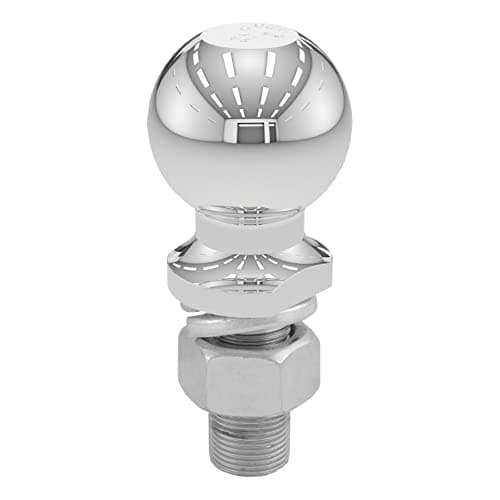 CURT Chrome Trailer Hitch Ball, 2-5/16 in, 10,000 lb, 40007 A 2-5/16 in ball on a 1 in shank rated to 10,000 lb. If your coupler says 2-5/16, no other size is acceptable, and this is the plain correct answer. For most travel trailers | The ball most travel trailers over 5,000 lb actually need | 8.9/ 10 | |
| 2 | 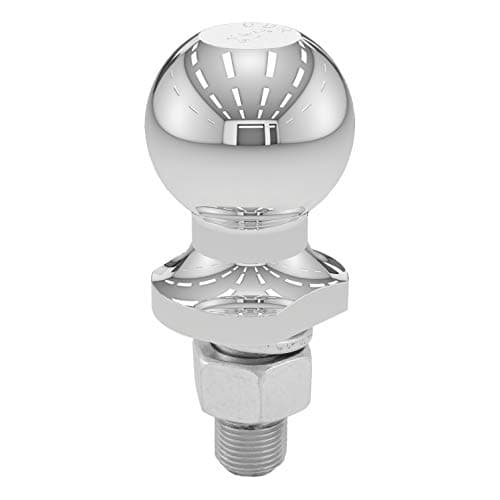 CURT Chrome Trailer Hitch Ball, 2 in, 3,500 lb, 40003 The 2 in, 3,500 lb ball. Correct for a small trailer and badly wrong for a loaded travel trailer, which is exactly the mistake the ball size chart exists to prevent. For light and utility trailers | Small trailers and utility trailers with a 2 in coupler | 8.1/ 10 | |
| 3 | 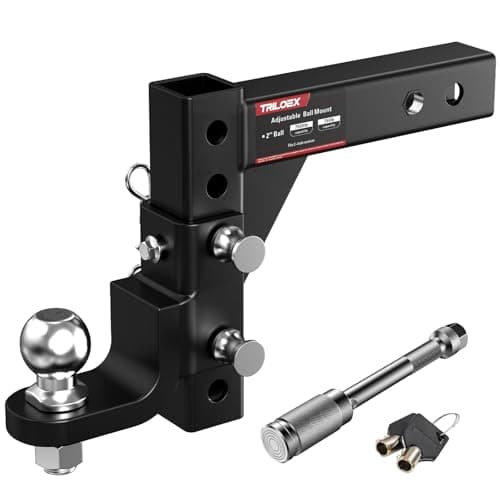 Adjustable Trailer Hitch Ball Mount, 9-1/2 in Drop A budget adjustable mount with a screw-in locking pin and a 7,500 lb rating. Fine for a light trailer; the rating is the reason it is not on the lifted-truck list. Fits a 2 in receiver | A cheap adjustable mount for a light trailer | 6.9/ 10 | $52.24View on Amazon
|
| 4 | 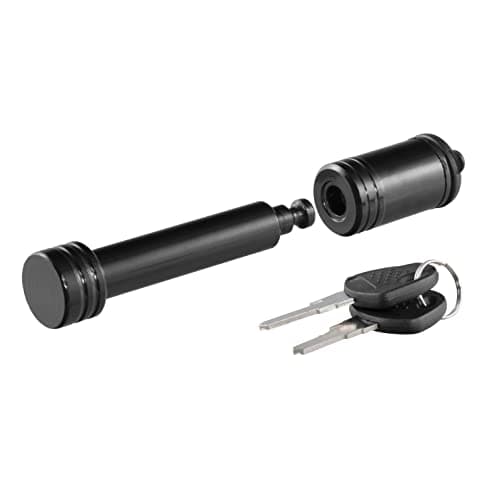 CURT Barbell Hitch Lock, 5/8 in, 23518 A 5/8 in locking pin for a 2 in receiver. Cheap, and it stops the single most casual theft on the list: somebody pulling the clip and walking off with your ball mount. Locks the pin | Replacing the pin and clip on a ball mount you leave in | 6.8/ 10 | $22.66View on Amazon
|
Tap any row to jump to the full write-up. Prices come from Amazon and are read automatically — see each product below for the date.
The short answer
Hitch classes describe the receiver, not the vehicle. Two things define a class: the square opening the mount slides into, and the ratings stamped on the hitch. Everything that frustrates people about this topic comes from treating the class as a property of the truck rather than of the part bolted to it — which is why the same model of SUV can leave the factory with either, depending on the package.
The two classes side by side
| Class 2 | Class 3 | |
|---|---|---|
| Receiver opening | 1-1/4 in square | 2 in square |
| Typical gross trailer weight | Up to about 3,500 lb | Up to about 8,000 lb |
| Typical tongue weight | Up to about 350 lb | Up to about 800 lb |
| Weight-distributing rating | Rarely offered | Commonly offered, often higher than carrying |
| Pin diameter | 5/8 in (some 1/2 in) | 5/8 in |
| Typical vehicles | Sedans, small crossovers, minivans | Mid-size and full-size SUVs and pickups |
| Travel trailer suitable | Only the very lightest, if at all | Yes, for most bumper-pull trailers |
The rating columns are where the caution belongs. A class 3 receiver rated to 8,000 lb bolted to a vehicle rated to tow 5,000 lb does not give you an 8,000 lb tow vehicle. The lowest number in the chain governs, and it is usually the vehicle, not the hitch. Payload vs towing capacity works through which number actually limits you — it is normally payload.
What class 2 rules out
The ratings are only half the difference. The practical half is the ecosystem.
Ball mounts. A 1-1/4 in shank fits a much smaller catalog. Adjustable ball mounts, drop hitches for lifted vehicles, mounts with integrated tongue weight scales and almost every specialist mount are built for a 2 in shank. The adjustable ball mount roundup is entirely 2 in hardware, and that is representative of the market rather than a choice we made.
Weight distribution. Essentially no mainstream weight distribution kit is offered in a 1-1/4 in shank, because tongue weights that need weight distribution are above what a class 2 is rated for anyway. If the squat test or your manual says you need weight distribution, class 2 is not a starting point. The three tests tells you whether you are in that position.
Bike racks and cargo carriers. Here class 2 is fine and sometimes preferable. Plenty of hitch racks are made for 1-1/4 in, and if a bike rack is your only use case, a class 2 hitch is a perfectly good purchase at a lower price.
The common mistake
How to tell which one you have
- 1
Measure the opening
Put a tape across the inside of the receiver tube. 1-1/4 in is class 1 or class 2; 2 in is class 3 or class 4. A 2-1/2 in opening is class 5. - 2
Find the label
Every hitch carries a sticker or stamping with its class and ratings — usually on the side of the receiver tube or the cross-member. This, not the class, is your authoritative number. - 3
Check for two sets of ratings
A class 3 label frequently lists both a weight-carrying and a higher weight-distributing rating. If your tongue weight is above the carrying figure, a weight distribution hitch is required rather than optional. - 4
Cross-check against the vehicle
Read the towing section of your owner's manual. If the vehicle's rating is lower than the hitch's, the vehicle governs — always.
Note the distinction between class 1 and class 2: both use a 1-1/4 in opening, so the opening alone does not identify the class. Class 1 is typically rated to about 2,000 lb and class 2 to about 3,500 lb. Read the label. The full class reference table covers all five, and receiver sizes covers the openings in detail.
Which should you buy
Buy class 3 if there is any chance of a travel trailer, a boat over about 2,500 lb, or a utility trailer carrying real weight. It costs modestly more, the hardware ecosystem is enormous, and it leaves the weight distribution option open. For anyone reading this site, this is almost always the answer.
Buy class 2 if your vehicle will never tow more than a small utility trailer or a light boat and your main use is a bike rack or cargo carrier. It is cheaper, lighter, and fits vehicles where a class 3 is not offered at all.
Either way, buy the ball by measuring the coupler rather than guessing. A 2-5/16 in coupler on a 2 in ball is the single most dangerous common towing error, and it is the one the ball size chart exists to prevent.
What to remember
- Class 2 is a 1-1/4 in receiver, roughly 3,500 lb. Class 3 is 2 in, roughly 8,000 lb.
- The class describes the hitch. The vehicle's own rating still governs, and is often lower.
- Nearly all specialist mounts and all weight distribution kits are 2 in — the ecosystem difference is bigger than the ratings difference.
- Do not use a 1-1/4 in to 2 in adapter to get around it. It adds leverage without adding rating.
- Class 1 and class 2 share the same opening. Read the label on the receiver, not the tape measure.
The picks in full
CURT Chrome Trailer Hitch Ball, 2-5/16 in, 10,000 lb, 40007
CURT · Best for the ball most travel trailers over 5,000 lb actually need
A 2-5/16 in ball on a 1 in shank rated to 10,000 lb. If your coupler says 2-5/16, no other size is acceptable, and this is the plain correct answer.
Key specifications
- Ball diameter
- 2-5/16 in
- Capacity
- 10,000 lb
- Shank
- 1 in diameter x 2-1/4 in long
- Finish
- Chrome
Capacity figures read from CURT hitch ball specifications, October 2026.
How it scored
- How often you use it (40%)9
- Build quality (25%)8
- Takes up little room (20%)9
- Price for capability (15%)10
Weighted average of the figures above. We did not test this product — see how we pick.
What it does well
- Correct size for the majority of mid-size and larger travel trailers
- Cheap enough to keep a spare
- Chrome finish resists the rust that seizes a coupler
What it is bad at
- A 1 in shank will not fit a ball mount drilled for 3/4 in
- Chrome chips, and then it rusts under the chip
- Needs a torque wrench to tighten properly, which most people skip
Price as of October 10, 2026. #ad How this is funded
CURT Chrome Trailer Hitch Ball, 2 in, 3,500 lb, 40003
CURT · Best for small trailers and utility trailers with a 2 in coupler
The 2 in, 3,500 lb ball. Correct for a small trailer and badly wrong for a loaded travel trailer, which is exactly the mistake the ball size chart exists to prevent.
Key specifications
- Ball diameter
- 2 in
- Capacity
- 3,500 lb
- Shank
- 3/4 in diameter x 1-3/4 in long
- Finish
- Chrome
Capacity figures read from CURT hitch ball specifications, October 2026.
How it scored
- How often you use it (40%)7
- Build quality (25%)8
- Takes up little room (20%)9
- Price for capability (15%)10
Weighted average of the figures above. We did not test this product — see how we pick.
What it does well
- The right answer for a utility or small boat trailer
- Inexpensive
- Universal 3/4 in shank fits most light-duty mounts
What it is bad at
- 3,500 lb is well below a typical loaded travel trailer
- Easy to confuse with a 2 in ball rated higher — read the stamp on the ball
- Chrome, so it chips
Price as of October 10, 2026. #ad How this is funded
Adjustable Trailer Hitch Ball Mount, 9-1/2 in Drop
Generic · Best for a cheap adjustable mount for a light trailer
A budget adjustable mount with a screw-in locking pin and a 7,500 lb rating. Fine for a light trailer; the rating is the reason it is not on the lifted-truck list.
Key specifications
- Capacity
- 7,500 lb
- Drop
- 9-1/2 in
- Rise
- 8-1/4 in
- Pin
- Screw-in locking pin included
How it scored
- Rated capacity (25%)5
- Adjustability (25%)8
- Security (20%)7
- Build quality (15%)6
- Price for capability (15%)9
Weighted average of the figures above. We did not test this product — see how we pick.
What it does well
- A fraction of the price of a name-brand adjustable mount
- Big drop range, useful behind a lifted truck
- Locking pin included
What it is bad at
- 7,500 lb rating rules out most loaded travel trailers
- No published maker spec sheet to check the rating against
- Heavy steel — this is not a one-hand lift
CURT Barbell Hitch Lock, 5/8 in, 23518
CURT · Best for replacing the pin and clip on a ball mount you leave in
A 5/8 in locking pin for a 2 in receiver. Cheap, and it stops the single most casual theft on the list: somebody pulling the clip and walking off with your ball mount.
Key specifications
- Pin diameter
- 5/8 in
- Fits
- 2 in receivers
- Type
- Barbell style
- Finish
- Black
Capacity figures read from CURT hitch lock specifications, October 2026.
How it scored
- Security (35%)6
- Fit range (25%)7
- Weather resistance (20%)5
- Everyday usability (10%)9
- Price for capability (10%)10
Weighted average of the figures above. We did not test this product — see how we pick.
What it does well
- The cheapest security upgrade on the whole site
- Barbell shape is harder to lever than a padlock-style pin
- Fits the 2 in receiver on most half-ton trucks
What it is bad at
- 5/8 in only — a 1-1/4 in receiver needs a 1/2 in pin
- The lock cylinder is the first thing to corrode
- Protects the mount, not the trailer
Common questions
Only the very lightest, and usually you should not. Class 2 is typically about 3,500 lb and 350 lb tongue — a loaded travel trailer passes that fast — and no mainstream weight distribution kit fits a 1-1/4 in receiver.
Yes — class 3 is a 2 in opening. But a 2 in opening does not prove class 3, since class 4 shares it at a higher rating. Trust the label on the hitch.
You can buy one, but it adds leverage without adding rating, and some makers derate or prohibit it. If you need 2 in hardware, fit a class 3 hitch.
No. The lowest number in the chain governs, and that is usually the vehicle. Payload is normally the real limit.
Sources
- CURT published towing product specifications — read October 2026
- REDARC Tow-Pro Elite published specifications and vehicle fitment — read October 2026
- SAE J684 — trailer couplings, hitches and safety chains — read October 2026
- SAE J2807 — tow-vehicle gross combination weight rating procedure — read October 2026
- 49 CFR 393.40 — required brake systems, including trailer brakes — read October 2026