Power & Electrical
Surge Protector vs EMS
A surge protector watches for the fault that rarely happens. An EMS disconnects for the one that does.
By Mike M. ·
How this page is funded: we earn a commission if you buy through our links, at no extra cost to you. It never changes which product we rank first. Prices come from Amazon and are read automatically — each one shows the date it was read. Full disclosure.
Quick picks
One of each, in both service sizes.
| # | Product | Best for | Score | Price |
|---|---|---|---|---|
| 1 | 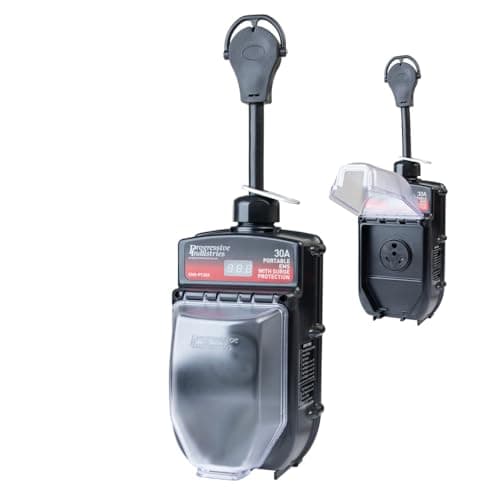 Progressive Industries EMS-PT30X Electrical Management System, 30 Amp A full electrical management system, not just a surge protector: it reads the pedestal and disconnects on low or high voltage, which is the fault that actually kills air conditioners. EMS | Most 30-amp trailers — the one to actually buy | 8.7/ 10 | |
| 2 | 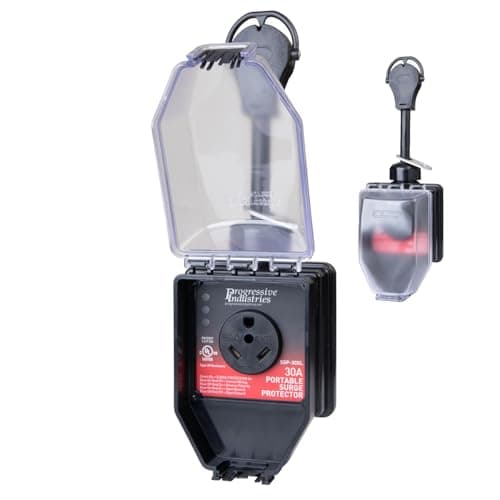 Progressive Industries SSP-30XL Surge Protector, 30 Amp Surge suppression plus pedestal diagnostics in one plug, from the maker whose heavier units are the category benchmark. It will not disconnect power, but it will tell you not to plug in. Surge only | A first surge protector that also tests the pedestal | 6.2/ 10 | |
| 3 | 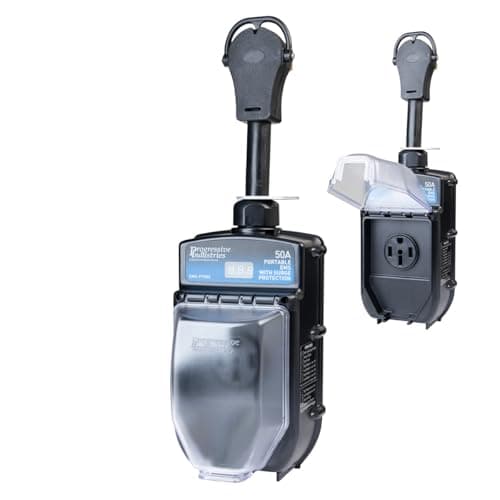 Progressive Industries EMS-PT50X Electrical Management System, 50 Amp The 50-amp version of the same system. A 50-amp service is two 120 V legs, and this watches both — which a 30-amp unit on an adapter cannot do. | 50-amp trailers and fifth wheels | 8.7/ 10 | |
| 4 | 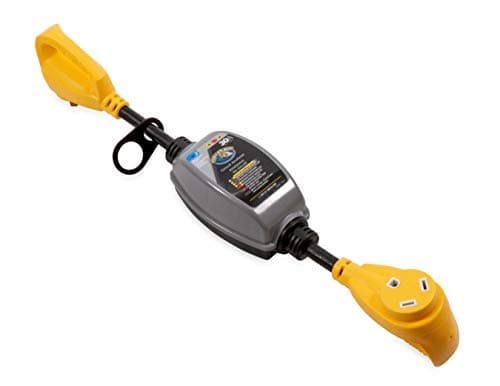 Camco PowerGrip 30-Amp Circuit Analyzer Dogbone, 55318 A dogbone-form protector with 2,100 joules of suppression and fault LEDs. The form factor is the point: it hangs on the cord instead of dangling from the outlet. | Surge protection in a dogbone you can leave on the cord | 6.1/ 10 | $111.09View on Amazon
|
Tap any row to jump to the full write-up. Prices come from Amazon and are read automatically — see each product below for the date.
The short answer
What each one catches
| Fault | How often | Surge protector | EMS |
|---|---|---|---|
| Lightning or switching spike | Rare | Absorbs | Absorbs |
| Reverse polarity | Common | Warns | Refuses to connect |
| Open ground | Common | Warns | Refuses to connect |
| Open neutral | Occasional, dangerous | Warns | Disconnects |
| Low voltage (brownout) | Very common in summer | Nothing | Disconnects |
| High voltage | Occasional | Nothing | Disconnects |
| Overheating connection | Occasional | Nothing | Some models detect |
Three of the rows in that table have “nothing” in the surge protector column, and one of those three is the most common fault on the list.
Why low voltage is the one that matters
An induction motor at reduced voltage draws more current to produce the same mechanical power. More current through the same winding resistance means more heat. Sustained, that degrades insulation and eventually fails the winding.
A full campground on a hot afternoon with every air conditioner running is a park drawing far more than its distribution was sized for, and the voltage at the far pedestals sags. It is not a fault anybody has caused; it is a supply at its limit.
Your air conditioner, your refrigerator compressor and your converter all keep running through it, drawing more current and getting hotter, until something gives. An EMS cuts power at its low-voltage threshold — typically somewhere around 104 V — and restores it with a delay once the supply recovers.
That one behavior is most of the value in this category.
When a surge protector is genuinely enough
Three honest cases:
- You camp off-grid most of the time. If you rarely plug into a pedestal, the exposure is small.
- You always use the same well-maintained site. A private pad with known wiring and spare capacity is a very different risk from a packed state park in August.
- You cannot afford the EMS right now. A surge protector with good diagnostics is substantially better than nothing — it will stop you plugging into a miswired pedestal, which is a real and common hazard — and it is a reasonable stepping stone.
What is not a good reason: “I have never had a problem.” Neither has anybody else until the afternoon they do.
The common mistake
Three features that separate good EMS units from basic ones
Numeric display. Pass/fail LEDs hide a developing sag. A voltage readout lets you see 108 V and make a decision before the unit trips.
Reconnect delay. After a fault clears, a delay of a couple of minutes before restoring power stops an air conditioner compressor short-cycling, which is its own failure mode.
Replaceable surge module. A unit that has absorbed a serious spike has spent its surge components. A replaceable module turns that into a cheap part rather than a new unit.
The verdict
Buy the EMS. The price difference is roughly three times, and the thing it adds is protection against the fault that actually damages equipment. If the budget genuinely will not stretch, buy a surge protector with good diagnostics now and upgrade later — but know what you are not covered for.
What to remember
- A surge protector absorbs spikes and warns about wiring. It does nothing about voltage.
- An EMS disconnects on low and high voltage, which is the fault that actually happens.
- Low voltage makes motors draw more current and overheat. Breakers do not catch it.
- Look for a numeric display, a reconnect delay and a replaceable surge module.
- 'I have never had a problem' is not a risk assessment.
The picks in full
Progressive Industries EMS-PT30X Electrical Management System, 30 Amp
Progressive Industries · Best for most 30-amp trailers — the one to actually buy
A full electrical management system, not just a surge protector: it reads the pedestal and disconnects on low or high voltage, which is the fault that actually kills air conditioners.
Key specifications
- Service
- 30 amp
- Function
- Full EMS with automatic disconnect
- Protects against
- Surge, low voltage, high voltage, miswiring
- Display
- Scrolling diagnostic display
How it scored
- Protection coverage (30%)10
- Diagnostics (25%)9
- Weather sealing (20%)6
- Auto shutoff (15%)10
- Price for capability (10%)7
Weighted average of the figures above. We did not test this product — see how we pick.
What it does well
- Disconnects on voltage faults, which is what saves the air conditioner
- Readable display shows actual voltage and amperage
- The reference product in the category
What it is bad at
- Three times the price of a plain surge protector
- Portable units are a theft target — lock it to the pedestal
- Not weather-sealed to the degree a hardwired unit is
Price as of October 5, 2026. #ad How this is funded
Progressive Industries SSP-30XL Surge Protector, 30 Amp
Progressive Industries · Best for a first surge protector that also tests the pedestal
Surge suppression plus pedestal diagnostics in one plug, from the maker whose heavier units are the category benchmark. It will not disconnect power, but it will tell you not to plug in.
Key specifications
- Service
- 30 amp
- Function
- Surge suppression plus diagnostics
- Diagnostics
- Open ground, open neutral, reverse polarity
- Auto shutoff
- No
How it scored
- Protection coverage (30%)6
- Diagnostics (25%)8
- Weather sealing (20%)6
- Auto shutoff (15%)2
- Price for capability (10%)9
Weighted average of the figures above. We did not test this product — see how we pick.
What it does well
- Cheapest way to stop plugging into a miswired pedestal blind
- Lifetime-warranty reputation on the brand's surge line
- Small enough to leave on the cord
What it is bad at
- Surge only — it does not cut power on low or high voltage
- No remote display
- LEDs are hard to read in bright sun
Price as of October 5, 2026. #ad How this is funded
Progressive Industries EMS-PT50X Electrical Management System, 50 Amp
Progressive Industries · Best for 50-amp trailers and fifth wheels
The 50-amp version of the same system. A 50-amp service is two 120 V legs, and this watches both — which a 30-amp unit on an adapter cannot do.
Key specifications
- Service
- 50 amp
- Function
- Full EMS with automatic disconnect
- Legs monitored
- Both 120 V legs
- Display
- Scrolling diagnostic display
How it scored
- Protection coverage (30%)10
- Diagnostics (25%)9
- Weather sealing (20%)6
- Auto shutoff (15%)10
- Price for capability (10%)7
Weighted average of the figures above. We did not test this product — see how we pick.
What it does well
- Monitors both legs of a 50-amp service independently
- Same disconnect behavior as the 30-amp unit
- Costs barely more than the 30-amp version
What it is bad at
- Only useful if you actually have 50-amp service
- Large and heavy on the pedestal
- Needs locking up
Price as of October 5, 2026. #ad How this is funded
Camco PowerGrip 30-Amp Circuit Analyzer Dogbone, 55318
Camco · Best for surge protection in a dogbone you can leave on the cord
A dogbone-form protector with 2,100 joules of suppression and fault LEDs. The form factor is the point: it hangs on the cord instead of dangling from the outlet.
Key specifications
- Service
- 30 amp
- Suppression
- Up to 2,100 joules
- Diagnostics
- Fault indicator LEDs
- Form
- Dogbone
Capacity figures read from Camco PowerGrip specifications, October 2026.
How it scored
- Protection coverage (30%)6
- Diagnostics (25%)7
- Weather sealing (20%)7
- Auto shutoff (15%)2
- Price for capability (10%)8
Weighted average of the figures above. We did not test this product — see how we pick.
What it does well
- Dogbone shape takes the weight off the pedestal outlet
- Clear fault LEDs for the three common miswirings
- Reasonable joule rating for the money
What it is bad at
- Surge only — no voltage disconnect
- Joule ratings are a rough guide, not a guarantee
- No display beyond LEDs
Common questions
For most owners yes. Roughly three times the price, and what it buys is automatic disconnection on low and high voltage — the fault that actually damages equipment.
Typically around 104 V low and around 132 V high, varying by model. Power is restored after a delay once the supply recovers, which protects compressors from short-cycling.
No. Breakers protect against overcurrent. Nothing in a standard RV system monitors supply voltage and disconnects for it — that is what an EMS adds.
Sources
- National Fire Protection Association — standards including NFPA 1192 for recreational vehicles — read October 2026
- Camco published electrical product specifications — read October 2026
- RV Industry Association — standards and compliance program — read October 2026