Power & Electrical
How To Check A Campground Power Pedestal
Six checks, thirty seconds, before your cord touches it. Two of the faults you will find are worth asking for a different site over.
By Mike M. ·
How this page is funded: we earn a commission if you buy through our links, at no extra cost to you. It never changes which product we rank first. Prices come from Amazon and are read automatically — each one shows the date it was read. Full disclosure.
Quick picks
The tools that make this check possible.
| # | Product | Best for | Score | Price |
|---|---|---|---|---|
| 1 | 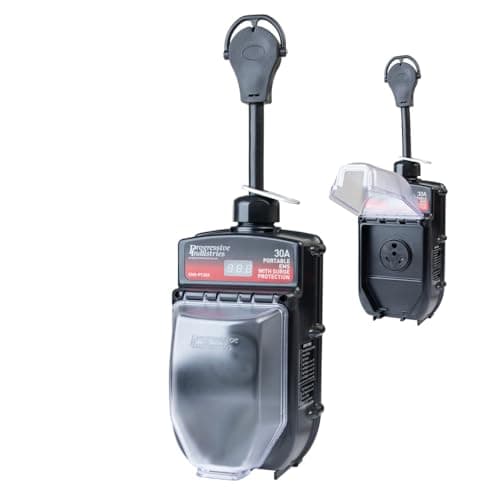 Progressive Industries EMS-PT30X Electrical Management System, 30 Amp A full electrical management system, not just a surge protector: it reads the pedestal and disconnects on low or high voltage, which is the fault that actually kills air conditioners. Does this for you | Most 30-amp trailers — the one to actually buy | 8.7/ 10 | |
| 2 | 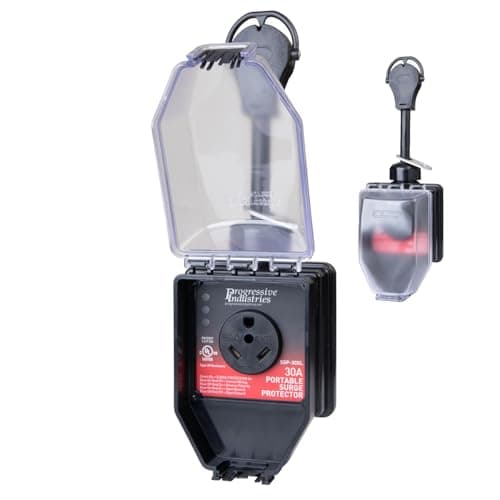 Progressive Industries SSP-30XL Surge Protector, 30 Amp Surge suppression plus pedestal diagnostics in one plug, from the maker whose heavier units are the category benchmark. It will not disconnect power, but it will tell you not to plug in. | A first surge protector that also tests the pedestal | 6.2/ 10 | |
| 3 | 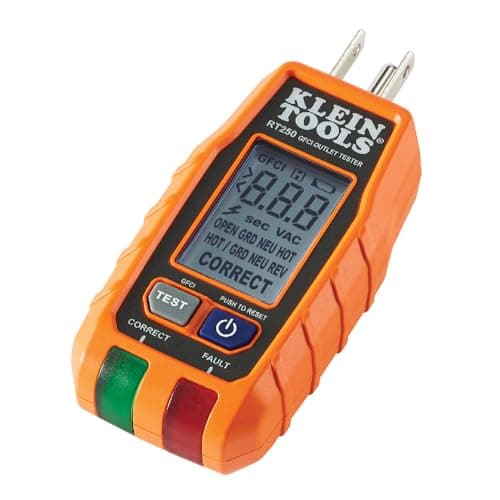 Klein Tools RT250 GFCI Outlet Tester with LCD Display Reads voltage and wiring faults on a standard 120 V outlet. It will not test a 30-amp pedestal, but it is how you check the outlets inside the trailer and the GFCI that feeds them. | Checking the trailer's own outlets, and a 15-amp pedestal outlet | 8.8/ 10 | $17.84View on Amazon
|
| 4 |  Plug-In AC Voltage Monitor, 2-Pack A flat-plug LCD voltmeter you leave in an outlet. It cannot protect anything, but it shows you the evening voltage sag that tells you the park is overloaded. | Watching voltage sag inside the trailer all evening | 7.8/ 10 |
Tap any row to jump to the full write-up. Prices come from Amazon and are read automatically — see each product below for the date.
The short answer
A pedestal is an outdoor electrical fitting of unknown age, wired by somebody you will never meet, exposed to weather and to hundreds of RVs plugging in and out. It is worth thirty seconds.
The six checks
- 1
Look at the outlet before you touch it
Brown or black scorch marks around the slots, melted plastic, or a socket that looks loose and sloppy. Burn marks mean a previous high-resistance connection and heat. Do not use that outlet. - 2
Check the breaker is off before plugging anything in
Switch the pedestal breaker off, connect, then switch on. Plugging a live circuit into a connector arcs across the prongs as they engage, which is what pits and burns contacts over time. - 3
Plug the protector in alone, cord disconnected
This is the whole point of a portable unit. It tests the pedestal before your trailer is connected to it, so a wiring fault never reaches your trailer at all. - 4
Switch on and read the diagnostic
Give it the full cycle — an EMS typically takes a couple of minutes before it passes power. Read the voltage and any fault codes. What each class of unit can tell you. - 5
Judge the voltage
Roughly 110-126 V is normal. Below about 108 V with nothing connected is a park already struggling and will get worse as the evening load rises. Above about 130 V is also a problem. - 6
Connect your cord, then check inside
Once the pedestal passes, connect your shore cord and check an interior outlet with a receptacle tester, including the GFCI test. That covers the trailer’s own wiring, which the pedestal diagnostic does not see.
The faults you will find, and what each means
| Fault | What it means | What to do |
|---|---|---|
| Open ground | No safety ground connection. A fault in your trailer has no path to earth | Do not connect. Report it, ask for another site |
| Reverse polarity | Hot and neutral swapped. Appliance chassis can sit at line voltage | Do not connect. Report it, ask for another site |
| Open neutral | On 50 amp, legs sit in series across 240 V and voltages go wild | Do not connect. This is the dangerous one |
| Low voltage (108-115 V) | Supply under load, or long undersized feeders | Connect with an EMS; expect it to trip in the evening |
| Very low voltage (under 105 V) | Park at or past its capacity | Ask for a different loop; consider not using A/C |
The common mistake
What to tell the office
Be specific and unemotional. “The pedestal on site 42 is showing an open ground on my tester, so I have not connected. Can I move to another site?” is a sentence that gets a useful response.
Most campgrounds want to know. A pedestal with an open ground is a liability for them and many will have it looked at. Some will shrug, and the answer to a shrug is still to move rather than to connect.
The evening check nobody does
Voltage at four in the afternoon on arrival is not voltage at nine in the evening when the park is full and every air conditioner is running. If your protector has a display or an app, look at it in the evening.
A reading of 118 V on arrival and 106 V at nine is a park running at its limit, and that is the condition that damages air conditioner compressors. An EMS will disconnect; a plain surge protector will not, and the only thing standing between your compressor and a long afternoon of excess current is that you noticed.
A cheap plug-in voltage monitor inside the trailer does this for a few dollars if your protector has no display.
What to remember
- Look for burn marks on the outlet before anything else.
- Breaker off, connect, breaker on — it stops arcing across the prongs.
- Test with the protector alone, before your cord is connected.
- Open ground, reverse polarity and open neutral are all reasons to move sites.
- Check voltage again in the evening, not just on arrival.
The picks in full
Progressive Industries EMS-PT30X Electrical Management System, 30 Amp
Progressive Industries · Best for most 30-amp trailers — the one to actually buy
A full electrical management system, not just a surge protector: it reads the pedestal and disconnects on low or high voltage, which is the fault that actually kills air conditioners.
Key specifications
- Service
- 30 amp
- Function
- Full EMS with automatic disconnect
- Protects against
- Surge, low voltage, high voltage, miswiring
- Display
- Scrolling diagnostic display
How it scored
- Protection coverage (30%)10
- Diagnostics (25%)9
- Weather sealing (20%)6
- Auto shutoff (15%)10
- Price for capability (10%)7
Weighted average of the figures above. We did not test this product — see how we pick.
What it does well
- Disconnects on voltage faults, which is what saves the air conditioner
- Readable display shows actual voltage and amperage
- The reference product in the category
What it is bad at
- Three times the price of a plain surge protector
- Portable units are a theft target — lock it to the pedestal
- Not weather-sealed to the degree a hardwired unit is
Price as of October 5, 2026. #ad How this is funded
Progressive Industries SSP-30XL Surge Protector, 30 Amp
Progressive Industries · Best for a first surge protector that also tests the pedestal
Surge suppression plus pedestal diagnostics in one plug, from the maker whose heavier units are the category benchmark. It will not disconnect power, but it will tell you not to plug in.
Key specifications
- Service
- 30 amp
- Function
- Surge suppression plus diagnostics
- Diagnostics
- Open ground, open neutral, reverse polarity
- Auto shutoff
- No
How it scored
- Protection coverage (30%)6
- Diagnostics (25%)8
- Weather sealing (20%)6
- Auto shutoff (15%)2
- Price for capability (10%)9
Weighted average of the figures above. We did not test this product — see how we pick.
What it does well
- Cheapest way to stop plugging into a miswired pedestal blind
- Lifetime-warranty reputation on the brand's surge line
- Small enough to leave on the cord
What it is bad at
- Surge only — it does not cut power on low or high voltage
- No remote display
- LEDs are hard to read in bright sun
Price as of October 5, 2026. #ad How this is funded
Klein Tools RT250 GFCI Outlet Tester with LCD Display
Klein Tools · Best for checking the trailer's own outlets, and a 15-amp pedestal outlet
Reads voltage and wiring faults on a standard 120 V outlet. It will not test a 30-amp pedestal, but it is how you check the outlets inside the trailer and the GFCI that feeds them.
Key specifications
- Use
- Standard 3-wire 120 V receptacles
- Display
- LCD voltage readout
- Tests
- Wiring faults and GFCI trip
- Model
- RT250
How it scored
- How often you use it (40%)8
- Build quality (25%)9
- Takes up little room (20%)10
- Price for capability (15%)9
Weighted average of the figures above. We did not test this product — see how we pick.
What it does well
- Numeric voltage, not just a pattern of lights
- Tests the GFCI trip, which is the one nobody checks
- Pocket-sized and from a tool maker with a real reputation
What it is bad at
- Does not fit a 30-amp TT-30 pedestal outlet
- No surge protection — it is a diagnostic tool only
- Needs a working outlet to tell you anything
Plug-In AC Voltage Monitor, 2-Pack
DROK · Best for watching voltage sag inside the trailer all evening
A flat-plug LCD voltmeter you leave in an outlet. It cannot protect anything, but it shows you the evening voltage sag that tells you the park is overloaded.
Key specifications
- Range
- AC 80-300 V
- Display
- LCD
- Form
- Flat plug
- Pack
- 2
How it scored
- How often you use it (40%)7
- Build quality (25%)6
- Takes up little room (20%)10
- Price for capability (15%)10
Weighted average of the figures above. We did not test this product — see how we pick.
What it does well
- Shows the slow evening voltage drop a surge protector hides from you
- Flat plug does not block the second socket
- Costs less than a meal out
What it is bad at
- Monitors only — no protection whatsoever
- Accuracy is approximate
- Generic brand with no calibration claim
Price as of October 5, 2026. #ad How this is funded
Common questions
Roughly 110–126 V is normal. Below about 108 V with nothing connected is a supply already under strain. Above about 130 V is also a problem.
The safety ground is not connected, so a fault in your trailer has no path to earth and the chassis can become live. Do not connect; report it and move.
Yes. Plugging into a live circuit arcs across the prongs as they engage, and repeated arcing pits the contacts. Breaker off, connect, breaker on.
Sources
- National Fire Protection Association — standards including NFPA 1192 for recreational vehicles — read October 2026
- Camco published electrical product specifications — read October 2026
- RV Industry Association — standards and compliance program — read October 2026