Power & Electrical
RV Electrical Basics For First-Time Owners
Your trailer has two electrical systems that do different jobs. Understanding which is which explains almost every question you will have.
By Mike M. ·
How this page is funded: we earn a commission if you buy through our links, at no extra cost to you. It never changes which product we rank first. Prices come from Amazon and are read automatically — each one shows the date it was read. Full disclosure.
Quick picks
The protection and diagnostics worth owning from day one.
| # | Product | Best for | Score | Price |
|---|---|---|---|---|
| 1 | 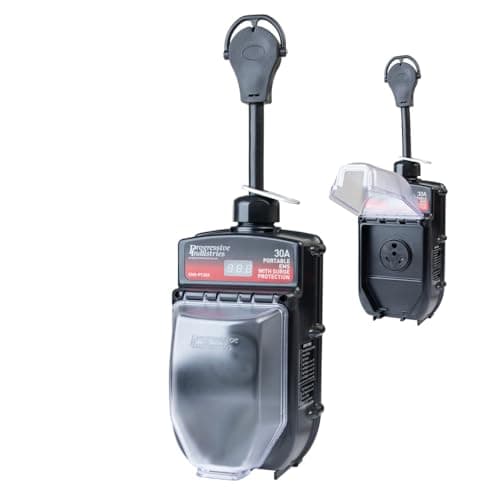 Progressive Industries EMS-PT30X Electrical Management System, 30 Amp A full electrical management system, not just a surge protector: it reads the pedestal and disconnects on low or high voltage, which is the fault that actually kills air conditioners. The one purchase that matters | Most 30-amp trailers — the one to actually buy | 8.7/ 10 | |
| 2 | 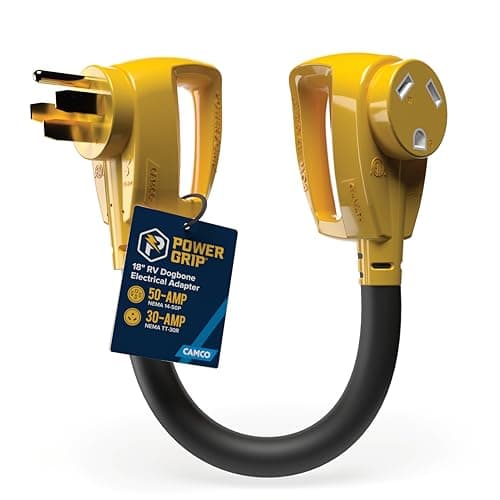 Camco PowerGrip Dogbone Adapter, 50A Male to 30A Female, 55175 The adapter for a 30-amp trailer at a 50-amp post. Ten-gauge copper and a molded grip, and it does not give you more power — it gives you a connection. | Plugging a 30-amp trailer into a 50-amp pedestal | 8.4/ 10 | |
| 3 | 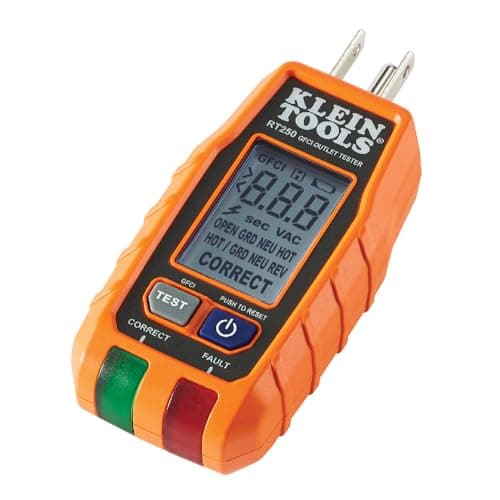 Klein Tools RT250 GFCI Outlet Tester with LCD Display Reads voltage and wiring faults on a standard 120 V outlet. It will not test a 30-amp pedestal, but it is how you check the outlets inside the trailer and the GFCI that feeds them. | Checking the trailer's own outlets, and a 15-amp pedestal outlet | 8.8/ 10 | $17.84View on Amazon
|
| 4 | 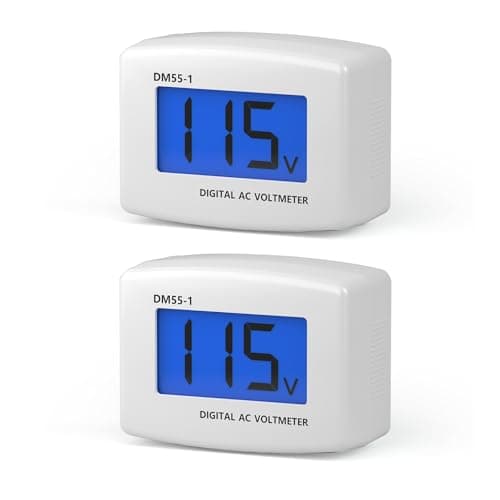 Plug-In AC Voltage Monitor, 2-Pack A flat-plug LCD voltmeter you leave in an outlet. It cannot protect anything, but it shows you the evening voltage sag that tells you the park is overloaded. | Watching voltage sag inside the trailer all evening | 7.8/ 10 |
Tap any row to jump to the full write-up. Prices come from Amazon and are read automatically — see each product below for the date.
The short answer
The two systems
| 120 V (shore power) | 12 V (battery) |
|---|---|
| Air conditioner | Interior lights |
| Microwave | Water pump |
| Wall outlets | Furnace blower and controls |
| Electric water heater element | Refrigerator control board |
| Residential refrigerator | Slide-out and jack motors |
| Converter / battery charger | Range hood fan, vent fans |
| TV (usually) | Propane detector, CO detector |
Two consequences fall straight out of that table. If your lights work but the air conditioner does not, you have a 120 V problem — shore power, breaker, or the pedestal. If your air conditioner works but the lights are dim, you have a 12 V problem — battery, or the converter not charging it.
Converter: the box that turns 120 V shore power into 12 V to run the 12 V system and charge the battery. Not to be confused with an inverter, which does the opposite — 12 V battery to 120 V, for running outlets without shore power.
Shore power: the 30 or 50 amp question
Look at the plug on your cord. Three prongs with one angled is 30 amp, a single 120 V circuit of about 3,600 watts. Four prongs is 50 amp, two 120 V legs of about 12,000 watts total.
On 30 amp you are managing a budget. The air conditioner takes 12–16 amps running, the microwave 10–13, the electric water heater 10–12. Two of those at once is usually fine; three trips the breaker. The two services compared.
And the pedestal is not to be trusted. Buy an EMS before you buy anything else electrical — low voltage in a full park is the fault that actually damages equipment. Surge protector vs EMS.
The battery, and why it is flat
Your trailer’s battery runs the 12 V system. It charges from shore power via the converter, from the tow vehicle while driving (slowly), and from solar if fitted.
Three things drain it faster than people expect. The propane and CO detectors run continuously — they have to. The furnace blower is a surprisingly heavy 12 V load, so a cold night off grid takes a real bite. And the refrigerator control board draws constantly even when the fridge is running on propane.
Which is why a trailer left in storage with the battery connected is flat in a few weeks. Use the battery disconnect switch if yours has one, or disconnect a terminal.
The common mistake
Breakers and fuses: two panels, not one
Open your trailer’s electrical panel and you will usually see both systems in one cabinet.
Breakers — the switches — protect the 120 V circuits. One main, then branch breakers for the air conditioner, outlets, water heater and converter. These reset.
Fuses — usually blade fuses in a row — protect the 12 V circuits. These do not reset; you replace them, and you carry spares in the sizes your panel uses.
A tripped breaker trips for a reason. Resetting it once is diagnosis; resetting it repeatedly without finding out why is how a problem becomes a fire.
The GFCI nobody tests
One of your trailer’s outlets — usually in the bathroom — is a GFCI, and it protects several other outlets downstream of it. When it trips, several outlets stop working at once and people conclude the trailer has a serious fault.
Press the reset button on that outlet. It solves “half my outlets stopped working” a remarkable proportion of the time.
And test it occasionally with the test button, or with a receptacle tester that has a GFCI test. A GFCI that will not trip when tested is a GFCI that will not protect you, and that is worth knowing before you need it.
The five things to do first
- Find out whether you are 30 or 50 amp and buy the matching protector.
- Buy an EMS, not a surge protector, and lock it to the pedestal.
- Buy the 50-to-30 dogbone adapter — the one you will use most — and the 30-to-15 for home.
- Learn your 30 amp budget. Which two appliances you can run together and which three you cannot.
- Find the battery disconnect and the GFCI outlet. Both will save you an unnecessary service visit.
What to remember
- Two systems: 120 V shore power for the big loads, 12 V battery for lights, pump and furnace.
- The converter charges the battery from shore power. An inverter does the reverse.
- Lights fine but no A/C means a 120 V problem; A/C fine but dim lights means a 12 V problem.
- Breakers reset; 12 V fuses do not — carry spares.
- Half your outlets dead is usually a tripped GFCI in the bathroom.
The picks in full
Progressive Industries EMS-PT30X Electrical Management System, 30 Amp
Progressive Industries · Best for most 30-amp trailers — the one to actually buy
A full electrical management system, not just a surge protector: it reads the pedestal and disconnects on low or high voltage, which is the fault that actually kills air conditioners.
Key specifications
- Service
- 30 amp
- Function
- Full EMS with automatic disconnect
- Protects against
- Surge, low voltage, high voltage, miswiring
- Display
- Scrolling diagnostic display
How it scored
- Protection coverage (30%)10
- Diagnostics (25%)9
- Weather sealing (20%)6
- Auto shutoff (15%)10
- Price for capability (10%)7
Weighted average of the figures above. We did not test this product — see how we pick.
What it does well
- Disconnects on voltage faults, which is what saves the air conditioner
- Readable display shows actual voltage and amperage
- The reference product in the category
What it is bad at
- Three times the price of a plain surge protector
- Portable units are a theft target — lock it to the pedestal
- Not weather-sealed to the degree a hardwired unit is
Price as of October 5, 2026. #ad How this is funded
Camco PowerGrip Dogbone Adapter, 50A Male to 30A Female, 55175
Camco · Best for plugging a 30-amp trailer into a 50-amp pedestal
The adapter for a 30-amp trailer at a 50-amp post. Ten-gauge copper and a molded grip, and it does not give you more power — it gives you a connection.
Key specifications
- Configuration
- 50 A male to 30 A female
- Wire
- 100% copper 10/3 gauge
- Rating
- 125 V / 3,750 W
- Part
- 55175
Capacity figures read from Camco PowerGrip adapter specifications, October 2026.
How it scored
- How often you use it (40%)9
- Build quality (25%)8
- Takes up little room (20%)7
- Price for capability (15%)9
Weighted average of the figures above. We did not test this product — see how we pick.
What it does well
- Correct heavy gauge for a 30-amp load
- Molded grips make it removable with wet hands
- The adapter you will use most often
What it is bad at
- Does not increase available power — your trailer is still 30 amp
- Dogbone body is bulky in a cord bag
- Prongs bend if you yank it by the cord
Price as of October 5, 2026. #ad How this is funded
Klein Tools RT250 GFCI Outlet Tester with LCD Display
Klein Tools · Best for checking the trailer's own outlets, and a 15-amp pedestal outlet
Reads voltage and wiring faults on a standard 120 V outlet. It will not test a 30-amp pedestal, but it is how you check the outlets inside the trailer and the GFCI that feeds them.
Key specifications
- Use
- Standard 3-wire 120 V receptacles
- Display
- LCD voltage readout
- Tests
- Wiring faults and GFCI trip
- Model
- RT250
How it scored
- How often you use it (40%)8
- Build quality (25%)9
- Takes up little room (20%)10
- Price for capability (15%)9
Weighted average of the figures above. We did not test this product — see how we pick.
What it does well
- Numeric voltage, not just a pattern of lights
- Tests the GFCI trip, which is the one nobody checks
- Pocket-sized and from a tool maker with a real reputation
What it is bad at
- Does not fit a 30-amp TT-30 pedestal outlet
- No surge protection — it is a diagnostic tool only
- Needs a working outlet to tell you anything
Plug-In AC Voltage Monitor, 2-Pack
DROK · Best for watching voltage sag inside the trailer all evening
A flat-plug LCD voltmeter you leave in an outlet. It cannot protect anything, but it shows you the evening voltage sag that tells you the park is overloaded.
Key specifications
- Range
- AC 80-300 V
- Display
- LCD
- Form
- Flat plug
- Pack
- 2
How it scored
- How often you use it (40%)7
- Build quality (25%)6
- Takes up little room (20%)10
- Price for capability (15%)10
Weighted average of the figures above. We did not test this product — see how we pick.
What it does well
- Shows the slow evening voltage drop a surge protector hides from you
- Flat plug does not block the second socket
- Costs less than a meal out
What it is bad at
- Monitors only — no protection whatsoever
- Accuracy is approximate
- Generic brand with no calibration claim
Price as of October 5, 2026. #ad How this is funded
Common questions
Lights are 12 V battery and the air conditioner is 120 V shore power, so that points to a 120 V problem: pedestal, shore cord, main breaker or the A/C breaker.
A converter turns 120 V shore power into 12 V to run the lights and charge the battery. An inverter does the reverse — 12 V battery to 120 V for the outlets.
Most often a tripped GFCI, usually in the bathroom, which protects several outlets downstream. Press its reset. If it will not reset, there is a genuine fault.
Detectors and the fridge control board draw continuously, so a connected battery goes flat in weeks of storage. Use the disconnect switch, and keep lead-acid batteries charged — sulfation from sitting flat is largely irreversible.
Sources
- National Fire Protection Association — standards including NFPA 1192 for recreational vehicles — read October 2026
- Camco published electrical product specifications — read October 2026
- RV Industry Association — standards and compliance program — read October 2026