Leveling, Chocks & Stabilizing
The Best RV Leveling Blocks For Dual Wheels
A single curved leveler is designed for one tire. Put two wheels on it and the back one hangs off the end. This is the category where interlocking blocks still win.
By Mike M. ·
How this page is funded: we earn a commission if you buy through our links, at no extra cost to you. It never changes which product we rank first. Prices come from Amazon and are read automatically — each one shows the date it was read. Full disclosure.
Quick picks
Scored on the published leveling rubric — stability (30%), height range (25%), ease of use (20%), durability (15%), packed size (10%) — with one extra filter applied: whether the product can actually support two wheels per side at equal height.
| # | Product | Best for | Score | Price |
|---|---|---|---|---|
| 1 | 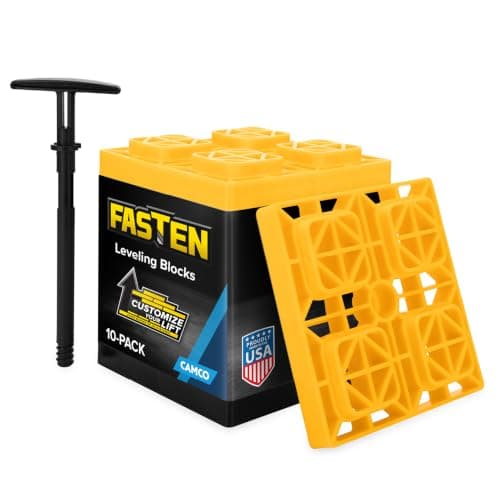 Camco FasTen RV Leveling Blocks, 10-Pack Interlocking plastic blocks that lock together instead of sliding apart, which is the whole difference between these and loose wood. They also go under a jack, which a curved leveler cannot. Top pick | The default: cheap, interlocking, use them for everything | 7.5/ 10 | |
| 2 | 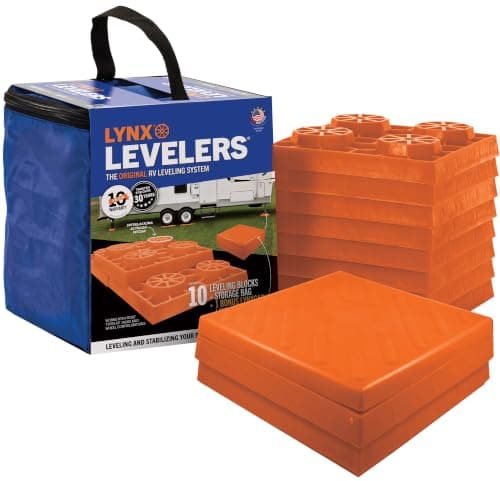 Lynx Levelers, 11-Pack with Cap and Storage Bag The long-standing honeycomb block. Eleven pieces including a cap, which is the detail that matters: the cap gives a flat top so a jack foot does not sit in the honeycomb. Best for tall builds | Leveling, jack pads and stabilizer feet from one bag | 7.3/ 10 | |
| 3 | 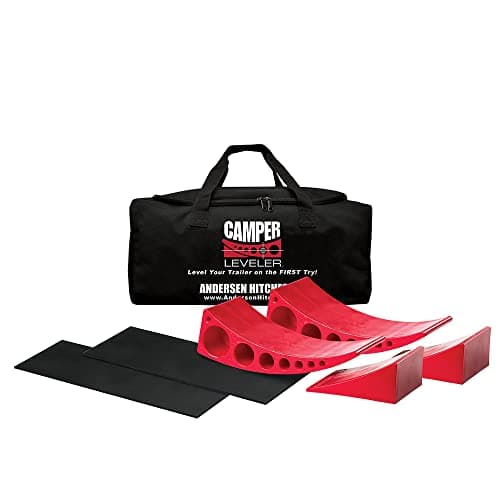 Andersen Camper Leveler, 2-Pack with Mats and Bag A curved ramp you drive up until the bubble centers, then chock. It replaces the guess-stack-check-restack cycle that makes stacking blocks the most annoying job at a campsite. Only with two of them | Side-to-side leveling in one pull-up, with no stacking | 7.5/ 10 | |
| 4 | 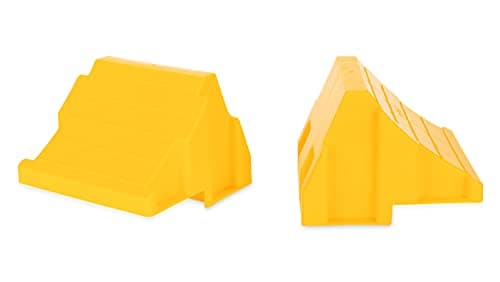 Camco Leveling Block Wheel Chocks, 2-Pack, 44401 A chock shaped to sit against a tire that is already up on blocks, which is exactly the situation where a normal chock does not reach. Chock on top of blocks | Chocking a trailer that is sitting on leveling blocks | 7.8/ 10 | $34.24View on Amazon
|
| 5 | 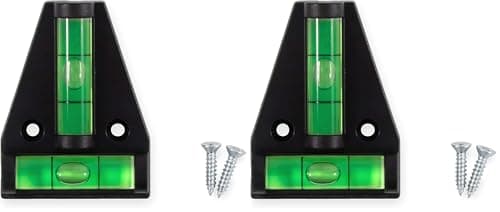 Camco RV T Level, 2-Pack, 25543 Two screw-on bubble levels, one for front-to-back and one for side-to-side. Cheap, and the reason you stop guessing from inside the trailer. Know when to stop | Knowing when to stop driving up the leveler | 8.6/ 10 | $9.16View on Amazon
|
Tap any row to jump to the full write-up. Prices come from Amazon and are read automatically — see each product below for the date.
The short answer
“Dual wheels” means two different things in RV parts listings, and both end up at the same answer. On a dually truck or a large motorhome it means two tires side by side on one hub. On a travel trailer — which is what this site is about — it almost always means a tandem axle: two wheels, one behind the other, on each side of the trailer. Either way the requirement is the same: a support surface long enough and flat enough to carry two tires at identical height.
Tandem axle: two axles close together under the trailer, so each side has two tires in line a few inches apart. Nearly every travel trailer over about 22 ft is built this way, and it changes how leveling and chocking work compared with a single-axle trailer.
Why one block per tire is the wrong answer
Put a tandem-axle trailer’s front wheel on a 2 in block and leave the rear wheel on the ground and you have not just failed to level it — you have loaded one axle with a disproportionate share of the trailer. Trailer axles on a tandem are not independently sprung in the way a car’s are; they share load through an equalizer between the springs. Raising one and not the other transfers load off the low wheel and onto the high one, and does it while the trailer is parked for days.
The visible consequences are a trailer that still reads out of level after you thought you had fixed it, a noticeable rock when anyone walks inside, and tire wear concentrated on whichever tire is carrying more. Uneven trailer tire wear has several causes and this is one of the avoidable ones.
The common mistake
What to look for
Usable platform length. You need a flat section long enough for two tires, plus the ramp to get up there. For a typical travel trailer with 15 in wheels that is roughly 36–40 in of flat surface before the ramp begins. Interlocking blocks get there by addition; curved levelers get there only in pairs.
Published load rating, and how it is stated. Block makers publish a capacity per block or per stack. The figure that matters is the rating for the stack height you actually build, which is usually lower than the headline number. Check the maker’s own stacking guidance rather than assuming more blocks equals more capacity.
Maximum safe stack height. Every manufacturer states one. Stacking past it turns a stable platform into a tower, and a tower under a tandem axle on soft ground is how trailers come off blocks. If you routinely need more than about 4 in of correction, the answer is a different site or a shovel, not another layer.
Whether it also works under jacks. Blocks that double as jack pads and stabilizer feet mean one bag instead of three. The Lynx 11-pack is the usual choice for that reason. Dedicated jack pads are still better under a scissor jack, but a block will do it.
| Correction needed | What to use | Note |
|---|---|---|
| Up to 2 in | One layer of interlocking blocks, both wheels | Fastest option; no ramp needed on a 1 in layer |
| 2-4 in | Stacked interlocking blocks with a ramp layer | Build the ramp as a staircase, not a cliff |
| 2-4 in, one-pull method | Two curved levelers per side, matched height | One per side is the common error |
| Over 4 in | Move the trailer | Past most published stack maximums |
| Soft or gravel ground | Blocks on a wider base layer | Spread the load before you build up |
Curved levelers on a tandem axle: how to do it properly
Curved levelers are genuinely good, and the one-pull convenience is real: you drive up until the bubble is right and chock behind, with no getting out to add a layer. The constraint is that each one is designed to carry one tire.
On a tandem axle that means two per side, placed in line, set so both tires end up at the same height. Which in turn means buying a two-pack per side — four units for the trailer — and matching how far you drive up on each. It works, and plenty of tandem-axle owners run exactly that setup. It is simply not the cheap option, and the listings rarely spell it out.
If you want the convenience and have a single-axle trailer, the calculus is completely different and curved levelers are the easy win. Blocks vs curved levelers compares the two approaches properly, and the camper leveler roundup ranks the curved ones on their own terms.
Chocking on top of blocks
A trailer sitting on blocks needs chocking differently from one on the ground. The chock has to sit on the same raised surface as the tire, not on the ground beside it, or it does nothing. Blocks designed with a chock profile on one face solve this directly; otherwise build one extra block position at the front and rear of the platform for the chock to sit on.
On a tandem axle, chock all four wheels, downhill side first. How many chocks you need covers why four rather than two, and X-chocks deal with the separate problem of the trailer rocking between its own tandem wheels.
What this ranking is, and is not
We did not test these on a trailer. This ranking is a documented reading of each maker’s published load ratings, dimensions and stacking guidance, the current retailer listing data read automatically, and what owners consistently report — stated as reporting rather than as our own experience. Load ratings and maximum stack heights come from the manufacturers and should be checked against your own trailer weight. The rubric is on how we pick.
What to remember
- Two wheels per side need one continuous platform at equal height, not one block per tire.
- Interlocking blocks are the default because length and height are both additive.
- Curved levelers work on a tandem axle, but you need two per side — four for the trailer.
- Never let the rear tire of a tandem pair hang off the end of a ramp.
- Respect the published maximum stack height. Over about 4 in of correction, move the trailer.
- Chocks must sit on the same raised surface as the tire, not on the ground beside it.
The picks in full
Camco FasTen RV Leveling Blocks, 10-Pack
Camco · Best for the default: cheap, interlocking, use them for everything
Interlocking plastic blocks that lock together instead of sliding apart, which is the whole difference between these and loose wood. They also go under a jack, which a curved leveler cannot.
Key specifications
- Block size
- 8.5 in x 8.5 in x 1 in
- Pack
- 10 blocks
- Interlocking
- Yes
- Origin
- Made in USA
Capacity figures read from Camco FasTen specifications, October 2026.
How it scored
- Lift range (25%)7
- Grip / stability (25%)7
- Packed size (20%)8
- Build quality (20%)7
- Price for capability (10%)10
Weighted average of the figures above. We did not test this product — see how we pick.
What it does well
- Interlock, so a stack does not shear sideways under load
- Do double duty under jacks and stabilizers
- Cheapest route to usable leveling
What it is bad at
- Stacking to the right height is trial and error
- One inch per layer means coarse adjustment
- They crack if you drive onto an unsupported overhang
Price as of October 10, 2026. #ad How this is funded
Lynx Levelers, 11-Pack with Cap and Storage Bag
Tri-Lynx · Best for leveling, jack pads and stabilizer feet from one bag
The long-standing honeycomb block. Eleven pieces including a cap, which is the detail that matters: the cap gives a flat top so a jack foot does not sit in the honeycomb.
Key specifications
- Pack
- 11 pieces including 1 cap level top
- Design
- Interlocking honeycomb
- Storage
- Bag included
- Origin
- Made in USA
How it scored
- Lift range (25%)7
- Grip / stability (25%)6
- Packed size (20%)8
- Build quality (20%)7
- Price for capability (10%)10
Weighted average of the figures above. We did not test this product — see how we pick.
What it does well
- Cap piece gives a flat bearing surface for jacks
- Honeycomb is strong for its weight
- Decades of owner reports to read
What it is bad at
- Honeycomb edges split if you drive onto a stack at an angle
- No grip mat, so they slide on wet concrete
- Same coarse one-inch-per-layer stacking
Price as of October 10, 2026. #ad How this is funded
Andersen Camper Leveler, 2-Pack with Mats and Bag
Andersen Hitches · Best for side-to-side leveling in one pull-up, with no stacking
A curved ramp you drive up until the bubble centers, then chock. It replaces the guess-stack-check-restack cycle that makes stacking blocks the most annoying job at a campsite.
Key specifications
- Pack
- 2 levelers, 2 rubber mats, duffel bag
- Rated to
- 30,000 lb
- Lift
- Continuous, up to about 4 in
- Use
- Single-axle and tandem-axle trailers
Capacity figures read from Andersen Camper Leveler specifications, October 2026.
How it scored
- Lift range (25%)9
- Grip / stability (25%)8
- Packed size (20%)5
- Build quality (20%)8
- Price for capability (10%)6
Weighted average of the figures above. We did not test this product — see how we pick.
What it does well
- One pull-up, any lift height — no stacking to the nearest inch
- Chock is built into the design
- Rubber mats stop the ramp sliding on hardpack
What it is bad at
- Expensive next to a bag of plastic blocks
- Bulky to store, even in the bag
- You still need a spotter or a camera to know when to stop
Price as of October 10, 2026. #ad How this is funded
Camco Leveling Block Wheel Chocks, 2-Pack, 44401
Camco · Best for chocking a trailer that is sitting on leveling blocks
A chock shaped to sit against a tire that is already up on blocks, which is exactly the situation where a normal chock does not reach.
Key specifications
- Pack
- 2 chocks
- Sizing
- Sized for larger vehicle tires
- Use
- Alongside leveling blocks
- Function
- Centers and stabilizes the wheel
Capacity figures read from Camco leveling chock specifications, October 2026.
How it scored
- Holding force (35%)7
- Fit range (25%)9
- Everyday usability (20%)8
- Build quality (10%)6
- Price for capability (10%)9
Weighted average of the figures above. We did not test this product — see how we pick.
What it does well
- Solves the real problem of chocking a raised wheel
- Taller profile suits big trailer tires
- Works as a plain chock too
What it is bad at
- Bulkier to store than a standard chock
- Still plastic, still slides on wet concrete
- Not needed if you use curved levelers with built-in chocks
Camco RV T Level, 2-Pack, 25543
Camco · Best for knowing when to stop driving up the leveler
Two screw-on bubble levels, one for front-to-back and one for side-to-side. Cheap, and the reason you stop guessing from inside the trailer.
Key specifications
- Pack
- 2 levels
- Mounting
- Screw-mounted
- Axes
- Front-to-back and side-to-side
- Part
- 25543
Capacity figures read from Camco RV T Level specifications, October 2026.
How it scored
- How often you use it (40%)9
- Build quality (25%)6
- Takes up little room (20%)10
- Price for capability (15%)10
Weighted average of the figures above. We did not test this product — see how we pick.
What it does well
- Lets you read level from outside the trailer, where you are standing
- Costs less than a sandwich
- No batteries, nothing to pair
What it is bad at
- You have to mount them with the trailer already level, or they lie forever
- Screw holes in the trailer skin
- Harder to read at dusk than a phone app
Common questions
Yes. A tandem shares load through an equalizer between the springs, so raising one wheel transfers load onto it and leaves the trailer out of level anyway. Support both tires at the same height.
Not properly. Each curved leveler carries one tire, so a tandem needs two per side — four for the trailer. One unit with the second tire hanging off the end loads the ramp edge.
Follow the published maximum for your blocks and build a ramp rather than a step. Past about four inches of correction, reposition the trailer instead of stacking higher.
On the same raised surface as the tire — a chock on the ground beside a raised tire does nothing. Use a block with a chock face, or extend the platform front and rear.
Sources
- Camco published leveling block and chock specifications — read October 2026
- Andersen Hitches Camper Leveler published specifications — read October 2026
- Tri-Lynx Lynx Levelers published load ratings and stacking guidance — read October 2026
- Lippert published RV leveling and stabilizing documentation — read October 2026