Towing Setup & Capacity
How Much Can My Truck Actually Tow?
Fifteen minutes, a tape measure not required. Four stickers, five numbers, and an honest answer instead of a marketing one.
By Mike M. ·
How this page is funded: we earn a commission if you buy through our links, at no extra cost to you. It never changes which product we rank first. Prices come from Amazon and are read automatically — each one shows the date it was read. Full disclosure.
Quick picks
The hardware the answer usually points you at.
| # | Product | Best for | Score | Price |
|---|---|---|---|---|
| 1 | 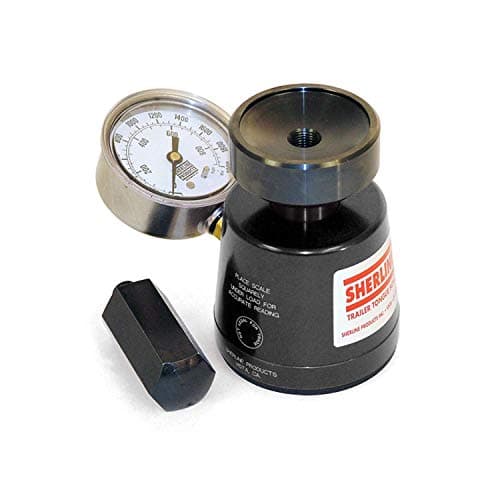 Sherline LM 2000 Trailer Tongue Weight Scale A hydraulic scale you set the coupler down on. It is the only tool here that answers the one question every hitch decision depends on, and it reads up to 2,000 lb. | Measuring loaded tongue weight properly, once and for all | 7.4/ 10 | |
| 2 | 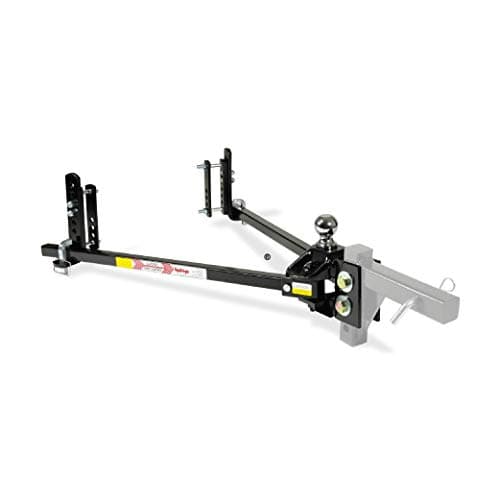 Equal-i-zer 4-Point Sway Control Hitch, 90-00-1001 Four-point sway control built into the head, so there is no friction bar to unclip before you back into a site — the single biggest quality-of-life difference for a first-timer. | Most half-ton trucks pulling a 5,000-10,000 lb trailer | 7.9/ 10 | |
| 3 | 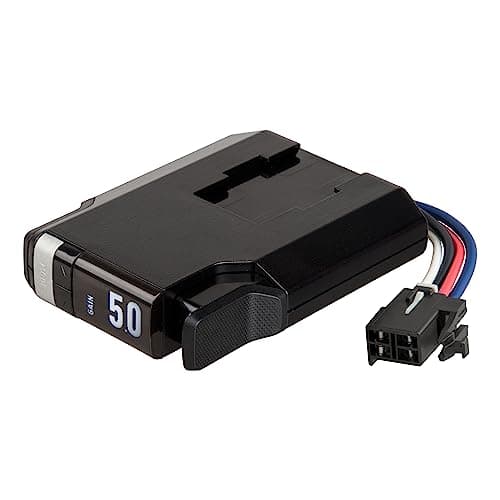 CURT TriFlex Next Proportional Trailer Brake Controller, 51146 Proportional, plug-and-play, fully adjustable and rated to four axles for well under the price of the knob-controlled version — the sensible default if your truck has a factory brake harness. | Most first-time buyers who want proportional braking cheaply | 8.2/ 10 |
Tap any row to jump to the full write-up. Prices come from Amazon and are read automatically — see each product below for the date.
The short answer
“How much can my truck tow” has a brochure answer and a real answer, and the gap between them is where first-time trailer owners get hurt. Here is the procedure for the real one.
Step 1: read the four stickers
| Number | Where | What it limits |
|---|---|---|
| Payload | Yellow sticker, driver's door frame | People plus cargo plus tongue weight |
| GVWR | Certification label, door frame | The loaded truck's total weight |
| Towing capacity | Owner's manual, towing section, your configuration | The loaded trailer's weight |
| GCWR | Owner's manual, same section | Truck plus trailer together |
Also worth noting: the maximum tongue weight figure in the towing section, and whether the manual gives a higher towing capacity with weight distribution. Both matter.
And read the rating stamped on your receiver. It is usually not the binding limit, but it is the fifth number in the chain. The classes explained.
Step 2: spend your payload
Payload is the limit that almost always binds first on a half-ton, so start there. Subtract, honestly:
01Everyone who travels in the truck
Including you. Use real weights, not optimistic ones. Four adults is commonly 600-700 lb.02The hitch
A weight distribution head, bars, brackets and shank is commonly 70-100 lb, all of it in the receiver.03Everything in the bed and cab
Coolers, firewood, generator, tools, chairs, the dog. This is the category people under-count by the widest margin.04Permanent accessories
Bed liner, topper, running boards, roof rack, heavier wheels and tires. These are already in the truck's weight if fitted before the sticker was printed, and not if they were added later.
What is left is your tongue weight budget.
Step 3: divide
Divide the remaining payload by the tongue weight percentage you expect. Use 0.12 for a conventional travel trailer. The result is the heaviest loaded trailer your payload supports.
Worked: 652 lb of remaining payload ÷ 0.12 = about 5,430 lb of loaded trailer. Note “loaded” — not the dry weight on the dealer’s window sticker, which is typically 1,000–1,500 lb lighter than the trailer you will actually tow.
The common mistake
Step 4: check the other three limits
Your payload-derived figure is usually the lowest, but check:
- Towing capacity. Is your figure under it? On a half-ton this is normally comfortable.
- Maximum tongue weight. Is your tongue weight budget under the manual’s figure? On a mid-size SUV this often binds before payload does.
- GCWR. Truck curb weight plus everything in it plus the loaded trailer — under GCWR?
- Receiver rating. Both the weight-carrying and weight-distributing figures.
The lowest number wins. There is no averaging and no “close enough.”
Step 5: verify it on a scale
Once you own the trailer, confirm the arithmetic. A public truck scale gives you gross combined weight and tongue weight in one visit, and some scales let you weigh axle by axle so you can check the truck’s rear axle load too.
People are routinely surprised. The usual surprise is that the trailer weighs more than the dry figure and the tongue weight is higher than 12%.
If the answer is lower than the trailer you wanted
Four options, and they are the only four:
- A lighter trailer. The cheapest option by a wide margin if you have not bought yet.
- Load less. Travel with empty fresh-water tanks and fill at the campground — that is often 300 lb of the problem. Leave the generator at home.
- Fewer passengers. Occasionally practical, usually not.
- A truck with more payload. A max-tow or heavy-payload package, or a three-quarter-ton.
Accessories are not on that list. Neither is a hitch.
What to remember
- Four limits: payload, towing capacity, maximum tongue weight and GCWR. The lowest governs.
- On most half-tons payload binds first, by thousands of pounds.
- Divide remaining payload by 0.12 for a realistic loaded trailer weight.
- A trailer's dry weight is typically 1,000-1,500 lb less than what you will tow.
- Verify on a truck scale once you own it.
The picks in full
Sherline LM 2000 Trailer Tongue Weight Scale
Sherline · Best for measuring loaded tongue weight properly, once and for all
A hydraulic scale you set the coupler down on. It is the only tool here that answers the one question every hitch decision depends on, and it reads up to 2,000 lb.
Key specifications
- Capacity
- 2,000 lb
- Type
- Hydraulic dial gauge
- Use
- Jack the coupler down onto the scale
- Power
- None — mechanical
How it scored
- How often you use it (40%)9
- Build quality (25%)9
- Takes up little room (20%)4
- Price for capability (15%)5
Weighted average of the figures above. We did not test this product — see how we pick.
What it does well
- Gives you the loaded number, not the brochure dry number
- No batteries, no calibration routine, no app
- Capacity covers essentially every bumper-pull trailer
What it is bad at
- Expensive for a tool most people use twice a year
- Bulky to store
- You need level ground and the coupler at the right height to read it accurately
Price as of October 5, 2026. #ad How this is funded
Equal-i-zer 4-Point Sway Control Hitch, 90-00-1001
Equal-i-zer · Best for most half-ton trucks pulling a 5,000-10,000 lb trailer
Four-point sway control built into the head, so there is no friction bar to unclip before you back into a site — the single biggest quality-of-life difference for a first-timer.
Key specifications
- Trailer weight rating
- 10,000 lb
- Tongue weight rating
- 1,000 lb
- Sway control
- 4-point, integral to the head
- Included
- Weight distribution kit; shank and ball sold separately
Capacity figures read from Equal-i-zer product specifications, October 2026.
How it scored
- Sway control (25%)9
- Tongue-weight range (20%)8
- Backing up (20%)9
- Setup effort (15%)7
- Quietness (10%)5
- Price for capability (10%)7
Weighted average of the figures above. We did not test this product — see how we pick.
What it does well
- Sway control is always on — nothing to remember, nothing to remove
- Back up and turn sharply without unhooking anything
- Bracket height is adjustable in the field with a wrench, not a shop visit
What it is bad at
- It creaks and groans in tight turns; owners report this consistently and it is normal, not a fault
- Needs a shank and ball bought separately, which catches people out on price
- Heavier to lift onto the coupler than a friction-bar setup
Price as of October 5, 2026. #ad How this is funded
CURT TriFlex Next Proportional Trailer Brake Controller, 51146
CURT · Best for most first-time buyers who want proportional braking cheaply
Proportional, plug-and-play, fully adjustable and rated to four axles for well under the price of the knob-controlled version — the sensible default if your truck has a factory brake harness.
Key specifications
- Braking
- Proportional, inertia-based
- Axles
- 2-4 axles
- Install
- Plug-and-play with factory harness
- Profile
- Low profile, fully adjustable
Capacity figures read from CURT TriFlex Next specifications, October 2026.
How it scored
- Braking control (30%)9
- Install effort (25%)8
- Adjustability (20%)8
- Readout / feedback (15%)7
- Price for capability (10%)9
Weighted average of the figures above. We did not test this product — see how we pick.
What it does well
- Cheapest genuine proportional controller here
- Handles up to four axles, so it outgrows a single trailer
- Low-profile case fits where a knob controller will not
What it is bad at
- Plug-and-play only if the truck already has the brake-control connector
- Adjustment is through buttons, which is slower than a knob while moving
- No app, no remote display
Price as of October 5, 2026. #ad How this is funded
Common questions
The figure is real but it describes the best configuration of that model, and it is a towing capacity rather than a payload. Your manual has your configuration’s number, and payload usually binds first.
No — four-wheel drive adds curb weight, which usually reduces payload. Use it for traction on loose ground, not as a capacity upgrade.
Commonly 1,000–1,500 lb more than the dry weight, once water, propane, batteries and your gear are aboard. The trailer’s GVWR placard is the ceiling, and most owners use most of it.
Sources
- SAE J2807 — tow-vehicle gross combination weight rating procedure — read October 2026
- SAE J684 — trailer couplings, hitches and safety chains — read October 2026
- 49 CFR 393.70 — coupling devices and towing methods — read October 2026
- CURT published towing product specifications — read October 2026