Weight Distribution & Sway Control
Do I Need A Weight Distribution Hitch With A Half-Ton Truck?
Half-ton trucks have enormous tow ratings and modest payloads. That gap is exactly where weight distribution stops being optional, and it arrives earlier than most owners expect.
By Mike M. ·
How this page is funded: we earn a commission if you buy through our links, at no extra cost to you. It never changes which product we rank first. Prices come from Amazon and are read automatically — each one shows the date it was read. Full disclosure.
Quick picks
If the checks below say yes - and for most half-ton owners with a travel trailer they will - these are the three to look at, all in the 1,000 lb tongue weight class a half-ton actually sees.
| # | Product | Best for | Score | Price |
|---|---|---|---|---|
| 1 | 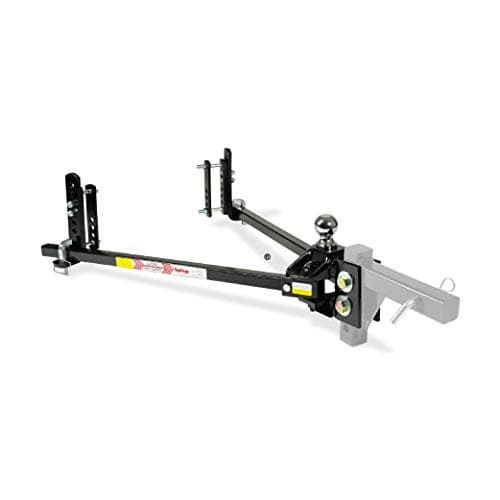 Equal-i-zer 4-Point Sway Control Hitch, 90-00-1001 Four-point sway control built into the head, so there is no friction bar to unclip before you back into a site — the single biggest quality-of-life difference for a first-timer. Top pick for a half-ton | Most half-ton trucks pulling a 5,000-10,000 lb trailer | 7.9/ 10 | |
| 2 | 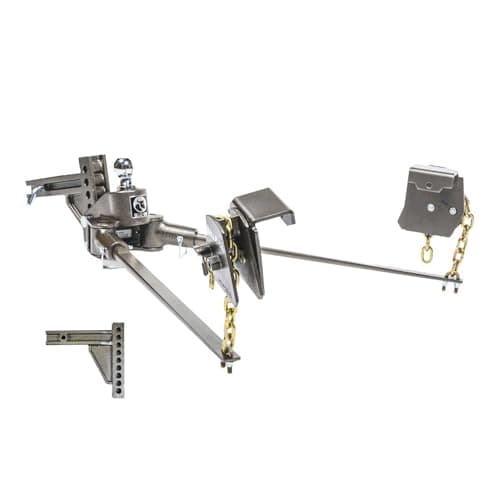 Blue Ox SwayPro BXW1000-S Weight Distributing Hitch Chain-tensioned spring bars that run under the A-frame rather than clamping onto it — quieter than a bracket hitch, and the hookup is a latch rather than a lift. Quietest of the three | Owners who want a quiet, under-slung bar setup | 7.5/ 10 | |
| 3 | 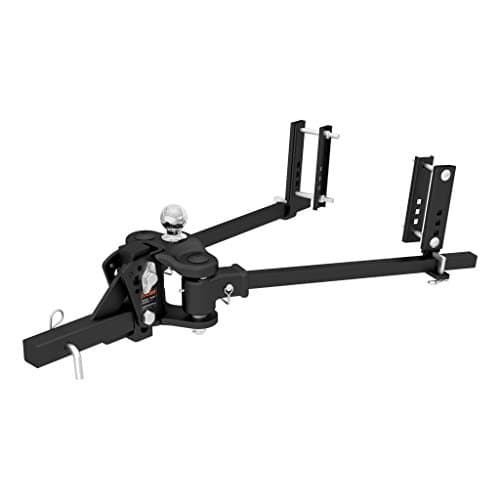 CURT TruTrack 4P Weight Distribution Hitch, 17500 CURT's answer to the four-point Equal-i-zer, with a 10,000 lb rating and an adjustable sway bias — generally a couple of hundred dollars under the hitch it is aimed at. Best value | Four-point sway control at a mid-range price | 7.9/ 10 |
Tap any row to jump to the full write-up. Prices come from Amazon and are read automatically — see each product below for the date.
The short answer
The confusion here is structural. A modern half-ton advertises a tow rating in the 9,000–13,000 lb range, which sounds like it should shrug off a 6,000 lb trailer. But that rating is a gross combined weight figure that assumes almost nothing else in the truck, and it comes with a stated condition: above a certain trailer weight, weight distribution is required. Meanwhile the payload sticker on the door jamb is often 1,400–1,900 lb, and that is the number tongue weight comes out of.
Half-ton: the traditional name for the lightest full-size pickup class — F-150, Silverado 1500, Ram 1500, Sierra 1500, Tundra, Titan. The “half ton” has not described real payload for decades; read your own door-jamb sticker instead.
The three checks, in order
1. The manual’s threshold. Open the towing section of your owner’s manual and find the trailer weight above which weight distribution is required. For most half-tons this lands in the 5,000 lb region, though it varies by manufacturer, model year and whether you have a max tow package. Above that number, this is settled and the rest of the page is academic.
2. Tongue weight against 10% of GVWR. Your truck’s gross vehicle weight rating is on the door jamb. Ten percent of it is the practical threshold above which the load behind the rear axle has lifted enough weight off the front axle to matter. A 7,000 lb GVWR half-ton gives you 700 lb; a loaded travel trailer tongue is very often above that.
3. How it sits and where the headlights point. Hook the loaded trailer, park on level ground, and look. A visibly squatting rear and headlights aimed into the trees means the front axle is unloaded. That is the condition, visible without a scale.
| Figure | Where to find it | Typical half-ton range |
|---|---|---|
| Gross vehicle weight rating | Driver's door jamb sticker | 6,800 - 7,700 lb |
| Payload | Yellow sticker, same door jamb | 1,400 - 1,900 lb |
| 10% of GVWR (tongue weight threshold) | Calculate from GVWR | 680 - 770 lb |
| Weight distribution required above | Owner's manual, towing section | Commonly about 5,000 lb trailer |
Why payload decides this, not tow rating
Work an example with your own numbers and the answer usually becomes obvious. Take a half-ton with 1,600 lb of payload. Put two adults and a kid in it: that is roughly 400 lb gone. Add a weekend’s worth of gear in the bed, a cooler and a full tank: call it another 250 lb. You have about 950 lb of payload left for everything the hitch puts into the truck.
A weight distribution hitch head, bars and shank will take 60–100 lb of that before the trailer is connected. A 6,500 lb travel trailer with a 13% tongue weight is 845 lb. Add them up and you are at or past the sticker. This is why half-ton owners run out of payload while still thousands of pounds below their tow rating, and why payload vs towing capacity is the page worth reading before you shop for a trailer, not after.
Note what weight distribution does and does not do about this. It moves tongue weight between the truck’s axles and the trailer’s axles, which restores steering and braking balance. It does not reduce the total the truck is carrying, so it does not fix a payload overage. If your numbers do not close, the fix is a lighter trailer or a heavier truck — see the three-quarter-ton version of this question.
What to buy for a half-ton
Half-ton tongue weights with a travel trailer behind them cluster in the 700–1,000 lb range, which puts almost everyone in a 1,000 lb-class bar set. That is convenient, because it is the best-supported size in the category.
Equal-i-zer 1,000 lb is the default: four-point sway control integral to the head, always engaged, widest parts availability. Blue Ox SwayPro 1000 is the same capacity with under-slung bars and noticeably less noise, with sway resistance from bar tension rather than friction faces. CURT TruTrack 4P is four-point at a lower price with adjustable sway bias.
All three need a shank sized to your receiver height and your trailer’s coupler height, and none includes a ball. The half-ton roundup ranks the field in detail, and the setup guide covers getting the tension right once it arrives.
The common mistake
What to remember
- Most half-ton manuals require weight distribution above roughly 5,000 lb of trailer.
- A loaded travel trailer that suits a half-ton is usually above that threshold.
- Payload, not tow rating, is what runs out first on a half-ton.
- The hitch hardware itself consumes 60-100 lb of payload.
- Weight distribution fixes axle balance; it does not fix a payload overage.
- Half-ton tongue weights cluster at 700-1,000 lb, so buy the 1,000 lb bar class.
Where these numbers come from
The GVWR, payload and manual-threshold figures above are ranges you should replace with your own truck’s numbers — they are on your door jamb and in your manual, and they vary enough between configurations that a published range is only a sanity check. The hitch ratings are each maker’s published figures, read October 2026 and cited below. Prices come from retailer listing data read automatically. Our method is on how we pick, and the SAE J2807 procedure is what standardizes how manufacturers derive the ratings in the first place.
The picks in full
Equal-i-zer 4-Point Sway Control Hitch, 90-00-1001
Equal-i-zer · Best for most half-ton trucks pulling a 5,000-10,000 lb trailer
Four-point sway control built into the head, so there is no friction bar to unclip before you back into a site — the single biggest quality-of-life difference for a first-timer.
Key specifications
- Trailer weight rating
- 10,000 lb
- Tongue weight rating
- 1,000 lb
- Sway control
- 4-point, integral to the head
- Included
- Weight distribution kit; shank and ball sold separately
Capacity figures read from Equal-i-zer product specifications, October 2026.
How it scored
- Sway control (25%)9
- Tongue-weight range (20%)8
- Backing up (20%)9
- Setup effort (15%)7
- Quietness (10%)5
- Price for capability (10%)7
Weighted average of the figures above. We did not test this product — see how we pick.
What it does well
- Sway control is always on — nothing to remember, nothing to remove
- Back up and turn sharply without unhooking anything
- Bracket height is adjustable in the field with a wrench, not a shop visit
What it is bad at
- It creaks and groans in tight turns; owners report this consistently and it is normal, not a fault
- Needs a shank and ball bought separately, which catches people out on price
- Heavier to lift onto the coupler than a friction-bar setup
Price as of October 21, 2026. #ad How this is funded
Blue Ox SwayPro BXW1000-S Weight Distributing Hitch
Blue Ox · Best for owners who want a quiet, under-slung bar setup
Chain-tensioned spring bars that run under the A-frame rather than clamping onto it — quieter than a bracket hitch, and the hookup is a latch rather than a lift.
Key specifications
- Tongue weight
- 1,000 lb
- Towing capacity
- 10,000 lb
- Shank
- 9-hole, 2 in receiver
- Sway control
- Spring-bar tension, always engaged
Capacity figures read from Blue Ox SwayPro specifications, October 2026.
How it scored
- Sway control (25%)8
- Tongue-weight range (20%)8
- Backing up (20%)8
- Setup effort (15%)6
- Quietness (10%)9
- Price for capability (10%)5
Weighted average of the figures above. We did not test this product — see how we pick.
What it does well
- Notably quieter than bracket-style friction hitches
- Clamp-on latches make hooking up quick once set
- Bars stay under tension through a turn, so backing is normal
What it is bad at
- Most expensive option in this range
- Initial setup is the fussiest here — chain link count has to be right
- Shank included, ball is not
Price as of October 21, 2026. #ad How this is funded
CURT TruTrack 4P Weight Distribution Hitch, 17500
CURT · Best for four-point sway control at a mid-range price
CURT's answer to the four-point Equal-i-zer, with a 10,000 lb rating and an adjustable sway bias — generally a couple of hundred dollars under the hitch it is aimed at.
Key specifications
- Gross trailer weight
- 10,000 lb
- Sway control
- 4-point, integral
- Adjustment
- Sway-control bias adjustable
- Included
- Weight distribution kit with sway control
Capacity figures read from CURT TruTrack specifications, October 2026.
How it scored
- Sway control (25%)9
- Tongue-weight range (20%)8
- Backing up (20%)9
- Setup effort (15%)6
- Quietness (10%)5
- Price for capability (10%)8
Weighted average of the figures above. We did not test this product — see how we pick.
What it does well
- Four points of sway control for less than the obvious four-point alternative
- Bias adjustment lets you dial sway resistance to the trailer
- No bar to unclip before backing
What it is bad at
- More parts to understand on first setup than a two-point kit
- Less owner experience published than the market leaders, so fewer reports to read
- Friction surfaces mean friction noise
Price as of October 21, 2026. #ad How this is funded
Common questions
Above the trailer weight your manual states, yes — commonly around 5,000 lb. Below it, use the 10% of GVWR tongue weight check and look at how the truck sits.
Usually the 1,000 lb class, because half-ton tongue weights land at 700–1,000 lb. Measure first and buy the class your number sits inside.
No. It redistributes load across axles. The only rating that changes is the receiver’s own tongue weight rating.
Often yes — but do the payload arithmetic, not the tow-rating arithmetic. That is where half-tons run out.
Sources
- Equal-i-zer published hitch ratings and sizing guidance — read October 2026
- Blue Ox published SwayPro ratings — read October 2026
- CURT published TruTrack and weight distribution specifications — read October 2026
- SAE J684 — trailer couplings, hitches and safety chains — read October 2026