First-Trailer Essentials & Tires
TPMS vs Manual Tire Pressure Checks On A Travel Trailer
A gauge is cheap, accurate and completely blind to the thing that actually destroys trailer tires: heat building over the next two hours.
By Mike M. ·
How this page is funded: we earn a commission if you buy through our links, at no extra cost to you. It never changes which product we rank first. Prices come from Amazon and are read automatically — each one shows the date it was read. Full disclosure.
Quick picks
The three monitoring systems worth fitting to a trailer, plus the gauge you still need whichever one you choose.
| # | Product | Best for | Score | Price |
|---|---|---|---|---|
| 1 | 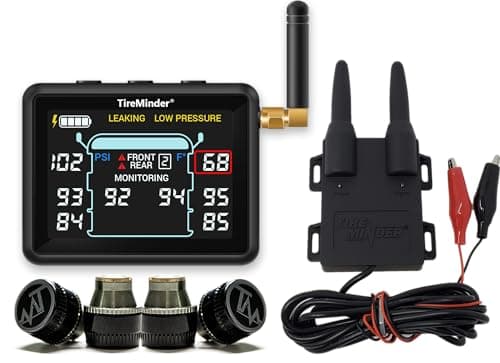 TireMinder i10 RV TPMS with 4 Transmitters Four transmitters and a dedicated monitor, which is exactly the count a tandem-axle travel trailer needs. The dedicated screen beats a phone app you have to keep awake. Top pick | A straightforward four-tire TPMS for a tandem-axle trailer | 7.5/ 10 | |
| 2 | 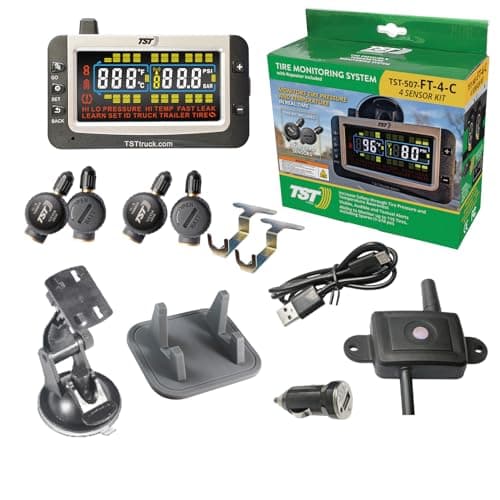 TST 507 TPMS with 4 Flow-Through Sensors and Color Display Flow-through sensors let you air up a tire without unscrewing anything, which is the difference between checking pressure weekly and meaning to. It needs metal valve stems. Best for adjusting pressure | Checking and adjusting pressure without removing the sensor | 7.9/ 10 | |
| 3 | 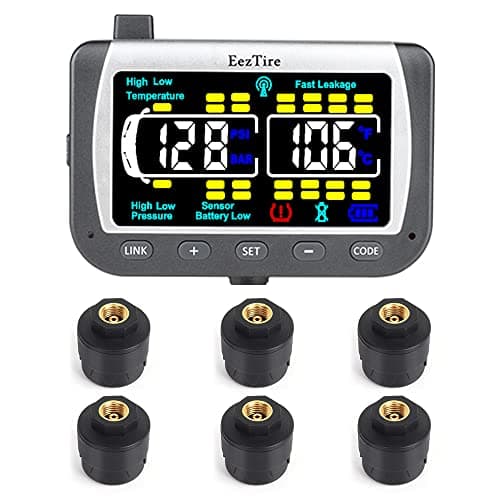 EEZTire TPMS6ATC with Color Monitor and 6 Sensors Six anti-theft sensors and a color monitor, which is the count that covers four trailer tires and two more — the spare being the one people wish they had monitored. Covers the spare too | Covering four trailer tires plus the spare and a dually | 7.9/ 10 | |
| 4 | 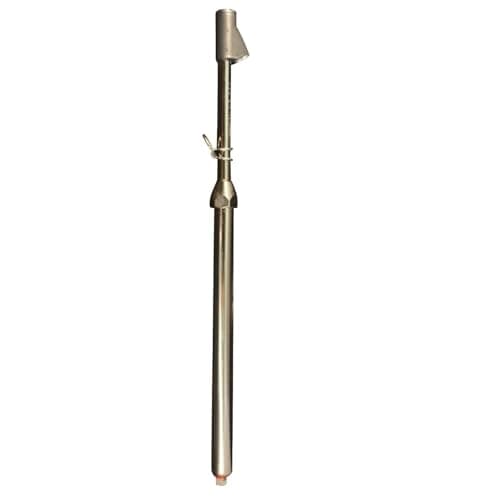 Milton S-986 Dual Head Tire Pressure Gauge, 10-160 psi Trailer tires often run 50-80 psi, which is past the top of a typical car gauge. This one reads to 160 psi and the dual head reaches an inner dually valve. You need this either way | Reading trailer tire pressure that a car gauge cannot | 9.6/ 10 |
Tap any row to jump to the full write-up. Prices come from Amazon and are read automatically — see each product below for the date.
The short answer
The framing of this as a versus question is slightly wrong, and it is worth saying so before going further: these two things measure different moments. A gauge measures one tire, once, when it is cold. A TPMS measures every tire, continuously, hot. Buying a TPMS does not excuse you from a gauge, and owning a gauge does not do what a TPMS does.
What is genuinely a decision is whether the TPMS is worth its price for how you tow. That is what this page is actually about.
Cold pressure: the pressure in a tire that has not been driven on for at least three hours, measured in shade. Every pressure specification on a trailer — the sidewall figure and the number on the trailer’s own placard — is a cold pressure. Measuring a hot tire and “correcting” it down is one of the most common ways people end up underinflated.
What each one actually does
| Job | Manual gauge | TPMS |
|---|---|---|
| Set cold pressure to the placard figure | Yes — this is its job | No, it only reports |
| Catch a slow leak overnight | Only if you check that morning | Yes, at the next power-up |
| Catch a puncture at 60 mph | No | Yes, within minutes |
| Watch temperature rise on a long climb | No | Yes |
| Detect a dragging brake or failing bearing | No | Indirectly — as heat on one tire |
| Monitor the spare | Only if you check it | Yes, on systems with a spare sensor |
| Accuracy of the absolute number | High on a good gauge | Good, but verify against a gauge |
| Cost | Low | Moderate to high |
Two rows carry most of the argument. “Catch a puncture at 60 mph” is the headline, but “watch temperature rise on a long climb” is the one experienced owners talk about, because temperature leads pressure as a failure signal. A tire that is running hotter than its three neighbors is telling you something before the pressure moves at all.
Why a trailer is a different case from a car
The case for monitoring on a travel trailer is much stronger than on the tow vehicle, for reasons that have nothing to do with the tires being worse.
You cannot feel it. A car tire going down changes the steering and the noise. A trailer tire going down, three or four axles behind you, behind a pickup with its own road noise, changes nothing you will notice — especially on a tandem axle where the other tire on that side takes the load. People drive for miles on a flat trailer tire and find out when the tread leaves it.
Trailer tires run closer to their limits. Special Trailer tires are designed for load rather than for grip or comfort, and they are routinely run at or near their maximum sidewall pressure because that is where their rated capacity is. ST vs LT trailer tires explains the difference, and the PSI guide covers why the sidewall figure is the number for an ST tire rather than a maximum to stay under.
A failure does real damage. A trailer tire coming apart at speed does not usually cause a crash, but the tread leaving the carcass flails into the wheel well and takes out underbelly, plumbing, wiring and sometimes the fender and sidewall. The repair bill for a blowout is frequently several times the cost of a monitoring system, which is the actual economic argument.
Age kills them before tread wear does. Most trailer tires are replaced on age, not tread, and they frequently fail while still looking fine. How long trailer tires last covers the date code and the replacement interval, and that is the part a TPMS cannot help with at all.
The common mistake
The honest trade on each side
Manual gauge only
- Cheap, accurate and nothing to fail or charge
- Sets cold pressure, which is the single highest-value thing you can do
- Works on the spare, the tow vehicle and anything else
- Blind to everything that happens after you pull away
- Only as good as the discipline to use it every trip
TPMS as well
- Catches slow leaks and punctures while you drive
- Temperature data flags a dragging brake or failing bearing
- Covers the spare on systems with a spare sensor
- Sensors, batteries and a monitor to maintain
- Cap-style sensors add weight at the valve and need valve stems in good condition
That last point deserves a line of its own because it catches people. Most RV systems use sensors that screw onto the valve stem in place of the cap. That adds mass at the end of a stem that is spinning at road speed, so rubber valve stems in poor condition are a genuine consideration — and some owners fit metal stems when they fit a TPMS. Flow-through sensors let you add air without removing the sensor, which is the practical difference between the systems on this page.
What to look for in a trailer TPMS
Enough sensors, including the spare. Four for a tandem axle, six if you want the spare and a dually tow vehicle covered. Counting the spare is not a luxury: a spare that has been slowly deflating in its carrier for two years is the classic way a blowout becomes a tow truck.
Flow-through or not. Flow-through sensors let you check and adjust pressure with the sensor in place. Non-flow-through means unscrewing a sensor to add air, which you will do less often than you should.
Signal reach to the back of the trailer. A 35 ft trailer puts the rear sensors a long way from a monitor on the dash, and metal in between. Systems offer a repeater or booster for this; on a long trailer, plan on needing it rather than hoping.
Alert thresholds you can set. The useful alerts are low pressure, high pressure, rapid pressure loss and high temperature. Being able to set them to your tires rather than accepting a generic default is what stops you ignoring the thing because it cries wolf.
Battery arrangement. Sensors run on small cells. Some are user replaceable, some are not, and the difference shows up in year three rather than in the review.
So which should you buy
If you tow a handful of weekends a year, close to home, on a single-axle trailer: a good gauge, used properly before every trip, genuinely covers most of the risk. Buy the gauge, learn the placard figure, and check all the tires and the spare cold.
If you tow long distances, in heat, on a tandem axle, or your trailer is worth protecting: fit a TPMS as well. The case is not that your tires are bad; it is that you cannot feel a trailer tire fail and the damage when one does is expensive. On this site’s rubric the TireMinder i10 is the straightforward four-tire choice, the TST 507 is the one to get if you want flow-through sensors you can inflate through, and the EEZTire six-sensor set is the one that covers the spare.
Whichever way you go, buy the gauge. Every TPMS wants verifying against one when you fit it, and the cold-pressure routine is the part that actually prevents failures rather than reporting them. The full TPMS roundup ranks the systems in detail, and the tire roundup covers what you should be monitoring in the first place.
What to remember
- They measure different moments: a gauge sets cold pressure, a TPMS watches hot pressure and temperature.
- A TPMS does not inflate anything. You still need a gauge, and you should verify the TPMS against one.
- The strongest argument for monitoring a trailer is that you cannot feel a trailer tire fail.
- Temperature leads pressure as a failure signal, and also flags a dragging brake or failing bearing.
- Count the spare. A spare that deflated in its carrier turns a blowout into a tow truck.
- On a long trailer, plan on a signal repeater rather than hoping the rear sensors reach.
- Neither tool helps with tire age, which is what actually ends most trailer tires.
How we compared them
We have not run these systems over a season. This comparison is a documented reading of each maker’s published specifications and alert thresholds, the current retailer listing data read automatically, the tire-safety guidance cited below, and what owners consistently report — stated as reporting rather than as our own testing. Pressure specifications for your own trailer come from its placard and the tire sidewall, not from us. Our method is on how we pick.
The picks in full
TireMinder i10 RV TPMS with 4 Transmitters
TireMinder · Best for a straightforward four-tire tpms for a tandem-axle trailer
Four transmitters and a dedicated monitor, which is exactly the count a tandem-axle travel trailer needs. The dedicated screen beats a phone app you have to keep awake.
Key specifications
- Transmitters
- 4 included
- Monitor
- Dedicated display
- Expandable
- Yes, additional transmitters
- Model
- i10
How it scored
- Sensor coverage (25%)7
- Display (25%)8
- Alerting (25%)8
- Battery life (15%)7
- Price for capability (10%)7
Weighted average of the figures above. We did not test this product — see how we pick.
What it does well
- Four sensors matches a tandem-axle trailer with no add-ons
- Dedicated monitor, not a phone app
- Established name in RV tire monitoring
What it is bad at
- Four sensors means no spare coverage without buying a fifth
- Monitor needs 12 V power routed to it
- Sensor batteries are a periodic chore
Price as of October 10, 2026. #ad How this is funded
TST 507 TPMS with 4 Flow-Through Sensors and Color Display
TST · Best for checking and adjusting pressure without removing the sensor
Flow-through sensors let you air up a tire without unscrewing anything, which is the difference between checking pressure weekly and meaning to. It needs metal valve stems.
Key specifications
- Sensors
- 4 flow-through
- Display
- Color monitor
- Requirement
- Metal valve stems required
- Series
- 507
How it scored
- Sensor coverage (25%)7
- Display (25%)9
- Alerting (25%)9
- Battery life (15%)7
- Price for capability (10%)6
Weighted average of the figures above. We did not test this product — see how we pick.
What it does well
- Air up without removing the sensor — the feature that changes behavior
- Clear color monitor
- Strong reputation among full-time RV owners
What it is bad at
- Metal valve stems required, which can mean a tire-shop visit first
- Most expensive TPMS here
- Flow-through sensors are taller and more exposed to curb damage
Price as of October 10, 2026. #ad How this is funded
EEZTire TPMS6ATC with Color Monitor and 6 Sensors
EEZTire · Best for covering four trailer tires plus the spare and a dually
Six anti-theft sensors and a color monitor, which is the count that covers four trailer tires and two more — the spare being the one people wish they had monitored.
Key specifications
- Sensors
- 6 anti-theft sensors
- Monitor
- Color display, real time
- Monitoring
- 24x7
- Model
- TPMS6ATC
How it scored
- Sensor coverage (25%)9
- Display (25%)8
- Alerting (25%)8
- Battery life (15%)7
- Price for capability (10%)6
Weighted average of the figures above. We did not test this product — see how we pick.
What it does well
- Six sensors covers trailer tires plus the spare
- Anti-theft collars on the sensors
- Color screen is readable in daylight
What it is bad at
- Expensive before you have added a repeater for a long trailer
- Monitor is bulky on a windshield
- Sensor batteries are user-replaceable, which also means user-forgettable
Price as of October 10, 2026. #ad How this is funded
Milton S-986 Dual Head Tire Pressure Gauge, 10-160 psi
Milton · Best for reading trailer tire pressure that a car gauge cannot
Trailer tires often run 50-80 psi, which is past the top of a typical car gauge. This one reads to 160 psi and the dual head reaches an inner dually valve.
Key specifications
- Range
- 10-160 psi
- Head
- Dual head chuck
- Type
- Straight foot, mechanical
- Model
- S-986
How it scored
- How often you use it (40%)10
- Build quality (25%)9
- Takes up little room (20%)9
- Price for capability (15%)10
Weighted average of the figures above. We did not test this product — see how we pick.
What it does well
- Range actually covers trailer tire pressures
- Dual head reaches awkward and inner valves
- Mechanical — no battery to die in a cold trailer
What it is bad at
- Analog scale is harder to read precisely than a digital gauge
- No calibration certificate
- Brass head is heavy in a pocket
Price as of October 10, 2026. #ad How this is funded
Common questions
Yes. A TPMS reports but cannot inflate, and you should verify its readings against a known-good gauge when you fit it. Setting cold pressure correctly remains a gauge job.
For long-distance or hot-weather towing, usually yes. You cannot feel a trailer tire going down, and one tread separation commonly costs several times what the system does.
Most do, and temperature is often the more useful signal — a tire hotter than its neighbors can mean a dragging brake, a failing bearing or a tire starting to fail. Make sure you can set a high-temperature alert.
They add mass at the end of the stem, which matters if the stems are aged. Inspect them when you fit sensors, and consider metal stems if the rubber ones are old.
Sources
- TireMinder published TPMS specifications and alert thresholds — read October 2026
- TST published 507 series TPMS specifications — read October 2026
- NHTSA tire safety information, including pressure and load guidance — read October 2026
- Tire and Rim Association load and inflation principles as published by tire makers — read October 2026