First-Trailer Essentials & Tires
The Best RV Tire Pressure Monitoring System
The one accessory that tells you about a problem before it becomes a blowout. Three systems, and the sensor-count question that decides which.
By Mike M. ·
How this page is funded: we earn a commission if you buy through our links, at no extra cost to you. It never changes which product we rank first. Prices come from Amazon and are read automatically — each one shows the date it was read. Full disclosure.
Quick picks
Scored on sensor coverage (25%), display (25%), alerting (25%), battery life (15%) and price (10%).
| # | Product | Best for | Score | Price |
|---|---|---|---|---|
| 1 | 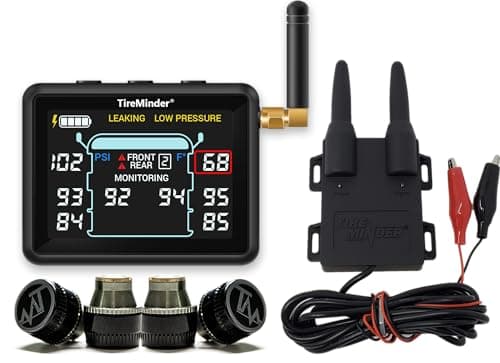 TireMinder i10 RV TPMS with 4 Transmitters Four transmitters and a dedicated monitor, which is exactly the count a tandem-axle travel trailer needs. The dedicated screen beats a phone app you have to keep awake. Top pick | A straightforward four-tire TPMS for a tandem-axle trailer | 7.5/ 10 | |
| 2 | 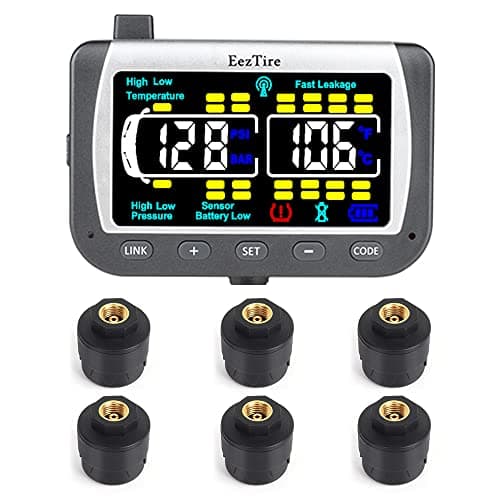 EEZTire TPMS6ATC with Color Monitor and 6 Sensors Six anti-theft sensors and a color monitor, which is the count that covers four trailer tires and two more — the spare being the one people wish they had monitored. Covers the spare | Covering four trailer tires plus the spare and a dually | 7.9/ 10 | |
| 3 | 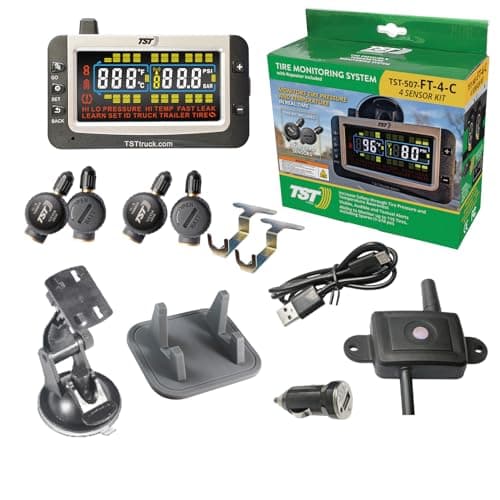 TST 507 TPMS with 4 Flow-Through Sensors and Color Display Flow-through sensors let you air up a tire without unscrewing anything, which is the difference between checking pressure weekly and meaning to. It needs metal valve stems. Flow-through sensors | Checking and adjusting pressure without removing the sensor | 7.9/ 10 | |
| 4 | 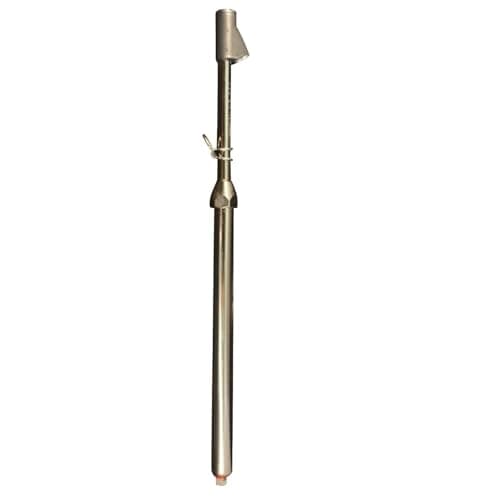 Milton S-986 Dual Head Tire Pressure Gauge, 10-160 psi Trailer tires often run 50-80 psi, which is past the top of a typical car gauge. This one reads to 160 psi and the dual head reaches an inner dually valve. | Reading trailer tire pressure that a car gauge cannot | 9.6/ 10 |
Tap any row to jump to the full write-up. Prices come from Amazon and are read automatically — see each product below for the date.
The short answer
Here is why this is one of the few accessories we would call genuinely important. A trailer tire losing pressure gives the driver no feedback. There is no vibration through the wheel, no pull, no noise over road noise. The tire runs underinflated, builds heat, and comes apart — usually taking fender skirting, wiring and sometimes the side wall of the trailer with it.
A monitor tells you at the moment the pressure starts falling, when the fix is pulling over calmly.
Sensor count: do the arithmetic first
| Setup | Sensors needed |
|---|---|
| Single-axle trailer | 2 |
| Single-axle trailer plus spare | 3 |
| Tandem-axle trailer | 4 |
| Tandem-axle trailer plus spare | 5 |
| Tandem trailer plus tow vehicle | 8 |
| Tandem trailer plus dually tow vehicle | 10 |
Most travel trailer owners want four or five. Buying a four-sensor kit and then wanting the spare monitored means buying a fifth sensor separately, which is usually fine but worth knowing before you order.
Monitoring the spare is more useful than it sounds. A spare that has been flat for a year is a spare that does not help you on the day you need it, and nobody checks it.
Cap sensors or flow-through
Cap sensors
- Screw onto the valve stem in place of the cap
- Work with rubber or metal valve stems
- Must be unscrewed to add air
- Lower profile, less exposed to curb damage
Flow-through sensors
- Have a pass-through so you can air up without removing them
- Require metal valve stems — rubber stems flex too much
- Taller, so more exposed
- Change behavior: you actually check pressure more often
The flow-through argument is behavioral and it is a real one. If adding air means unscrewing a sensor, remembering the position, airing up and re-fitting, you do it less often. If it means putting a chuck on the sensor, you do it more.
The catch is the metal valve stem requirement. Many trailer wheels have rubber stems, and a flow-through sensor on a rubber stem flexes under centrifugal load and can leak or tear the stem. Changing to metal stems means a tire shop visit, which should be priced into the decision.
The common mistake
The monitor
A dedicated monitor sits on the dash or windshield, powered from 12 V, and shows all tires at once. It is always on and needs nothing from you. The downside is another thing on the dash and a cable to route.
A phone app saves the dash space and gives you a bigger screen. The downside is needing the phone paired and awake, and Bluetooth range from the back of a 35 ft trailer to the cab is marginal without a repeater.
For a long trailer, a signal repeater is often necessary whichever you choose. Budget for one if your trailer is over about 30 ft, and check whether the kit includes it.
What good alerting looks like
Pressure alone is not enough. The systems worth buying alert on:
- Low pressure, with a threshold you set per tire.
- High pressure, which rises with heat and indicates a problem if it goes far enough.
- High temperature, which is often the first signal of a failing bearing or a dragging brake — and that is a fault a pressure reading alone never shows.
- Rapid pressure loss, distinguished from slow loss, because the responses are different.
The temperature alert is underrated. A wheel bearing that is about to fail heats up long before anything else happens, and a TPMS sensor on that wheel sees it.
Batteries and maintenance
Sensors run on small coin cells, typically a year or two. Replaceable batteries are preferable to sealed sensors, and the better systems alert when a sensor battery is low.
Two habits: note the date you changed them, and keep spares. A sensor with a dead battery reads nothing, and a system you have stopped trusting is a system you stop looking at.
The verdict
Buy the four-sensor system with a dedicated monitor if you have a tandem-axle trailer and want the straightforward answer. Buy the six-sensor option if you want the spare and the tow vehicle covered. Buy the flow-through system if you have metal valve stems or are willing to fit them, because being able to air up without removing the sensor genuinely changes how often you check.
What to remember
- A trailer tire going down gives the driver no feedback until it comes apart.
- Count your tires: four for a tandem axle, five to include the spare.
- Flow-through sensors need metal valve stems. Rubber stems flex too much.
- Temperature alerts catch failing bearings, which pressure alone never shows.
- A trailer over about 30 ft often needs a signal repeater.
The picks in full
TireMinder i10 RV TPMS with 4 Transmitters
TireMinder · Best for a straightforward four-tire tpms for a tandem-axle trailer
Four transmitters and a dedicated monitor, which is exactly the count a tandem-axle travel trailer needs. The dedicated screen beats a phone app you have to keep awake.
Key specifications
- Transmitters
- 4 included
- Monitor
- Dedicated display
- Expandable
- Yes, additional transmitters
- Model
- i10
How it scored
- Sensor coverage (25%)7
- Display (25%)8
- Alerting (25%)8
- Battery life (15%)7
- Price for capability (10%)7
Weighted average of the figures above. We did not test this product — see how we pick.
What it does well
- Four sensors matches a tandem-axle trailer with no add-ons
- Dedicated monitor, not a phone app
- Established name in RV tire monitoring
What it is bad at
- Four sensors means no spare coverage without buying a fifth
- Monitor needs 12 V power routed to it
- Sensor batteries are a periodic chore
Price as of October 5, 2026. #ad How this is funded
EEZTire TPMS6ATC with Color Monitor and 6 Sensors
EEZTire · Best for covering four trailer tires plus the spare and a dually
Six anti-theft sensors and a color monitor, which is the count that covers four trailer tires and two more — the spare being the one people wish they had monitored.
Key specifications
- Sensors
- 6 anti-theft sensors
- Monitor
- Color display, real time
- Monitoring
- 24x7
- Model
- TPMS6ATC
How it scored
- Sensor coverage (25%)9
- Display (25%)8
- Alerting (25%)8
- Battery life (15%)7
- Price for capability (10%)6
Weighted average of the figures above. We did not test this product — see how we pick.
What it does well
- Six sensors covers trailer tires plus the spare
- Anti-theft collars on the sensors
- Color screen is readable in daylight
What it is bad at
- Expensive before you have added a repeater for a long trailer
- Monitor is bulky on a windshield
- Sensor batteries are user-replaceable, which also means user-forgettable
Price as of October 5, 2026. #ad How this is funded
TST 507 TPMS with 4 Flow-Through Sensors and Color Display
TST · Best for checking and adjusting pressure without removing the sensor
Flow-through sensors let you air up a tire without unscrewing anything, which is the difference between checking pressure weekly and meaning to. It needs metal valve stems.
Key specifications
- Sensors
- 4 flow-through
- Display
- Color monitor
- Requirement
- Metal valve stems required
- Series
- 507
How it scored
- Sensor coverage (25%)7
- Display (25%)9
- Alerting (25%)9
- Battery life (15%)7
- Price for capability (10%)6
Weighted average of the figures above. We did not test this product — see how we pick.
What it does well
- Air up without removing the sensor — the feature that changes behavior
- Clear color monitor
- Strong reputation among full-time RV owners
What it is bad at
- Metal valve stems required, which can mean a tire-shop visit first
- Most expensive TPMS here
- Flow-through sensors are taller and more exposed to curb damage
Price as of October 5, 2026. #ad How this is funded
Milton S-986 Dual Head Tire Pressure Gauge, 10-160 psi
Milton · Best for reading trailer tire pressure that a car gauge cannot
Trailer tires often run 50-80 psi, which is past the top of a typical car gauge. This one reads to 160 psi and the dual head reaches an inner dually valve.
Key specifications
- Range
- 10-160 psi
- Head
- Dual head chuck
- Type
- Straight foot, mechanical
- Model
- S-986
How it scored
- How often you use it (40%)10
- Build quality (25%)9
- Takes up little room (20%)9
- Price for capability (15%)10
Weighted average of the figures above. We did not test this product — see how we pick.
What it does well
- Range actually covers trailer tire pressures
- Dual head reaches awkward and inner valves
- Mechanical — no battery to die in a cold trailer
What it is bad at
- Analog scale is harder to read precisely than a digital gauge
- No calibration certificate
- Brass head is heavy in a pocket
Price as of October 5, 2026. #ad How this is funded
Common questions
Yes. A trailer tire losing pressure gives the driver no feedback, so the first sign is usually the tire coming apart. The temperature alerts can also catch a failing bearing.
One per tire monitored: four for a tandem axle, five with the spare, eight if you include the tow vehicle. Kits come in fours and sixes.
Flow-through sensors do — their extra length and mass on a rubber stem is a leak and failure risk at speed. Cap sensors are lighter and work with rubber stems.
Often, on a trailer over about 30 ft — the sensors are low-power and the rear-axle signal to the cab is marginal. Check whether one is included.
Sources
- FMVSS 109 — new pneumatic and certain specialty tires — read October 2026
- FMVSS 139 — new pneumatic radial tires for light vehicles — read October 2026
- Tire Industry Association — read October 2026