First-Trailer Essentials & Tires
How Long Do Travel Trailer Tires Last?
Three to five years, and tread depth has almost nothing to do with it. Here is what actually kills them and what slows it down.
By Mike M. ·
How this page is funded: we earn a commission if you buy through our links, at no extra cost to you. It never changes which product we rank first. Prices come from Amazon and are read automatically — each one shows the date it was read. Full disclosure.
Quick picks
The gear that extends tire life and tells you when something is wrong.
| # | Product | Best for | Score | Price |
|---|---|---|---|---|
| 1 | 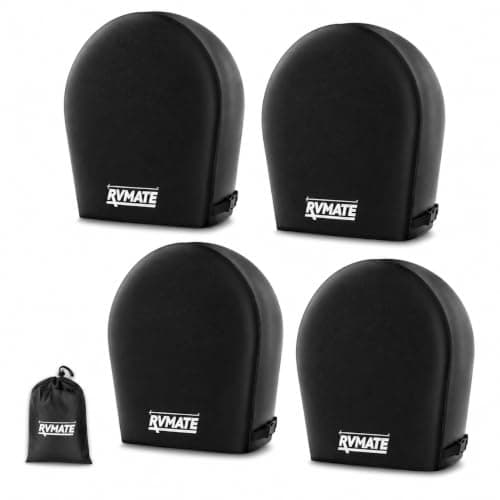 RVMATE RV Tire Covers, 4-Pack, Fits 27-29 in Tires Trailer tires usually die of age and sun rather than tread wear, so covering them during storage is the cheapest life extension available. Four covers, one purchase. Cheapest life extension | Slowing the UV aging that kills trailer tires | 7.9/ 10 | |
| 2 | 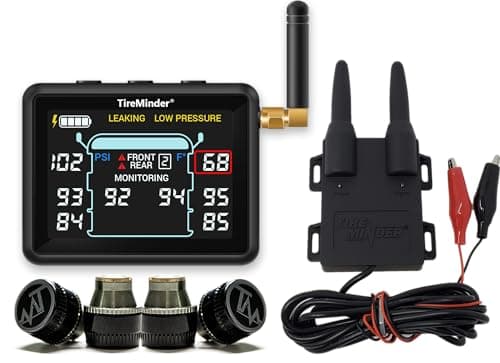 TireMinder i10 RV TPMS with 4 Transmitters Four transmitters and a dedicated monitor, which is exactly the count a tandem-axle travel trailer needs. The dedicated screen beats a phone app you have to keep awake. | A straightforward four-tire TPMS for a tandem-axle trailer | 7.5/ 10 | |
| 3 | 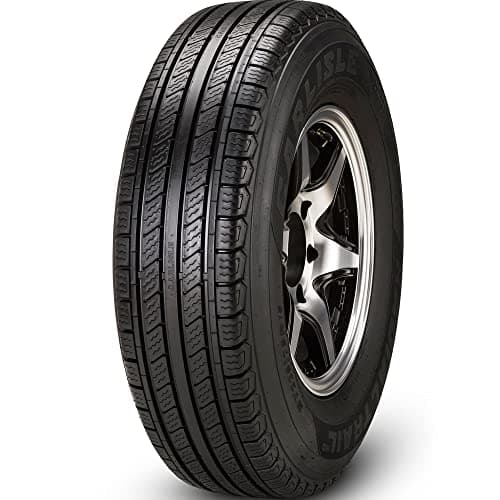 Carlisle Radial Trail HD Trailer Tire, ST205/75R15, 107M A genuine special-trailer radial in the size most single- and tandem-axle travel trailers wear, with a load index and speed symbol printed on the sidewall you can actually check. | The most common travel trailer size, at a sensible price | 8.0/ 10 | |
| 4 | 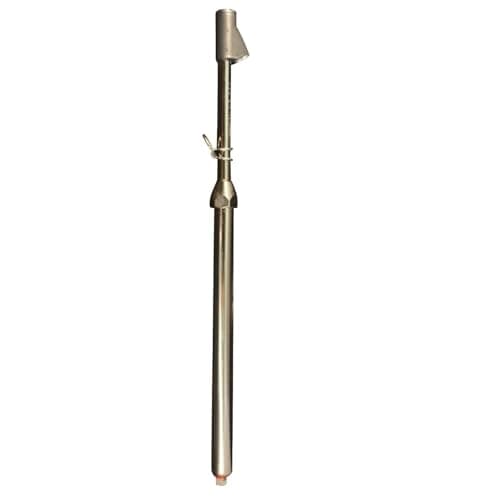 Milton S-986 Dual Head Tire Pressure Gauge, 10-160 psi Trailer tires often run 50-80 psi, which is past the top of a typical car gauge. This one reads to 160 psi and the dual head reaches an inner dually valve. | Reading trailer tire pressure that a car gauge cannot | 9.6/ 10 |
Tap any row to jump to the full write-up. Prices come from Amazon and are read automatically — see each product below for the date.
The short answer
This surprises people who come to trailers from cars, where tires wear out. A trailer tire with 80% of its tread left can be dangerously old, and it will look fine right up until it comes apart.
Why age rather than miles
A typical travel trailer covers a few thousand miles a year. The rest of the time it sits — in a driveway, a storage lot, or a seasonal site — with the tires exposed to sunlight.
Two processes work on the rubber. UV breaks down the polymer chains at the surface, which is what produces the fine cracking you see on an old sidewall. Ozone attacks the rubber chemically, which does the same thing from a different direction. Both act on the sidewall, which is the part doing structural work and the part that fails.
Tread depth measures abrasion, which is a function of miles. It tells you almost nothing about the condition of the sidewall, which is a function of years.
Reading the date code
Find the DOT code molded into the sidewall. It is a long alphanumeric string, and the last four digits are the week and year of manufacture.
| Code ends | Means | Replace by |
|---|---|---|
| 2225 | 22nd week of 2025 | 2028-2030 |
| 0824 | 8th week of 2024 | 2027-2029 |
| 4521 | 45th week of 2021 | Already past — replace now |
Two practical notes. The code may be on only one side of the tire, so check both. And check the date on tires you are buying, not just on the ones you are replacing — a tire that has sat in a warehouse for two years has already used two years of its life.
The common mistake
What shortens tire life
Sunlight. The dominant factor. A trailer parked south-facing in Arizona ages tires far faster than one in a covered storage unit.
Underinflation. Sidewall flex generates heat, and heat accelerates the chemical degradation. Running 15 psi low on hot interstates is how a three-year tire fails at two. The psi guide.
Overloading. Running near or past the tire’s rated capacity, which is what happens when somebody fitted a lower load range than the placard specifies.
Sitting still, in one position. A tire supporting weight in one spot for months takes a flat spot and the sidewall is under constant local stress. Moving the trailer occasionally helps, and taking weight off the tires for long-term storage helps more.
Heat and speed. Heat build-up rises sharply with speed, and the sidewall speed symbol is a limit.
What extends it
- Covers. The cheapest and most effective single measure, because it addresses UV directly. Four covers cost less than one tire.
- Correct pressure, cold, every trip. Free.
- Correct load range. Match the placard when you replace.
- Moving it occasionally. Even a few feet changes the loaded spot.
- Shade. Where you have the option, park out of direct sun.
What does not help, despite being widely sold: tire dressings and protectants. Many contain petroleum distillates that leach the anti-ozonant compounds out of the rubber, which accelerates exactly what you were trying to prevent. If you use anything, use a water-based product, and mostly just use covers.
What to check, twice a season
Date codes, so you know where you are in the window.
Sidewall cracking. Fine surface crazing is age showing. Cracks deep enough to catch a fingernail in are a tire to replace now regardless of date.
Uneven wear. Wear concentrated on one edge points at an axle or alignment problem rather than a tire problem. What inside-edge wear means.
Bulges. A bulge in the sidewall is internal structural damage, usually from a curb or a pothole impact. Replace immediately; this one does not wait.
What to remember
- Three to five years from the date code, regardless of tread depth.
- UV and ozone degrade the sidewall; tread depth measures something else entirely.
- Last four digits of the DOT code are the week and year of manufacture.
- Check the date on tires you are buying, not just the ones you are replacing.
- Covers are the cheapest effective measure. Petroleum-based dressings make it worse.
The picks in full
RVMATE RV Tire Covers, 4-Pack, Fits 27-29 in Tires
RVMATE · Best for slowing the uv aging that kills trailer tires
Trailer tires usually die of age and sun rather than tread wear, so covering them during storage is the cheapest life extension available. Four covers, one purchase.
Key specifications
- Pack
- 4 covers
- Fits
- 27-29 in diameter tires
- Material
- Waterproof fabric
- Use
- Storage and seasonal parking
How it scored
- How often you use it (40%)8
- Build quality (25%)7
- Takes up little room (20%)7
- Price for capability (15%)10
Weighted average of the figures above. We did not test this product — see how we pick.
What it does well
- Directly addresses UV, the usual cause of trailer tire failure
- Four covers for less than one tire costs
- Quick to fit and remove
What it is bad at
- Measure your tire diameter — 27-29 in does not fit every trailer
- Fabric covers can trap moisture if fitted wet
- They flap and wear in constant wind
Price as of October 5, 2026. #ad How this is funded
TireMinder i10 RV TPMS with 4 Transmitters
TireMinder · Best for a straightforward four-tire tpms for a tandem-axle trailer
Four transmitters and a dedicated monitor, which is exactly the count a tandem-axle travel trailer needs. The dedicated screen beats a phone app you have to keep awake.
Key specifications
- Transmitters
- 4 included
- Monitor
- Dedicated display
- Expandable
- Yes, additional transmitters
- Model
- i10
How it scored
- Sensor coverage (25%)7
- Display (25%)8
- Alerting (25%)8
- Battery life (15%)7
- Price for capability (10%)7
Weighted average of the figures above. We did not test this product — see how we pick.
What it does well
- Four sensors matches a tandem-axle trailer with no add-ons
- Dedicated monitor, not a phone app
- Established name in RV tire monitoring
What it is bad at
- Four sensors means no spare coverage without buying a fifth
- Monitor needs 12 V power routed to it
- Sensor batteries are a periodic chore
Price as of October 5, 2026. #ad How this is funded
Carlisle Radial Trail HD Trailer Tire, ST205/75R15, 107M
Carlisle · Best for the most common travel trailer size, at a sensible price
A genuine special-trailer radial in the size most single- and tandem-axle travel trailers wear, with a load index and speed symbol printed on the sidewall you can actually check.
Key specifications
- Size
- ST205/75R15
- Load index / speed
- 107M (about 2,149 lb per tire, 81 mph)
- Construction
- 8-ply rating radial
- Type
- ST — special trailer
Capacity figures read from FMVSS 109 — new pneumatic tires (load and marking requirements), October 2026.
How it scored
- Load rating (30%)8
- speed (20%)7
- Build quality (25%)8
- Size availability (15%)9
- Price for capability (10%)9
Weighted average of the figures above. We did not test this product — see how we pick.
What it does well
- Correct ST construction, with stiffer sidewalls than a passenger tire
- Widely stocked, so a roadside replacement is findable
- Load rating suits most 5,000-7,000 lb tandem-axle trailers
What it is bad at
- M speed symbol means 81 mph — not a license to tow at 80
- Trailer tires age out before they wear out; the date code matters more than the tread
- Sold individually, so a set is four purchases
Price as of October 5, 2026. #ad How this is funded
Milton S-986 Dual Head Tire Pressure Gauge, 10-160 psi
Milton · Best for reading trailer tire pressure that a car gauge cannot
Trailer tires often run 50-80 psi, which is past the top of a typical car gauge. This one reads to 160 psi and the dual head reaches an inner dually valve.
Key specifications
- Range
- 10-160 psi
- Head
- Dual head chuck
- Type
- Straight foot, mechanical
- Model
- S-986
How it scored
- How often you use it (40%)10
- Build quality (25%)9
- Takes up little room (20%)9
- Price for capability (15%)10
Weighted average of the figures above. We did not test this product — see how we pick.
What it does well
- Range actually covers trailer tire pressures
- Dual head reaches awkward and inner valves
- Mechanical — no battery to die in a cold trailer
What it is bad at
- Analog scale is harder to read precisely than a digital gauge
- No calibration certificate
- Brass head is heavy in a pocket
Price as of October 5, 2026. #ad How this is funded
Common questions
Every three to five years from the date code, regardless of tread. Sidewall degradation from UV and ozone ends their life before tread wear does.
In the DOT code on the sidewall — the last four digits are week and year, so 2225 is the 22nd week of 2025. It may only be on one side, so check both.
Yes, and they are the cheapest effective measure — UV degradation of the sidewall is the dominant failure mechanism, and covers address it directly.
Avoid petroleum-based ones — many contain distillates that leach anti-ozonant compounds out of the rubber, accelerating the degradation. Water-based is acceptable; covers work better.
Sources
- FMVSS 109 — new pneumatic and certain specialty tires — read October 2026
- FMVSS 139 — new pneumatic radial tires for light vehicles — read October 2026
- Tire Industry Association — read October 2026