Towing Setup & Capacity
The Best Electric Tongue Jack
Any of these will raise the front of your trailer. What separates them is the published rating, how much of it the maker will commit to in writing, and whether you ever have to run a wire.
By Mike M. ·
How this page is funded: we earn a commission if you buy through our links, at no extra cost to you. It never changes which product we rank first. Prices come from Amazon and are read automatically — each one shows the date it was read. Full disclosure.
Top pick
Our pick on this page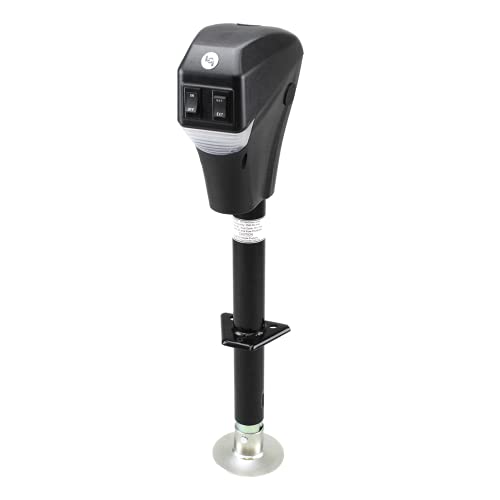
Lippert Power Tongue Jack, 3,500 lb, 285318
The A-frame jack a large share of travel trailers leave the factory with, bought as a part rather than a mystery. Lippert publishes every figure, and a replacement is on a shelf in every RV town in the country.
$259.95 15% off
Price as of November 18, 2026. #ad How this is funded
Read the full write-up or compare it with the rest below.
Quick picks
Scored on the published tongue-jack rubric - rated capacity (30%), lift range (20%), install effort (20%), build quality (20%) and price for capability (10%). Where a maker publishes no specification sheet we score build down for the absence rather than assuming a number. Every jack here was confirmed currently available before it was featured, and prices move, so check the current figure on the card.
| # | Product | Best for | Score | Price |
|---|---|---|---|---|
| 1 | Lippert Power Tongue Jack, 3,500 lb, 285318 The A-frame jack a large share of travel trailers leave the factory with, bought as a part rather than a mystery. Lippert publishes every figure, and a replacement is on a shelf in every RV town in the country. Top pick | Most travel trailers, and the jack the factory probably fitted | 9.3/10 | $219.95Lippert Power Tongue Jack on Amazon
|
| 2 | 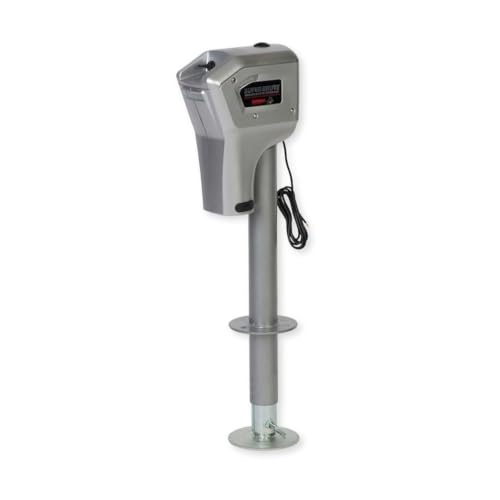 Husky Towing Super Brute Electric Tongue Jack, 5,000 lb, 82022 The highest rating here by 1,000 lb, with a wireless remote — which turns hitching from a two-person job into a one-person job. Best for a heavy tongue | A heavy tongue, or anyone who wants to work the jack from the driver's seat | 9.2/10 | |
| 3 | 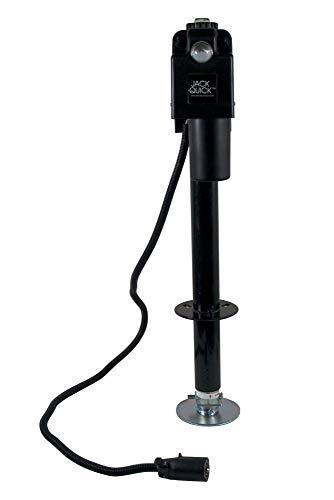 Quick Products JQ-3500B-7P Power A-Frame Tongue Jack with 7-Way Plug, 3,650 lb Draws its power through the 7-way plug instead of a hardwired battery lead, which removes the only genuinely awkward part of fitting an electric tongue jack. Easiest install | Swapping a dead jack without running a single wire | 9.1/10 | |
| 4 | 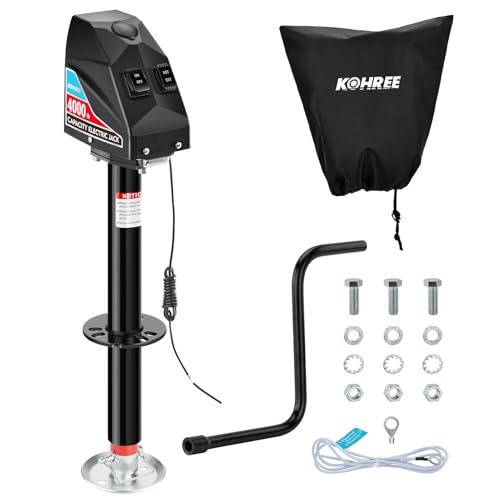 Kohree Electric Trailer Tongue Jack, 4,000 lb, A-Frame Roughly half the price of the name brands with a higher published rating and more travel than either, which is the trade every budget jack offers: better numbers, no spec sheet behind them. Budget pick | The cheapest way to stop cranking by hand | 9.1/10 | $103.99Kohree Electric Trailer Tongue on Amazon
|
| 5 | 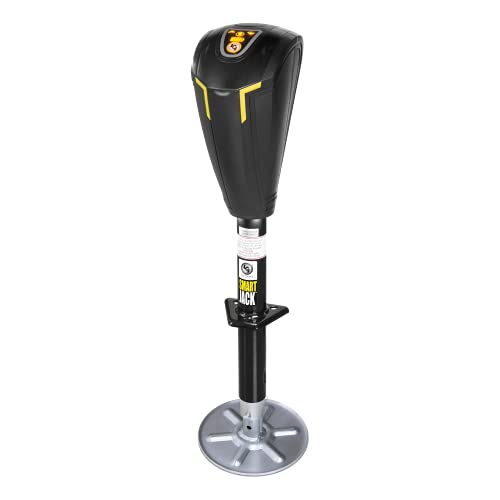 Lippert Smart Jack One-Touch Power Tongue Jack, 643589 The 3,500 lb Lippert with a memory: it learns your hitch height and returns to it at one touch, which is a real convenience and a real premium for the same capacity. Most automated | Hitching and unhitching on the same driveway every week | 9.0/10 |
Tap any row to jump to the full write-up. Prices come from Amazon and are read automatically — see each product below for the date.
The short answer
The tongue jack is the part of the trailer you use more than anything else. It lifts the coupler off the ball, it holds the front of the trailer up while you are parked, and it is how you get the trailer level front-to-back before you ever touch a leveling block. On a new travel trailer it is usually already electric. On an older one, a utility trailer, or a trailer whose original jack has died, you are cranking a handle 18 inches up and 18 inches down every single time you hitch — which is the entire reason this is a popular upgrade.
It is also a category where the marketing numbers run well ahead of what anybody will put in writing. Two of the five jacks here come with a full published specification table. One comes with a manual for the product family rather than the exact model. Two publish a capacity on the retail listing and nothing else. That gap is the most useful thing to understand before you spend the money, and it is what our rubric is weighted to expose.
Tongue jack vs stabilizer jack: A tongue jack bolts to the A-frame at the front of the trailer and lifts the whole front end — it carries the tongue weight, which on a travel trailer is usually 10–15% of the loaded trailer weight. A stabilizer jack is one of the four scissor jacks near the corners, and it is not a lifting jack: it stops the trailer rocking once the trailer is already level and on its wheels. Confusing the two is the most common mistake in this corner of the catalog. The difference, with what each one is rated for, is worth two minutes before you buy either.
What actually decides this
Rated capacity against your real tongue weight, not your trailer weight. This carries 30% of the rubric because it is the only specification with a safety margin attached. A tongue jack is rated for the vertical load it will lift, and the vertical load is the tongue weight — not the trailer weight. A 7,000 lb travel trailer with a tongue weight of 13% puts about 910 lb on the jack, which a 3,500 lb jack handles with a large margin. The trouble comes from the other direction: people buy a jack because the number on the box is bigger than they need, and a 5,000 lb jack on a 600 lb tongue is money spent on nothing. Get the real number first. Our tongue weight calculator will get you a working figure, and the tongue weight scale roundup covers how to measure it properly.
Lift, and where you are going to park. Eighteen inches of stroke is the standard, and it is enough for a level driveway and a level site. It gets tight when the site slopes away from the tow vehicle, when the truck is lifted, or when you are putting blocks under the jack foot and losing stroke to them. Four of these five publish 18 in; the Kohree listing claims 22. If you park on anything but flat concrete, the extra travel is worth more than the extra capacity.
Whether you have to run a wire. This is the part that stops people. A conventional electric tongue jack needs a fused 12 V feed from the trailer battery, which means crimping a ring terminal, routing a lead along the A-frame and fitting an inline fuse. It is an hour with the right crimper and an afternoon with the wrong one. The Quick Products 7-way version sidesteps it entirely by drawing power through the trailer plug, which is the single biggest install difference in the category and the reason it scores a 9 on install effort despite being the lightest-built jack here.
Amp draw, and the battery it comes out of. Lippert publishes 30 amps for both of its jacks. That is a serious draw — more than most trailer 12 V circuits see all day — and it comes out of a single Group 24 or Group 27 battery that may have been sitting since October. A tired battery raises a trailer slowly, then not at all. This is why every jack here has a manual crank override, and why the override is not a feature so much as the thing that gets you home.
What the maker publishes. Weighted into build quality, and the reason the ranking does not simply follow the capacity numbers. Lippert publishes capacity, stroke, retracted height, extended height, amp draw and footplate diameter for the 285318. Husky publishes no downloadable sheet for the 82022, and at least one third-party video review quotes a lift figure that disagrees with the retail listings — so we print 18 in as approximate rather than as fact. Kohree publishes the highest capacity and the longest lift on this page, and nothing at all behind either. You are not buying the number; you are buying whoever stands behind it.
| Jack | Capacity | Lift | Install | Published by |
|---|---|---|---|---|
| Lippert 285318 | 3,500 lb | 18 in | Bolt-on, 12 V feed required | Lippert, full spec table |
| Husky Super Brute 82022 | 5,000 lb | 18 in (approx) | Bolt-on, 12 V feed + remote | Retail listing only |
| Quick Products JQ-3500B-7P | 3,650 lb | 18 in | Bolt-on, powered via 7-way | Manual for the JQ-3500B family |
| Kohree 4,000 lb | 4,000 lb (listed) | 22 in (listed) | Bolt-on, 12 V feed required | Retail listing only |
| Lippert Smart Jack 643589 | 3,500 lb | 18 in | Bolt-on, 12 V feed + calibration | Lippert, full spec table |
The five picks, and who each one is for
Lippert 285318 — top pick. There is a reason this jack is on so many travel trailers: it is the sensible middle of every specification and Lippert publishes all of them. Three thousand five hundred pounds of lift capacity, 18 inches of stroke, 10-3/4 in retracted and 28-3/4 in extended, 30 amps of draw, a 5-3/8 in footplate, four integrated LEDs lighting the ball and coupler, a hand crank override, bolt-on A-frame mounting. If you are replacing a factory jack, this is very likely the same part. The honest cons: 3,500 lb is the standard rating rather than a generous one, so there is no headroom if you move up to a bigger trailer; there is no weather cover in the box, and the motor housing is the part that dies first on a jack left uncovered through a winter; the hand crank is slow going — 18 inches by hand is a real arm workout, and you will do it the one time the battery is flat; and 30 amps is a meaningful draw on a battery that has been sitting.
Husky Super Brute 82022 — best for a heavy tongue. Five thousand pounds of rated capacity, 1,000 lb more than anything else here, with a wireless remote and three-sided LED lighting. The remote is the part worth paying for and it has nothing to do with laziness: it means you can raise and lower the coupler while standing where you can actually see the ball, which turns a two-person hitch-up into a one-person one. If your loaded tongue weight is up near 1,000 lb, or you tow something heavier than a travel trailer as well, the margin is real. The honest cons: Husky publishes no downloadable spec sheet we could check the retailer figures against, and third-party reviews quote a different lift travel, so treat 18 in as approximate; it costs half again what the Lippert does for capacity most travel trailers will never use; the remote is one more thing with a battery in it and one more thing to lose; and it is the heaviest unit here to hold in place while you start the bolts.
Quick Products JQ-3500B-7P — easiest install. This is the one to buy if the wiring is what has stopped you. It draws its power through the trailer’s 7-way plug rather than a hardwired battery lead, so fitting it is four bolts and a plug — no crimping, no inline fuse, no routing a lead down the A-frame. It is also rated slightly higher than the 3,500 lb standard, at 3,650 lb, for less money than either Lippert, and it arrives with a weatherproof cover, a bubble leveling cap and a manual crank override in the box. The honest cons are specific and you need to read them: powering the jack through the 7-way only works while the tow vehicle is connected and its circuit can actually supply the current, so once you unhitch and the truck drives away you are on the hand crank until it comes back; the published figures come from the manual for the JQ-3500B family rather than a sheet specific to the -7P; construction is lighter-duty than the Lippert or the Husky, with a one-year warranty; and some retailers list this model as discontinued, so availability moves.
Kohree 4,000 lb A-frame — budget pick. Roughly half the price of the name brands, with a listed 4,000 lb capacity and a listed 22 inches of lift — better numbers on both counts than anything else on this page — plus a manual crank handle, a weatherproof cover and the wiring included. If the choice in front of you is this jack or carrying on with a hand crank, take this jack. The honest cons are why it does not rank higher: Kohree publishes no engineering specification sheet, so the 4,000 lb and 22 in figures rest on the retail listing alone, and we have scored build quality down for that absence rather than assuming the numbers are wrong or right; there is no dealer network, so a failure out of warranty means buying another jack rather than a motor; there is no remote and the lighting is a single work lamp; and this is the component holding the front of your trailer off the ground, which is the last place we would choose to save money if the budget stretches.
Lippert Smart Jack 643589 — most automated. The same 3,500 lb, 18 in Lippert with an auto-hitch memory: it learns the height at which your coupler clears your ball and returns to it at one touch. On a trailer you hitch and unhitch most weekends on the same driveway, that is a genuine convenience, and the 9-inch footpad spreads the load far better than the 5-3/8 in plate on the standard jack — which matters on gravel, where a small foot sinks. Backlit controls and a battery indicator too. It ranks last here for one honest reason: it is about a third more money than the 285318 for exactly the same capacity and exactly the same travel. You are buying convenience, not capability. The other cons: more electronics living outdoors on the front of a trailer, and a memory function that is one more thing to recalibrate; it is the heaviest of the Lippert-family options to bolt on; and it has no remote at a price where the Husky includes one.
The common mistake
Fitting one, and the two things that go wrong
An electric tongue jack is four bolts through the A-frame bracket and a 12 V feed. The bolts are the easy half: the new jack normally uses the existing holes, and if it does not, you are drilling the A-frame, which is the point at which most people decide the matching replacement was worth paying for. Measure the bracket spacing and the post diameter before you order — the Quick Products post is 2-1/4 in, and not every A-frame bracket takes every post.
The feed is where the job actually lives. The jack wants a fused connection to the trailer battery, sized for a motor that can pull 30 amps, which means proper gauge wire and an inline fuse at the battery end rather than a splice into the nearest convenient circuit. Running it off the running-light circuit is the thing not to improvise; the one jack here designed to work that way is designed for it, and the others are not. If you are not comfortable with that, the 7-way jack is a legitimate answer rather than a compromise.
Then there is the part nobody puts in the instructions: cover it. A tongue jack sits at the very front of the trailer, unshielded, taking road spray all summer and salt all winter, and the motor housing at the top is the part that fails. Two of the jacks here ship with a cover. For the others, a cover is the cheapest insurance in this project. The same logic applies at the bottom of the post — a jack foot parked on dirt sinks, and a jack pad under the foot is a few dollars against a jack that has twisted itself out of line.
What to remember
- The jack lifts the tongue weight, not the trailer weight. Weigh the tongue first.
- Eighteen inches of lift is the standard. Twenty-two helps on a sloped site.
- Two of these five makers publish a full spec table. Three do not.
- Lippert publishes 30 amps of draw, which is a lot to ask of a battery that has been sitting.
- Every one of these has a manual crank override, and you will use it at least once.
- The 7-way jack needs the tow vehicle connected to work under power.
- A tongue jack is not a stabilizer jack and will not stop the trailer rocking.
- Cover the motor housing and put a pad under the foot. Both are cheap; the jack is not.
How we picked
Every jack here carried a live price and was confirmed currently available before it was featured. All five were added to our registry specifically for this page, each with an ASIN taken from a live retailer lookup where the returned title contained the brand and model tokens we searched for — nothing was typed from memory. We added a new scoring rubric for the category rather than reusing an existing one, because the leveling rubric scores grip and packed size and neither means anything on a bolt-on jack; the tongue-jack rubric weights rated capacity at 30%, then lift range, install effort and build quality at 20% each, and price for capability at 10%. Where a maker publishes no specification sheet we scored build quality down for the absence rather than estimating a figure, which is why the cheapest jack on the page does not win on price alone and why the highest-rated jack does not win on capacity alone. Specifications come from each maker’s own published page where one exists, from the published owner’s manual where the model page does not, and from the retail listing where the maker publishes nothing — and the table says which is which. Prices are read automatically from retailer listing data and date-stamped. The rubric and its weights are on how we pick.
The picks in full
Lippert Power Tongue Jack, 3,500 lb, 285318
Lippert · Best for most travel trailers, and the jack the factory probably fitted
The A-frame jack a large share of travel trailers leave the factory with, bought as a part rather than a mystery. Lippert publishes every figure, and a replacement is on a shelf in every RV town in the country.
Key specifications
- Lift capacity
- 3,500 lb
- Lift (stroke)
- 18 in
- Bracket height
- 10-3/4 in retracted, 28-3/4 in extended
- Power consumption
- 30 amps
- Footplate diameter
- 5-3/8 in
- Mounting
- Bolt-on, A-frame
- Override
- Hand crank
Capacity figures read from Lippert published specifications, part 285318, October 2026.
How it scored
- Rated capacity (30%)7
- Lift range (20%)8
- Install effort (20%)9
- Build quality (20%)9
- Price for capability (10%)8
The figures above, at the weights above, converted to our published 8.4–9.8 scale by one site-wide formula. Both the weights and the formula are on how we pick, so this number is reproducible from this card.
Why we picked it
- Lippert publishes capacity, stroke, retracted and extended height, amp draw and footplate size — most of this category publishes none of that
- Four integrated LEDs light the ball and coupler, which is the half of the job you do in the dark
- The OEM part on a large share of travel trailers, so parts and replacements are genuinely easy to find
Good to know
3,500 lb is the standard rating, not a generous one — a heavy tandem-axle trailer with a loaded tongue near 1,000 lb is fine, but there is no headroom for a bigger trailer later
$259.95 15% off
Price as of November 18, 2026. #ad How this is funded
Husky Towing Super Brute Electric Tongue Jack, 5,000 lb, 82022
Husky Towing · Best for a heavy tongue, or anyone who wants to work the jack from the driver's seat
The highest rating here by 1,000 lb, with a wireless remote — which turns hitching from a two-person job into a one-person job.
Key specifications
- Lift capacity
- 5,000 lb
- Travel
- 18 in (retailer listing figure)
- Remote
- Wireless remote included
- Lighting
- Three LED lights
- Mounting
- Bolt-on, A-frame
How it scored
- Rated capacity (30%)9
- Lift range (20%)8
- Install effort (20%)7
- Build quality (20%)8
- Price for capability (10%)6
The figures above, at the weights above, converted to our published 8.4–9.8 scale by one site-wide formula. Both the weights and the formula are on how we pick, so this number is reproducible from this card.
Why we picked it
- 5,000 lb rating leaves real headroom above a typical loaded travel trailer tongue
- The wireless remote is the genuinely useful feature: you can raise and lower the coupler standing where you can see the ball
- Three-sided LED lighting rather than a single downward lamp
Good to know
Husky publishes no downloadable spec sheet we could check the retailer figures against, and third-party reviews quote a different lift travel — treat 18 in as approximate
Price as of November 18, 2026. #ad How this is funded
Quick Products JQ-3500B-7P Power A-Frame Tongue Jack with 7-Way Plug, 3,650 lb
Quick Products · Best for swapping a dead jack without running a single wire
Draws its power through the 7-way plug instead of a hardwired battery lead, which removes the only genuinely awkward part of fitting an electric tongue jack.
Key specifications
- Lift capacity
- 3,650 lb
- Travel
- 18 in
- Post diameter
- 2-1/4 in
- Power
- 12 V DC via the 7-way running-light circuit
- Included
- LED work light, manual crank override, bubble leveling cap, weatherproof cover
How it scored
- Rated capacity (30%)7
- Lift range (20%)8
- Install effort (20%)9
- Build quality (20%)6
- Price for capability (10%)9
The figures above, at the weights above, converted to our published 8.4–9.8 scale by one site-wide formula. Both the weights and the formula are on how we pick, so this number is reproducible from this card.
Why we picked it
- The 7-way feed means no battery lead, no fuse, no crimping — this is the easiest install in the category
- 3,650 lb is a slightly higher rating than the 3,500 lb standard, for less money
- A weatherproof cover and a bubble level are in the box, and both are things you would otherwise buy
Good to know
Powering the jack through the 7-way only works while the tow vehicle is connected and its circuit can supply the current — park the trailer, unplug, and you are on the hand crank
Price as of November 18, 2026. #ad How this is funded
Kohree Electric Trailer Tongue Jack, 4,000 lb, A-Frame
Kohree · Best for the cheapest way to stop cranking by hand
Roughly half the price of the name brands with a higher published rating and more travel than either, which is the trade every budget jack offers: better numbers, no spec sheet behind them.
Key specifications
- Lift capacity
- 4,000 lb (retailer listing figure)
- Lift
- 22 in (retailer listing figure)
- Power
- 12 V DC, wiring included
- Included
- Manual crank handle, weatherproof cover
- Mounting
- Bolt-on, A-frame
How it scored
- Rated capacity (30%)8
- Lift range (20%)9
- Install effort (20%)7
- Build quality (20%)5
- Price for capability (10%)9
The figures above, at the weights above, converted to our published 8.4–9.8 scale by one site-wide formula. Both the weights and the formula are on how we pick, so this number is reproducible from this card.
Why we picked it
- Cheapest electric tongue jack here by a wide margin
- Published lift of 22 in is more than the 18 in the name brands quote, which matters on a sloped site
- Cover and crank handle included rather than extra
Good to know
Kohree publishes no engineering spec sheet, so the 4,000 lb and 22 in figures rest on the retail listing alone and we have scored build down for the absence rather than assuming
$111.10 6% off
Price as of November 18, 2026. #ad How this is funded
Lippert Smart Jack One-Touch Power Tongue Jack, 643589
Lippert · Best for hitching and unhitching on the same driveway every week
The 3,500 lb Lippert with a memory: it learns your hitch height and returns to it at one touch, which is a real convenience and a real premium for the same capacity.
Key specifications
- Lift capacity
- 3,500 lb
- Travel
- 18 in
- Power
- 12 V, 30 amps
- Footpad
- 9 in
- Features
- Auto-hitch memory, backlit controls, battery indicator, integrated LEDs
- Mounting
- Bolt-on, A-frame
Capacity figures read from Lippert published specifications, Smart Jack 643589, October 2026.
How it scored
- Rated capacity (30%)7
- Lift range (20%)8
- Install effort (20%)7
- Build quality (20%)8
- Price for capability (10%)6
The figures above, at the weights above, converted to our published 8.4–9.8 scale by one site-wide formula. Both the weights and the formula are on how we pick, so this number is reproducible from this card.
Why we picked it
- Auto-hitch memory genuinely speeds up a hitch-up you do often — one button and it stops where the coupler clears the ball
- A 9 in footpad spreads the load better than the 5-3/8 in plate on the standard jack, which matters on gravel
- Battery indicator and backlit controls, so you can see what you are doing at night
Good to know
A third more money than the 285318 for exactly the same 3,500 lb capacity and 18 in travel — you are buying convenience, not capability
Price as of November 18, 2026. #ad How this is funded
Our recommendation
Of the 5 picks above, these are the two to choose between.
Our pick
Lippert Power Tongue Jack, 3,500 lb, 285318
Best for most travel trailers, and the jack the factory probably fitted. The A-frame jack a large share of travel trailers leave the factory with, bought as a part rather than a mystery. Lippert publishes every figure, and a replacement is on a shelf in every RV town in the country.
$259.95 15% off
Price as of November 18, 2026. #ad How this is funded
Runner-up
Husky Towing Super Brute Electric Tongue Jack, 5,000 lb, 82022
Best for a heavy tongue, or anyone who wants to work the jack from the driver's seat. The highest rating here by 1,000 lb, with a wireless remote — which turns hitching from a two-person job into a one-person job.
Price as of November 18, 2026. #ad How this is funded
Common questions
Size it to your loaded tongue weight, which is 10–15% of the trailer. A 3,500 lb jack covers almost every travel trailer with a wide margin. Work out your number first.
Front to back, yes — that is its job. Side to side needs blocks under one set of wheels, and it goes first. The order matters.
Most do: a fused 12 V feed, proper gauge, fuse at the battery end. The Quick Products 7-way jack is designed to draw through the trailer plug instead, which removes the wiring job — but it only runs under power while the truck is connected.
You wind it by hand. Every jack here has a manual crank override under a cap at the top — slow, but it always works. Keep the handle in the trailer, not the garage.
No. The tongue jack lifts the front end; scissor stabilizers only stop the rocking once you are level, and they are not lifting jacks. The difference.
Sources
- Lippert published specifications, Power Tongue Jack 285318 — read November 2026
- Lippert published specifications, Smart Jack 643589 — read November 2026
- Quick Products published owner's manual, JQ-3500B power A-frame jack family — read November 2026
- NHTSA — towing safety and trailer loading guidance — read November 2026
Read next
Brands: want your product tested? For Brands.