Weight Distribution & Sway Control
How A Weight Distribution Hitch Actually Works
It is a lever, and once you see where the fulcrum is, every setting on the hitch stops being arbitrary.
By Mike M. ·
How this page is funded: we earn a commission if you buy through our links, at no extra cost to you. It never changes which product we rank first. Prices come from Amazon and are read automatically — each one shows the date it was read. Full disclosure.
Quick picks
The hitches whose mechanism this page describes.
| # | Product | Best for | Score | Price |
|---|---|---|---|---|
| 1 | 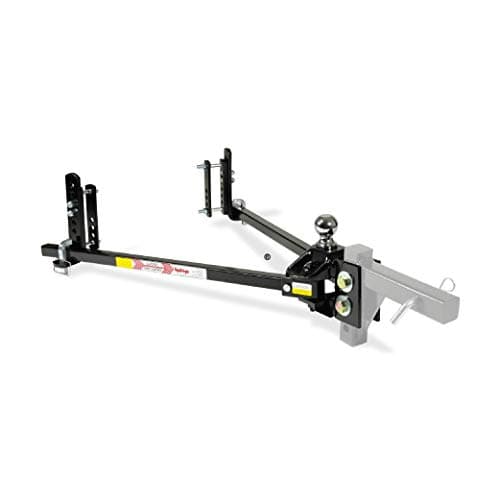 Equal-i-zer 4-Point Sway Control Hitch, 90-00-1001 Four-point sway control built into the head, so there is no friction bar to unclip before you back into a site — the single biggest quality-of-life difference for a first-timer. | Most half-ton trucks pulling a 5,000-10,000 lb trailer | 7.9/ 10 | |
| 2 | 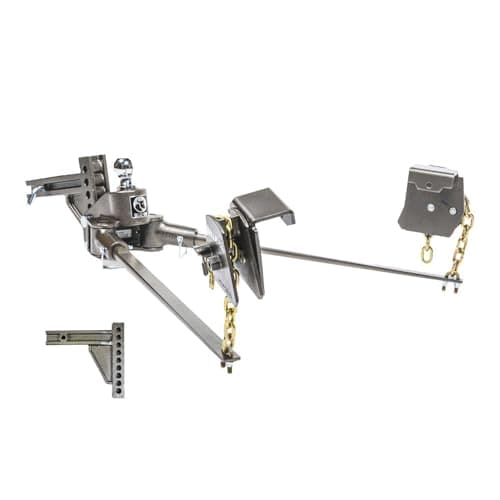 Blue Ox SwayPro BXW1000-S Weight Distributing Hitch Chain-tensioned spring bars that run under the A-frame rather than clamping onto it — quieter than a bracket hitch, and the hookup is a latch rather than a lift. | Owners who want a quiet, under-slung bar setup | 7.5/ 10 | |
| 3 | 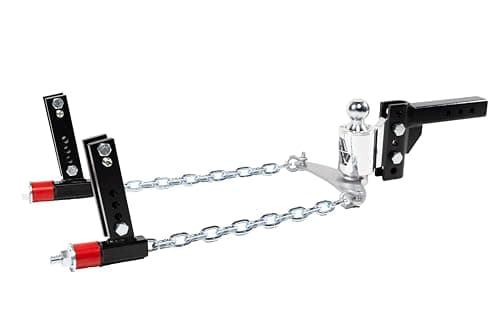 Andersen No-Sway Weight Distribution Hitch Chains and a urethane cone instead of steel spring bars, so it is the quietest and the lightest of the mainstream kits — and the only one most people can lift with one hand. | Owners who care most about weight, noise and a short hookup | 7.5/ 10 | Check price on Amazon No buyable offer at the last price check. |
Tap any row to jump to the full write-up. Prices come from Amazon and are read automatically — see each product below for the date.
The short answer
You do not need statics to tow a trailer. But understanding this one mechanism is what turns hitch setup from a ritual into a decision, and it explains why the adjustments exist.
The problem, drawn in words
Imagine a plank balanced on a brick. Push down on one end and the other end lifts. That is your truck.
The brick is the rear axle. The short end behind it is the few feet from the axle to the hitch ball. The long end in front of it runs forward to the front axle. Put 800 lb on the hitch ball and you are pushing down on the short end, so the long end lifts — which means weight comes off the front tires.
The arithmetic is unkind. Because the hitch is close to the rear axle and the front axle is far from it, a 800 lb tongue load can remove well over 200 lb from the front axle and add over 1,000 lb to the rear. Both directions are bad: the front tires lose grip and braking authority, the rear tires and springs get overloaded.
The fix: make the trailer part of the lever
A plain ball mount gives the trailer a free pivot. The trailer’s own axles carry the trailer’s weight, the ball carries the tongue weight, and nothing connects the two beyond that single point.
Spring bars change that. They run from the hitch head, back and down, to brackets clamped to the trailer’s A-frame some distance behind the coupler. When you tension them — by lifting the bar into a bracket, or tightening a chain — they are trying to straighten. That generates two forces: downward on the A-frame bracket, and upward at the back of the hitch head.
The upward force at the head rotates the whole truck-and-trailer assembly about the rear axle in the opposite direction to the tongue load. Some of the tongue weight moves forward onto the truck’s front axle. And the downward force on the A-frame pushes some of it back onto the trailer’s own axles.
Three axles now share what two were carrying badly. That is the entire trick.
Why every adjustment exists
Bracket height on the A-frame. Moving the bracket up or down changes the angle of the bar, which changes how much it has to deflect to seat — and therefore how much tension it carries. Higher bracket, more tension, more transfer. This is your main control.
Bar rating. The spring rate. A stiffer bar generates more force for the same deflection. That is why a bar rated far above your tongue weight gives a harsh ride: it is carrying more force than the geometry needs, transmitted straight into the frame.
Head angle / tilt. On many hitches the head tilts on the shank. That sets the preload in the bars before any bracket adjustment, and it is what gets you into the right range to begin with.
Chain link count, on chain-tensioned designs, is the same control as bracket height expressed differently: fewer links means more tension.
Which is why setup is a measurement, not a feel. The procedure measures fender heights before and after precisely because the fender height is a proxy for how much load has moved.
The common mistake
Where sway control fits into the same hardware
The bars and brackets are already under load, so making their contact surfaces resist sliding costs nothing extra in hardware. That is what integral sway control is: the bar-to-bracket and bar-to-head interfaces are designed as friction surfaces, so the trailer cannot rotate around the ball without dragging steel across steel.
It also explains the noise. Those surfaces are sliding under hundreds of pounds every time you turn. The different designs are different answers to how to generate that friction, and the quiet ones use a urethane cone or chain geometry instead of steel-on-steel.
What the mechanism cannot do
It cannot create capacity. Load moves between axles; nothing disappears. Your gross combined weight is unchanged, your payload is unchanged, and the tongue weight still counts against the door-jamb sticker in full.
It cannot fix a trailer loaded tail-heavy. If the tongue weight percentage is below about 10%, the trailer is unstable for reasons the hitch does not address — the problem is where the cargo sits relative to the trailer’s own axles.
And it cannot work on a trailer frame that is not strong enough for the bracket load. Some lightweight and pop-up trailers specifically prohibit weight distribution for this reason. Check the trailer’s manual as well as the truck’s.
What to remember
- The rear axle is the fulcrum; tongue weight on the short end lifts the front of the truck.
- Spring bars tie the truck and trailer into one beam so three axles share the load.
- Bracket height and bar rating both control how much force the bars carry.
- Over-tensioning is a real mistake — it unloads the rear axle too far.
- The mechanism relocates load. It never creates capacity.
The picks in full
Equal-i-zer 4-Point Sway Control Hitch, 90-00-1001
Equal-i-zer · Best for most half-ton trucks pulling a 5,000-10,000 lb trailer
Four-point sway control built into the head, so there is no friction bar to unclip before you back into a site — the single biggest quality-of-life difference for a first-timer.
Key specifications
- Trailer weight rating
- 10,000 lb
- Tongue weight rating
- 1,000 lb
- Sway control
- 4-point, integral to the head
- Included
- Weight distribution kit; shank and ball sold separately
Capacity figures read from Equal-i-zer product specifications, October 2026.
How it scored
- Sway control (25%)9
- Tongue-weight range (20%)8
- Backing up (20%)9
- Setup effort (15%)7
- Quietness (10%)5
- Price for capability (10%)7
Weighted average of the figures above. We did not test this product — see how we pick.
What it does well
- Sway control is always on — nothing to remember, nothing to remove
- Back up and turn sharply without unhooking anything
- Bracket height is adjustable in the field with a wrench, not a shop visit
What it is bad at
- It creaks and groans in tight turns; owners report this consistently and it is normal, not a fault
- Needs a shank and ball bought separately, which catches people out on price
- Heavier to lift onto the coupler than a friction-bar setup
Price as of October 5, 2026. #ad How this is funded
Blue Ox SwayPro BXW1000-S Weight Distributing Hitch
Blue Ox · Best for owners who want a quiet, under-slung bar setup
Chain-tensioned spring bars that run under the A-frame rather than clamping onto it — quieter than a bracket hitch, and the hookup is a latch rather than a lift.
Key specifications
- Tongue weight
- 1,000 lb
- Towing capacity
- 10,000 lb
- Shank
- 9-hole, 2 in receiver
- Sway control
- Spring-bar tension, always engaged
Capacity figures read from Blue Ox SwayPro specifications, October 2026.
How it scored
- Sway control (25%)8
- Tongue-weight range (20%)8
- Backing up (20%)8
- Setup effort (15%)6
- Quietness (10%)9
- Price for capability (10%)5
Weighted average of the figures above. We did not test this product — see how we pick.
What it does well
- Notably quieter than bracket-style friction hitches
- Clamp-on latches make hooking up quick once set
- Bars stay under tension through a turn, so backing is normal
What it is bad at
- Most expensive option in this range
- Initial setup is the fussiest here — chain link count has to be right
- Shank included, ball is not
Price as of October 5, 2026. #ad How this is funded
Andersen No-Sway Weight Distribution Hitch
Andersen Hitches · Best for owners who care most about weight, noise and a short hookup
Chains and a urethane cone instead of steel spring bars, so it is the quietest and the lightest of the mainstream kits — and the only one most people can lift with one hand.
Key specifications
- Gross trailer weight rating
- 14,000 lb
- Shank
- 2 in shank, 4 in drop
- Ball
- 2-5/16 in included
- Sway control
- Friction cone, always engaged
Capacity figures read from Andersen Hitches weight distribution specifications, October 2026.
How it scored
- Sway control (25%)7
- Tongue-weight range (20%)8
- Backing up (20%)8
- Setup effort (15%)6
- Quietness (10%)10
- Price for capability (10%)6
Weighted average of the figures above. We did not test this product — see how we pick.
What it does well
- Quiet — the complaint that defines steel-bar hitches mostly goes away
- Much lighter than a bar-and-bracket kit, so hookup is a one-person job
- Ball and shank are included, which is rarer than it should be
What it is bad at
- Chain tension is set by feel and a wrench, which is fiddlier to get right the first time
- The urethane cone is a wear part you will eventually replace
- Price sits at the top of the range
Common questions
It varies with bar rating, bracket height and geometry. The practical target is restoring the front fender to within about an inch of its unhitched height, which is most of the lost front axle load.
Follow the maker’s guidance. Where the bar-to-bracket interface is the sway control, lubricating it reduces sway resistance. Where the bars just seat, light lubrication of the sockets is often specified.
Incorrectly installed brackets or an unsuitable trailer can be, which is why some lightweight and pop-up trailers prohibit weight distribution outright. Check the trailer’s manual as well as the truck’s.
Sources
- Equal-i-zer published hitch specifications and bar ratings — read October 2026
- SAE J684 — trailer couplings, hitches and safety chains — read October 2026
- SAE J2807 — tow-vehicle gross combination weight rating procedure — read October 2026
- 49 CFR 393.70 — coupling devices and towing methods — read October 2026