Weight Distribution & Sway Control
How To Install A Friction Sway Control Bar
It is two brackets, a second ball and a telescoping arm. Fitting one takes an hour; living with one takes a habit, because it has to come off before every tight turn.
By Mike M. ·
How this page is funded: we earn a commission if you buy through our links, at no extra cost to you. It never changes which product we rank first. Prices come from Amazon and are read automatically — each one shows the date it was read. Full disclosure.
Quick picks
One bolt-on kit, plus two complete hitches that already include the friction bar in case you have not bought a hitch yet and would rather not retrofit later.
| # | Product | Best for | Score | Price |
|---|---|---|---|---|
| 1 | 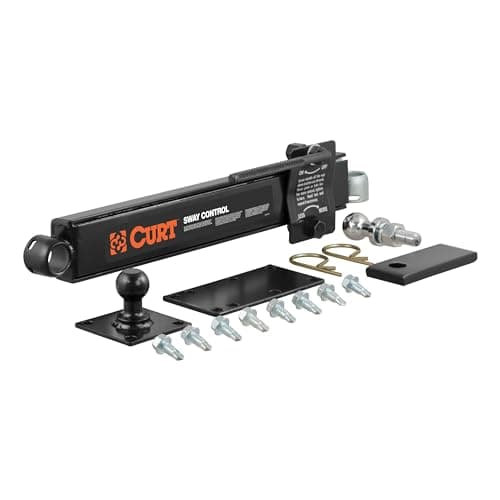 CURT Trailer Sway Control Kit, 17200 A friction bar and the brackets to mount it. The honest use for this is retrofitting a plain weight distribution hitch, not replacing a hitch that has sway control built in. The retrofit kit | Adding sway control to a hitch that has none | 5.4/ 10 | |
| 2 | 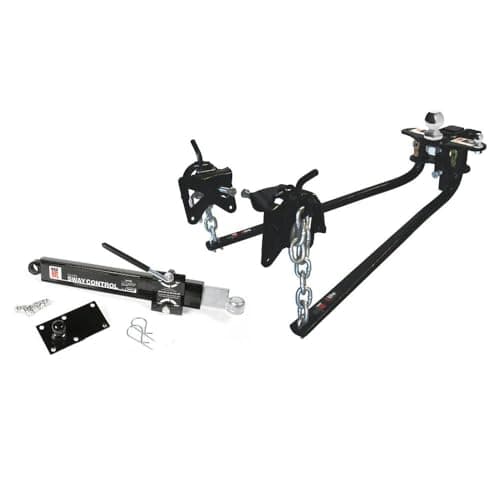 Camco Eaz-Lift Elite 1,000 lb Weight Distribution Hitch Kit, 48058 Ships ready to tow — hitch ball, sway control ball, U-bolts and chains all pre-installed — which is why this is usually the cheapest route from zero to legally hooked up. Complete kit, bar included | Getting a complete, ready-to-tow kit for the least money | 6.3/ 10 | |
| 3 | 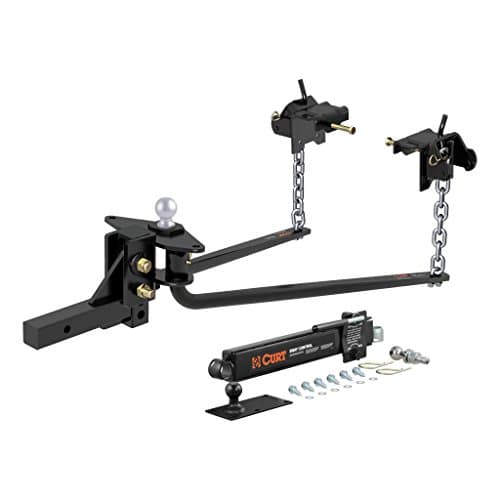 CURT Round Bar Weight Distribution Hitch with Sway Control, 17062 A conventional round-bar kit with a friction sway bar in the box. It is the cheapest way to get both jobs covered, and the cheapness shows up as a bar you have to remember to unclip. Cheapest with sway control included | The lowest price with sway control included | 6.2/ 10 | $331.07View on Amazon
|
Tap any row to jump to the full write-up. Prices come from Amazon and are read automatically — see each product below for the date.
The short answer
This is a retrofit page. If your hitch already has four-point sway control built into the head you do not need any of this and should not add it — the four-point roundup explains why an integral head is always working and a bolt-on arm is not. This page is for the owner of a plain spring-bar kit who wants sway resistance without replacing the whole hitch.
Friction sway control: a single telescoping arm clamped between a ball on the hitch shank and a bracket on the trailer A-frame. Tightening its handle increases friction inside the arm, so the trailer has to overcome that friction to rotate. One friction surface, considerably weaker than a four-point head, and it has to be disconnected for tight maneuvering.
Confirm these three things first
A spare hole in the shank. The second ball mounts on your hitch shank alongside the main ball, which means the shank needs a hole for it and enough material around that hole. Some shanks have one from the factory and some do not — and drilling a hitch shank is not a job to improvise. Look before you order.
A flat run of A-frame. The bracket clamps to the trailer’s A-frame and needs a straight, parallel section long enough for its clamp plates. Check the side you intend to use is not occupied by the propane tanks, the battery box, a generator tray or a spare tire carrier.
Which side. Convention is the driver’s side, because that is the side you can reach from outside the trailer while hooking up. But the correct side is whichever one is clear — one bar works the same wherever it is mounted.
| Requirement | Why it matters | If you do not have it |
|---|---|---|
| Spare shank hole | Carries the second ball | Do not drill - buy a hitch with integral sway control |
| Flat A-frame section | Clamp plates need parallel faces | Try the other side, then reconsider the retrofit |
| A clear side of the A-frame | Propane, battery and spare tire get in the way | Use the other side |
| A torque wrench | Bracket bolts slip on painted steel if under-tightened | Buy one - this is not a job to guess |
The install
- 1
Hitch the trailer and tension the weight distribution bars
Fit the sway bar with the trailer hitched and the spring bars already tensioned, so the geometry you set is the geometry you will tow in. The hitch setup guide covers getting that tension right first. - 2
Fit the second ball to the shank
Install the sway control ball in the shank’s spare hole on your chosen side and torque the nut to the figure in the kit instructions. The ball has to sit square, not cocked. - 3
Position the A-frame bracket
Clamp the bracket to the flat section of A-frame so the arm will run roughly parallel to the trailer’s centerline when the rig is straight. Do not final-tighten yet. - 4
Fit the arm and check its travel
Drop the arm onto the shank ball and the bracket ball. With the rig straight the arm should be partly extended — not at either end of its travel — so it has room to move in both directions. - 5
Torque the bracket bolts
To the kit’s stated figure, with a torque wrench. Under-tightened brackets slide along a painted A-frame under load, which is the most common complaint about these kits and is an installation fault rather than a design one. - 6
Set the friction handle light, then increase it
Start near the bottom of the handle’s range. Tow, and add friction only if the trailer still moves more than you want. Too much friction fights your steering on an ordinary corner. - 7
Re-check the bracket after the first trip
Bolts settle on painted steel. Re-torque after the first outing, then at the start of each season.
The common mistake
Living with it, honestly
A bolt-on friction bar is a real improvement over no sway control at all. It is not equivalent to a hitch with friction surfaces built into the head, and the gap is not only friction area — it is that this one depends on you remembering. Owners who tow a few times a year are the ones most likely to forget.
The honest decision tree runs like this. If you already own a plain hitch and tow a moderate trailer on ordinary roads, fit the bar and build the habit. If you are buying a hitch now, buy one with sway control integral to the head and skip this page entirely — the sway control roundup ranks those. And if you have fitted a bar and the trailer still moves at highway speed, the problem is almost certainly loading rather than hardware: what causes trailer sway works through the six causes in order of likelihood.
Bolt-on friction bar
- Cheapest route to some sway resistance on a hitch that has none
- Simple and serviceable, with nothing electronic
- Works with most conventional round-bar kits
- One friction point, much weaker than a four-point head
- Must be unclipped before every tight turn and reverse
Integral sway control
- Always engaged - nothing to remember
- Back into a site without touching anything
- Two or four friction surfaces instead of one
- Costs more than a bar, less than a bar plus a later upgrade
- Noisier at parking-lot speeds
What to remember
- Confirm a spare shank hole and a flat A-frame section before buying the kit.
- Fit it hitched, with the weight distribution bars already tensioned.
- Torque the bracket bolts - a slipping bracket is an install fault, not a design fault.
- Set the friction light and increase it only if the trailer still moves.
- Unclip the arm before every tight turn and every sharp reverse.
- Buying a hitch now? Buy integral sway control rather than planning a retrofit.
What this page is, and is not
We have not fitted these kits ourselves. The sequence above follows the install documentation the kit makers publish and the general practice those documents describe, and the failure modes named are what owners consistently report — stated as reporting rather than as our own experience. Your kit’s own instructions carry the torque figures and clearances that govern; follow them, not this page, where the two differ. Prices come from retailer listing data read automatically, and our method is on how we pick. The coupling hardware this bolts to is covered by SAE J684.
The picks in full
CURT Trailer Sway Control Kit, 17200
CURT · Best for adding sway control to a hitch that has none
A friction bar and the brackets to mount it. The honest use for this is retrofitting a plain weight distribution hitch, not replacing a hitch that has sway control built in.
Key specifications
- Type
- Friction sway control bar
- Use
- Add-on for weight distribution hitches
- Mounting
- A-frame bracket plus ball on the shank
- Operation
- Manual — must be disconnected to back sharply
Capacity figures read from CURT 17200 specifications, October 2026.
How it scored
- Sway control (25%)4
- Tongue-weight range (20%)6
- Backing up (20%)3
- Setup effort (15%)7
- Quietness (10%)6
- Price for capability (10%)9
Weighted average of the figures above. We did not test this product — see how we pick.
What it does well
- Cheapest route to some sway resistance on a hitch that has none
- Simple, serviceable, nothing to go wrong electronically
- Works with most conventional round-bar kits
What it is bad at
- Must be unclipped before tight turns and backing, every single time
- One friction point is much weaker than an integrated four-point head
- Needs a second ball and a spare hole in the shank
Price as of October 21, 2026. #ad How this is funded
Camco Eaz-Lift Elite 1,000 lb Weight Distribution Hitch Kit, 48058
Camco Eaz-Lift · Best for getting a complete, ready-to-tow kit for the least money
Ships ready to tow — hitch ball, sway control ball, U-bolts and chains all pre-installed — which is why this is usually the cheapest route from zero to legally hooked up.
Key specifications
- Tongue weight
- 1,000 lb
- Sway control
- Manually adjusted friction bar, included
- Included
- Hitch ball, sway ball, U-bolts, chain package
- Assembly
- Pre-installed hardware
Capacity figures read from Camco Eaz-Lift specifications, October 2026.
How it scored
- Sway control (25%)5
- Tongue-weight range (20%)7
- Backing up (20%)4
- Setup effort (15%)8
- Quietness (10%)6
- Price for capability (10%)10
Weighted average of the figures above. We did not test this product — see how we pick.
What it does well
- Genuinely complete in the box — no second order for a ball
- Lowest all-in cost of any kit here
- Chain-and-bracket setup is easy to understand
What it is bad at
- Manual friction sway control: unclip before tight turns, every time
- Finish is the least durable here; surface rust is a common report
- No sway resistance at all if you forget to reconnect the bar
Price as of October 21, 2026. #ad How this is funded
CURT Round Bar Weight Distribution Hitch with Sway Control, 17062
CURT · Best for the lowest price with sway control included
A conventional round-bar kit with a friction sway bar in the box. It is the cheapest way to get both jobs covered, and the cheapness shows up as a bar you have to remember to unclip.
Key specifications
- Gross trailer weight
- 10,000 lb
- Sway control
- Separate friction bar, included
- Bars
- Round bar
- Ball
- Not included
Capacity figures read from CURT 17062 specifications, October 2026.
How it scored
- Sway control (25%)5
- Tongue-weight range (20%)8
- Backing up (20%)4
- Setup effort (15%)7
- Quietness (10%)6
- Price for capability (10%)9
Weighted average of the figures above. We did not test this product — see how we pick.
What it does well
- Sway control included at this price, which is unusual
- Round bars tolerate a slightly wrong bracket angle
- Simple design, cheap to replace parts on
What it is bad at
- The friction bar must be unclipped before a tight turn or you can damage it
- Sway resistance is a single point, so it is the weakest here in a crosswind
- No ball included
Common questions
Second ball into the shank’s spare hole, bracket clamped to a flat section of A-frame, arm between the two balls sitting partly extended, bracket bolts torqued, then friction set light and increased only if the trailer still moves.
Yes — before every sharp turn and reverse. The arm runs out of travel at a tight jackknife angle and breaks. Integral heads do not need this.
Whichever side is clear. Driver’s side is the convention for reach, but propane, battery and spare tire often decide it for you.
No — one friction surface against four, and you have to remember it. It is still a real improvement over no sway control at all.
Sources
- CURT published 17200 sway control kit specifications and install documentation — read October 2026
- Camco Eaz-Lift published Elite weight distribution kit contents — read October 2026
- SAE J684 — trailer couplings, hitches and safety chains — read October 2026