Towing Setup & Capacity
Proportional vs Time-Delay Brake Controllers
This is the one brake controller specification that changes how the rig feels. Everything else on the box is convenience.
By Mike M. ·
How this page is funded: we earn a commission if you buy through our links, at no extra cost to you. It never changes which product we rank first. Prices come from Amazon and are read automatically — each one shows the date it was read. Full disclosure.
Quick picks
Proportional controllers at three install levels. We do not rank time-delay units, for the reasons below.
| # | Product | Best for | Score | Price |
|---|---|---|---|---|
| 1 | 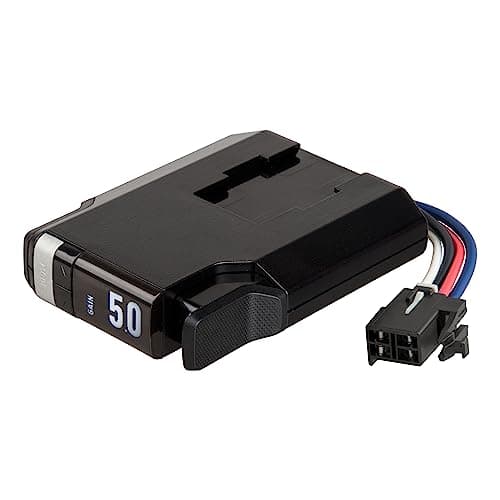 CURT TriFlex Next Proportional Trailer Brake Controller, 51146 Proportional, plug-and-play, fully adjustable and rated to four axles for well under the price of the knob-controlled version — the sensible default if your truck has a factory brake harness. Top pick | Most first-time buyers who want proportional braking cheaply | 8.2/ 10 | |
| 2 | 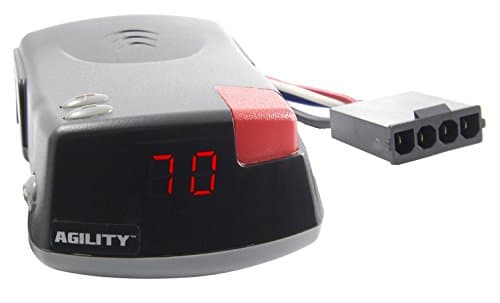 Hopkins Agility Trailer Brake Control An inexpensive proportional controller from a long-standing towing-electrics maker. It does the one job that matters — braking in proportion to the truck — without a readout to admire. Cheapest proportional | The cheapest proportional controller worth fitting | 6.6/ 10 | |
| 3 | 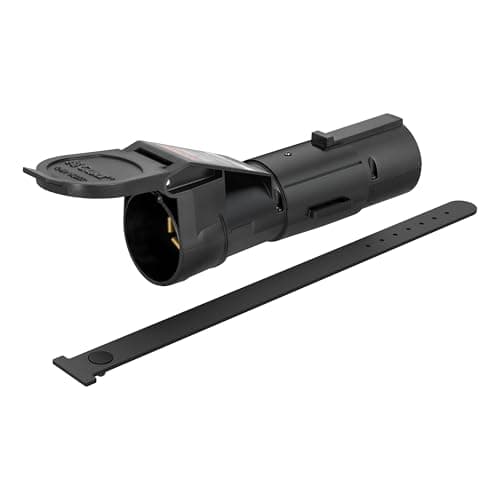 CURT Echo Mobile Bluetooth Trailer Brake Controller, 51180 Plugs in between the truck's 7-way and the trailer plug and is controlled from a phone, so there is nothing to mount and nothing to wire — the only controller here you can move between vehicles in a minute. | A rented or borrowed tow vehicle, or a truck you do not want to drill | 8.2/ 10 | |
| 4 | 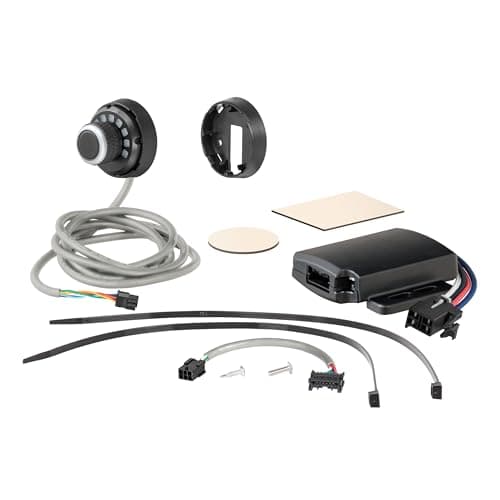 CURT Spectrum Proportional Trailer Brake Controller, 51170 Proportional braking with a dash-mounted knob, which beats an app the first time you feel the trailer push and want to change gain without looking away from the road. | A permanent install with a physical knob you can reach | 7.2/ 10 |
Tap any row to jump to the full write-up. Prices come from Amazon and are read automatically — see each product below for the date.
The short answer
Both kinds of controller send a current to the trailer’s electromagnetic brakes. The only difference is how they decide how much current. That one decision changes everything about how the rig behaves.
How time-delay works
You touch the brake pedal. The controller starts at a low output and ramps up to the gain you set, over a delay period you also set. It has no idea whether you are easing up to a red light two hundred feet away or standing on the pedal because somebody pulled out.
So there is no setting that is right for both. Set the gain for emergency stops and every gentle stop over-brakes the trailer, which you feel as the trailer dragging the truck to a halt and which flat-spots trailer tires over time. Set it for gentle stops and you have under-braked trailer in an emergency, which is the one time it matters.
Time-delay controllers are cheaper, simpler, mount in any orientation, and have no calibration. They are genuinely adequate for a light utility trailer. They are a poor match for a travel trailer.
How proportional works
An accelerometer measures how hard the vehicle is actually decelerating, and output tracks it. Gentle stop, gentle trailer braking. Hard stop, hard trailer braking.
In use this means the trailer brakes feel like part of the vehicle rather than a separate system with opinions. You stop noticing the trailer, which is the correct outcome.
Older proportional controllers had to be mounted at a specific angle so the accelerometer read correctly, and had a leveling procedure. Modern units are mount-anywhere and self-calibrating, which removed the main practical objection.
| Situation | Time-delay | Proportional |
|---|---|---|
| Gentle stop at a light | Over-brakes, trailer drags | Matches the truck |
| Hard emergency stop | Under-brakes until the ramp completes | Full braking immediately |
| Long downgrade | Fixed output regardless of grade | Tracks actual deceleration |
| Slowing for a curve | Grabs then releases | Smooth |
| Tire wear | Flat spots if gain is set high | Even |
The emergency-stop difference, concretely
This is the argument that settles it. In a hard stop, a time-delay controller spends its ramp period applying less than full trailer braking. During that window the trailer is pushing the truck, which both lengthens the stop and unloads the truck’s rear axle at the worst possible moment.
A proportional controller applies in proportion from the first instant. The trailer contributes its share of the braking straight away, the rig stays in line, and the stop is shorter.
You will use that behavior rarely. It is still the reason to buy proportional.
The common mistake
Both should have a manual override
Whatever you buy, it needs a lever, slider or button that applies the trailer brakes alone. That is how you set the gain, how you take up slack on a descent, and the correct response if the trailer starts to sway — trailer brakes alone pull the rig straight.
Covered in what causes trailer sway, and it is one of the strongest practical arguments for not buying the cheapest controller on the shelf.
The verdict
Buy proportional. The cheapest proportional controller costs less than a tank of diesel more than a time-delay unit, and it is the difference between a trailer you manage and a trailer you forget about. The only case for time-delay is a light utility trailer towed occasionally on flat roads.
Then pick on install: the controller roundup splits the picks by whether you can use a factory connector, want to hardwire, or want to wire nothing at all.
What to remember
- Time-delay applies a fixed ramp; proportional tracks actual deceleration.
- There is no time-delay gain setting that is right for both gentle and emergency stops.
- Proportional stops shorter in an emergency, because it brakes from the first instant.
- Setting a time-delay gain high flat-spots trailer tires.
- Any controller you buy must have a manual trailer-brake override.
The picks in full
CURT TriFlex Next Proportional Trailer Brake Controller, 51146
CURT · Best for most first-time buyers who want proportional braking cheaply
Proportional, plug-and-play, fully adjustable and rated to four axles for well under the price of the knob-controlled version — the sensible default if your truck has a factory brake harness.
Key specifications
- Braking
- Proportional, inertia-based
- Axles
- 2-4 axles
- Install
- Plug-and-play with factory harness
- Profile
- Low profile, fully adjustable
Capacity figures read from CURT TriFlex Next specifications, October 2026.
How it scored
- Braking control (30%)9
- Install effort (25%)8
- Adjustability (20%)8
- Readout / feedback (15%)7
- Price for capability (10%)9
Weighted average of the figures above. We did not test this product — see how we pick.
What it does well
- Cheapest genuine proportional controller here
- Handles up to four axles, so it outgrows a single trailer
- Low-profile case fits where a knob controller will not
What it is bad at
- Plug-and-play only if the truck already has the brake-control connector
- Adjustment is through buttons, which is slower than a knob while moving
- No app, no remote display
Price as of October 5, 2026. #ad How this is funded
Hopkins Agility Trailer Brake Control
Hopkins · Best for the cheapest proportional controller worth fitting
An inexpensive proportional controller from a long-standing towing-electrics maker. It does the one job that matters — braking in proportion to the truck — without a readout to admire.
Key specifications
- Braking
- Proportional
- Install
- Hardwired
- Form
- Compact, multi-orientation mount
- Adjustment
- Gain dial
How it scored
- Braking control (30%)8
- Install effort (25%)5
- Adjustability (20%)6
- Readout / feedback (15%)5
- Price for capability (10%)10
Weighted average of the figures above. We did not test this product — see how we pick.
What it does well
- By far the lowest price for proportional braking
- Small enough to tuck out of the way
- Simple: a gain dial and a boost setting, nothing else to learn
What it is bad at
- Minimal display — you are flying on feel
- Hardwire install with no plug-and-play option
- Fewer configuration options than the CURT units
Price as of October 5, 2026. #ad How this is funded
CURT Echo Mobile Bluetooth Trailer Brake Controller, 51180
CURT · Best for a rented or borrowed tow vehicle, or a truck you do not want to drill
Plugs in between the truck's 7-way and the trailer plug and is controlled from a phone, so there is nothing to mount and nothing to wire — the only controller here you can move between vehicles in a minute.
Key specifications
- Install
- Plug-in between 7-way connectors
- Control
- Bluetooth app
- Axles
- 1-2 axles
- Mounting
- None required
Capacity figures read from CURT Echo specifications, October 2026.
How it scored
- Braking control (30%)8
- Install effort (25%)10
- Adjustability (20%)8
- Readout / feedback (15%)7
- Price for capability (10%)6
Weighted average of the figures above. We did not test this product — see how we pick.
What it does well
- No wiring, no drilling, no dash real estate
- Moves between tow vehicles in under a minute
- Sensitivity and gain adjust from the phone
What it is bad at
- You need the phone awake and paired to change anything while driving
- Rated for 1-2 axles only — not for a triple-axle trailer
- Highest price here for the fewest axles
Price as of October 5, 2026. #ad How this is funded
CURT Spectrum Proportional Trailer Brake Controller, 51170
CURT · Best for a permanent install with a physical knob you can reach
Proportional braking with a dash-mounted knob, which beats an app the first time you feel the trailer push and want to change gain without looking away from the road.
Key specifications
- Braking
- Proportional (inertia sensing)
- Control
- Dash-mount knob
- Install
- Hardwired, mount-anywhere orientation
- Display
- LED status
Capacity figures read from CURT Spectrum specifications, October 2026.
How it scored
- Braking control (30%)9
- Install effort (25%)5
- Adjustability (20%)8
- Readout / feedback (15%)7
- Price for capability (10%)6
Weighted average of the figures above. We did not test this product — see how we pick.
What it does well
- Physical knob — adjust by feel without taking your eyes off the road
- Mounts in any orientation, which matters in a cramped footwell
- Proportional response rather than a fixed time delay
What it is bad at
- Hardwiring is a real afternoon if the truck has no factory harness
- Priced above controllers with more axle capacity
- Readout is LEDs, not a numeric display
Price as of October 5, 2026. #ad How this is funded
Common questions
For a travel trailer, yes. Smoother in normal driving, and it applies full trailer braking immediately in an emergency instead of ramping up over a delay.
Older ones did — the accelerometer needed a known orientation. Modern units are mount-anywhere and self-calibrating.
Factory integrated controllers in modern trucks are almost always proportional. A trailer gain figure in the dash plus a manual slider near the column is the giveaway — and do not add a second controller.
Sources
- SAE J2807 — tow-vehicle gross combination weight rating procedure — read October 2026
- SAE J684 — trailer couplings, hitches and safety chains — read October 2026
- CURT published towing product specifications — read October 2026
- 49 CFR 393.70 — coupling devices and towing methods — read October 2026