Power & Electrical
What EPO Means On An RV Surge Protector
EPO is the difference between a device that tells you the pedestal is dangerous and one that refuses to pass the power along.
By Mike M. ·
How this page is funded: we earn a commission if you buy through our links, at no extra cost to you. It never changes which product we rank first. Prices come from Amazon and are read automatically — each one shows the date it was read. Full disclosure.
Quick picks
The protectors that actually cut power rather than only reporting a fault, plus the portable EMS most 30-amp owners end up with.
| # | Product | Best for | Score | Price |
|---|---|---|---|---|
| 1 | 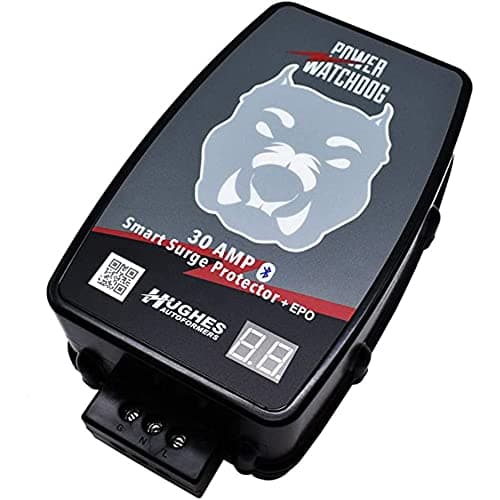 Hughes Power Watchdog PWD30-EPO-H, 30 Amp Hardwire Hardwired inside the trailer with Bluetooth monitoring and a replaceable surge module, so it cannot be stolen off the pedestal and a surge hit does not mean a new unit. 30 amp, hardwired | A permanently installed protector you cannot leave behind | 8.8/ 10 | Check price on Amazon No buyable offer at the last price check. |
| 2 | 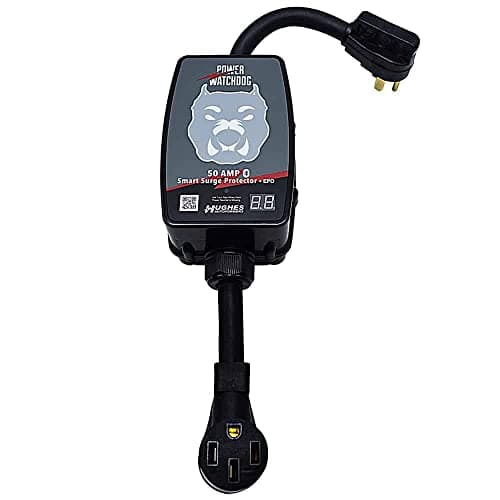 Hughes Power Watchdog PWD50EPO Smart Surge Protector, 50 Amp Portable 50-amp protection with an IP65-sealed body, Bluetooth monitoring and auto shutoff — the answer if you want app diagnostics without hardwiring. 50 amp | 50-amp service where you want the readout on your phone | 9.0/ 10 | $337.51View on Amazon
|
| 3 | 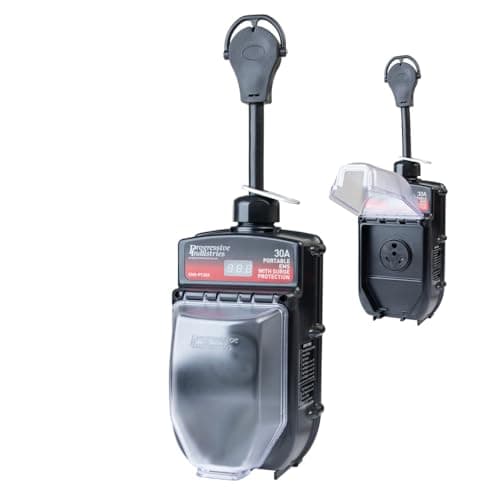 Progressive Industries EMS-PT30X Electrical Management System, 30 Amp A full electrical management system, not just a surge protector: it reads the pedestal and disconnects on low or high voltage, which is the fault that actually kills air conditioners. Portable alternative | Most 30-amp trailers — the one to actually buy | 8.7/ 10 |
Tap any row to jump to the full write-up. Prices come from Amazon and are read automatically — see each product below for the date.
The short answer
A lot of RV electrical shopping comes down to one question people do not know they are asking: does this thing warn me, or does it act? A $40 surge protector and a $350 electrical management system can both detect a miswired pedestal. Only one of them will do anything about it while you are asleep.
EPO (Emergency Power Off): a relay inside the protector that opens the circuit on a detected fault, cutting power to the trailer. Units with EPO are usually also described as an EMS — an electrical management system — because disconnecting is management rather than just protection.
What actually triggers an EPO
Different units protect against slightly different lists, and the published thresholds are the specification to compare rather than the marketing copy. The common triggers:
| Fault | What it does to the trailer | Basic surge protector |
|---|---|---|
| Open neutral | Can put dangerous voltage on appliance cases | Warns only |
| Reversed polarity | Energizes what should be neutral | Warns only |
| Low voltage (brownout) | Burns out air conditioner and fridge compressors | No detection |
| High voltage | Damages electronics and motors | No detection |
| Open ground | Removes the fault path that protects you | Warns only |
| Surge or spike | Damages electronics | Clamps it — this is the one it does well |
| Miswired 30 to 50 amp pedestal | Potentially 240 V to 120 V equipment | Warns only |
Read down that third column and the case for EPO makes itself. A surge protector is good at exactly one job — absorbing a spike — and that is not the job that destroys most RV appliances. Sustained low voltage on a hot afternoon when the whole campground is running air conditioning is what kills compressors, and no surge protector detects it at all. Surge protector vs EMS covers that distinction in full.
The open neutral, which is the reason to care
Of everything on that list, the open neutral is the one worth understanding properly, because it is the one that can hurt a person rather than an appliance.
In a correctly wired 120 V circuit, current flows out on the hot conductor and returns on the neutral. If the neutral connection at the pedestal is broken or corroded — which happens in old campground wiring more than anyone would like — the return path is gone. On a 50-amp service, which is two 120 V legs sharing a neutral, an open neutral can allow the voltage between the legs to redistribute, and equipment on the lightly loaded leg can see well above 120 V. On either service, an open neutral combined with another fault can put voltage where it should not be, including on the metal case of an appliance.
A unit that only reports this has done its job and failed you simultaneously: the fault is present, the light is on, and the trailer is still connected. A unit with EPO opens the relay and the problem becomes a dark trailer instead of an electrical hazard.
The common mistake
Hardwired or portable
EPO-equipped units come in both forms and the choice is about theft and convenience rather than protection.
Portable units plug in at the pedestal between the post and your cord. You can see the display, move it between trailers, and take it home. You can also forget it, and so can someone else — an unsecured EMS sitting on a pedestal is the most commonly stolen item in an RV park. Most portable units have a lock provision; use it.
Hardwired units install inside the trailer, in the power path after the inlet. Nothing is visible at the pedestal, there is nothing to steal and nothing to forget, and the display or app is inside with you. The trade is an installation job and the fact that the protection travels with that trailer only.
| Portable | Hardwired | |
|---|---|---|
| Theft exposure | High unless locked | None |
| Can you forget it | Yes, frequently | No |
| Moves between trailers | Yes | No |
| Weather exposure | Sits outside in all of it | Protected inside |
| Install effort | None | Real — do it properly or have it done |
| Reading the display | At the pedestal, or by app | Inside, or by app |
What to check before buying
- 1
Confirm it actually has a relay, not just indicators
The specification to look for is explicit: a statement that the unit disconnects or cuts power on a fault. Terms like EPO, auto shutoff and electrical management system all point to it; surge protection alone does not. - 2
Match the amperage to your service
A 30-amp trailer needs a 30-amp unit and a 50-amp trailer needs a 50-amp one. Do not buy up or down and bridge it with an adapter — the protector should match the service it is protecting. - 3
Read the published voltage thresholds
Makers state the low and high voltage limits at which the unit disconnects, and the delay before it reconnects. Those numbers, not the product name, are what you are buying. - 4
Check the reconnect behavior
After a fault clears, the unit waits before reconnecting — commonly a couple of minutes — to protect air conditioner compressors from short-cycling. Confirm the unit does this rather than snapping straight back on. - 5
Check the surge rating too
EPO handles wiring and voltage faults. The joule or surge-current rating is still what handles a spike, so you want both rather than trading one for the other.
Two of those steps have their own pages worth reading first: 30 amp vs 50 amp service if you are not certain which you have, and how to check a campground pedestal for what to do before you plug anything in at all.
Who actually needs EPO
Yes, clearly: anyone who leaves the trailer connected and unattended, anyone who stays in older parks or at campgrounds with visibly aged pedestals, anyone with a residential-style fridge or a newer air conditioner they cannot cheaply replace, and anyone in a region that gets summer brownouts.
Probably not: someone doing a handful of weekends a year at new, well-maintained parks, who checks the pedestal with an analyser at hookup and is inside the trailer the whole time. A good surge protector plus a pedestal check genuinely covers a lot of that case.
The honest framing is that EPO is insurance against the pedestal you did not test and the fault that arrived after you plugged in. How much that is worth depends on what is in your trailer and how often you are not standing next to it. The 30-amp roundup and the 50-amp roundup rank both kinds of device with the thresholds printed on each card.
What to remember
- EPO means the unit opens a relay and disconnects. Without it, a protector only reports the fault.
- The faults that matter most are open neutral, reversed polarity and voltage outside a safe window.
- Low voltage, not surges, is what kills most RV air conditioners — and basic surge protectors do not detect it at all.
- An open neutral is the one that can put voltage on an appliance case. That is the case for a relay.
- Portable units get stolen; hardwired units cannot be forgotten. Protection is equivalent.
- Buy on published voltage thresholds and reconnect delay, not on the product name.
How we checked this
Everything above is drawn from the manufacturers’ own published specifications and from the standards referenced below, read in October 2026. We have not bench-tested these units and do not claim to have. Where a figure varies by model — thresholds, delays, surge ratings — we have said so rather than printing a number that would be wrong for half the range. Our method is on how we pick. If you are not confident working on trailer wiring, a hardwired install is a job for an RV technician.
The picks in full
Hughes Power Watchdog PWD30-EPO-H, 30 Amp Hardwire
Hughes Autoformers · Best for a permanently installed protector you cannot leave behind
Hardwired inside the trailer with Bluetooth monitoring and a replaceable surge module, so it cannot be stolen off the pedestal and a surge hit does not mean a new unit.
Key specifications
- Service
- 30 amp
- Install
- Hardwired
- Monitoring
- Bluetooth app
- Surge module
- Replaceable
How it scored
- Protection coverage (30%)9
- Diagnostics (25%)9
- Weather sealing (20%)9
- Auto shutoff (15%)9
- Price for capability (10%)7
Weighted average of the figures above. We did not test this product — see how we pick.
What it does well
- Cannot be stolen from the pedestal
- The surge module is replaceable, so one big hit is cheap to recover from
- App shows live voltage and amp draw from inside the trailer
What it is bad at
- Hardwiring means a real install, or paying for one
- You need the phone to see the readout
- Does not move to a second trailer easily
Hughes Power Watchdog PWD50EPO Smart Surge Protector, 50 Amp
Hughes Autoformers · Best for 50-amp service where you want the readout on your phone
Portable 50-amp protection with an IP65-sealed body, Bluetooth monitoring and auto shutoff — the answer if you want app diagnostics without hardwiring.
Key specifications
- Service
- 50 amp
- Sealing
- IP65
- Monitoring
- Bluetooth
- Protection
- Surge plus automatic shutoff
How it scored
- Protection coverage (30%)9
- Diagnostics (25%)10
- Weather sealing (20%)9
- Auto shutoff (15%)9
- Price for capability (10%)6
Weighted average of the figures above. We did not test this product — see how we pick.
What it does well
- IP65 body handles weather better than most portable units
- App logging shows what the pedestal did overnight
- Replaceable surge module
What it is bad at
- Most expensive portable unit here
- Needs a phone for anything beyond basic status
- Heavy to hang off a pedestal outlet
Progressive Industries EMS-PT30X Electrical Management System, 30 Amp
Progressive Industries · Best for most 30-amp trailers — the one to actually buy
A full electrical management system, not just a surge protector: it reads the pedestal and disconnects on low or high voltage, which is the fault that actually kills air conditioners.
Key specifications
- Service
- 30 amp
- Function
- Full EMS with automatic disconnect
- Protects against
- Surge, low voltage, high voltage, miswiring
- Display
- Scrolling diagnostic display
How it scored
- Protection coverage (30%)10
- Diagnostics (25%)9
- Weather sealing (20%)6
- Auto shutoff (15%)10
- Price for capability (10%)7
Weighted average of the figures above. We did not test this product — see how we pick.
What it does well
- Disconnects on voltage faults, which is what saves the air conditioner
- Readable display shows actual voltage and amperage
- The reference product in the category
What it is bad at
- Three times the price of a plain surge protector
- Portable units are a theft target — lock it to the pedestal
- Not weather-sealed to the degree a hardwired unit is
Price as of October 10, 2026. #ad How this is funded
Common questions
Emergency Power Off — the unit has a relay that disconnects the trailer from the pedestal on a detected fault, rather than only lighting a warning and passing the power through anyway.
It depends on exposure. A surge protector handles spikes and detects nothing else; an EMS acts on low and high voltage, open neutral and polarity faults. Low voltage, not surges, kills most compressors.
The return path is gone. On a 50-amp service the two legs share that neutral, so equipment on a lightly loaded leg can see well above 120 V — and combined with another fault it can energize an appliance case. A unit without EPO reports it and stays connected.
Protection is equivalent. Portable moves between trailers but sits outside and gets stolen — use the lock provision. Hardwired cannot be stolen or forgotten but stays with that trailer.
Sources
- Progressive Industries published EMS specifications and protection thresholds — read October 2026
- Hughes Autoformers Power Watchdog published specifications — read October 2026
- National Fire Protection Association — standards including NFPA 1192 for recreational vehicles — read October 2026