Power & Electrical
The Best 30 Amp RV Extension Cord
Every cord worth buying here is 10-gauge copper, which means the specification people argue about is already settled. The decision that is left is length, and the longest cord on this page costs you about seven volts.
By Mike M. ·
How this page is funded: we earn a commission if you buy through our links, at no extra cost to you. It never changes which product we rank first. Prices come from Amazon and are read automatically — each one shows the date it was read. Full disclosure.
Top pick
Our pick on this page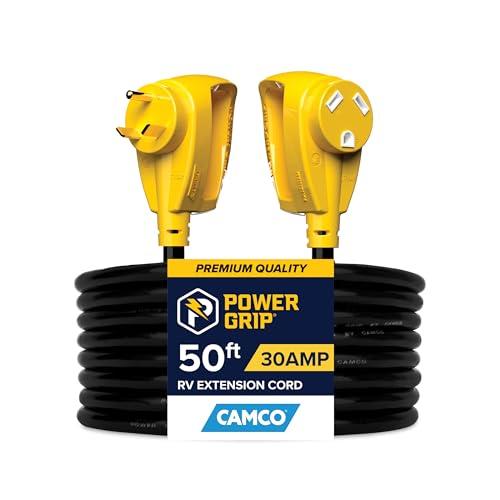
Camco PowerGrip 50 ft 30 Amp RV Extension Cord, 55197
Fifty feet of 10-gauge copper rated 125 V / 3,750 W with Camco's molded PowerGrip handles — the plain, known-quantity version of this purchase.
Price as of November 18, 2026. #ad How this is funded
Read the full write-up or compare it with the rest below.
Quick picks
Scored on the general-gear rubric - how often the length is the one you need (40%), build (25%), packed bulk (20%) and price for capability (15%). All six are 10-gauge copper, so the wire itself is not a differentiator; the ranking is about length, connector type and what the plug tells you. Every cord was confirmed currently available before it was featured, and prices move, so check the current figure on the card.
| # | Product | Best for | Score | Price |
|---|---|---|---|---|
| 1 | Camco PowerGrip 50 ft 30 Amp RV Extension Cord, 55197 Fifty feet of 10-gauge copper rated 125 V / 3,750 W with Camco's molded PowerGrip handles — the plain, known-quantity version of this purchase. Top pick | A 50 ft cord from the brand every campground store stocks | 9.2/10 | |
| 2 | 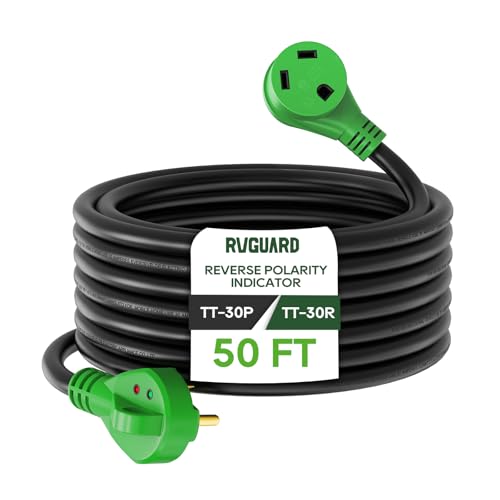 RVGUARD 30 Amp 50 ft RV Extension Cord with Reverse Polarity Indicator Fifty feet of 10/3 STW with a reverse-polarity lamp in the plug, for less than the name-brand 50 ft cord with no indicator at all. Best value at 50 ft | The length that covers almost any awkward site, with a fault light at the plug | 9.1/10 | |
| 3 | 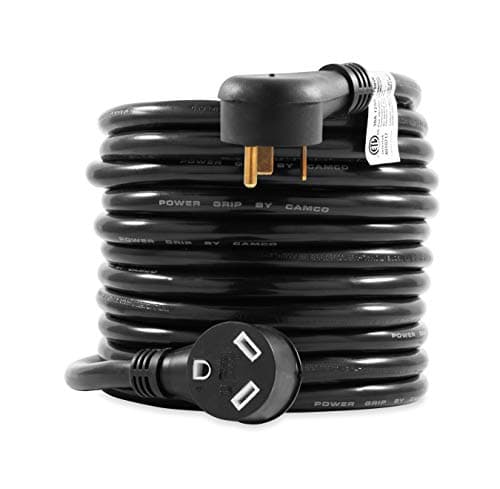 Camco 25 ft 30 Amp RV Extension Cord, 55193 Twenty-five feet of 10-gauge copper rated 125 V / 3,750 W. The gauge is the only thing that matters here; a thin cord gets hot and drops voltage. | Reaching a pedestal that is 10 feet too far away | 9.1/10 | |
| 4 | 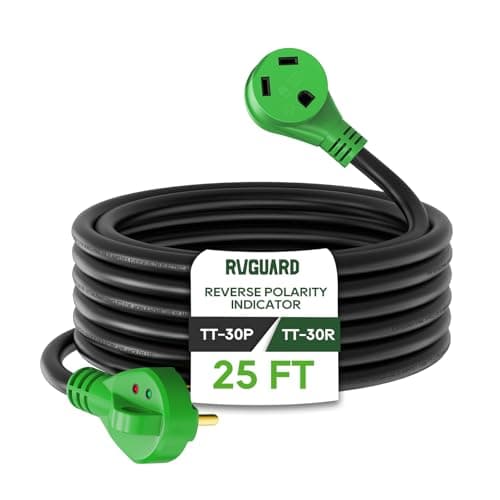 RVGUARD 30 Amp 25 ft RV Extension Cord with Polarity Indicator The same 25 ft 30-amp job with a reverse-polarity indicator built into the plug, at roughly half the price of the name-brand cord. Budget pick | A 30-amp extension cord at half the usual price | 9.0/10 | |
| 5 | 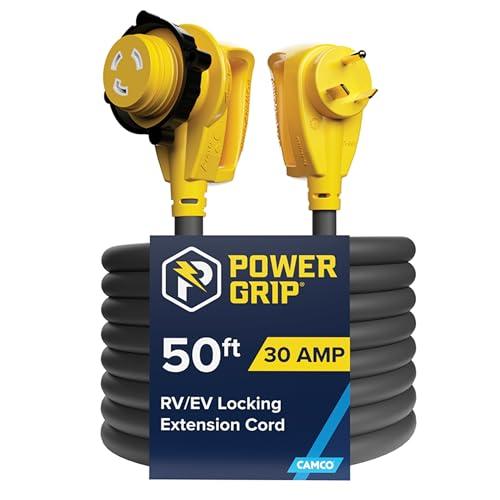 Camco PowerGrip 50 ft 30 Amp RV Extension Cord with 90-Degree Locking End, 55525 The same 50 ft of 10-gauge copper with a 90-degree twist-lock L5-30R female end, so the connection to the trailer stays made and sits flat against the side. Best locking end | A cord that cannot be pulled out of the trailer inlet | 8.8/10 | |
| 6 | 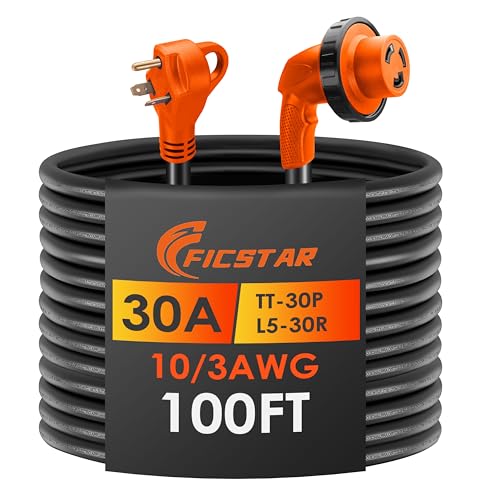 Ficstar 30 Amp 100 ft RV Extension Cord with Locking Connector A hundred feet of 10-gauge STW with a twist-lock end and a polarity lamp. It solves a real problem and it costs you voltage doing it — know the trade before you buy. Longest reach | A pedestal or a house outlet that is genuinely 100 feet away | 8.4/10 | $217.99Ficstar 30 Amp 100 ft on Amazon
|
Tap any row to jump to the full write-up. Prices come from Amazon and are read automatically — see each product below for the date.
The short answer
A 30 amp RV service is a single 120 V circuit rated at 30 amps — about 3,600 watts at the pedestal, which is one air conditioner and not much else running at the same time. The shore cord attached to your trailer is usually 25 or 30 feet, and campground pedestals have an infuriating habit of being on the wrong side of the site, 10 feet further away than you need, or across the road. So you buy an extension cord, and the question people ask is which one.
Here is the thing that makes this an unusually short decision once you see it: every cord on this page is 10-gauge copper rated 125 V / 3,750 W. That is the correct specification for a 30 amp RV service and all six have it. The argument about wire gauge, which is the argument every article about RV cords has, is already over before you choose between these. What is left is length, the shape of the connectors, and whether the plug tells you anything about the pedestal. Length is the one that actually costs you something.
Why length is not free: copper has resistance, and a cord is two conductors long — out and back. NFPA 70 (the National Electrical Code) Chapter 9, Table 8 lists stranded uncoated 10 AWG copper at about 1.24 ohms per 1,000 feet. A 50 ft cord is 100 ft of conductor round trip, so roughly 0.12 ohms; at a 30 amp draw that is around 3.7 volts lost before the power reaches your trailer. A 100 ft cord doubles it: about 0.25 ohms and roughly 7.4 volts. Start from a pedestal already sagging to 110 V on a hot afternoon in a full park and you are asking a compressor to run on something close to 103 V, which is exactly the condition that an electrical management system exists to disconnect for. The arithmetic is why “buy the shortest cord that reaches” is real advice and not just thrift.
What decides this
Length, and only the length you need. It carries 40% of the rubric for the reason worked out above: a longer cord is not a better cord, it is a cord that delivers less voltage. Twenty-five feet covers the overwhelming majority of campground sites, because the pedestal is usually within reach of your shore cord and the extension is covering the last awkward stretch. Fifty feet is the sensible one-cord-for-everything answer and the length to buy if you boondock on friends’ property or park in an odd corner of a driveway. One hundred feet is a specific solution to a specific site, not a general upgrade.
Gauge — already settled, and still worth stating. Ten-gauge copper is the right wire for 30 amps and every cord here has it. The reason it still matters is the substitution people make instead: a household extension cord is typically 14 or 16 gauge, which under a sustained 30 amp load gets hot, drops far more voltage than the figures above, and is the one genuinely dangerous shortcut in this part of the trailer. If a cord does not say 10-gauge and 125 V / 3,750 W, it is not a 30 amp RV cord whatever the listing title says.
Standard or locking connectors. A standard 30 amp cord is NEMA TT-30P male to TT-30R female: push-fit at both ends, and it can be pulled apart by somebody walking into the cord or by a gust catching a loop. A locking cord ends in an L5-30R twist-lock female, which stays connected but only mates with a locking inlet or plug. This is the single most common buying error on this page: check what your trailer’s shore cord and inlet actually have before you buy a locking cord, because a twist-lock female will not accept a standard TT-30P shore plug.
Whether the plug tells you anything. Two cords here have a reverse-polarity lamp built into the plug, and one of those adds a power lamp. That is a 30-second check that you do before the trailer is connected to the pedestal, and reverse polarity and open ground are both common enough at older campgrounds to be worth catching. The full pedestal check is the proper version of this, and an indicator lamp is not a substitute for a surge protector or an EMS — it reports, it does not disconnect.
Handles and bulk, which sound trivial and are not. A 50 ft 10-gauge cord is heavy, stiff in the cold, and awkward in a pass-through. Camco’s molded PowerGrip handles let you pull the plug by the handle rather than by the cord, which is both easier and the correct way to do it; the budget cords use a smaller molded grip and include a cord organizer strap instead. Neither approach is wrong. Packed bulk is 20% of the rubric because every foot you are not using is a foot you are carrying.
| Cord | Length | Female end | Indicator | Approx. drop at 30 A |
|---|---|---|---|---|
| RVGUARD 30 A 25 ft | 25 ft | TT-30R standard | Reverse polarity | ~1.9 V |
| Camco PowerGrip 55193 | 25 ft | TT-30R standard | None | ~1.9 V |
| RVGUARD 30 A 50 ft | 50 ft | TT-30R standard | Reverse polarity | ~3.7 V |
| Camco PowerGrip 55197 | 50 ft | TT-30R standard | None | ~3.7 V |
| Camco PowerGrip 55525 | 50 ft | L5-30R locking, 90-degree | None | ~3.7 V |
| Ficstar 100 ft | 100 ft | L5-30R locking | Power + reverse polarity | ~7.4 V |
The six cords, and which one is yours
Camco PowerGrip 50 ft, 55197 — top pick. The 50 ft cord in the version every campground store and hardware aisle stocks: 10-gauge copper, 125 V / 3,750 W, heat-resilient PVC jacket, standard connectors, and Camco’s molded PowerGrip handles at both ends. It tops the rubric on build quality, and the handles are the genuinely good part — you unplug by pulling the handle instead of the cord, which is how a plug is supposed to be removed and which the cheaper cords make slightly harder. Fifty feet also means you stop thinking about whether the pedestal is reachable. The honest cons: no polarity or power indicator at all, which the cheaper RVGUARD cord below has; it costs more for the same 10-gauge copper, so the value score is where it loses ground; 50 feet of it is heavy and bulky to store; and standard push-fit connectors can be pulled apart by a tripping foot, which is exactly what the locking version further down exists for.
RVGUARD 30 amp 50 ft with reverse-polarity indicator — best value at 50 ft. The same 50 ft job for less money and with a feature the Camco does not have: 10/3 STW with a reverse-polarity lamp in the plug and a cord organizer, ETL listed. The lamp means you find out the pedestal is miswired before your trailer is plugged into it, which is worth more at a strange campground than a nicer handle is. If you are buying one 50 ft cord and the brand on it does not matter to you, buy this one. The honest cons: 50 feet of 10-gauge at 30 amps costs you around 3.7 volts round-trip, so use the length you need rather than the length you own; RVGUARD has a shorter track record than Camco or Southwire, which is the whole of the gap in their build scores; the indicator is a lamp and not protection — it reports a fault, it does not disconnect anything; and the cord is heavy and stiff to coil, especially in cold weather.
Camco 25 ft, 55193 — the brand-name short cord. Twenty-five feet of 10-gauge copper rated 125 V / 3,750 W with the heat-resilient jacket, from the brand that is stocked everywhere, and at this length the voltage drop is around 1.9 volts — small enough to stop thinking about. If your preference is a known name over a feature, this is the 25 ft version of that choice. The honest cons: it is expensive for an extension cord and noticeably more than the RVGUARD equivalent below, which also has an indicator it lacks; it is heavy and stiff in cold weather; 25 feet is not enough when the pedestal is across the site; and every extra foot of cord is extra voltage drop, which is an argument for not buying more length than you need rather than against this cord.
RVGUARD 30 amp 25 ft — budget pick. The cheapest correct cord on this page, and for a great many people the right one: 25 feet covers the last awkward stretch at most sites, the reverse-polarity indicator is built into the plug, and it costs roughly half what the name-brand 25 ft cord above does. Same 1.9 volts of drop, same correct 10-gauge copper, much less money. It finishes a hair below the Camco 25 ft only because the rubric weights build quality above price. The honest cons: 25 feet is not enough when the pedestal is across the site, and discovering that in the dark is annoying; the brand track record is shorter; the indicator does not protect anything; and it has the same stiffness and bulk as any 10-gauge cord, just less of it.
Camco PowerGrip 50 ft with 90-degree locking end, 55525 — best locking end. Same 50 feet of 100% copper 10-gauge, with a NEMA L5-30R twist-lock female on a 90-degree head. Two real benefits: a twist-lock connection does not come apart because somebody walked into the cord, and the right-angle head keeps the plug flat against the trailer rather than standing proud where it catches on things and strains the inlet. The honest cons: it is roughly twice the price of the standard 50 ft Camco, which is a lot of money for a connector shape; an L5-30R female only mates with a locking male, so check what your shore cord and inlet actually have before ordering; it is the heaviest and least flexible cord here; and nothing about a locking end improves voltage drop, which is the real 50 ft problem.
Ficstar 100 ft with locking connector — longest reach. A hundred feet of 10-gauge STW with a twist-lock L5-30R end, a 90-degree twist-lock adapter in the box, a power lamp and a reverse-polarity lamp, ETL listed. It exists for one situation and solves it properly: a pedestal or a house outlet that is genuinely 100 feet from where the trailer has to sit. The alternative — coupling two 50 ft cords together — is worse, because you add a connection sitting in the dirt and lose the same voltage anyway. The honest cons, and the first one is the reason it ranks last: voltage drop is unavoidable at this length, at roughly 7.4 volts at a 30 amp draw, which is the self-inflicted version of the low-voltage fault that damages air conditioner compressors; it costs around three times a 50 ft cord; it is very heavy to carry, coil and store, so this is a cord you own for one specific site rather than one you travel with; and running air conditioning at the far end of it is precisely the condition an EMS will disconnect for, which means the cord can make your protection do its job rather than nothing happening.
The common mistake
Using one without creating the problem you bought it to avoid
Uncoil it fully. A cord left in a tight coil carrying 30 amps is a coil of wire with current in it, and it holds its own heat in the middle of the bundle instead of shedding it along its length. Run the cord out, keep it out of standing water and out of the path people walk, and do not leave the unused half wound on the reel while the used half carries the load.
Check the pedestal before you connect anything, cord or no cord. Breaker off, test the outlet, then plug in, then breaker on — the whole sequence takes thirty seconds. If the cord has a polarity lamp, that check is partly done for you at the plug. Then put your surge protector or EMS at the pedestal end, which is where it can see the supply before any of it reaches the trailer.
And if the reason you are looking at cords is that the pedestal is a 50 amp outlet rather than a 30 amp one, a cord is not the part you need — that is a dogbone adapter, and which adapter does which job is a five-minute read. An adapter changes the plug shape and nothing else: a 30 amp trailer on a 50 amp post is still a 30 amp trailer. Our cords-and-adapters roundup covers the adapter side of the kit; this page is the cords.
What to remember
- All six cords here are 10-gauge copper rated 125 V / 3,750 W. The gauge argument is settled.
- Buy the shortest cord that reaches. Length costs voltage, not nothing.
- At 30 amps a 50 ft cord loses roughly 3.7 V and a 100 ft cord roughly 7.4 V.
- A household 14 or 16 gauge extension cord under a 30 amp load is the real hazard here.
- An L5-30R locking female only mates with a locking male. Check your inlet first.
- A reverse-polarity lamp in the plug reports a fault; it does not disconnect anything.
- Uncoil the cord fully before you put load on it.
- Put the surge protector or EMS at the pedestal end, ahead of the cord.
How we picked
Four of these six cords were added to our registry specifically for this page, each with an ASIN taken from a live retailer lookup where the returned title contained the brand and model tokens we searched for, and each confirmed currently available before it was featured; the two 25 ft cords were already in the registry and were re-verified the same way. Ranking applies the general-gear rubric, in which usefulness carries 40% — and on this page usefulness means “how often is this the length you actually need”, which is why a 50 ft cord with a fault lamp finishes above a 100 ft cord that costs three times as much. The voltage-drop figures in the table are not measurements and are not estimates: they are calculated from the DC resistance of 10 AWG stranded uncoated copper published in NFPA 70, Chapter 9, Table 8 — about 1.24 ohms per 1,000 feet — doubled for the round trip and multiplied by a 30 amp draw, and they are approximate because real resistance varies with conductor temperature. Specifications come from each maker’s published listing; where a maker publishes no engineering sheet we have said so on the product card rather than filling the gap. Prices are read automatically from retailer listing data and date-stamped. The rubric and its weights are on how we pick.
The picks in full
Camco PowerGrip 50 ft 30 Amp RV Extension Cord, 55197
Camco · Best for a 50 ft cord from the brand every campground store stocks
Fifty feet of 10-gauge copper rated 125 V / 3,750 W with Camco's molded PowerGrip handles — the plain, known-quantity version of this purchase.
Key specifications
- Length
- 50 ft
- Service
- 30 amp, standard connectors
- Wire
- 10-gauge copper
- Rating
- 125 V / 3,750 W
- Handles
- Molded PowerGrip at both ends
Capacity figures read from Camco published extension cord specifications, October 2026.
How it scored
- How often you use it (40%)9
- Build quality (25%)9
- Takes up little room (20%)4
- Price for capability (15%)7
The figures above, at the weights above, converted to our published 8.4–9.8 scale by one site-wide formula. Both the weights and the formula are on how we pick, so this number is reproducible from this card.
Why we picked it
- The PowerGrip handles are the best part: you pull the plug by the handle instead of the cord
- Heat-resilient PVC jacket, which matters on hot asphalt in a full sun site
- Camco cords are stocked almost everywhere, so a replacement is never a shipping delay
Good to know
No polarity or power indicator at all, which the cheaper RVGUARD cord has
Price as of November 18, 2026. #ad How this is funded
RVGUARD 30 Amp 50 ft RV Extension Cord with Reverse Polarity Indicator
RVGUARD · Best for the length that covers almost any awkward site, with a fault light at the plug
Fifty feet of 10/3 STW with a reverse-polarity lamp in the plug, for less than the name-brand 50 ft cord with no indicator at all.
Key specifications
- Length
- 50 ft
- Service
- 30 amp, TT-30P to TT-30R
- Wire
- 10/3 gauge STW
- Feature
- Reverse polarity indicator, cord organizer
- Listing
- ETL listed
How it scored
- How often you use it (40%)9
- Build quality (25%)7
- Takes up little room (20%)4
- Price for capability (15%)9
The figures above, at the weights above, converted to our published 8.4–9.8 scale by one site-wide formula. Both the weights and the formula are on how we pick, so this number is reproducible from this card.
Why we picked it
- Fifty feet reaches a pedestal on the wrong side of the site without a second cord and a coupling
- The polarity lamp tells you the pedestal is miswired before the trailer is connected to it
- Cheaper than the equivalent Camco cord despite the extra feature
- ETL listed, which is the mark worth checking on any cord carrying 30 amps
Good to know
Fifty feet of 10-gauge at 30 amps drops several volts round-trip — use the length you need, not the length you own
Price as of November 18, 2026. #ad How this is funded
Camco 25 ft 30 Amp RV Extension Cord, 55193
Camco · Best for reaching a pedestal that is 10 feet too far away
Twenty-five feet of 10-gauge copper rated 125 V / 3,750 W. The gauge is the only thing that matters here; a thin cord gets hot and drops voltage.
Key specifications
- Length
- 25 ft
- Service
- 30 amp
- Wire
- Heavy-duty 10-gauge copper
- Rating
- 125 V / 3,750 W
Capacity figures read from Camco extension cord specifications, October 2026.
How it scored
- How often you use it (40%)8
- Build quality (25%)9
- Takes up little room (20%)5
- Price for capability (15%)6
The figures above, at the weights above, converted to our published 8.4–9.8 scale by one site-wide formula. Both the weights and the formula are on how we pick, so this number is reproducible from this card.
Why we picked it
- Correct 10-gauge copper, not a repurposed household cord
- Heat-resilient jacket survives hot asphalt
- Twenty-five feet covers most awkward sites
Good to know
Expensive for an extension cord
Price as of November 18, 2026. #ad How this is funded
RVGUARD 30 Amp 25 ft RV Extension Cord with Polarity Indicator
RVGUARD · Best for a 30-amp extension cord at half the usual price
The same 25 ft 30-amp job with a reverse-polarity indicator built into the plug, at roughly half the price of the name-brand cord.
Key specifications
- Length
- 25 ft
- Service
- 30 amp
- Feature
- Reverse polarity indicator
- Handle
- Molded grip
How it scored
- How often you use it (40%)8
- Build quality (25%)7
- Takes up little room (20%)5
- Price for capability (15%)9
The figures above, at the weights above, converted to our published 8.4–9.8 scale by one site-wide formula. Both the weights and the formula are on how we pick, so this number is reproducible from this card.
Why we picked it
- Polarity indicator catches a miswired pedestal at the plug
- Half the price of the obvious alternative
- Grip handle makes it easy to unplug
Good to know
Shorter brand track record
Price as of November 18, 2026. #ad How this is funded
Camco PowerGrip 50 ft 30 Amp RV Extension Cord with 90-Degree Locking End, 55525
Camco · Best for a cord that cannot be pulled out of the trailer inlet
The same 50 ft of 10-gauge copper with a 90-degree twist-lock L5-30R female end, so the connection to the trailer stays made and sits flat against the side.
Key specifications
- Length
- 50 ft
- Male end
- NEMA TT-30P
- Female end
- NEMA L5-30R locking, 90-degree head
- Wire
- 100% copper 10-gauge
- Rating
- 125 V / 3,750 W
Capacity figures read from Camco published extension cord specifications, October 2026.
How it scored
- How often you use it (40%)7
- Build quality (25%)9
- Takes up little room (20%)4
- Price for capability (15%)5
The figures above, at the weights above, converted to our published 8.4–9.8 scale by one site-wide formula. Both the weights and the formula are on how we pick, so this number is reproducible from this card.
Why we picked it
- A twist-lock connection does not come apart because somebody walked into the cord
- The 90-degree head keeps the plug tight to the trailer instead of standing proud where it catches
- Same copper and jacket as the standard Camco cord
Good to know
Twice the price of the standard 50 ft cord, which is a lot for a connector shape
Price as of November 18, 2026. #ad How this is funded
Ficstar 30 Amp 100 ft RV Extension Cord with Locking Connector
Ficstar · Best for a pedestal or a house outlet that is genuinely 100 feet away
A hundred feet of 10-gauge STW with a twist-lock end and a polarity lamp. It solves a real problem and it costs you voltage doing it — know the trade before you buy.
Key specifications
- Length
- 100 ft
- Male end
- NEMA TT-30P
- Female end
- L5-30R locking, with 90-degree twist-lock adapter
- Wire
- 10-gauge STW
- Rating
- 125 V / 3,750 W
- Indicators
- LED power lamp and reverse polarity lamp
How it scored
- How often you use it (40%)6
- Build quality (25%)7
- Takes up little room (20%)2
- Price for capability (15%)5
The figures above, at the weights above, converted to our published 8.4–9.8 scale by one site-wide formula. Both the weights and the formula are on how we pick, so this number is reproducible from this card.
Why we picked it
- Reaches a house outlet or a far pedestal without coupling two cords together, which is the worse option
- Locking end and a 90-degree adapter in the box
- Both a power lamp and a polarity lamp, which a 100 ft run needs more than a short one
- ETL listed
Good to know
Voltage drop is unavoidable at this length: 200 ft of 10-gauge copper round-trip is roughly a quarter of an ohm, so a 30 amp draw costs you around 7 volts at the trailer
$229.99 5% off
Price as of November 18, 2026. #ad How this is funded
Our recommendation
Of the 6 picks above, these are the two to choose between.
Our pick
Camco PowerGrip 50 ft 30 Amp RV Extension Cord, 55197
Best for a 50 ft cord from the brand every campground store stocks. Fifty feet of 10-gauge copper rated 125 V / 3,750 W with Camco's molded PowerGrip handles — the plain, known-quantity version of this purchase.
Price as of November 18, 2026. #ad How this is funded
Runner-up
RVGUARD 30 Amp 50 ft RV Extension Cord with Reverse Polarity Indicator
Best for the length that covers almost any awkward site, with a fault light at the plug. Fifty feet of 10/3 STW with a reverse-polarity lamp in the plug, for less than the name-brand 50 ft cord with no indicator at all.
Price as of November 18, 2026. #ad How this is funded
Common questions
Ten gauge, rated 125 V / 3,750 W. Every cord on this page is. A household 14 or 16 gauge cord under a 30 amp load gets hot and drops a lot of voltage — that is the substitution to avoid.
About 3.7 V at a 30 amp draw, calculated from the published resistance of 10 AWG copper. A 100 ft cord loses roughly 7.4 V. Fine on its own; not fine added to a pedestal already sagging.
You can, and it is worse: same voltage drop as one long cord, plus a connection lying on the ground. If you truly need 100 ft, buy one 100 ft cord.
TT-30R is the standard push-fit RV female; L5-30R is a twist-lock that cannot be pulled apart — and will not accept a standard TT-30P plug. Check your own shore cord before buying a locking cord.
Useful, not protection. The lamp tells you the pedestal is miswired before you connect; it does not disconnect anything. That is the EMS’s job.
Sources
- Camco published PowerGrip extension cord specifications (55191, 55193, 55197, 55525) — read November 2026
- NFPA 70 (National Electrical Code) Chapter 9, Table 8 — conductor properties, DC resistance of 10 AWG copper — read November 2026
- NFPA 1192 — standard on recreational vehicles — read November 2026
- Intertek ETL listed mark — what the mark certifies — read November 2026
Read next
Brands: want your product tested? For Brands.