Water & Waste
The Best RV Sewer Hose For Cold Weather
Cold does not usually split a sewer hose by freezing the waste inside it. It splits the hose because a stiff wall gets forced into a bend it can no longer make.
By Mike M. ·
How this page is funded: we earn a commission if you buy through our links, at no extra cost to you. It never changes which product we rank first. Prices come from Amazon and are read automatically — each one shows the date it was read. Full disclosure.
Quick picks
Scored on the published sewer rubric - crush resistance (25%), fittings (20%), storage (20%), build (20%), price (15%) - then reweighted for cold: published cold-temperature behavior first, complete drainage second, slope third.
| # | Product | Best for | Score | Price |
|---|---|---|---|---|
| 1 | 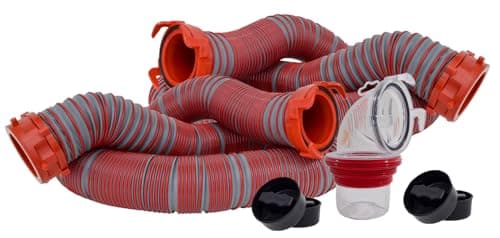 Valterra Viper 20 ft RV Sewer Hose Kit Two 10 ft hoses with rotating fittings and a 90-degree clear adapter. The clear elbow sounds like a gimmick until the first time you need to know whether a rinse has finished. Top pick | Rotating fittings and a clear elbow so you can see the flow | 7.4/ 10 | |
| 2 | 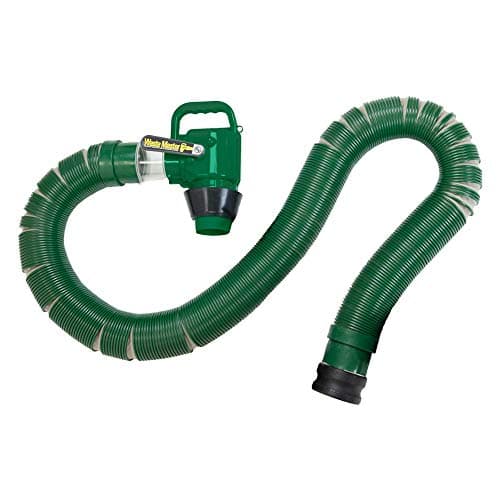 Lippert Waste Master 20 ft Extended RV Sewer Hose System A smooth-bore hose with a clear bayonet nozzle and an integrated valve — the only system here that does not trap residue in accordion ridges, which is its whole argument. Best drainage | Owners who want a smooth-bore hose and a clear nozzle valve | 8.1/ 10 | |
| 3 | 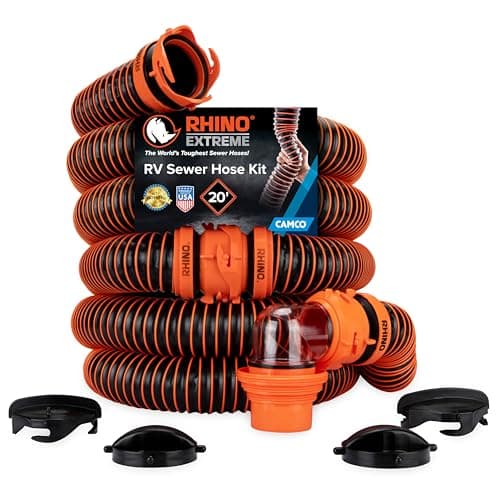 Camco RhinoEXTREME 20 ft RV Sewer Hose Kit The thicker-walled version of the RhinoFLEX, pre-assembled with swivel fittings. The upgrade you buy after the first hose fails, or instead of it. Toughest wall | Full-season use and anyone who has already split a hose | 8.5/ 10 | |
| 4 | 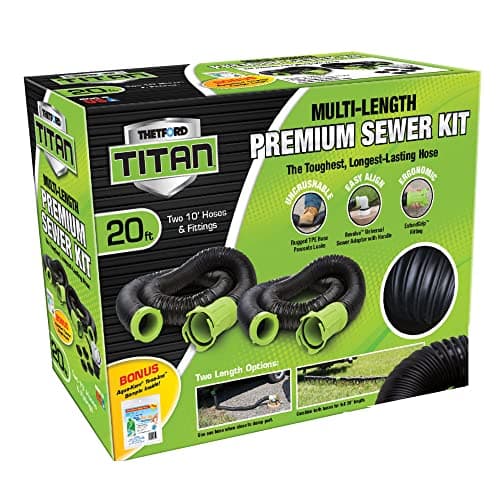 Thetford Titan Premium RV Sewer Hose Kit, 20 ft A metal-reinforced polyolefin hose that resists abrasion better than a standard vinyl accordion, sold as a complete system. The usual owner report is that it outlasts two cheaper hoses. | The toughest-feeling hose in the mainstream price range | 8.3/ 10 | |
| 5 | 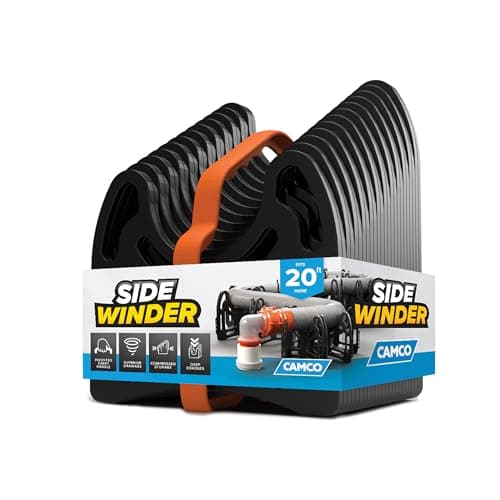 Camco Sidewinder Telescoping RV Sewer Hose Support, 20 ft A rigid folding trough that holds the hose in a steady slope. Without one, the hose sags, the sag holds waste, and the smell you blame on the hose is actually the sag. Buy this too | Giving the hose a continuous downhill run | 6.9/ 10 |
Tap any row to jump to the full write-up. Prices come from Amazon and are read automatically — see each product below for the date.
The short answer
Here is the thing that surprises people the first time they camp into November. The failure is almost never a hose that burst because the waste inside it froze solid. It is a hose that cracked at a fitting, or split along a ridge, because you dragged a cold-stiffened wall out of a storage tube at 24°F and bent it through ninety degrees to reach the inlet. Plastic that is pliable at 70°F behaves like a different material at 20°F, and the forces you apply to it by hand have not changed at all.
That reframes the purchase. You are not shopping for insulation or for a heating element. You are shopping for a wall that is still willing to bend when it is cold, for a bore that empties completely so there is nothing standing in it to freeze, and for a slope that keeps anything from pooling in the first place. Those three things are what the ranking below is built on, in that order.
TPE: thermoplastic elastomer — a family of flexible plastics that behave more like rubber than like rigid vinyl across a wide temperature range. It is the material Valterra states the Viper’s wall is made from, and the reason the maker is willing to publish a low-temperature flexibility figure at all. Most sewer hose makers publish a wall thickness in mils and say nothing whatsoever about temperature.
What cold actually does to a sewer setup
Four separate failures hide under the phrase “the hose froze,” and they have different fixes. Knowing which one you are solving is most of the purchase decision.
The wall stiffens and splits under a bend. This is the common one and it is a handling failure, not a freezing failure. The hose goes rigid in the cold, you force the bend you have always forced, and the accordion ridge that has flexed a hundred times opens up. It usually happens within a few feet of a fitting, where the bend is tightest.
Residue in the ridges freezes into a ring. An accordion-wall hose traps a film of waste in every corrugation. Overnight at 20°F that film becomes ice bonded to the wall, which narrows the bore, holds more residue on the next dump, and makes the next flex even harder. This is the failure a smooth-bore system is designed out of.
A sag holds standing waste and freezes solid. If the run from the trailer to the dump inlet dips anywhere, that dip never empties. A dip full of standing liquid at freezing temperature becomes a plug you cannot clear from either end, and the hose is usually a write-off. A rigid support that holds a continuous downhill slope is the fix, and it is cheaper than the hose it saves.
The dump valve or the campground inlet freezes. Nothing about your hose choice helps here. This is the one that argues for the discipline covered further down: keep the gray and black valves closed, dump in the warmest part of the day, and disconnect afterward.
| What goes wrong | Why | What fixes it |
|---|---|---|
| Split near a fitting | Stiff wall forced into a tight bend | A wall with a published cold-flex rating |
| Ice ring narrowing the bore | Residue trapped in accordion ridges | A smooth bore, or a proper rinse before cold |
| Solid plug mid-run | A sag holding standing waste | A rigid support set to a continuous slope |
| Nothing drains at all | Trailer valve or park inlet frozen | Dumping routine, not hardware |
| Fittings will not seat | Cold-shrunk plastic and stiff gaskets | Warm the ends in the cab for a few minutes |
What to look for, in cold-weather order
A published cold-temperature figure, if one exists. This sounds like an obvious criterion and it is almost impossible to satisfy. Sewer hose marketing is built on wall thickness in mils and on crush resistance, because those are easy to demonstrate in a store. A maker who states a temperature down to which the wall stays flexible has made a claim you can hold them to, and in this category exactly one of our picks does.
Whether the bore is smooth or corrugated. Every conventional sewer hose is an accordion, which is what lets it compress to a fraction of its length for storage. The trade is that the ridges hold residue. In summer that is a smell problem. Below freezing it is an ice problem, and it compounds night over night.
Whether the fittings swivel. Non-swiveling fittings mean you rotate the whole hose to line up the bayonet lugs. At 20°F, rotating a stiff hose is exactly the twisting load that opens a seam. Swivel or rotating fittings let the connector turn while the hose stays still, and that is a genuine cold-weather feature sold as a convenience feature.
Whether it compresses without being forced. A hose you have to fight into a bumper tube in July is a hose that cracks going into the tube in December. Valterra states the Viper’s 10 ft sections collapse to about 52 in; a hose with a heavier wall will not compress as willingly, and that is a cost you pay twice a day in cold weather.
An outer bead or reinforcement where it drags. Frozen gravel is more abrasive than warm gravel and the ground is harder, so a hose dragged across a frozen site takes more damage than the same drag in summer. A protective outer bead or a metal-reinforced wall earns its keep here. Keeping the hose off the ground entirely earns more.
Whether it is the right length, not the longest length. Twenty feet is the default because it reaches awkward inlets, but every extra foot you do not need is extra run to drain, extra wall to stiffen and extra chance of a sag. In cold weather a 20 ft hose used as 12 ft with a support under the whole run beats a 20 ft hose lying slack on frozen ground.
The common mistake
The picks
Valterra Viper 20 ft kit. The top pick on one specification that matters more than everything else in this category combined: Valterra publishes that the 25 mil TPE wall stays flexible down to −20°F. Nobody else here publishes a temperature at all. The kit is two 10 ft hoses with rotating fittings, four drip caps and a clear 90-degree adapter, and the 135 mil outer bead is there so you can drag it. The honest cons: the wall is thinner than the RhinoEXTREME’s, so it is not the hose to buy if your problem is crush damage rather than cold; the clear elbow yellows and stains with use; and Valterra’s fittings are less universally stocked than Camco’s, which matters when you need a part on a Sunday. It is also the pick on our Camco versus Valterra comparison, for a different reason, and the two arguments happen to agree.
Lippert Waste Master 20 ft. The pick if your cold-weather problem is residue. It is the only system here with a smooth interior rather than accordion ridges, so a rinse genuinely empties it and there is no film left in corrugations to turn into an ice ring overnight. The clear bayonet nozzle with an integrated valve also means you can see that the run is clear before you pack it away, which in the cold is the check that matters. Honest cons, and they are substantial: it is far and away the most expensive option here, it is designed around a permanent trailer-side fitting so it is a commitment rather than a purchase, and replacement parts are brand-specific. Lippert publishes no cold-temperature figure for it, so we are ranking it on drainage, not on cold behavior.
Camco RhinoEXTREME 20 ft. The toughest wall of the mainstream hoses and genuinely the one that survives being dragged across frozen gravel. It arrives pre-assembled with swivel fittings on both ends, which removes the twisting load that cracks hoses in the cold. The honest con is the one that keeps it off the top spot: a thicker wall is a stiffer wall, it already fights you into a storage tube at room temperature, and stiffness is the property you least want below freezing. Camco publishes no cold-temperature figure. Buy this if your hoses die from abrasion and crush damage; buy the Viper if they die from cracking in the cold.
Thetford Titan 20 ft. Metal-reinforced polyolefin, sold as a complete system, and the best abrasion resistance in the mainstream price range. It compresses smaller than a comparable heavy vinyl hose, which is a real cold-weather advantage because you are not forcing it. The cons are fair: the reinforcement makes it heavier to carry, the fittings are Thetford’s own so mixing brands can mean an adapter, and it is priced above the obvious default. Polyolefin does stiffen as the temperature drops and Thetford publishes no figure for how far, so treat its cold behavior as unknown rather than as good.
Camco Sidewinder 20 ft support. Not a hose, and the item on this page most likely to save you a hose. It is a rigid folding trough that holds a continuous downhill slope, which is the single thing that prevents a sag full of standing waste from freezing into a plug mid-run. It also keeps the hose off frozen ground, where the abrasion is worse. The cons are real: it is bulky even folded, it eats the full length of a pass-through, and the folding hinges are the part that eventually fails. If storage space rules it out, the support roundup covers the collapsing coil alternative and what you give up for it.
The common mistake
The routine that matters more than the hose
A −20°F wall rating buys you a hose that survives handling. It does not drain your tanks. Below freezing, the sequence does more work than the hardware.
- 1
Keep both valves closed and let the tanks fill
Standing water in an open line is the thing that freezes. Full tanks dumped in one rush carry the line clear; a slow trickle through a cold hose does the opposite. - 2
Dump in the warmest part of the day
Early afternoon, not first thing. A few degrees changes how willingly the wall bends and whether the campground inlet is open at all. - 3
Warm the fittings before you connect
Two minutes with the hose ends in the cab or the trailer is enough. Cold-shrunk plastic and stiff gaskets are why a bayonet that always seats suddenly will not. - 4
Set the slope before you open anything
Lay the support first and get a continuous fall from the trailer outlet to the inlet. No dips. If the ground will not allow it, shorten the run rather than accepting a sag. - 5
Black tank first, then gray
The gray water rinses the solids the black tank left behind. Doing it the other way around leaves residue in the hose, and residue is what becomes an ice ring. This is the same order as the standard setup, and it matters more in the cold. - 6
Rinse, drain and disconnect - every time
Lift the trailer end and walk the hose down so everything runs out. Do not leave it connected overnight in freezing weather, even with the valves shut. An empty hose cannot freeze. - 7
Store it dry and loose, not forced
Cap both ends, store it where it is not crushed into a tight coil, and resist cramming a cold hose into a tube. Most cold-weather hose deaths happen during storage, not during use.
Three things a better hose will not fix
A frozen dump valve on the trailer. If the blade valve itself is iced, the hose on the other side of it is irrelevant. That is a tank-heating and skirting problem, and it is the point at which genuine cold-weather camping stops being a gear purchase.
A campground inlet that is closed for the season. Many parks cap sewer inlets once overnight temperatures stay below freezing. Check before you book a late-season site, because the answer may be that you are using the dump station on the way out and carrying tanks in between.
A sewer smell you blamed on the hose. Nine times in ten that is residue in a sag or a dry trap, not the hose material. The main sewer hose roundup covers the everyday version of that problem, and the fittings guide covers the adapter that usually turns out to be the leak.
What to remember
- Cold cracks hoses through handling, not usually by freezing waste inside them.
- The Valterra Viper is the only pick with a published cold-flex figure: -20F.
- A smooth bore matters in the cold because ridges hold residue that becomes ice.
- A sag full of standing waste is the failure that writes off a hose. Use a support.
- Swivel fittings remove the twisting load that opens a seam on a stiff hose.
- Keep the valves closed, dump fast in the afternoon, then disconnect. Always.
- No sewer hose is freeze-proof. An empty hose is the only hose that cannot freeze.
How we picked
We have not run these five through a winter and we do not own units to test. This ranking reads each maker’s published product information, and it is deliberately built around the one specification that is published rather than around the ones that are not: Valterra states a temperature down to which the Viper’s wall stays flexible, so the Viper leads on cold. Camco, Thetford and Lippert publish no cold-temperature figure for the products here, so we rank those on claims they do make — wall toughness, abrasion resistance, smooth bore — and say plainly that their cold behavior is unknown rather than implying it is good. Every listing was confirmed live and in stock before it was featured. Current prices come from retailer listing data read automatically and date-stamped; we publish no price of our own. The rubric and its weights are on how we pick.
The picks in full
Valterra Viper 20 ft RV Sewer Hose Kit
Valterra · Best for rotating fittings and a clear elbow so you can see the flow
Two 10 ft hoses with rotating fittings and a 90-degree clear adapter. The clear elbow sounds like a gimmick until the first time you need to know whether a rinse has finished.
Key specifications
- Length
- 20 ft (two 10 ft hoses)
- Fittings
- Rotating
- Adapter
- 90-degree ClearView sewer adapter
- Caps
- 4 drip caps included
How it scored
- Crush resistance (30%)7
- Fittings (25%)9
- Storage (20%)6
- Build quality (15%)7
- Price for capability (10%)8
Weighted average of the figures above. We did not test this product — see how we pick.
What it does well
- Clear elbow genuinely helps you judge when the tank is empty
- Rotating fittings reduce hose twist
- Drip caps included, which keeps the storage tube clean
What it is bad at
- Wall is thinner than the RhinoEXTREME
- Clear plastic yellows and stains with use
- Fittings are less universally stocked than Camco's
Price as of October 28, 2026. #ad How this is funded
Lippert Waste Master 20 ft Extended RV Sewer Hose System
Lippert · Best for owners who want a smooth-bore hose and a clear nozzle valve
A smooth-bore hose with a clear bayonet nozzle and an integrated valve — the only system here that does not trap residue in accordion ridges, which is its whole argument.
Key specifications
- Length
- 20 ft extended
- Bore
- Smooth interior
- Nozzle
- Clear, with integrated valve
- Connection
- Permanent trailer-side fitting
How it scored
- Crush resistance (30%)9
- Fittings (25%)8
- Storage (20%)8
- Build quality (15%)9
- Price for capability (10%)5
Weighted average of the figures above. We did not test this product — see how we pick.
What it does well
- Smooth bore rinses genuinely clean
- Clear nozzle and built-in valve replace a separate gate valve
- Reported to compress tightly for storage
What it is bad at
- Most expensive sewer system here by a wide margin
- Designed around a permanent trailer-side fitting, so it is a commitment
- Replacement parts are brand-specific
Price as of October 28, 2026. #ad How this is funded
Camco RhinoEXTREME 20 ft RV Sewer Hose Kit
Camco · Best for full-season use and anyone who has already split a hose
The thicker-walled version of the RhinoFLEX, pre-assembled with swivel fittings. The upgrade you buy after the first hose fails, or instead of it.
Key specifications
- Length
- 20 ft
- Wall
- Heavier than RhinoFLEX
- Assembly
- Pre-assembled
- Fittings
- Swivel both ends
Capacity figures read from Camco RhinoEXTREME specifications, October 2026.
How it scored
- Crush resistance (30%)10
- Fittings (25%)9
- Storage (20%)5
- Build quality (15%)10
- Price for capability (10%)7
Weighted average of the figures above. We did not test this product — see how we pick.
What it does well
- Visibly tougher wall — survives being dragged across gravel
- Arrives assembled, which saves a confusing ten minutes
- Swivel fittings mean no fighting the hose into alignment
What it is bad at
- Stiffer, so it fights you into a storage tube
- Costs noticeably more than the standard kit
- Same twenty-foot storage problem
Price as of October 28, 2026. #ad How this is funded
Thetford Titan Premium RV Sewer Hose Kit, 20 ft
Thetford · Best for the toughest-feeling hose in the mainstream price range
A metal-reinforced polyolefin hose that resists abrasion better than a standard vinyl accordion, sold as a complete system. The usual owner report is that it outlasts two cheaper hoses.
Key specifications
- Length
- 20 ft complete system
- Construction
- Metal-reinforced polyolefin
- Kit
- Complete with fittings
- Class
- Premium
How it scored
- Crush resistance (30%)9
- Fittings (25%)8
- Storage (20%)7
- Build quality (15%)9
- Price for capability (10%)8
Weighted average of the figures above. We did not test this product — see how we pick.
What it does well
- Abrasion resistance is the best of the mainstream hoses
- Complete system, no parts hunting
- Compresses smaller than a comparable heavy vinyl hose
What it is bad at
- Fittings are Thetford's own; mixing brands can mean an adapter
- Priced above the obvious default
- Reinforcement makes it heavier to carry
Price as of October 28, 2026. #ad How this is funded
Camco Sidewinder Telescoping RV Sewer Hose Support, 20 ft
Camco · Best for giving the hose a continuous downhill run
A rigid folding trough that holds the hose in a steady slope. Without one, the hose sags, the sag holds waste, and the smell you blame on the hose is actually the sag.
Key specifications
- Length
- 20 ft
- Type
- Telescoping, folding
- Material
- Rigid plastic
- Part
- 43052
Capacity figures read from Camco Sidewinder specifications, October 2026.
How it scored
- Crush resistance (30%)8
- Fittings (25%)6
- Storage (20%)5
- Build quality (15%)8
- Price for capability (10%)8
Weighted average of the figures above. We did not test this product — see how we pick.
What it does well
- Rigid, so the slope stays where you set it
- Folds and telescopes for storage
- Keeps the hose off gravel, which is what kills hoses
What it is bad at
- Bulky even folded
- The folding hinges are the failure point over time
- Takes up the whole length of a pass-through
Price as of October 28, 2026. #ad How this is funded
Common questions
Rarely from the waste freezing. The usual failure is a cold-stiffened wall splitting when you bend it, or a sag in the run freezing into a plug. An empty, disconnected hose has almost nothing in it to freeze.
TPE, because it is the only wall material here with a published figure — Valterra states −20°F for the Viper. Vinyl and polyolefin both stiffen in cold and their makers publish no rating, so treat that as unknown.
No. A trickle is what freezes. Keep both valves closed, let the tanks fill, dump fast in the afternoon — black first, then gray to rinse — and disconnect afterward.
Usually not. A heated hose solves a line that must stay wet, which is the fresh water side. A sewer hose should be empty nearly all the time — flexibility, slope and disconnecting are the cold-weather answer.
Sources
- Valterra Viper 20 ft sewer hose kit — published specifications (25 mil TPE, flexible to -20F) — read October 2026
- Camco published RhinoFLEX and RhinoEXTREME sewer hose specifications — read October 2026
- Thetford published Titan sewer hose product information — read October 2026
- Lippert published Waste Master sewer hose system information — read October 2026